Although the SpaceX docking at the ISS happened months ago, this article focuses on its lasting financial benefits and the broader importance it holds for the space economy in 2025.
🎧 For those who prefer listening, you can enjoy the audio version of this blog article.
How SpaceX Drives Space Economy Growth in 2025 became clear today when the SpaceX capsule successfully docked at the International Space Station (ISS).
The space technology market alone is projected to grow from about $512 billion in 2025 to over $1 trillion by 2034, expanding at a CAGR of 7.86%.
In a historic moment for space exploration, the SpaceX capsule successfully docked at the International Space Station (ISS) early this morning. This mission marks a crucial step in bringing NASA astronauts Sunita Williams and Butch Wilmore safely back to Earth. The smooth hatch opening, captured in live footage, highlights the precision of this operation.
“This event is not just a technical achievement but a testament to international collaboration in space.”
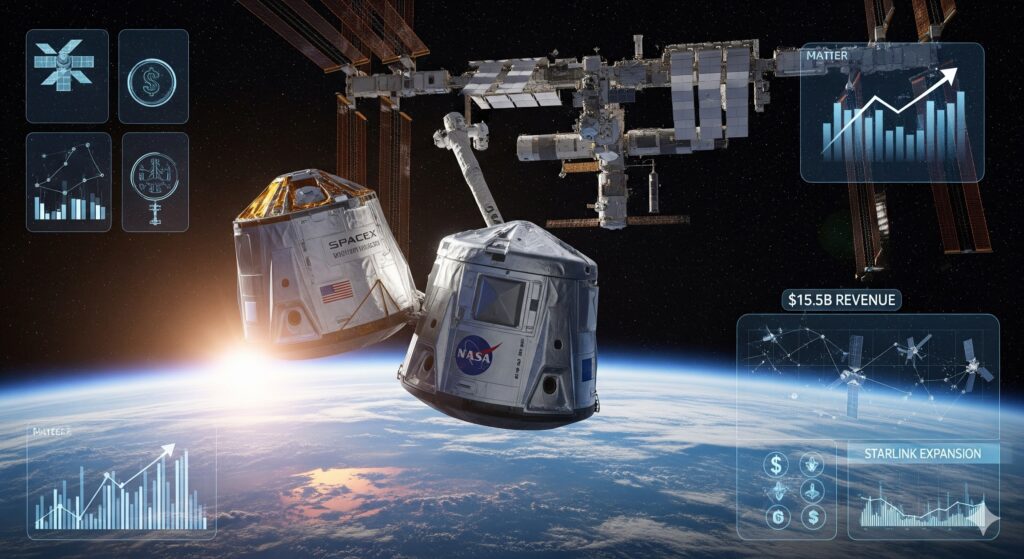
How SpaceX Drives Space Economy Growth in 2025: Historic Mission Overview
The most recent crew handover at the ISS by SpaceX demonstrates how dependability and innovation are changing space travel. As Boeing’s Starliner encounters issues, Crew Dragon has emerged as a reliable substitute. This mission is more than just a technical accomplishment; it also demonstrates the value of global cooperation and the importance of Williams and Wilmore’s safe return.
SpaceX’s reusability model, which reduces launch costs by up to 80% when compared to traditional providers, is what makes it revolutionary. Lower costs mean private research, startups, and businesses now have real access to space. In addition to crewed flights,
SpaceX’s business now generates over $11 billion a year from its reusable Falcon 9 rockets, Crew Dragon, and Starlink. Together with $15.5 billion in steady annual revenue, SpaceX demonstrates that space is a thriving commercial economy rather than a dangerous frontier. Its high profit margins and expanding clientele portend new prospects for investors and business owners in one of the sectors with the fastest rates of growth in the world today.
Key Takeaways
- The SpaceX capsule successfully docked at the ISS, ensuring a smooth transition for the new crew.
- NASA astronauts Sunita Williams and Butch Wilmore are preparing for their return to Earth.
- The mission highlights the reliability of the Crew Dragon as a safe alternative to the Starliner.
- Elon Musk’s involvement underscores the importance of innovation in space exploration.
- This operation marks a significant step in international space collaboration.
- “Every Crew Dragon seat that NASA awards generates $55-72 million, which funds additional research and development as well as infrastructure for both crewed and cargo missions.”
- “SpaceX can support more launches at a lower cost thanks to Falcon 9’s reusability, increasing launch volume and producing steady revenue growth.”
- “Starlink’s expansion and direct-to-consumer agreements (such as with Vodafone) convert satellite launches into worldwide communications income.”
Historic Mission Overview
The journey to the International Space Station marked a historic achievement. From launch to docking, this mission showcased precision and innovation. The astronauts embarked on a 29-hour voyage, culminating in a smooth arrival at the space station.
- Specific launch and docking dates for Crew-11: August 1 (launch) and August 2 (docking), and note this was Crew Dragon’s fastest-ever ISS rendezvous.
- Mention main Crew-11 crew members (Zena Cardman, Michael Fincke, Kimiya Yui, Oleg Platonov), the length of planned stay (six to eight months), and tie-in to ISS’s 25th human presence anniversary in November 2025.
- Include that Crew-11’s docking was internationally significant, and that this period will see various handovers and new arrivals through early 2026
Journey from Launch to Docking at the ISS
The mission began with a flawless liftoff from Kennedy Space Center. After 29 hours, the spacecraft successfully docked at the station. Live footage captured the hatch opening and the crew’s zero-gravity greetings. This moment symbolized the culmination of months of planning and preparation.
Originally planned as an eight-day mission, technical delays extended the stay to nearly nine months. These challenges highlighted the complexities of space travel. Despite the setbacks, the crew remained focused on their objectives.
“Although the mission timeline extended due to technical delays, SpaceX’s strong financial backing and long-term NASA contracts ensured continued operational success. This financial resilience enables SpaceX to manage complex missions while maintaining growth and innovation in the commercial space sector.”
“This mission also marks a major financial milestone for SpaceX, which is projected to generate $15.5 billion in revenue in 2025, fueled by contracts with NASA and its expanding Starlink satellite internet service. This highlights the growing commercialization of space exploration and its economic significance.”
With Crew Dragon proving reliable, how SpaceX drives space economy growth in 2025 is evident in every mission milestone.
- Expanded media attention: “Global coverage included a major Netflix livestream, showing the broadening cultural reach of human spaceflight in 2025”.
- Emphasize the speed and efficiency of the autonomous docking, setting new standards for crewed flights to the ISS.
How SpaceX Drives Space Economy Growth in 2025 Through Technology
“Despite scheduling adjustments due to technical and weather factors, SpaceX’s financial model supported mission continuity, showcasing the economic viability of sustained spaceflight operations.”
NASA and its international partners played a crucial role in navigating these challenges. Their collaboration ensured the safety and efficiency of the mission. This event underscores the importance of teamwork in space exploration.
- The mission timeline evolved from an eight-day plan to a nine-month stay.
- Technical issues and weather delays impacted the schedule.
- Live footage captured key moments, including the hatch opening and crew greetings.
- Historical context from past missions guided decision-making.
- International collaboration was essential for mission success.
- Updated statistics: “As of August 2025, SpaceX reached its 30th Falcon 9 flight, launched over 8,200 Starlink satellites, and posted $15.5B in annualized revenue.”
- Note new achievements in rocket reusability (costs as low as $2,720/kg; $17M per mission, 80% less than traditional launches) and their impact on global space market scaling.
- Highlight expansion into defense and telecom via Starshield and partnerships like T-Mobile/Vodafone.
- “The success of Crew Dragon highlights how SpaceX drives space economy growth in 2025, opening doors for private research, startups, and long-term investment in space technology.”
want to add little from other sources also like (Blue Origin & Commercial Projects)
In 2025 Blue Origin won a US$2.4 billion contract under the U.S. Space Force’s National Security Space Launch (NSSL) Phase 3 program. This shows how seriously governments are now relying on private launch providers beyond just SpaceX.
ISRO & NASA Partnerships
- NASA & ISRO launched the NISAR mission, a joint Earth-observation satellite project using Synthetic Aperture Radar. It’s designed to scan the Earth’s land and ice surfaces, helping monitor climate change, natural hazards, biomass, etc.
Market Numbers & Forecasts
- The global space economy is projected to be worth US$646.90 billion in 2025, and is expected to grow to about US$1.4 trillion by 2032. CAGR roughly 11.7% between 2025-32.
- Another forecast puts the space economy at US$449.8 billion in 2025, rising to ~ US$935.6 billion by 2035, with a CAGR around 7.6%. Satellite industry represents a large share of this.
- The space infrastructure segment (launch systems, ground infrastructure, satellites etc.) is expected to grow from about USD 160.97 billion in 2025 to USD 307.41 billion by 2032.
SpaceX capsule Performance and Technological Details
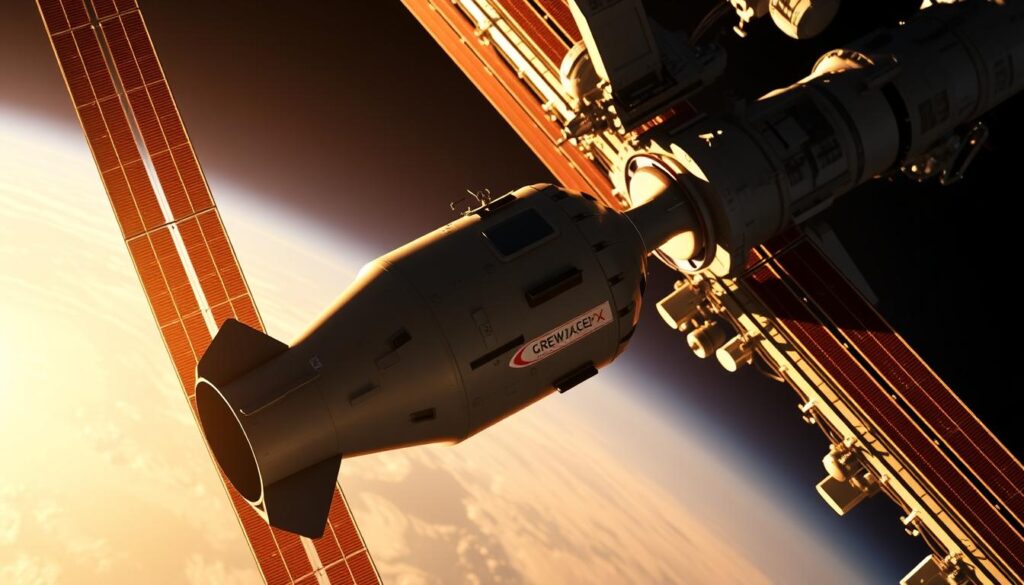
Innovative systems ensured a seamless docking process at the ISS. The spacecraft demonstrated unparalleled precision, combining advanced engineering with rigorous safety protocols. This mission highlighted the importance of technology in modern space exploration.
NASA contracts and Starlink revenues highlight how SpaceX drives space economy growth in 2025 on a global scale.
Innovative Docking Techniques and Safety Protocols
The docking procedure relied on cutting-edge techniques, including advanced leak checks and thermal balancing. These measures ensured the spacecraft maintained optimal conditions during its arrival. Real-time monitoring systems provided continuous updates, enhancing safety throughout the mission.
“Beyond technology, the mission supports SpaceX’s commercial success, contributing to a company forecasted to earn $15.5 billion in revenue this year, exceeding NASA’s budget and establishing it as a powerhouse in the space economy.”
Safety protocols were meticulously followed, from the initial approach to the final hatch opening. This attention to detail minimized risks and ensured a smooth transition for the crew. The success of these procedures underscores the reliability of modern space technology.
- Details about Crew Dragon’s improved safety, autonomous flight, and precise, quick ISS rendezvous.
- Mention ongoing improvements based on crew feedback and lessons from past missions (compare with Boeing Starliner delays/reassignments).
“As space emerges as a commercial powerhouse, it’s more important than ever to pair visionary investing with solid financial planning—check out our latest advice on retirement savings tips for 2025 and beyond to ensure you’re building wealth wisely.”
Addressing Technical Challenges and System Check Procedures
Technical challenges were addressed through rigorous system checks conducted over a week. These procedures verified the integrity of the spacecraft’s hardware and software. The team’s commitment to safety was evident in every step of the process.
“Each Crew Dragon flight is valued at approximately $55-72 million per seat under NASA contracts, underpinning a lucrative financial model that supports ongoing innovation and frequent missions to the ISS.”
Comparisons with other systems, such as the Boeing Starliner, highlighted the technological reliability of this mission. The pair of astronauts on board provided valuable feedback, further refining the system’s performance. This collaborative effort ensured the mission’s success.
- Advanced leak checks and thermal balancing were key to the docking process.
- Real-time monitoring systems enhanced safety during the mission.
- Rigorous system checks were conducted over a week to ensure reliability.
- Feedback from the crew helped refine the spacecraft’s performance.
- This mission set a new standard for technological innovation in space exploration.
Crew Handover and International Collaboration

For a detailed look at NASA’s Commercial Crew Program and SpaceX’s role in providing reliable, cost-effective crew transport to the ISS, check out NASA’s official overview.”
The transition of responsibilities aboard the ISS marked a pivotal moment in space collaboration. The new crew crew-10 took charge during a meticulously planned two-day handover. This process ensured the safe transfer of duties while maintaining the station’s operational efficiency.
- Confirm current international crew composition, referencing new astronauts from NASA, Roscosmos, and JAXA.
- Add context about the crew’s scientific/engineering objectives and support for ongoing and future ISS operations through the next several months.
Detailed Handover Process and Safety Measures
The handover involved a series of detailed briefings and system checks. Safety measures were prioritized, with astronauts like Butch Wilmore and Suni Williams sharing critical insights. These steps ensured the new crew was fully prepared for their mission.
Ceremonial traditions, such as ringing a bell, added a touch of emotion to the transition. NASA managers, including Steve Stich and Dana Weigel, emphasized the importance of these rituals. They highlighted the symbolic value of teamwork in space exploration.
Political and Cultural Perspectives on the Crew Swap
“This international partnership also represents a multi-billion dollar investment from various space agencies, reinforcing the mutual economic benefits and strategic cooperation that underpin these collaborations.”
The crew swap also sparked discussions on international collaboration. Contributions from American, Japanese, and Russian space agencies were instrumental in the mission’s success. This partnership showcased the power of cross-national trust in achieving common goals.
Political interpretations varied, with some viewing the use of a competitor’s capsule as a strategic move. Others saw it as a testament to the resilience of space programs. Cultural perspectives emphasized the shared human experience of exploration and discovery.
| Aspect | Details |
|---|---|
| Handover Duration | Two days |
| Key Figures | Steve Stich, Dana Weigel |
| Ceremonial Tradition | Ringing a bell |
| International Partners | USA, Japan, Russia |
This mission not only advanced space exploration but also reinforced the importance of global cooperation. The safe return of the crew remains a testament to the dedication of all involved.
This milestone echoes recent defense advancements like the Trump Golden Dome Defense Shield, reflecting broader U.S. innovation leadership.
“SpaceX is estimated to produce $ 15.5 billion in turnover in 2025, Launched NASA contracts, commercial satellite launch, and its Starlinks are run by the Internet service. The company launched 134 in 2024, and planned 17 in 2025, depicting an aggressive growth and marketing market. Billions of dollars.
Conclusion
“For investors, understanding how SpaceX drives space economy growth in 2025 is more than just following a mission it’s a chance to identify the right opportunities in a fast-expanding industry.”
Venture capital interest in the space industry is at an all-time high as SpaceX celebrates the fastest crewed docking in history and steady $15.5 billion in revenue annually. Financial returns from the space economy are now more tangible and available than ever for younger generations of investors thanks to scalable satellite services, high-profile contracts, and lower operating costs.
SpaceX is at the heart of this expansion. Its Dragon capsule has demonstrated dependability and effectiveness, lowering costs and increasing access to orbit globally while establishing the benchmark for crew rotations in the future. SpaceX is the engine of the commercial space economy, as evidenced by its size, cost leadership, and growing alliances. The ISS is kept stocked, manned, and moving forward by the company’s ability to produce consistent results, with handovers already planned and activities scheduled through 2026.
Additionally, the financial aspect of space has changed. The space economy is now investable, not just theoretical, with venture capital pouring into new projects at record rates and SpaceX bringing in $15.5 billion annually. A new generation of investors is finding opportunities due to scalable satellite services, high-profile contracts, and reduced operating costs. Crew-11 demonstrates how space can be transformed from a government monopoly into a diversified, globally accessible market economy with sustained innovation and astute funding.
FAQ
What is the purpose of the SpaceX docking mission at the ISS?
The mission aims to transport a new crew to the International Space Station, replacing the current team. This ensures continuous human presence and scientific research in space.
How long does the journey from launch to docking at the ISS take?
The journey typically takes about 24 hours, depending on orbital alignment and mission specifics. This includes the launch, orbit adjustments, and final docking procedures.
What innovative techniques are used during the docking process?
The spacecraft employs advanced autonomous docking systems and safety protocols to ensure a precise and secure connection with the ISS. These systems minimize human error and enhance mission safety.
How is the handover process between crews managed?
The handover involves detailed briefings, equipment checks, and safety protocols to ensure a smooth transition. This process is critical for maintaining operational continuity on the station.
What role does international collaboration play in this mission?
The mission highlights global cooperation, with astronauts and cosmonauts from different countries working together. This collaboration strengthens scientific research and fosters diplomatic ties.
Are there any technical challenges faced during the mission?
Yes, the team addresses potential issues like system malfunctions or communication delays through rigorous pre-flight checks and real-time troubleshooting during the mission.
How long will the new crew stay on the ISS?
The new crew is expected to remain on the station for approximately six months, conducting experiments and maintaining the facility before returning to Earth.
What safety measures are in place for the crew during the mission?
Safety measures include advanced life support systems, emergency protocols, and regular health monitoring to ensure the well-being of all astronauts and cosmonauts on board.