US Auto Tariffs 2025: The Initial Shock and What’s Changed
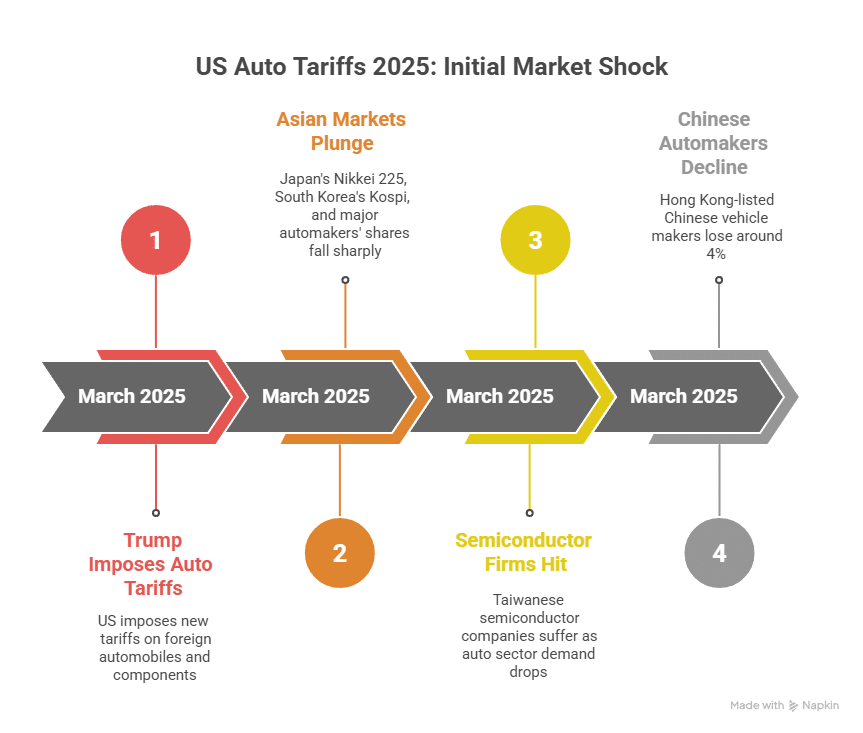
“Earlier this March 2025, when US Auto Tariffs 2025 were imposed, Asian markets reacted sharply, the response came fast and vicious. Asian markets suffered instantly. Japan’s Nikkei 225 fell by 220 points, South Korea’s Kospi by 1.8%, and top automakers such as Toyota, Honda, and Hyundai had their share prices tank. The kind of market response that makes front-page news and keeps sleepless nights for investors.
But the thing about trade wars is that they’re never as simple as they initially seem. Something that began as an easy tariff declaration has become anything but simple, with plot turns and surprises a soap opera writer would be envious of.
The Taiwanese semiconductor firms took the beating as well, which is only logical when one considers the situation. These companies produce vital parts for automobile makers, so if the auto sector sneezes, then they get pneumonia. Chinese vehicle makers that are listed in Hong Kong did not escape either, losing around 4% as investors were left guessing when this trade spat would end.
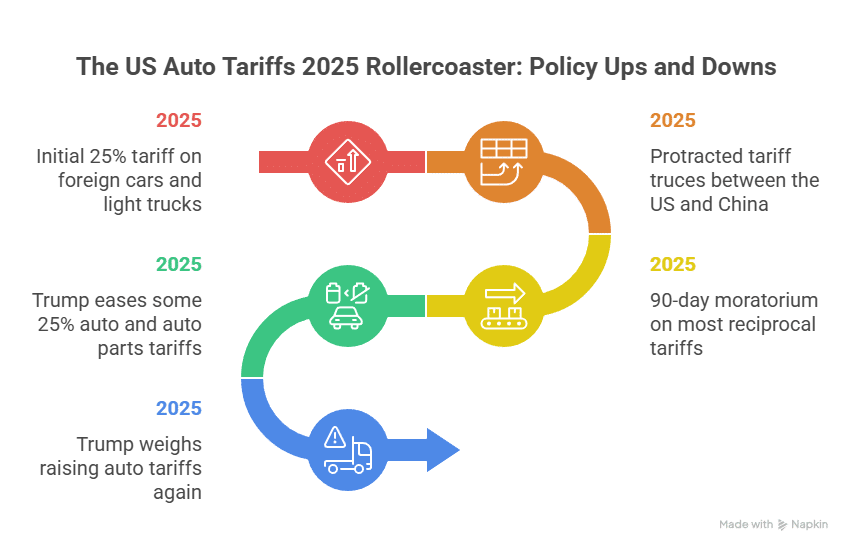
The US Auto Tariffs 2025 Rollercoaster: Policy Ups and Downs
This is where it gets complicated. The first 25% tariff on foreign cars and light trucks was the final word. Save American jobs, increase domestic production, case closed. But trade policy, it seems, is a hell of a lot more complicated than campaign rhetoric.
We’ve witnessed a string of what can only be characterized as policy zigzags. Yahoo Finance covered protracted tariff truces between the US and China – hardly what you’d anticipate from a “tough on trade” position. Car and Driver referenced a 90-day moratorium on most reciprocal tariffs, but they maintained a 10% tariff. It is akin to observing someone attempting to eat their cake and have it, too.
The biggest surprise came when AP News broke the news that Trump did sign executive orders to ease some of those 25% auto and auto parts tariffs. Lobbying pays off, it seems. These policy u-turns reveal how much pressure the administration was being subjected to from impacted businesses and perhaps even some economists who got the real-world effects.
But don’t think for a moment that the threat has gone away. Reuters broke a story in June 2025 that Trump was again weighing raising auto tariffs higher to prod more US production. It’s this never-ending uncertainty that’s driving executives bonkers. How do you map out a global supply chain when the rules keep changing?
“For insights into how international trade and policy decisions impact US businesses, read our detailed article on Trump’s Gulf Business Deals, which explores recent trade commitments and their market effects.”
Asian Automakers and US Auto Tariffs 2025: Strategies to Survive
The hardest-hit firms – Toyota, Honda, Nissan, Hyundai, and Kia – have been forced to overhaul their strategies entirely. It’s no longer only about short-term stock price plunges; it’s about survival in the world’s largest automobile market in the long run.
Fitch Ratings released a report in August 2025 that essentially said what everyone knew all along: these tariffs remain a thorn in the side of Japanese and Korean automakers. Although the recent tariff rate of 15% is less than the initial 25%, it is nevertheless a considerable expense that puts a dent directly in their competitiveness.
These firms are already considering everything from relocating production facilities to totally overhauling their supply chains. But come on, let’s be practical here – you can’t relocate a car factory in one night. These are multi-billion-dollar moves that take multiple years to execute, and the frequent policy changes make it almost impossible to plan well.
The Economic Impact of US Auto Tariffs 2025
“Earlier this March 2025, when US auto tariffs 2025 were imposed by the Trump administration.”
Here’s something that not enough people talk about: Mexico’s part in this. The nation is indeed the leading exporter of vehicles to the US, sending 2.5 million light vehicles in 2023. Nissan has major operations there, although American producers such as GM, Stellantis, and Ford remain dominant.
The issue is that contemporary auto production is very interconnected. One vehicle may have components that move across borders several times in its manufacture. So even if tariffs aren’t specifically aimed at Mexico, the impacts can be massive. One hiccup anywhere along the line can throw the whole system off.
“According to Reuters, Toyota has projected a $9.5 billion impact from U.S. tariffs on imported vehicles, leading to a 16% reduction in its full-year operating profit forecast.”
What’s Next for Asian Markets After US Auto Tariffs 2025?
Ultimately, these tariffs target automakers where it hurts the most – their profit margins. They have two unpleasant options: bear the additional expense and see their profit margins dwindle, or raise the prices and potentially lose sales.
Al Jazeera quoted that US car sales slowed up in fact after a temporary boost. The boost was likely individuals scrambling to purchase automobiles prior to prices increasing, but once tariffs were introduced and prices did increase, demand inevitably decreased. It’s fundamental economics – increase costs, and less people consume your product.
This establishes an unlevel playing ground in favor of local producers or US manufacturing-base companies. For Asian automakers who rely heavily on importation, it implies steadily losing business unless they are able to localize sooner.
“For readers interested in how policy changes affect Americans’ finances, our 2025 Social Security COLA Guide explains the latest cost-of-living adjustments and what they mean for retirees.”
The Bigger Economic Picture
The tariffs have had consequences far beyond the auto sector. The Tax Foundation pegged Trump’s tariffs at bringing federal tax coffers an additional $165.6 billion in 2025 – that’s 0.54% of GDP. From the standpoint of government revenues, that’s actually real money.
The policy was intended to pressure carmakers to invest heavier in US production, and to an extent, it’s succeeding. Companies are certainly reshuffling their global manufacturing plans, though whether this translates to more American jobs is still to be determined.
There are also disadvantages. US car sales have decreased, and customers are paying more. The tariffs even reach domestically made cars if they contain imported parts, which the majority do. This has a ripple effect throughout satellite industries such as auto insurance and financing.
The silver lining is that the rest of the US economy has been surprisingly resilient. Healthcare and technology stocks have been strong, which has helped to alleviate some of the weakness in the auto sector. The Nasdaq and the S&P 500 have held up fairly well, demonstrating the benefits of economic diversification in fending off sector-specific disruptions.
What’s Next?
The saga of US auto tariffs is not ending anytime soon. We’re faced with a complicated combination of political maneuvers, economic realities, and corporate tactics that’s changing daily. Japanese and South Korean automakers are still trying to figure it out, and the looming threat of higher future tariff increases hangs over the sector.
The uncertainty is likely the worst aspect. Businesses can find a way to fit into virtually any regimen of rules if they have some idea what those rules will be. But when policies change repeatedly, it is literally impossible to make long-term strategic plans.
For businesses and investors, the ticket is remaining agile and constantly monitoring policy evolution. The international automotive sector is currently undergoing a period of dramatic transformation, and how businesses manage this uncertainty will be a predictor of their success over the coming years.
The moral of the story is that in our highly connected global economy, a policy shift in one nation can have a ripple effect across several industries and continents. The auto tariff drama is just one example of how trade policy can send waves that go far beyond their intended target.
FAQ’s
1: What brought about America’s auto price lists in 2025?
The price lists were imposed through the Trump management in March 2025 to defend American jobs and inspire home car production. They centered overseas motors and auto components, to start with at a rate of 25%, later adjusted in response to business pressure and coverage changes.
2: Which Asian automakers were the most suffering from the price lists?
Japanese and South Korean automakers inclusive of Toyota, Honda, Nissan, Hyundai, and Kia faced the largest impact. They saw inventory rate declines and needed to reconsider international supply chains and production techniques.
3 : How have Asian automakers adapted to the conversion of US tariff policies?
Many firms are exploring options like relocating manufacturing facilities, overhauling supply chains, or growing nearby manufacturing in North America. These techniques take years to execute due to the dimensions and complexity of vehicle manufacturing.
4 : Did the price lists affect US automobile shoppers and home vehicle sales?
Yes. While the price lists aimed to boost American manufacturing, in addition they multiplied the price of vehicles containing imported components, leading to a slowdown in US car income after an preliminary pre-tariff shopping for surge.
5: What is the broader economic impact of the automobile tariffs?
Beyond the auto region, tariffs delivered an expected $165.6 billion to federal revenues in 2025. They stimulated satellite tv for pc industries such as automobile coverage and financing at the same time as demonstrating the resilience of other sectors like healthcare and era.