Trump 25% tariff on India 2025 is more than just a headline—it’s a direct hit on India’s $12B export market, shaking up global trade relations this August. The latest wave of Trump tariffs on India exports has triggered major concerns across multiple sectors in 2025.
India’s Response to the Trump 25% Tariff on India 2025
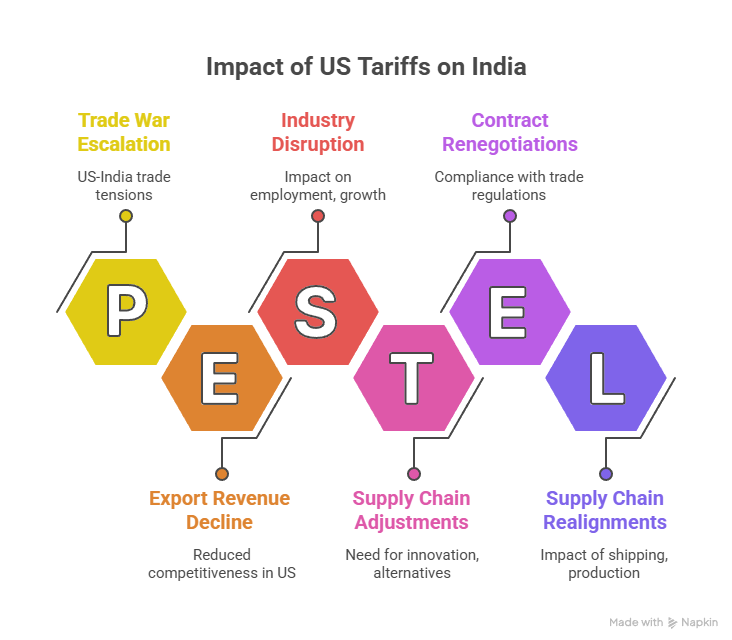
As the 2024 U.S. elections fade into memory and Donald Trump settles into his new term, America’s trade policies are once again causing waves around the globe. But this time, India is at the center of the storm.“The Trump 25% tariff on India 2025 could have long-lasting effects on U.S.-India trade.”
With Trump ramping up his “America First” trade revival, India is now facing a harsh reality: a 25% tariff slapped on key exports, penalties for buying Russian oil and defense equipment, and stalled trade talks that have left New Delhi scrambling for alternatives.
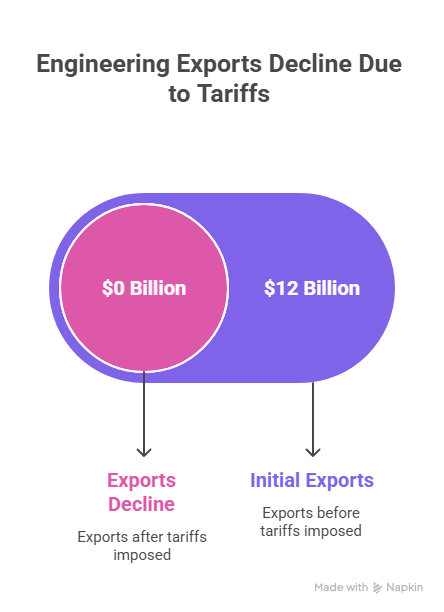
And the numbers? A whopping $12 billion hit to Indian engineering exports, according to the Engineering Export Promotion Council (EEPC) of India.
This blog breaks it all down — what’s happening, what it means for India’s economy, and what lies ahead.
“According to the Office of the United States Trade Representative, U.S.–India goods trade reached $129.2 billion in 2024, with a $45.7 billion trade deficit prompting the 25% tariff move by the Trump administration in 2025.”
How Trump Tariffs Are Reshaping India’s Export Economy
The 25% Tariff Shock: Why India Is Being “Made an Example”
Oh, things just got spicy in the trade world. The U.S. slapped a fat 25% tariff on, get this, 80 different categories of Indian exports—everything from car parts to industrial machinery, steel, aluminum, and a variety of electronic components. Basically, all the high-value sectors India counts on for export revenues.
As Trump’s tariffs hit Indian exports, industries like pharmaceuticals and textiles are seeing sharp declines.
And here’s the kicker: while the U.S. is handing out tariff exemptions to traditional allies, India got none. Zero. Zilch. According to a senior U.S. official, “India is being made an example” for continuing to trade with countries Washington isn’t exactly friendly with. Subtle? Not at all.
Trade analysts are calling this one of the harshest U.S. trade actions against India in over a decade—and the fallout? It’s already hitting hard across major Indian industries.
According to Reuters, India’s top export sectors—including pharmaceuticals, auto parts, and textiles—are bracing for heavy losses as Trump’s 25% tariff could severely dent trade flows and economic growth in 2025.
No Exemptions for India — “One of the Toughest Trade Actions”
Here’s a breakdown of the Indian companies taking the hardest hits from this tariff bombshell:
“India’s exports face major disruption due to the Trump 25% tariff on India 2025.”
Tata Motors
One of the biggest exporters of automotive components to the U.S., Tata Motors is facing a double whammy.
- Car parts prices will surge, potentially slashing U.S. demand overnight.
- Jaguar Land Rover, owned by Tata, is particularly exposed as its aluminum engines and precision parts are now significantly more expensive to ship.
- U.S. dealerships and service networks may delay orders or switch to domestic alternatives.
- Margins will shrink if Tata tries to absorb part of the cost to retain clients.
Bharat Forge
Known globally for forged automotive parts and industrial components, Bharat Forge has a lot riding on American partnerships.
- Their major clients include Ford, GM, and Caterpillar—all of whom might now look elsewhere for cheaper suppliers.
- Price renegotiations and contract disruptions are likely.
- Shipping costs and supply chain realignments could dent profit margins.
- A slowdown in orders could mean temporary production cuts.
JSW Steel & Tata Steel
Two of India’s largest steel exporters, especially to the U.S. construction and manufacturing sectors.
- They supply steel coils, pipes, and alloyed products—all now slapped with a 25% hike.
- Their products may lose competitiveness against tariff-free alternatives from countries like South Korea or Mexico.
- U.S. clients might pause or reduce future orders, affecting output.
- This could also lead to job cuts or deferred investments at home.
Havells India & Dixon Technologies
Key players in consumer electronics and component manufacturing, these companies are at serious risk.
- They export TV parts, smart appliance modules, and industrial electronics to the U.S.
- Tariffs will make their products less price-attractive, especially in a cost-sensitive market.
- American clients may shift orders to Southeast Asia or Mexico, hurting future pipeline deals.
- Growth forecasts for 2025 could take a major hit if alternative markets don’t pick up the slack.
Larsen & Toubro (L&T)
Heavily involved in industrial machinery, engineering services, and even select defense exports to the U.S.
- Many U.S. infrastructure and utility projects source heavy-duty machinery from L&T.
- The tariff means sudden cost spikes, which may lead to project delays or cancellations.
- Long-term joint ventures may face suspensions or re-negotiations.
- L&T’s diversification may help cushion the blow, but short-term export revenue will suffer.
India’s top exporters are scrambling to reassess strategy as the U.S. doubles down. With no exemptions in sight, the damage is real and widespread, and the long-term impact could reshape India’s global trade position—especially in advanced manufacturing and tech components.
Trade wars are fun… said no one, ever.
“The August 2025 update on the Trump 25% tariff on India 2025 highlights rising tensions.”
If you’re curious about how young professionals are adapting to economic uncertainty, check out our blog post on Why Gen Z in the U.S. Is Ditching Credit Cards and Embracing Debit.
Engineering Exports Just Got Slammed—Down $12 Billion
EEPC Drops a Bombshell
So, the EEPC of India basically just sounded the alarm: these shiny new tariffs? Yeah, they’re about to whack engineering exports by a jaw-dropping $12 billion this year. Ouch. We’re talking precision gear, transport machines, electronics—the works. Heavy equipment too, because of course.
And let’s not sugarcoat it: companies from Mumbai to Chennai (yep, Pune and Bengaluru too) are already seeing their U.S. buyers bail, orders getting ghosted, and the whole vibe turning sketchy. Uncertainty’s the new normal, apparently.
The Russia Factor: U.S. Penalties Over India’s Oil & Defense Purchases
Oil Imports From Russia Under the Scanner
Even though Indian officials have defended oil imports from Russia as “discount-driven and essential for domestic energy needs,” Trump’s team sees it differently.
The U.S. has:
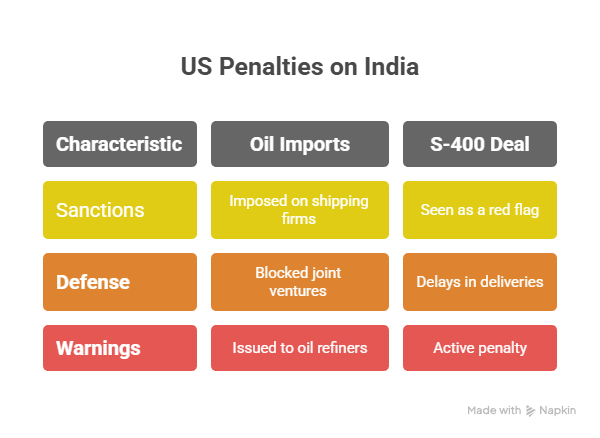
- Imposed secondary sanctions on Indian shipping firms and insurers dealing with Russian crude
- Blocked defense joint ventures involving Russian-origin tech
- Warned Indian oil refiners of “future consequences”
This adds further strain to India-U.S. relations, which are already on thin ice.
S-400 Deal Still Haunts India
India’s past purchase of the Russian-made S-400 air defense system is still seen as a red flag by Washington. While some delays in deliveries were expected, Trump’s stance has now shifted from diplomatic concern to active penalty.
Trade Talks Fall Apart — India’s in for a Bumpy Ride
So, here’s the deal:
India and the U.S. tried to play nice on trade, but things just fell apart. Negotiations kicked off all hopeful in late 2024, and now? Zilch. Nada. No handshake, no deal, just a big fat stalemate. Word is, officials in India’s Commerce Ministry are kinda frustrated, and honestly, who can blame them?
Let’s talk about the big elephant in the room—digital trade rules. The Americans are basically saying, “Hey, let our tech giants do their thing in your market, and by the way, let’s loosen up that data privacy stuff.” India’s not buying it.
Then there’s the pharma mess. U.S. companies are whining (as usual) for India to clamp down harder on generic drug makers. But India’s got a billion-plus people to look after.
And food subsidies—don’t even get me started. The U.S. acts like India’s feeding its poor is some international crime against capitalism. India, though, says, “Sorry, but people need to eat.”
Meanwhile, India’s wishlist:
- Remove leftover Trump tariffs
- Let more Indian techies work in the U.S.
- Support India’s “Make in India” campaign
Bottom line: Both sides are dug in, nobody’s blinking, and the gap keeps getting wider.
EEPC’s Countermove: Diversify or Die
So, what’s India up to with all this tariff chaos flying around?
The EEPC has basically told exporters, “Maybe don’t put all your hopes (and profits) in Uncle Sam’s lap, yeah?”
So, what’s the play? Spread those wings. India’s now flirting with:
- Latin America (Brazil and Mexico)
- Southeast Asia (Vietnam and Indonesia)
- Africa (South Africa, Kenya)
And they’re not being low-key about it either. Campaigns like “Engineering the Future: Beyond the West” and “India: Your Next Trusted Supplier” are everywhere.
Exporters? They’re being nudged to:
- Experiment with pricing
- Embrace Industry 4.0
- Ditch dollar-dependence where possible
Oh, and here’s a nugget: engineering exports just crossed $112 billion in 2024.Domestic Mess: MSMEs Getting Squeezed as Costs Go Haywire
Tariff Shockwaves Smack Indian Businesses
Man, Indian MSMEs are really catching it in the teeth right now. These little guys—who crank out almost half of India’s exports—are getting steamrolled by the U.S. slapping a 25% tariff on engineering goods.
Orders from the U.S.? Basically falling off a cliff.
If you’re making stuff in places like Gujarat or Maharashtra, it’s especially brutal. Rajkot, Jamnagar, Pune—profits down by 10–15%, layoffs, production hiccups—it’s a mess.
And here’s the kicker: most MSMEs don’t have the cash to pivot or absorb costs. They’re not like the big guys who can play with currencies or invest in new tech.
A quarter of small exporters are seeing shipments get delayed or canned. Some say it’s worse than COVID. Back then it was weak demand. Now? It’s hostile policy. Ouch.
Expert Opinions: “A Wake-Up Call for Indian Trade Policy”
Alright, here’s the thing—
Trade nerds and economists are basically yelling from the rooftops:
“India, wake up already!”
Time to Diversify Trade Relationships
- Push FTAs with the EU and ASEAN
- New buyers needed—for MSMEs and the big players
Look to the Neighborhood
- SAARC, BRICS—these aren’t just summit soundbites
- Regional trade has real money
Fix the Foundation
- India’s export system feels like the early 2000s
- Bad logistics, outdated customs, credit bottlenecks
- Fix it now or get steamrolled later
Quick Reality Check: What’s Actually on the Line?
| What’s Happening | Why You Should Care (2025) |
| 25% tariff on Indian engineering goods | U.S. market just got real tough |
| Export loss | $12 billion gone in autos, steel, electronics |
| Russian oil imports | Over $30B (FY 2024–25) – vital to energy security |
| MSMEs slammed | 50,000+ small businesses struggling |
| New hunting grounds | LATAM, ASEAN, Africa—India’s Plan B, C & D |
What’s Next: Can India Actually Handle This Mess?
Man, 2025 feels like curveballs from all directions.
Tightrope Time
India’s juggling:
- Don’t ghost America just yet: Tech, defense, investment—it’s still important
- Energy security: India’s spending $30B on Russian oil. Not negotiable
- Fix stuff at home: Logistics, paperwork, credit access—fix it or flop
- Make new friends: No more delays on EU or Africa trade deals
If India doesn’t act now, things could spiral.
Final Thoughts
Whether India retaliates or negotiates, the outcome of the Trump tariffs India exports standoff will shape future U.S.-India trade dynamics.
Alright, here’s the real talk.
Trump’s back with his tariff saber-rattling, and honestly, that’s Washington’s way of saying, “Fall in line or face the music.”
For India, this is one of those “oh snap” moments. Cracks in exports, energy, and diplomacy are all showing.
But chaos can be good—it pushes change. Cut red tape. Help MSMEs. Look beyond the U.S. and China. LATAM, ASEAN, Africa—they’re ready.
With 2026 elections coming up, expect “economic resilience” to be the buzzword. But a Band-Aid won’t cut it. India needs bold moves now to emerge stronger and smarter.
Stormy skies, sure. But maybe that’s the wake-up call we needed.
Frequently Asked Questions (FAQs)
1. What are Trump’s new tariffs on Indian exports?
Trump has proposed a 25% tariff on several Indian export categories, including automotive parts, pharmaceuticals, and textiles, as part of his broader “America First” trade strategy aimed at reshoring manufacturing and reducing trade deficits.
2. How will these tariffs affect India’s economy?
If fully implemented, these tariffs could cost India over $12 billion in annual export losses, putting pressure on key industries and leading to potential job cuts and reduced foreign exchange earnings.
3. Why is India being targeted by U.S. trade policies now?
The new administration is reassessing global trade deals, and India’s trade surplus with the U.S. has made it a focal point. Additionally, India’s growing tech and pharma exports have raised concerns among U.S. protectionists.
4. Can India counter these tariffs diplomatically or economically?
India may choose to respond with retaliatory tariffs, strengthen alliances with other trade blocs like the EU or ASEAN, or seek WTO intervention. However, immediate relief may be limited due to the power imbalance in U.S.–India trade.
5. What sectors in India will be most affected?
The auto parts, textile, and generic pharmaceuticals industries are expected to face the brunt of the tariffs. Small and medium exporters may also suffer due to reduced competitiveness and tighter margins.