Markets do not ask before correcting. They simply exhale, and investors suddenly assume the world has shifted under their feet. This week reminded us of that truth. Prices softened, screens turned red and the usual chorus began:
Is this the start of a bigger fall? Should I exit? Is the rally over?
The Market Correction 4th Nov 2025 reminded investors that reactions often move faster than reality.
🎧 Prefer listening? Here’s a short audio summary of this article.
Market Correction 4th Nov 2025: What Happened
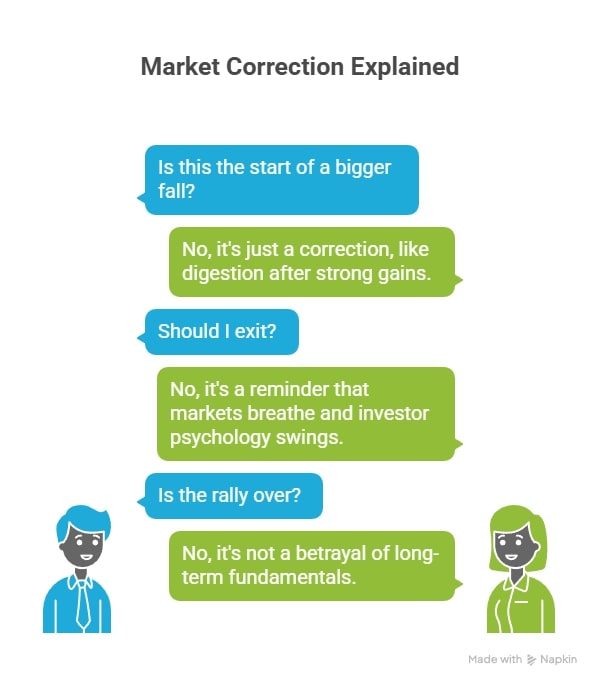
A correction is not a story about doom. It is a story about digestion. After strong gains, markets need time to cool and reset expectations. The recent pullback was not a betrayal of long-term fundamentals. It was a reminder that markets breathe and that investor psychology often swings harder than prices do.
This Market Correction 4th Nov 2025 was influenced by global uncertainty and aggressive FII outflows.
Fear is immediate and loud. Value is quiet and patient. The investors who learn to tell those two apart eventually stop reacting to temporary turbulence and start using it.
This article breaks down:
- What triggered this market pullback
- Which sectors were hit and why
- What signals to watch right now
- How traders should navigate this phase
- How long-term investors can turn volatility into advantage
- A grounded mindset for staying calm and focused
If you have ever felt uneasy watching markets correct, this analysis is built to give you clarity, not confusion.
For many traders, the Market Correction 4th Nov 2025 felt sudden, but price cycles like this are normal and healthy.
You can also explore our detailed breakdown of market instability in the U.S. during 2025, which explains the broader trends driving these sharp movements across global indices.
Why The Market Pulled Back: Factors Behind The Dip
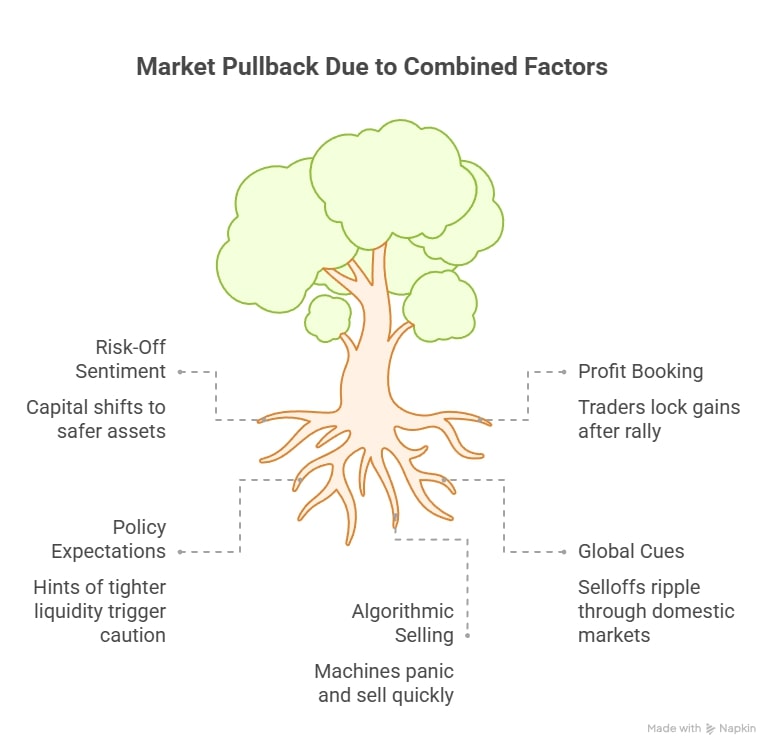
Corrections rarely have a single cause. They form like storms: a few clouds at first, then momentum builds. Several forces came together to push markets lower:
1. Global Investor Risk-Off Sentiment
When global investors switch to caution, capital moves toward safer assets. That shows up as profit booking in equities, especially in emerging markets.
This time, heightened global uncertainty, policy signals and geopolitical noise nudged international funds into defensive positioning.
2. Profit Booking After Strong Gains
Markets have had a strong run recently. Momentum attracts traders, not investors, and the moment confidence shakes, those positions unwind quickly.
Profit booking is not negative. It is maintenance. And strong markets need maintenance more than weak ones.
The Market Correction 4th Nov 2025 also reflected traders locking gains after a strong rally, not a collapse in fundamentals.
3. Policy and Rate Expectations
When policymakers speak in measured tones about inflation or interest rates, traders read between the lines. Even a hint of tighter liquidity or delayed easing can trigger caution. The Market Correction 4th Nov 2025 reflected short-term fear, not a shift in the economy’s structural outlook.
This phase reflects sensitivity to future policy clarity, not a loss of growth conviction.
4. Global Market Cues
Modern markets move in echo chambers. A selloff in US or European equities, concerns around economic data, or volatility in commodities can all ripple through domestic markets.
For a deeper look at how fear of China’s economic shifts shaped global investor behavior in 2025, see our guide on US Fear of China 2025 and its market impact.
For many retail investors, the Market Correction 4th Nov 2025 came as a surprise, but macro indicators still point to long-term strength.
Correlation does not mean dependence. It simply means investors are human and follow global signals.
5. Algorithmic and Quant Selling
Institutional and algorithmic traders often accelerate short-term selling once technical levels break. That creates swift dips but also quick stabilization once forced selling clears out.
In other words: machines panic faster than humans, but also calm down faster. Smart investors viewed the Market Correction 4th Nov 2025 as an opportunity to reassess portfolios instead of reacting emotionally.
For readers who want to understand long-term wealth building, explore our guide here: https://pennypowerplay.com/how-to-build-wealth-through-investing-in-2025/
What This Pullback Is Not
It is important to separate fact from fear. This correction is not:
- A collapse in economic growth
- A liquidity crisis
- A credit risk event
- A sign that valuations suddenly became meaningless
- A complete reversal of long-term trend
- If we zoom out, the Market Correction 4th Nov 2025 simply aligns with normal price cycles seen during high-volatility phases.
It is a cooling phase inside a broader growth cycle.
Corrections help remove excess leverage, flush out speculative positions, and allow long-term money to re-enter at better levels. They act like the market pressing a reset button so the next leg up is healthier, not forced.
On the same day, the Federal Reserve also issued an enforcement update, reflecting continued regulatory vigilance in the US financial system, which added to global market caution. Source:
Sector Performance: Who Felt The Heat
Markets rarely fall evenly. Some sectors adjust more quickly. Here is what happened during this pullback:
Banks and Financials
Financial stocks saw profit taking after steady accumulation in recent months. That is normal in interest-sensitive environments. Strong balance sheets and healthy credit demand remain intact, so long-term positioning here stays attractive.
IT and Technology
Global uncertainty hit IT stocks as cautious commentary from international clients and soft demand concerns resurfaced. The market is not abandoning tech, it is resetting expectation curves that had run ahead of fundamentals. The Market Correction 4th Nov 2025 reflected short-term fear, not a shift in the economy’s structural outlook.
Metals and Energy
Commodity-linked names cooled as global demand concerns weighed. These sectors often amplify cycles. They rise hard, correct hard, and reward investors who avoid chasing peaks.
Pharma and Defensives
Selective buying appeared here. When uncertainty rises, smart money looks for stability. Pharma, healthcare and quality consumer names quietly gain strength during turbulent periods.
Defensive buying during the Market Correction 4th Nov 2025 shows confidence in quality sectors even when volatility rises.
Midcaps and Smallcaps
Higher beta segments corrected sharper. They rose faster earlier, so a sharper cool-off is natural. Investor interest remains strong, but capital selectively favors quality over momentum.
Signals Investors Should Watch Now
Smart investors viewed the Market Correction 4th Nov 2025 as an opportunity to reassess portfolios instead of reacting emotionally.
Pullbacks are noisy. Clarity comes by watching the right indicators, not reacting to headlines.
For a deeper understanding of how diversification reduces risk and supports long-term portfolio performance during market corrections, see our detailed breakdown of Diversification in Investment Portfolios 2025.
1. Institutional Flow
Foreign investor flows matter during corrections. If outflows slow down or reverse, sentiment stabilizes fast. Domestic investment remains strong, providing long-term foundation.
2. Volatility Index (VIX)
Rising VIX signals uncertainty, but extreme spikes often precede stabilization. Watch for cooling in volatility as a sign that fear is resetting.
3. Bond Yields and Policy Commentary
Interest rate expectations shape risk appetite. Stable yields and measured central bank commentary help markets find footing.
4. Leadership Stocks
When market leaders hold strong or recover early, tides begin to turn. Index strength hides in the behavior of top-weighted companies.
5. Earnings Guidance
Fundamentals tell the real story. As long as corporate earnings stay healthy, selloffs remain tactical, not structural.
For smart personal finance planning during market swings, check out this detailed review of AI money management tools:
What Traders Should Do Right Now
Short-term traders face a different reality than long-term investors. This phase demands discipline:
Protect Capital
Capital preserved in fear markets compounds fastest in recovery phases. Cutting emotional trades and honoring stop loss rules matters more than chasing wins.
Avoid Full Aggression
This is not the environment to trade heavy or impulsively. Position sizing and staggered entries are your allies.
Trade Select Levels
Patience beats prediction. Let prices come to your levels. Do not chase breakouts blindly in correction phases.
Focus on Strength
Stocks that fall less than the market often lead the next uptrend. Relative strength is a compass.
What Long-Term Investors Should Do
Corrections build wealth for people who understand time. If your horizon stretches years, not days, this is not chaos. It is an opportunity disguised as noise.
Hold Quality
Strong businesses do not lose value in a panic. They get mispriced temporarily. Keep your allocation steady and review your holdings, not your doubts.
Add Gradually
Staggered buying in corrections improves long-term cost basis. You do not need to catch bottoms. You need consistency and discipline.
Keep SIPs Running
Stopping systematic investments during volatility is like stopping exercise when muscles hurt. The discomfort is the signal, not the problem.
Stay Rational
Do not take emotional cues from anxious traders. They are running a different race with a different clock.
The Psychology of Market Dips
Markets do not move only on numbers. They move on narratives.
A correction tells two stories:
To the impatient:
“Everything is changing. Get out before it gets worse.”
To the disciplined:
“Nothing fundamental broke. This is a chance to strengthen future returns.”
The market rewards the second group over time.
Nervous minds focus on the price screen. Patient minds focus on business strength, policy direction and long arc economics.
A Note for Investors
There are days when screens shake confidence more than fundamentals. The market forgets its manners, prices swing and fear rises faster than logic. These are the chapters every long-term investor must live through.
Corrections do not question your future. They question your patience.
Stay focused on real value. Stay aware, not anxious. Build positions with discipline and let noise pass like weather. Markets always remember their direction once fear calms.
Investing is not a sprint built on perfect entries. It is a journey built on steady conviction.
Keep Learning, Keep Growing
If this pullback made you uncomfortable, use that feeling. Growth begins where comfort ends.
Study businesses, not only prices. Learn cycles, not only headlines. Develop habits stronger than your emotions and wealth follows naturally.
The red days do not end your story. They prepare your next chapter.
Before You Go
To get the most from this analysis:
- Bookmark this for reference during future market dips
- Share it with someone who needs calm in volatility
- Explore our latest deep dives and investor mindset posts
- Subscribe for weekly market clarity and financial motivation
Real investing rewards patience, clarity and steady steps.
Start building that version of yourself today.
FAQs
1. Should I sell during a correction?
Only if your investment thesis has changed or risk exposure is too high. Selling because prices fell usually leads to regret.
2. Is this the start of a long downturn?
There is no evidence of structural breakdown. Current moves look corrective, not destructive.
3. Should I pause SIPs?
No. Volatility enhances SIP returns over time through cost averaging.
4. What sectors look strong after corrections?
Quality banks, tech leaders, healthcare, consumer staples and select manufacturing names often lead post-dip recoveries.
5. Should I wait for certainty before investing?
Certainty never announces itself. When the market feels safest, prices are often already higher.
6. Is holding cash useful right now?
A partial cash buffer helps you buy dips without emotional pressure. Full cash positions often result in missed opportunities.
A Steady Investor Mindset
Fear spikes quickly. Confidence rebuilds quietly. Use volatility to your benefit, not your downfall. When others rush, observe. When others panic, think. When others hesitate, prepare.
Market cycles do not punish patience. They reward it.
Related Articles
• Low Risk Investments for Beginners