How to build wealth through investing in 2025 is the question on many investors’ minds as we enter November. The market landscape has shifted, and building wealth today demands a different mindset. The era of easy money and unchecked growth has moved on. As we move deeper into Q4 2025, investors are getting clearer signals from central banks and markets.
Rate cuts are easing financial conditions, but the global economy is still on uneven ground, especially with mixed labor data and ongoing geopolitical tensions. For long-term investors, this environment rewards consistency over prediction. Focus on income-producing assets, disciplined cash-flow management and steady contributions instead of chasing short-term rallies.
If you’re just getting started, this complete guide on how to start investing can help you build wealth step by step
🎧 Prefer listening? Here’s a short audio summary of this article.
The Federal Reserve recently cut its benchmark rate to 3.75 %-4.00 %. At the same time, inflation remains above target, and labor-market weakness is starting to worry policy-makers. Investopedia+1
The Federal Reserve recently cut its benchmark rate to 3.75%–4.00%. At the same time, inflation remains above target, and labor-market weakness is starting to worry policymakers.
For investors, this means one thing: it’s time to build not just for growth, but for income and durability. Wealth isn’t built purely by having big returns tomorrow. It’s built by having reliable cash flows today and a mindset ready for the future.
If you’re searching for how to build wealth through investing in 2025, you need to understand today’s unique financial landscape.
“Building wealth through investing in 2025 means focusing on strategies that provide income and durability, not just growth.”
Why Building Wealth in 2025 Is More Important Than Ever
In past years, riding capital appreciation buying growth stocks, hoarding for rise could work. Not bad if you were lucky. But today’s market environment has changed. Higher rates, inflation risks, global supply disruptions, and geopolitical uncertainty make passive income not a side trick, but a foundation.
If you’re new to this concept, this guide on passive income ideas for long-term wealth breaks down how sustainable cash-flow strategies actually work in real life.
Here’s why passive income is crucial in 2025:

- It provides cash flow when markets wobble, reducing the need to sell at bad times.
- It keeps you invested rather than forced out when valuations get stretched.
- It counters inflation. When inflation is 3-4 % or more, you want your investments earning something, not just sitting.
- It gives you optionality freedom to make choices rather than reactive moves.
In other words: you no longer win just by being lucky with a stock pick. You win by building an income machine.
The Changing Market Landscape in 2025
Let’s ground this in what’s actually happening now:
- The Fed has cut rates to a 3.75 %-4.00 % range, signalling easing but also caution.
- Inflation is easing, but still above the 2 % target. The labour market is softening.
- Mortgage rates in the U.S. have started to moderate (though India and other markets will differ). CBS News
- The U.S. government shutdown has delayed economic data, introducing extra uncertainty. Wikipedia
- For Indian investors: global flows, currency pressures, and domestic credit bubbles matter more than ever.
For you, as an Indian-based investor (or someone globally aware), this means you need to think about two layers: the global backdrop and the local overlay (rupee, Indian real estate yields, tax regimes, regulatory changes).
Active vs Passive Income: What Actually Builds Wealth
Here’s the distinction every serious investor absorbs:
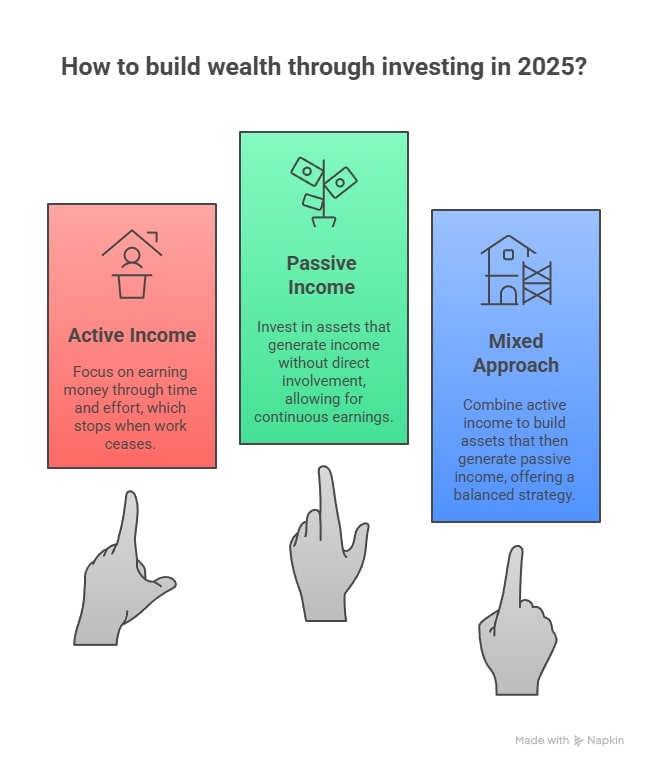
- Active income: your time equals your money. If you stop working, the income stops.
- Passive income: your money (or system) works for you. You can step back and it still earns.
Most people focus on active income (job, business). The handful who build lasting wealth shift to passive income or better yet, a mix where active income builds assets, and those assets then generate passive income.
Think: salary builds the business/investment; investments start earning while you sleep.
“In addition to passive income investing, exploring trending side hustles can help diversify your income streams. Check out our guide on Trending Side Hustles in 2025 to discover new opportunities.”
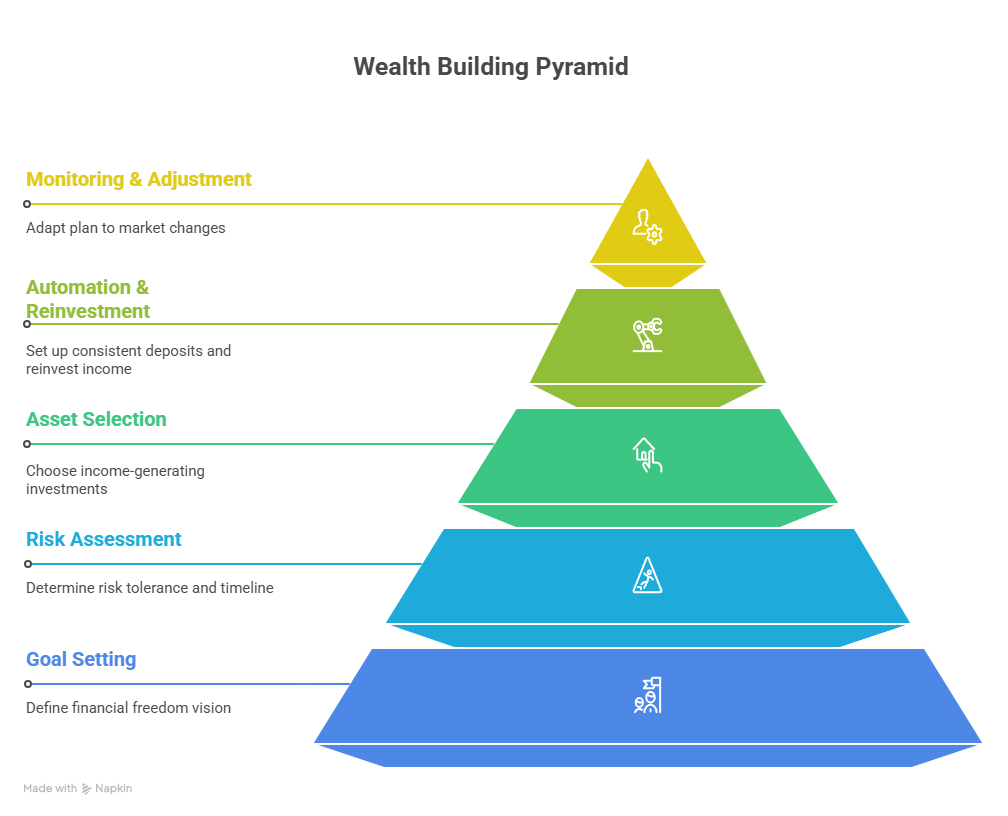
“The blueprint for how to build wealth through investing in 2025 includes: clarifying your goal, knowing your risk tolerance, choosing income-oriented assets, automating investments, monitoring and adjusting.”
5-Step Blueprint to Build Wealth in 2025
Here is the practical roadmap I recommend:
- Clarify your goal. What does financial freedom look like for you? Income cover? Lifestyle? Legacy?
- Know your risk tolerance and timeline. Are you in for 10 years? 20? What shocks can you withstand?
- Choose income-oriented assets. Dividend stocks, REITs, bonds, alternative credit, property.
- Automate and reinvest. Set monthly deposits. Reinvest income. Stay consistent.
- Monitor and adjust. Markets change. Your plan should flex but not wobble at every headline.
Where to Earn Passive Income in 2025
When considering how to build wealth through investing in 2025, start with dividend stocks, REITs, and bonds that pay regular income.
Dividend Stocks & Income ETFs
In 2025 you don’t want the highest flyers alone; you want companies that pay you. Reliable dividend streams matter. Look for:
- Profitable, debt-manageable companies.
- Dividend history and payout sustainability.
- Diversification across sectors (utilities, consumer goods, healthcare, financials).
By earning dividends you turn part of your portfolio from “hoping it goes up” to “it pays me”.
To understand the importance of financial discipline alongside investing, read our article on How Budgeting Can Boost Your Investment Growth
Real Estate & REITs
Real estate remains a solid income pillar but the script has changed.
- Direct rental property: still works, especially where yields are good and financing is prudent.
- REITs: for less hands-on investors; sectors gaining renewed interest: data centres, logistics, infrastructure, healthcare facilities.
Because borrowing costs are still elevated, choose properties with cash-flow buffer, not just appreciation hope. Financing wisely matters more than ever.
Private Credit & Lending
When interest rates are high, lending becomes more interesting. But the risk is also different: credit risk, platform risk, regulation risk. The smart move: allocate modestly, diversify across loans, use regulated platforms.
Bonds & Fixed Income
Bonds aren’t dead. When yields are meaningful, they play a stabilizer in your portfolio. They complement equities and real-assets income.
Technology Tools That Help You Build Wealth
One of the advantages of 2025? Tools. Automation is no longer optional.
- Robo-advisors and systematic investment platforms
- Fractional real estate investing
- Auto-dividend reinvestment tools
- Dashboard apps to track income, expenses and net worth
The key: don’t get lost in apps seeking “the one trade”. Use them to execute your plan quietly and consistently.
Budgeting: Where Discipline Lives
A disciplined approach to budgeting is key if you’re serious about how to build wealth through investing in 2025
Strong investing habits only work when supported by daily money discipline, which is why these budgeting tips for 2025 are essential alongside any long-term investment plan.
Even income streams don’t matter if you’re leaking cash elsewhere.
- Build an emergency fund (3-6 months of expenses).
- Track spending. Know where your money goes.
- Invest first, then live on the rest.
- Revisit annually: raise your investment contribution if income rises.
Budgeting is the foundation. Income-producing assets sit on top of it.
Discover how to effectively build and maintain your investment portfolio with our guide on Portfolio Diversification Strategies for 2025
Risks You Must Address
Even the best plan can fail if you ignore risks:
To reduce long-term downside risk, investors should also understand proper asset allocation, which is explained in this guide on portfolio diversification strategies for 2025.
- Market downturns income may drop, assets may shrink.
- Leverage risk — over-borrowed real estate investors get crushed in rate-shock.
- Illiquidity — some income assets (private credit, real estate) lock you in.
- Tax and regulation changes — especially in India and global markets.
Currency risk — rupee moves matter if you hold foreign assets.
Indian Investors: How to Build Wealth Through Investing in 2025 Locally
Because you are blogging in India, let’s zoom in:
- The domestic interest-rate cycle may follow global moves but with Indian conditions: inflation, growth, RBI policy.
- Real estate yields in Indian cities often differ from global peers be realistic.
- The rupee vs dollar changes your foreign asset returns.
- Tax rules: dividends, REITs, mutual funds know your slab.
SIPs (Systematic Investment Plans) remain powerful in equities paired with dividend/income focus and you get hybrid strength.

Putting It All Together
Imagine your wealth-building effort as a well-balanced portfolio of income machines:
- Job/business (active income) builds the engine.
- Dividend stocks + REITs + bonds (passive income) keeps you moving.
- Emergency fund + low-cost debt = safety gates.
- Budget and automation = fuel economy.
This is not about spectacular one-day gains. It is about quiet resilience. It is about building a system that works when you sleep.
Final Thoughts
In 2025, the loudest headline doesn’t win. The most consistent investor wins.
You don’t need perfect timing. You need good habits, an income-oriented mindset, a plan you can stick with.
Start today. Revisit your goals. Choose assets that pay you. Automate. Diversify. Adjust.
Time is your most powerful ally. Income is your anchor. Freedom is your destination.
Your wealth journey isn’t a sprint. It is a construction project. And you’re the architect.
FAQs: How to Build Wealth Through Investing in 2025
What is passive income in investing?
Passive income comes from assets you own or systems you build that generate cash flow without constant active work from you.
Why is passive income more relevant now than before?
Because with higher rates, volatile growth, inflation and global uncertainty, relying solely on capital-gains or speculative trades is riskier. Income gives you stability.
How can I get started with passive income investing?
Begin by clarifying your goal and risk profile, then pick one or two income-generating asset types (dividend stocks, REITs, bonds), invest automatically, reinvest your income, and diversify gradually.
Is real estate still a good passive income option in 2025?
Yes but the conditions are stricter. Focus on cash-flow positive properties, realistic financing, and sectors with structural tailwinds (logistics, data centres, healthcare).
What mistakes should I avoid?
Avoid chasing high returns without checking cash flow, using over-leverage, ignoring diversification, and failing to revisit your plan when market conditions change.
How do Indian investors apply this globally?
Combine domestic assets (Indian equities, real estate) with global income possibilities (foreign dividend stocks, global REITs), watch currency risk (rupee vs dollar), understand your tax liabilities, and stay aware of global central-bank shifts.
Related Articles