This article breaks down both events in simple English so investors, professionals, students and financial officers can understand what these events mean for the market and the future of AI investing.
🎧 Prefer listening? Here’s a short audio summary of this article.
Introduction
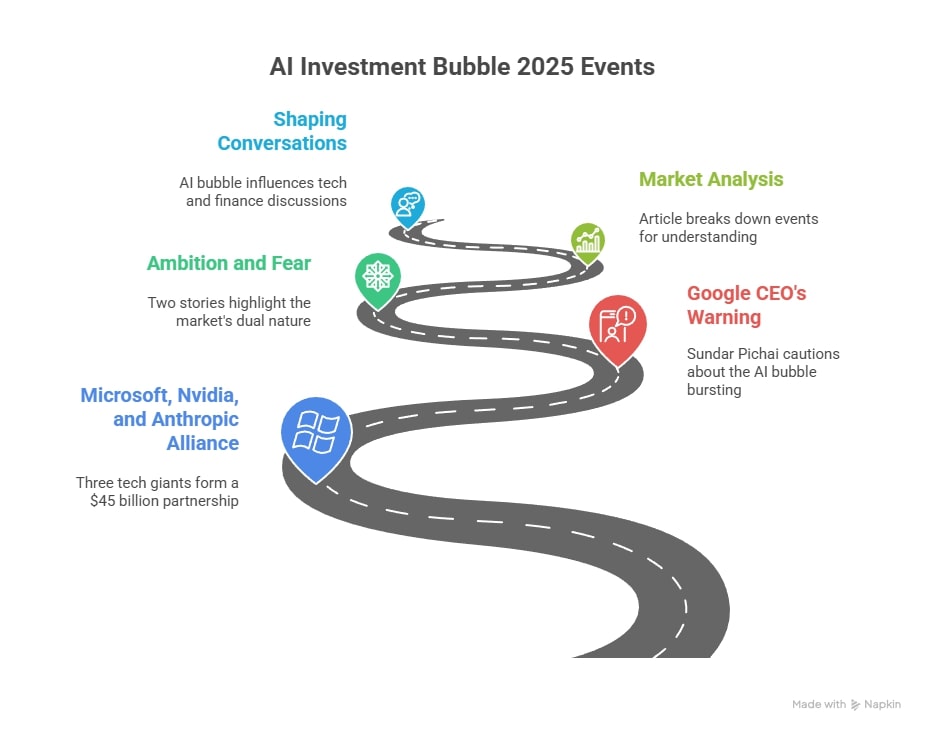
AI investment bubble 2025 is becoming one of the biggest concerns in the tech world, and this week’s developments made it even clearer. On one side, three giants Microsoft, Nvidia and Anthropic announced a massive partnership worth about forty five billion dollars. It is one of the largest AI alliances of the decade and shows how fast the AI industry is expanding.
On the other side, Google CEO Sundar Pichai warned that no company will be safe if the AI bubble bursts. His message came at the same time as the new AI alliance, which creates the perfect moment to understand where the AI market truly stands.
Two major stories on the same day tell us the truth about the AI investment bubble 2025. One shows ambition. The other shows fear. Together, they reveal the real picture of the AI market in 2025 a future full of opportunity but also full of risk.
The AI investment bubble 2025 is now shaping every major conversation in the tech and finance world.
This partnership is one of the clearest signals of how rapidly the AI investment bubble 2025 is expanding.
Part One: The 45B AI Alliance and Its Role in the AI Investment Bubble 2025
The biggest AI partnership of the year
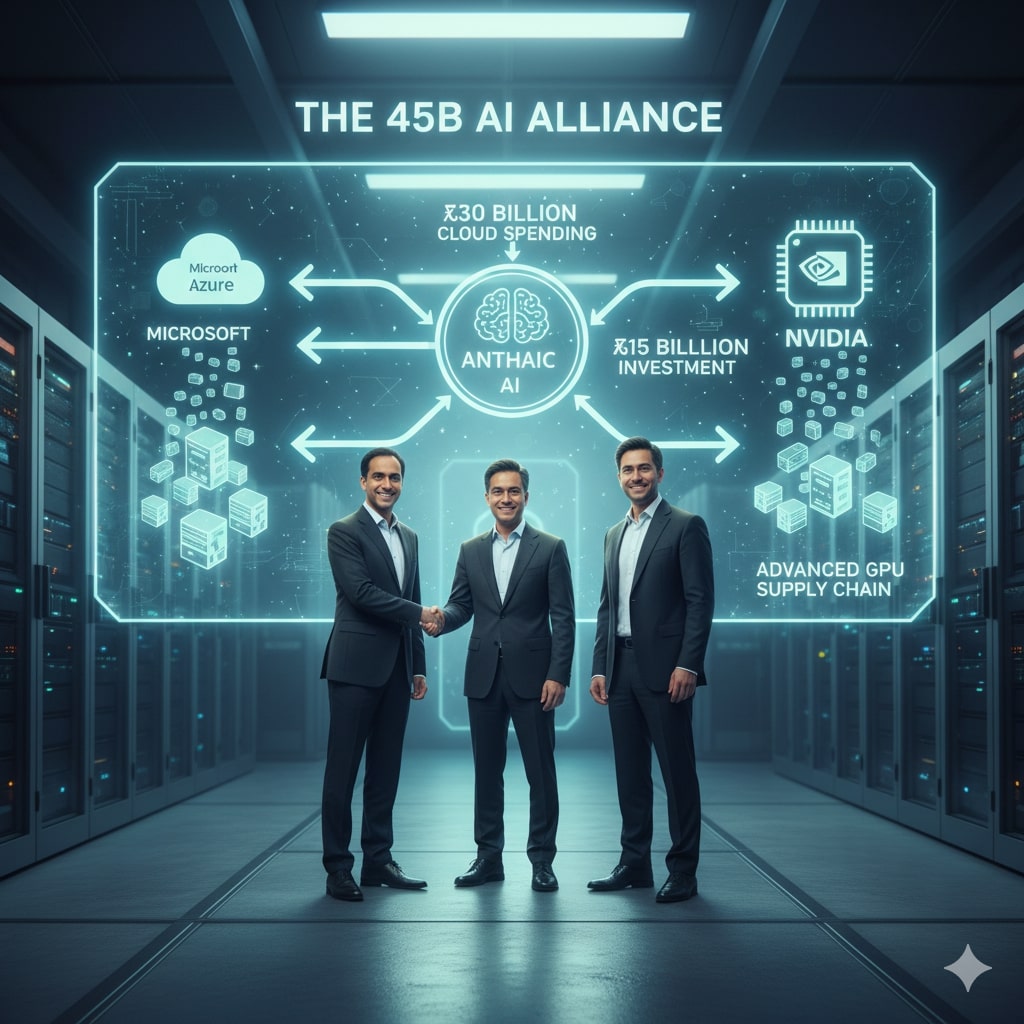
Microsoft, Nvidia and Anthropic announced a sweeping AI partnership that immediately changed the landscape. The deal includes three major pieces.
Anthropic will spend about $30 billion on Microsoft Azure
This means Anthropic will use Microsoft cloud infrastructure for training and running large language models. It also means Microsoft will become even more central in the AI compute market.
Microsoft and Nvidia will invest around $15 billion into Anthropic
You can read the full Reuters report on Anthropic’s 30 billion dollar Azure commitment here
This strengthens Anthropic’s position against rivals such as OpenAI and makes the competition for AI leadership even more intense.
Nvidia becomes a deeper part of the new AI supply chain
Nvidia will supply advanced GPUs and systems that Anthropic will need as it trains more powerful models. The demand for high performance AI chips is increasing, and this deal will support Nvidia’s role at the centre of this demand.
Read my detailed breakdown of how Nvidia is navigating AI financial growth in 2025 here
Why This Alliance Matters for the AI Investment Bubble 2025
This partnership is not just about money. It is about power, influence and control of the AI future.
Stronger competition with OpenAI
After OpenAI’s agreement with Amazon, this deal balances the field. Anthropic now has the support of two of the most powerful companies in the tech world.
A major investment signal
If companies are willing to spend tens of billions of dollars on AI infrastructure, it shows they believe AI is not a short trend. They see long term demand and want to secure their position early.
Moves of this scale often accelerate debates around the AI investment bubble 2025.
More pressure on the semiconductor industry
Nvidia already holds a huge share of the AI chip market. With this deal, the demand for its chips could grow even faster. This has direct effects on its earnings and market valuation.
Faster development of advanced AI models
With access to greater compute power and deeper integration with cloud systems, Anthropic will be able to build models that are stronger, faster and cheaper to deploy.
You can also explore how AI is reshaping personal finance in 2025 here:
https://pennypowerplay.com/ai-in-personal-finance-2025/
What Investors Should Learn in the Middle of the AI Investment Bubble 2025
The partnership tells us three things.
AI spending is still growing
Companies are investing aggressively even after two years of heavy AI expansion. This shows confidence that the AI market still has a long runway.
Big tech is building an AI wall
By forming deep partnerships, tech giants are trying to control compute supply, data, infrastructure and model development. This makes it hard for smaller companies to compete.
The AI market is moving into its next phase
Phase one was excitement.
Phase two was experimentation.
Phase three, which we are entering now, is consolidation, alliances and large-scale infrastructure building.
This is where the real money will be made but also where the biggest risks exist.
History shows that periods of rapid innovation are often followed by sharp pullbacks before long-term winners emerge.
Part Two: Sundar Pichai’s Warning and the AI Investment Bubble 2025
While the AI alliance shows confidence, Sundar Pichai’s statement shows caution. During an interview, he said no company will be immune if the AI bubble bursts. His message came at the perfect time and adds balance to the current enthusiasm.
Why Pichai is worried
His warning directly connects to broader fears surrounding the AI investment bubble 2025.
AI has attracted huge investment in a short period of time. Not all of this investment is based on real revenue or sustainable demand. This can create a bubble.
Pichai highlighted several concerns.
Irrational investment behaviour
Companies are spending first and planning later. Many are overestimating how quickly AI will generate results.
High valuations and weak business models
Some AI startups are valued at billions even though they do not have stable revenue. If expectations fall, valuations will collapse quickly.
Heavy dependence on cloud and chip providers
Most AI companies cannot survive without massive compute resources. If the cost increases or supply becomes tight, many small players may fail.
Talent costs rising too fast
AI expertise is expensive. Companies are hiring aggressively, which raises salaries and increases financial pressure.
For a related perspective on market volatility, you can read my article on U.S. market instability in 2025 here:
Why this warning matters today
This warning did not come from an outsider. It came from the CEO of Google, one of the world’s biggest AI companies. When a leader of that size expresses concern, the market listens.
His message is simple:
AI will change the world, but the path will not be smooth. There will be corrections, failures and unpredictable risks.
Connecting Both Stories: What They Reveal About the AI Investment Bubble 2025
We now have two powerful signals happening at the same time.
Together, these events show why the AI investment bubble 2025 is being watched so closely by global investors.
Signal one: Massive long term investment
The $45B alliance shows companies believe AI is the future and are willing to bet heavily on it.
Signal two: Warnings of a bubble
Sundar Pichai’s comments remind us that rapid investment does not always mean stable growth.
Together, these signals tell us that:
AI is entering a mature phase.
Growth will continue, but not without volatility.
Companies that cannot survive financial pressure will drop out.
Winners will grow stronger at high speed.
This is typical of every major technology revolution. The internet went through it. Smartphones went through it. Cloud computing went through it. AI is now entering the same cycle.
What This Means for Investors and Professionals in the AI Investment Bubble 2025
1. Expect both growth and correction
AI demand is real. Infrastructure is expanding. Companies are racing to build new models. But this does not mean every AI company will survive. Growth will happen, but corrections will also occur.
2. Focus on companies with real infrastructure
Much of the real value in AI is concentrating around chips, compute, and companies that control the physical infrastructure.
Cloud providers, chipmakers and platform companies have stronger foundations. They own the hardware and systems that everyone depends on.
Companies in this category include
Microsoft
Nvidia
Amazon
Google
These players usually survive corrections because they have revenue streams outside AI.
3. Be careful with smaller AI startups
Many AI startups depend on hype, fundraising and short term momentum. If the bubble cools, they may struggle.
4. Watch where the money is flowing
The new alliance shows that we are entering a stage where AI development depends on billion dollar partnerships. Companies that cannot access such partnerships will find it hard to compete.
5. Do not ignore risk
AI is not risk free. Overvaluation, supply shortages, high competition, regulation and market pressure can all create volatility.
How Students and Working Professionals Should Read This
For students
AI skills will remain in high demand, but it is important to understand the business side as well. The job market will evolve as companies combine AI with cloud, cybersecurity, data and automation.
For professionals
AI is becoming part of every industry. Finance, healthcare, retail, manufacturing and logistics all need AI understanding. Upskilling is essential.
For bankers and finance officers
This is the time to watch funding trends and evaluate company fundamentals. Not every AI startup deserves high valuation. Look for businesses with real revenue, real demand and long term strategy.
For investors
Focus on sustainable business models. Do not get carried away by hype. Consider long term risk and reward.
Final Thoughts
The AI market in 2025 is powerful, fast and unpredictable. The new $45B partnership shows how serious the competition has become. At the same time, Sundar Pichai’s warning shows that even the biggest companies are aware of the risks.
This is a moment of growth but also a moment of caution. Companies with real infrastructure, strong balance sheets and clear strategy will lead the next decade. Others may fall behind.
AI is not a bubble by nature, but some behaviour in the market can create bubble-like conditions. Investors and professionals need to stay aware, stay informed and avoid emotional decisions.
AI will shape the future, but the winners will be those who combine innovation with discipline.
Understanding the AI investment bubble 2025 helps investors stay prepared for any sudden market shift.
Frequently Asked Questions
1. Why is the Microsoft–Nvidia–Anthropic alliance important for the AI industry?
This alliance matters because it brings together three of the most powerful players in AI. They are investing heavily in cloud computing, chips and advanced model training. This will accelerate AI development and increase competition across the industry.
2. What does Sundar Pichai mean by an AI bubble?
He is referring to the possibility that companies are investing too fast without stable revenue or proven business models. If expectations fall, many companies could lose value quickly, just like past tech bubbles.
3. Will the AI market grow even if a bubble correction happens?
Yes. AI is a long term trend and will continue to grow, but the journey may include corrections. Strong companies with real infrastructure and revenue will continue to lead, even if some smaller players struggle.
4. Which companies are likely to benefit most from the new $45B AI alliance?
Microsoft and Nvidia will benefit because they provide the compute power and cloud infrastructure that Anthropic needs. Anthropic will also benefit because it gets the technology, chips and support required to build more powerful AI models.
5. Should retail investors worry about an AI bubble bursting?
Retail investors should stay aware but not panic. The best approach is to focus on companies with strong fundamentals, long term strategy and steady cash flow instead of chasing hype or overvalued startups.
6. How should students and working professionals prepare for the AI future?
They should build skills around AI, data, cloud computing and automation. Understanding how AI works in real business situations will create better job opportunities and help them stay competitive in a fast changing market.