Updated to reflect ongoing global mobility and EV developments as the industry enters 2026.
Big acquisitions often look sudden, but the Bajaj–KTM story was built patiently over years. In 2025, that long-term bet finally turned into one of India’s most important global mobility moves.
🎧 If you enjoy learning through audio, you can now listen to the full story in a clear, engaging Deep Dive format.
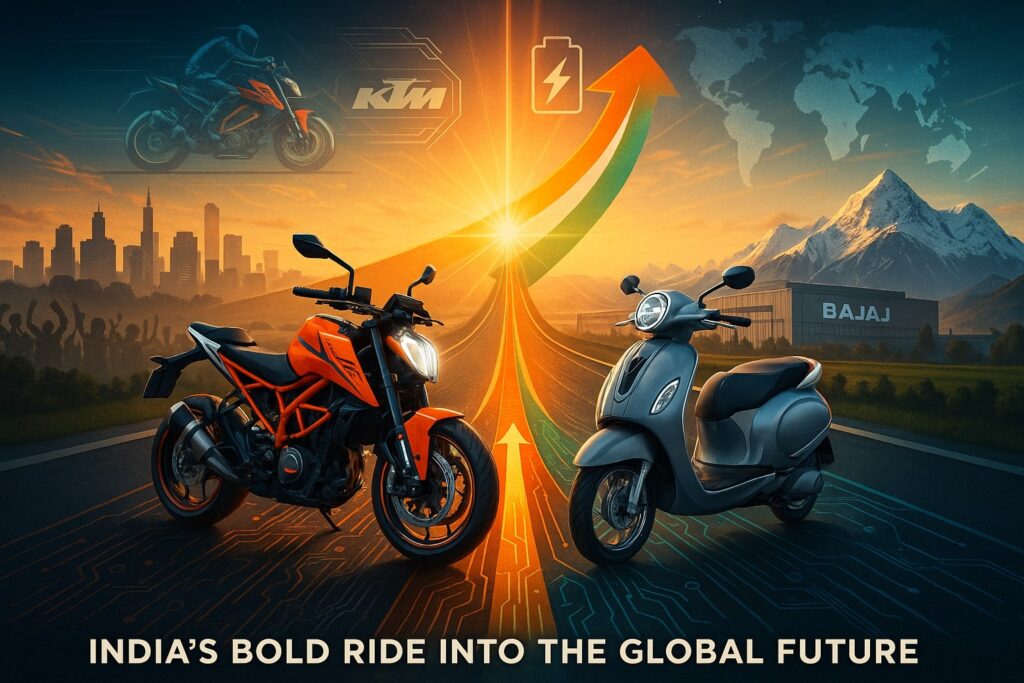
Bajaj + KTM: The Story of Two Companies, One Big Bet, and How It Could Change India’s Future
Bajaj KTM acquisition 2025 is one of the biggest milestones in India’s mobility landscape and marks a turning point in the global motorcycle industry.
Introduction: When Two Roads Met
The bajaj ktm acquisition 2025 has become one of the most important moves in India’s mobility landscape, shaping how the industry thinks about innovation and global expansion.
Every big success in business starts with a bold step.
Sometimes it’s a risk. Sometimes it’s a quiet decision people don’t notice at first.
For Bajaj Auto and KTM, the journey started more than a decade ago. One was an Indian company known for dependable bikes. The other was a European brand famous for speed, performance, and racing DNA.
Nobody expected these two worlds to blend. But they did. And today, the story has reached a historic moment.
In November 2025, Bajaj Auto officially completed its €800 million acquisition of KTM AG.
Through its renamed entity, Bajaj Auto International Holdings AG, it now controls 74.9% of the company.
This isn’t just a deal.
It’s a full-circle moment. A story of trust, long-term vision, and India’s climb toward global leadership in mobility. And for us at PennyPowerPlay, it’s a powerful case study in how to build wealth and a career with patience and smart strategy.
The Beginning: How Bajaj and KTM First Crossed Paths
Back in 2007, KTM wasn’t in the best shape. It needed a strong partner in Asia.
At the same time, Bajaj wanted to move beyond commuter bikes and enter the premium motorcycle segment.
So in 2007, Bajaj Auto bought a small 14.5% stake in KTM.
It didn’t make headlines. It didn’t look like a major turning point.
But it was. This was a classic value investment getting into a great but undervalued company early, the same way we look for strong assets for our own portfolios.
Over the years, Bajaj slowly increased its stake.
Both companies started designing motorcycles together.
And then came the game changer.
How One Idea Changed Everything
When KTM and Bajaj decided to build premium motorcycles in India, many people doubted them.
“Performance bikes made in India?”
“Will the world trust Indian manufacturing?”
“Can India produce racing-level machines?”
The answer came in the form of two iconic bikes:
- KTM Duke
- KTM RC
Designed in Austria.
Built in India.
Sold in more than 80+ countries.
In a short time, these bikes became a global hit.
People abroad were surprised that these powerful machines were made at Bajaj’s Chakan plant near Pune.
KTM’s global sales almost tripled.
Bajaj’s international presence exploded.
And both companies realized something important:
Together, they were stronger than they had ever been alone.
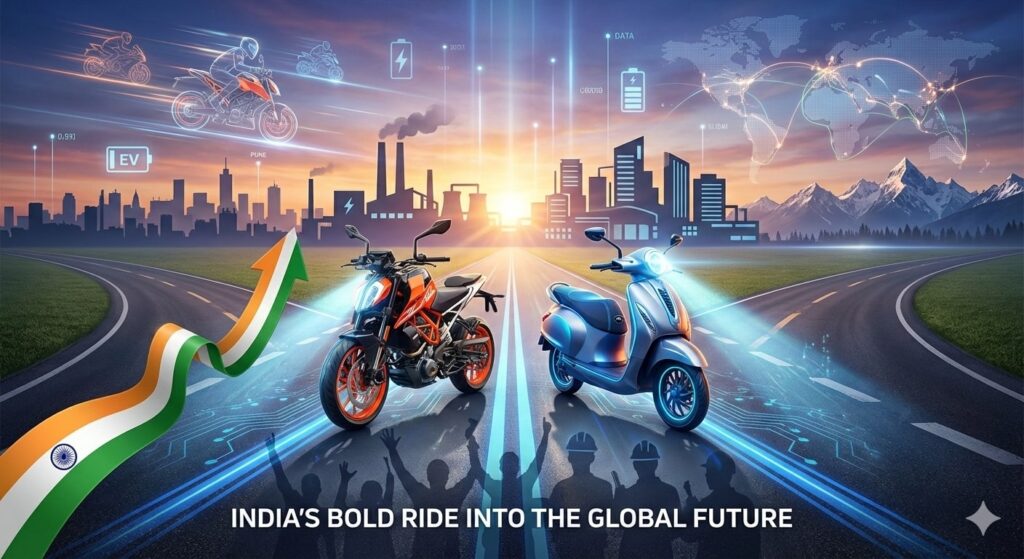
A Story of Growth: How Both Companies Benefited
1. KTM’s Worldwide Rise
Before its partnership with Bajaj, KTM was mostly a European racing brand.
After the partnership:
- KTM became Europe’s biggest motorcycle manufacturer.
- It expanded to Asia, Latin America, and the Middle East.
- Costs dropped because manufacturing was efficient in India.
- New models were launched faster.
KTM turned into a global powerhouse.
2. How the bajaj ktm acquisition 2025 Reshapes Global Mobility
Before KTM, Bajaj had a strong presence in India and developing markets but premium bikes weren’t its strength.
After KTM:
- Bajaj entered the global performance segment.
- Its export revenues surged, diversifying its income streams and boosting shareholder value a key goal for any solid financial plan.
- Its Chakan plant became one of the world’s most advanced motorcycle hubs.
- It earned respect from global mobility leaders.
This partnership made Bajaj Auto a world player, not just an Indian manufacturer.
The 2025 Moment: Bajaj Takes Control
According to The Economic Times’ auto industry reports, Bajaj Auto’s majority acquisition of KTM was completed only after receiving key regulatory approvals:
In 2025, the Pierer family exited KTM’s parent company, Pierer Mobility AG (PBAG).
This opened the door for Bajaj to take full control.
Bajaj now owns:
- 100% of Pierer Bajaj AG
- And through it, 74.9% of KTM AG
This means:
- Strategic control
- Brand decisions
- Innovation roadmaps
- EV development
- Global expansion
All now guided by an Indian company.
This is a historic shift in the global auto industry.
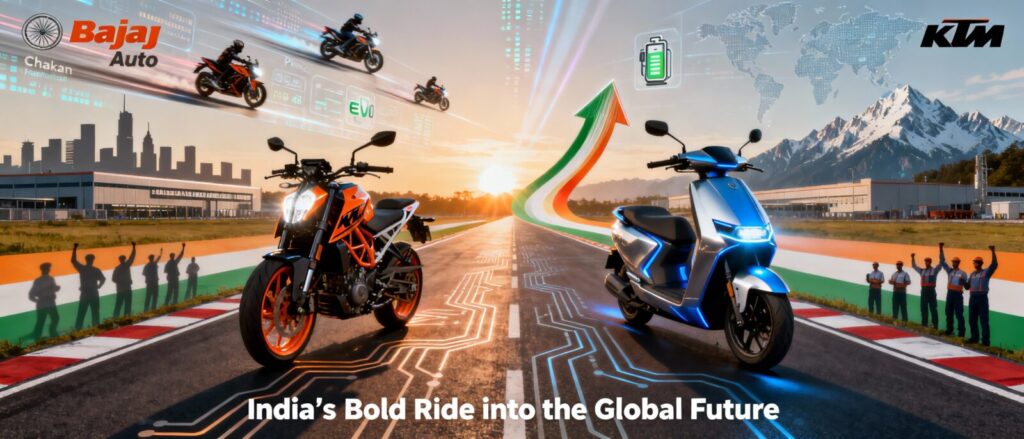
The Bajaj KTM Acquisition 2025: Why It Matters for India
This acquisition isn’t just a corporate headline.
It’s a signal to the world:
The bajaj ktm acquisition 2025 also strengthens India’s position in performance engineering, giving local talent access to world-class motorcycle technology.
India is no longer just a “low-cost factory.”
India is becoming a global innovation and mobility leader.
Here’s why:
1. India Becomes a Premium Motorcycle Powerhouse
For years, Japan dominated the global motorcycle market with Honda, Yamaha, Suzuki, and Kawasaki.
Now, India enters this club.
With the KTM acquisition:
- India controls a premium global brand
- High-performance bikes are designed and built in India
- India becomes a key player in the racing and adventure bike world
This boosts the country’s global reputation in engineering and manufacturing.
2. Huge Push for India’s EV Future
KTM is already deep into performance EVs.
Bajaj has the Chetak EV and is expanding fast.
Together, they can:
- Build high-performance electric motorcycles
- Scale EV exports from India
- Push Indian EV technology into Europe and America
- Compete with Tesla’s mobility ambitions in two-wheelers
- With the bajaj ktm acquisition 2025, both companies now share a unified vision for EV scalability, global exports, and next-generation motorcycle platforms.
This partnership can accelerate India’s EV leadership.
3. More Jobs, More Skilled Workers
Bajaj’s R&D, design and manufacturing centers in:
- Pune
- Chakan
- Akurdi
- Aurangabad
And expanding clusters will see massive growth.
The KTM acquisition is expected to create:
- Thousands of new skilled jobs
- Engineering roles
- Design roles
- EV research roles
- Supplier ecosystem expansion
This strengthens India’s industrial foundation.
Experts believe the bajaj ktm acquisition 2025 will accelerate joint product development and open new opportunities in premium motorcycles and EV strategies.
4. India’s Global Image Gets a Boost
When a major European brand is controlled by an Indian company, it sends a strong message.
India is not just competing it is winning.
This boosts:
- Investor confidence
- FDI confidence
- India’s brand value
- The global view of Indian corporate leadership
Just like when Tata Motors acquired Jaguar Land Rover.
The Global Impact: Why the World Is Watching
This acquisition affects more than India.
It shakes the global mobility industry.
This move also fits into a larger pattern of global companies betting on India’s future, especially in AI, manufacturing, and advanced technology.
Many analysts believe the bajaj ktm acquisition 2025 will influence how global manufacturers rethink their Asia-focused production and innovation strategies.
1. Europe Gets a Strong, Stable Automotive Partner
Europe’s motorcycle industry has been under pressure:
- High labor costs
- Supply chain disruptions
- EV transition challenges
Bajaj gives KTM the scale and stability to continue innovating.
2. Competitors Now Need to Rethink Their EV Strategy
Companies watching this closely:
- Honda
- Yamaha
- Ducati
- BMW
- Harley-Davidson
- Triumph
The Bajaj-KTM alliance pushes them to innovate faster.
3. Global Buyers Get Better, Cheaper, Faster Technology
Because of India’s manufacturing strength:
- Bikes become more affordable
- Bikes launch faster
- EVs get cheaper
- Technology becomes accessible
This expands the global performance and EV market.
Lessons for Your Wallet and Career
This story is not just about motorcycles.
It is a motivational journey.
Investors are closely watching how the bajaj ktm acquisition 2025 reshapes long-term value creation for both the Indian and European mobility markets.
This kind of long-term thinking mirrors how disciplined investors build wealth over time, which I’ve explained in detail in this guide on building wealth through investing.
There are lessons here for anyone building a career, startup, or skill.
1. Small Steps Create Big Futures (The SIP Principle)
Bajaj didn’t take over KTM overnight.
It took:
- 17+ years
- Multiple stake increases
- Shared projects
- Mutual trust
Success is often slow and quiet. Then one day, the world sees the result.
This is the corporate equivalent of a Systematic Investment Plan (SIP).
Consistent, small actions in your investments or skills beat occasional, giant leaps.
For simple budgeting ideas that match today’s fast lifestyle, you can check out my breakdown of the 100% Rule budgeting trend:
https://pennypowerplay.com/100-rule-budgeting-trend-2025/
2. Collaboration Beats Competition (The Diversification Rule)
Two companies from different worlds worked together.
They didn’t let differences stop them.
This mirrors diversification in personal finance don’t rely on one asset, income source, or skill.
Build partnerships.
Spread your risks.
Diversify your growth.
3. Don’t Limit Yourself to Your Local Market
Bajaj could have stayed focused on Indian commuter bikes.
But it aimed global.
Think beyond your city, job role, or comfort zone.
4. Invest in What You Understand
Bajaj didn’t buy a software company.
It invested in its core strength mobility.
This is straight out of Warren Buffett’s playbook:
Your biggest wins come from what you deeply understand.
If you want to see how technology is changing the way young people manage money, you can read my full guide on AI money management apps here: https://pennypowerplay.com/ai-money-management-apps-budgeting-2025/
The Road Ahead: What to Expect Next
The Bajaj–KTM story is entering a new phase.
Expect:
- High-performance EV motorcycles from India
- Stronger R&D in India and Europe
- AI-driven battery innovation
- Connected rider experiences
- New adventure, racing and EV models
- Bigger export markets (LATAM, ASEAN, Middle East, Europe)
- India rising as a global mobility innovation hub
Conclusion: A Story of Vision and Progress
The acquisition of KTM by Bajaj Auto is more than a headline.
It is proof of how far India has come and how far it can go.
It shows what happens when:
- You take long-term bets
- You believe in collaboration
- You build quietly
- You innovate consistently
From a small partnership in 2007 to a global takeover in 2025,
this is a story of growth, resilience, and ambition.
A reminder for every student and professional at PennyPowerPlay:
Building wealth and a strong career is a marathon.
It needs discipline, patience, and the courage to think globally.
This story proves that with smart strategy, you can Build Confidence With Money and create a future that once seemed impossible.
The bajaj ktm acquisition 2025 isn’t just a business deal it marks a turning point for India’s rise in the global high-performance mobility market.
If you’re working on improving your money mindset, you may also like my article on the psychology of saving and how small habits build long-term confidence:
https://pennypowerplay.com/psychology-of-saving-2025/
The bajaj ktm acquisition 2025 stands as a milestone that blends vision, technology, and long-term strategy, marking India’s rise as a global leader in high-performance mobility.
FAQs
1. Why did Bajaj Auto invest in KTM?
To enter the premium motorcycle market, expand globally, and gain access to KTM’s racing-focused engineering.
2. How much does Bajaj Auto own in KTM now?
Bajaj controls 74.9% of KTM AG.
3. Why is this acquisition important for India?
It positions India as a premium motorcycle and EV leader, boosting innovation, jobs and global reputation.
4. Will KTM bikes get cheaper in India?
Not guaranteed, but India’s efficient manufacturing can help keep prices competitive.
5. How does this deal affect the EV market?
It accelerates high-performance EV development through combined Bajaj–KTM expertise.
6. What can students and professionals learn from this story?
Think long-term, invest in what you understand, diversify your skills, and look beyond local opportunities.
7. Is this acquisition similar to Tata Motors acquiring Jaguar Land Rover?
Yes both show India’s ability to take over and successfully run iconic global brands.
8. Will the bajaj ktm acquisition 2025 affect future motorcycle prices?
It’s possible. The bajaj ktm acquisition 2025 allows both companies to streamline manufacturing and develop new platforms more efficiently, which could help keep premium motorcycle prices stable or even reduce costs in the long term.