As of May 2026, the Indian Rupee is trading near ₹95–₹96 against the US Dollar, showing how pressure on the currency has continued to intensify amid global inflation, trade uncertainty, and a strong US Dollar.
Indian Rupee Fall 2025 has become a key moment for India’s economy, and here’s why it matters.
The story of the Indian Rupee is not just about numbers on a screen; it’s a mirror reflecting the entire journey of India itself. Every major shift in the currency’s value tells a deeper story about what’s happening inside the country and in the world around us. Over the decades, the rupee has been tossed and turned by India’s wars, its big economic reforms, global oil shocks, the massive wave of globalization, and now, the fast-paced digital economy.
Latest exchange rate:
The rupee is now trading near ₹95.71 against the US Dollar, reflecting continued pressure from global inflation, trade imbalances, capital outflows, and strong demand for the US Dollar.
This update reflects the rupee breaking the psychological ₹90 barrier, a development that has intensified economic concerns.
Since then, the Reserve Bank of India has been actively managing volatility through measured market intervention, aiming to slow sharp swings rather than defend a fixed exchange rate.
🎧 Prefer listening? Here’s a short audio summary of this article.
Introduction
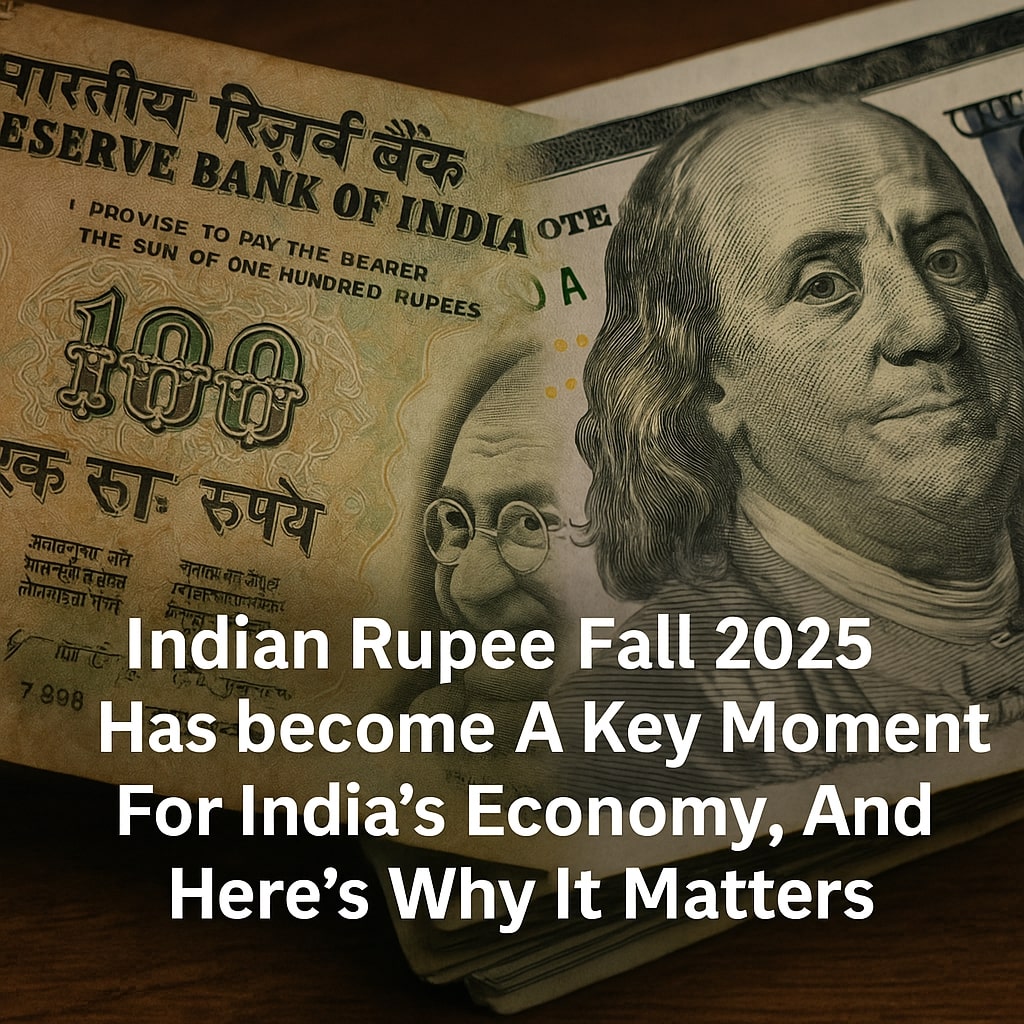
India’s currency faces renewed pressure amid global uncertainty.
Ongoing global trade tensions have added another layer of pressure on emerging market currencies like the rupee, as explained in this detailed breakdown of the Trump Trade War’s 2025 market impact.
In November 2025, that story took a sharp, worrying turn. The rupee slipped to around ₹89.50 per US Dollar, which at that time was the weakest level India had ever seen. Since then, the fall has gone even further. By early December 2025, the rupee has broken past the ₹90 mark and is trading near ₹90.10–₹90.30 per US Dollar, turning what looked like a warning sign into a full-blown stress test for India’s economy.
This article is here to break down this complex situation into simple, easy-to-understand pieces. We’ll look at exactly why the rupee fell, who is feeling the pressure the most, and, most importantly, what practical steps you can take right now. It’s written in simple English so that anyone from a college student to a global investor can understand what is actually going on and how to navigate it.
The pressure on the rupee has also been influenced by global trade tensions, especially the India–US tariff developments and their economic impact.
1. A Quick Look Back: The Rupee From 1947 to Today
To understand the present, we have to glance at the past. When India finally became independent in 1947, the rupee was not the volatile currency we know today. It traded in a very narrow range and was closely tied to the British pound.
But as India’s economy grew and changed, so did its currency. Wars, the constant need for oil imports, big policy changes, high inflation, and the opening up of the economy to the world (globalisation) all pushed the rupee in different directions.
Here is a simple, updated snapshot of how the rupee has moved over the years, showing the major milestones:
| Year | 1 USD in INR | What Was Happening in India |
| 1947 | ₹3.30 – ₹4.16 | Newly independent India, with a tightly controlled trade system. |
| 1966 | ₹7.50 | A major devaluation happened after a severe economic crisis. |
| 1991 | ₹22.74 | The famous Balance of Payments crisis, which forced the start of economic liberalization. |
| 2000 | ₹44.31 – ₹44.94 | The rise of globalization and the massive IT boom in India. |
| 2013 | ₹56.57 | High domestic inflation combined with the global “taper tantrum” (a sudden fear in global markets). |
| 2020 | ₹76.38 | The COVID-19 pandemic slowdown and massive global uncertainty. |
| 2025 | ₹85.30 – ₹90.30 (intraday above ₹90.00) | A massive trade deficit, a very strong US Dollar, and global markets running away from risk. |
A massive trade deficit, a very strong US Dollar, global risk-off mood, and fresh record lows beyond ₹90 per USD.
2. Why the Rupee Fell So Much in November 2025
The fall wasn’t caused by one single event. It was a perfect storm where several domestic problems and global forces came together at the exact same time.
A. Domestic Reasons (What happened inside India)
1. India’s Trade Deficit Keeps Growing This is the biggest problem. India consistently imports much more than it exports. We need to buy huge amounts of oil, electronics, machinery, and gold from other countries. When India imports, it has to pay in US Dollars. This creates a massive, constant demand for dollars. When the demand for dollars is high, its price goes up, and the rupee’s value goes down.
2. Inflation and Slower Factory Output Oil prices stayed stubbornly high throughout the year. Prices for other basic goods (commodities) were also unstable. This double-whammy increased inflation inside India and, at the same time, lowered confidence in how fast India’s economy would grow in the near future.
The weakening rupee is making imports costlier and pushing inflation higher.
This rising cost pressure is part of a broader trend where people across economies are feeling squeezed, which is explained clearly in Why Middle Class Feels Poorer.
3. Limited RBI Intervention The Reserve Bank of India (RBI) is the country’s central bank and its job is to manage the currency. This time, the RBI decided to let the rupee adjust more naturally instead of using its huge reserves of dollars to defend the currency. While this is a long-term healthy approach, it made the short-term fall much sharper.
B. Global Reasons (What happened outside India)
1. The US Dollar Became Very Strong The US Federal Reserve (their central bank) kept interest rates high for a long time in 2025. High interest rates in the US make it very attractive for global investors to move their money there. This pulled money out of countries like India and into US assets, making the dollar stronger. A strong dollar usually weakens almost all other world currencies, and the rupee was no exception.
2. Risk-Off Global Sentiment The world felt very uncertain. Ongoing conflicts, disruptions in global supply chains, and fears of a worldwide recession made investors nervous. When investors are nervous, they sell assets in developing countries (like India) and run to the safest asset they know: the US Dollar. This is called “risk-off” sentiment.
3. US–India Trade Uncertainty Talks around new tariffs and trade negotiations between the US and India added another layer of pressure. Global investors became cautious about putting more money into India until the trade picture became clearer.
This kind of global pressure is not limited to currency markets. It is also deeply connected to interest rate decisions, as seen in Japan Interest Rate Decision.
3. Where the Government Might Have Gone Wrong
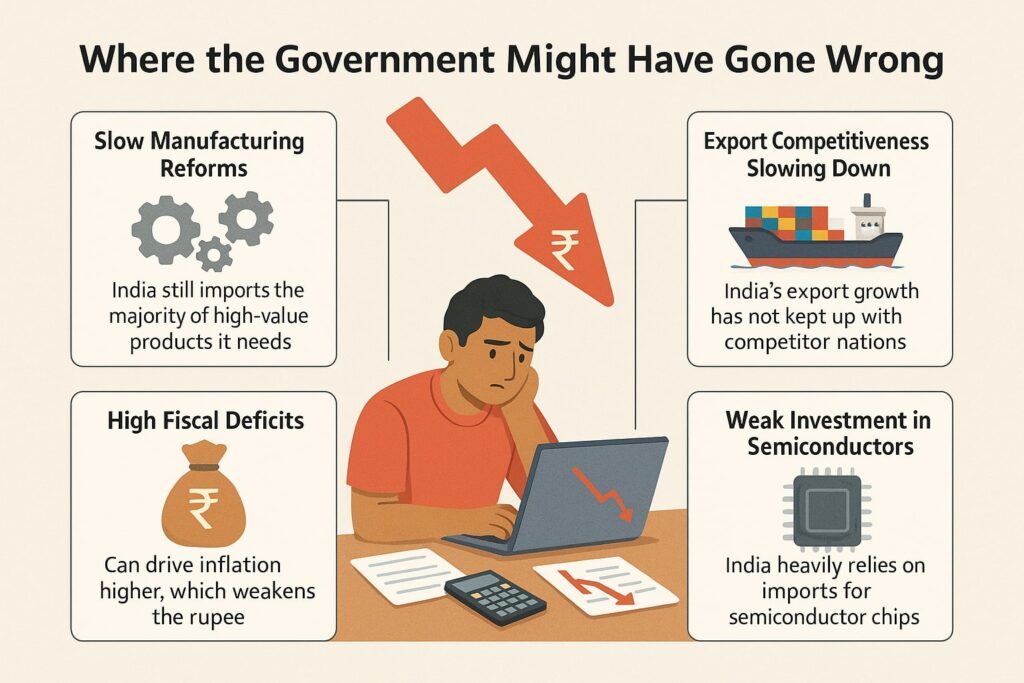
The rupee’s fall didn’t just expose immediate problems; it highlighted weaknesses that have been building up for years in India’s economic structure.
A. Slow Manufacturing Reforms: India still imports the majority of high-value products it needs things like semiconductor chips, advanced electronics, and energy equipment. If India had a stronger local manufacturing base, it would drastically reduce the need for these expensive imports, which would save billions of dollars and reduce the trade deficit.
B. High Fiscal Deficits: When the government borrows too much money (a high fiscal deficit), it can lead to higher inflation pressure. Higher inflation is a direct enemy of a strong currency, as it makes the rupee less valuable.
C. Export Competitiveness Slowing Down: While India’s exports are growing, countries like China, Vietnam, Bangladesh, and Mexico have improved their export efficiency faster. India’s export growth has slowed down recently due to higher costs for shipping and logistics, and a general weaker demand from global buyers.
D. Not Enough Currency Market Intervention (According to Some): Some respected economists believe the RBI waited too long and acted too softly when the rupee started its sharp decline. They argue that a more aggressive defense early on could have prevented the panic selling.
E. Weak Investment in Semiconductors: This is a critical point. India still depends heavily on Taiwan, China, and South Korea for the chips that power everything from phones to cars. These imports alone cost the country billions in dollars. A dedicated, fast-tracked investment in local chip manufacturing is long overdue.
According to Reuters, outflows and trade uncertainty pushed the rupee to a record low beyond the RBI’s defended level, highlighting the growing pressure on India’s currency.
https://www.reuters.com/world/india/rupee-weakens-record-low-us-india-trade-limbo-fed-rate-outlook-2025-11-21/
What the Government Is Expected to Do Next
The government and the RBI are not sitting idle. Here are the likely steps they will take to stabilize the situation and prevent future crises:
- Push ‘Make in India’ More Aggressively: Expect to see more incentives, tax breaks, and policy support for local manufacturing, especially in key areas like electronics, semiconductors, and advanced machinery. The goal is to replace imports with domestic production.
- Use Forex Reserves Strategically: The RBI will likely start intervening more often in the currency market, but only to reduce sudden, sharp volatility, not to fix a specific exchange rate. This strategic use of dollar reserves will calm the market.
- Increase Export Support: The government will focus on making it easier for Indian businesses to sell goods abroad. This means simpler rules, faster tax refunds, and major investments in improving logistics and port efficiency.
- Improve Trade Relations: Maintaining stable, predictable trade relationships with major partners like the US and the EU will be crucial. Stable international relationships attract steady, long-term foreign investments.
For a deeper look into how U.S. market instability influences emerging economies like India, here’s my detailed breakdown:
https://pennypowerplay.com/market-instability-usa-2025/
5. How Students Are Hit by the Weak Rupee
Students who plan to study abroad are arguably one of the worst-affected groups, as their entire financial plan is suddenly thrown into chaos.
The Immediate Impact
A. Costs Rise Instantly: Tuition fees, accommodation, and living expenses are all paid in foreign currencies (USD, CAD, AUD, GBP, or EUR). When the rupee falls, these costs go up instantly. A payment of ₹1 lakh can suddenly become ₹1.15 lakh or even ₹1.20 lakh overnight.
B. More Stress on Family Savings: Parents who have saved for years suddenly find their savings are not enough. They need to arrange more money quickly or take out much larger education loans than planned.
C. Bigger Education Loans: Higher loan amounts mean bigger monthly payments (EMIs) later on, and a longer period of debt repayment, putting immense pressure on the student’s early career.
D. Some Countries Become Too Expensive: The Eurozone countries (like Germany or France) become significantly more expensive because the Euro often strengthens when the rupee falls, multiplying the cost increase.
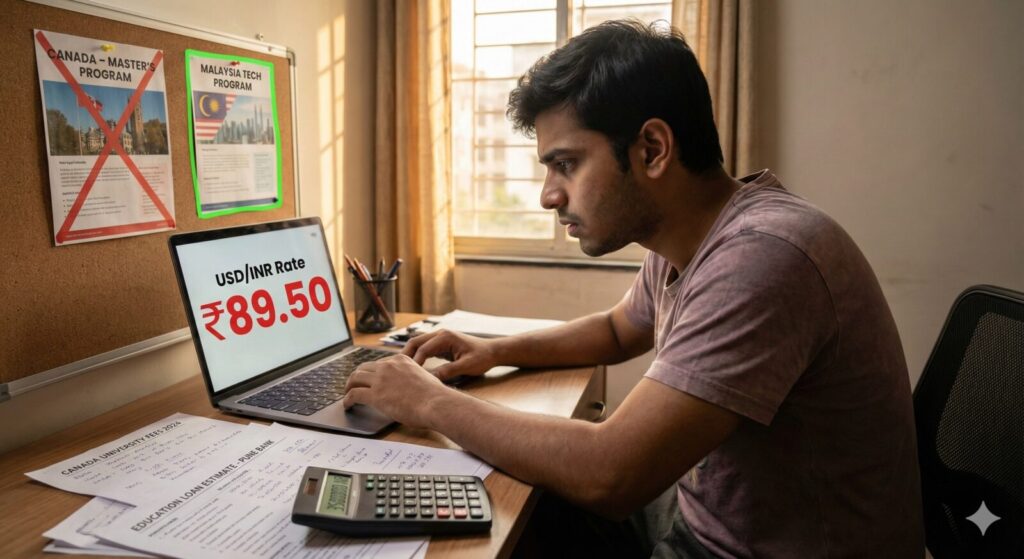
A Real Story of Rohan from Pune
Let’s look at Rohan, a 22-year-old from Pune. He had his heart set on a Master’s program in Canada. His family had meticulously planned the budget when the rupee was stable at around ₹82 to the dollar.
But once the rate touched ₹89.50, his total cost for the two-year program jumped by nearly ₹6 lakh. That increase alone was enough to shake his entire plan. His family couldn’t absorb that extra cost without selling an asset.
Instead of giving up, Rohan and his family explored alternatives. He found a high-quality tech program in Malaysia, where the entire two-year cost, including living expenses, matched his original Canadian budget. The currency shock didn’t kill his dream; it simply redirected it to a more financially sensible path.
Solutions for Students and Families
Use Prepaid Forex Cards: These cards allow you to lock in the exchange rate for a certain amount of money before you travel. This protects you from sudden drops in the rupee’s value.
- Convert Money in Small Parts: Don’t convert all your money at once. Convert gradually over time, especially when the exchange rate improves slightly. This is called “dollar-cost averaging” for currency.
- Apply for More Scholarships: Many universities and governments offer scholarships, but students often miss the deadlines. Start the scholarship application process early and apply for every single one you qualify for.
- Choose Affordable Countries: Look at destinations where the currency impact is lower and the cost of living is more manageable.
Malaysia (MYR): Low tuition fees and low living costs.
UAE (AED): Not cheap, but manageable and geographically closer to India.
Vietnam (VND): Great for tech and business programs.
Philippines (PHP): Very popular for medical education.
Turkey (TRY): Their currency is also weak, making education relatively cheaper.
Eastern Europe (Non-Euro): Countries like Romania (Leu), Hungary (Forint), and the Czech Republic (Koruna) offer quality education without the high cost of the Euro.
- Consider Hybrid Courses: Start your course online in India and then finish the last year or two abroad. This saves a significant amount of money on initial living expenses and travel.
- Work Part-Time Abroad (Legally): Most student visas allow for part-time work. This extra income is essential for managing daily living costs and reducing the burden on your family.
6. How Professional Investors Are Affected

The impact of the weak rupee is very different for Indian investors who want to invest globally versus global investors who have put money into India.
In volatile currency environments like this, many investors are increasingly turning to systematic and automated strategies, which is why understanding how robo-advisors are changing investing in 2025 has become more relevant than ever.
A. Impact on Indian Investors
| Effect | Explanation |
| Foreign Investments Become Costlier | Buying US stocks, global mutual funds, or international ETFs now requires more rupees. Your money doesn’t go as far. |
| Portfolio Volatility Increases | If you hold international assets, the currency movement adds another layer of risk. Even if your US stock goes up, a sharp rupee fall can wipe out those gains when you convert the money back to rupees. |
| Hedging Becomes Expensive | Financial tools used to protect against currency risk (called hedging) cost more when the market is volatile. |
| Domestic Import-Heavy Sectors Struggle | Companies that rely heavily on imports (like aviation, electronics, and auto components) face higher costs, which hurts their profits and stock prices. |
B. Impact on Global Investors
| Effect | Explanation |
| Returns Fall When Converted Back to Dollars | This is the biggest pain point. Even if Indian stocks perform well, when a global investor converts their rupee profits back into US Dollars, the weak rupee reduces their final profit. |
| India Becomes a Riskier Destination (Temporarily) | The sharp fall signals instability, causing global investors to pull back some of their money until the currency stabilizes. |
| But India Becomes Cheaper to Enter | On the flip side, a weak rupee means that the valuation of Indian companies (their stock price) is cheaper when measured in dollars. This can attract long-term investors who see a bargain. |
Solutions for Professional Investors
For Indian Investors:
Focus on Companies that Export: Invest in sectors like IT services, pharmaceuticals, and chemicals, as they earn in dollars and their profits actually increase when the rupee is weak.
- Use SIPs for Foreign Investments: Instead of a lump sum, use a Systematic Investment Plan (SIP) to invest small amounts regularly. This averages out the currency risk over time.
- Avoid Import-Heavy Sectors: Stay away from sectors like aviation, oil marketing, and electronics manufacturing until the rupee shows signs of stabilizing.
You can also explore how automated investing tools are evolving in volatile markets in my detailed breakdown on Robo-Advisors in 2025:
https://pennypowerplay.com/robo-advisors-2025-investing/
For Global Investors:
- Hedge INR Exposure: Use financial tools to protect the dollar value of their Indian investments.
- Prefer Export-Oriented Sectors: Focus on IT, pharma, and chemicals, which are natural beneficiaries of a weak rupee.
7. Impact on Banks in India and Abroad
The banking sector is the backbone of the economy, and it feels the pressure immediately.
A. How Indian Banks Are Affected
- Foreign Exchange Losses: Banks that have borrowed money in dollars or have dollar-denominated liabilities will see their costs rise when the rupee falls.
- More Non-Performing Assets (NPAs): Import-heavy companies that are struggling with higher costs may find it difficult to repay their loans, leading to an increase in bad loans (NPAs) for banks.
- Higher Borrowing Costs: When India’s currency is unstable, global markets charge Indian banks more interest to borrow money, which increases the cost of lending for everyone.
- Banks are adjusting strategies as currency volatility increases.
- Pressure on Forex Reserves: If the RBI intervenes frequently, it uses up the country’s dollar reserves, which can affect the overall liquidity and confidence in the banking system.
B. How Global Banks Are Affected
- Higher Currency Risk on Indian Portfolios: Global banks and financial institutions that lend to or invest in India face a higher risk that the currency will fall further, reducing their dollar-based returns.
- More Trading Opportunities: Volatility is a trader’s friend. The sharp swings in the rupee create more opportunities for global banks to make money through currency trading.
- Rising Credit Risk: They become more cautious about lending to Indian firms, especially those that are heavily dependent on imports.
8. How the Indian Stock Market Reacted
When the rupee weakens sharply, the stock market usually becomes much more volatile. The market is a quick judge, and it immediately separates the winners from the losers in a currency crisis.
Sectors Hit the Most (The Losers)
- Aviation: Airlines pay for fuel and aircraft leases in dollars. Their costs skyrocket.
- Oil Marketing Companies: They buy crude oil in dollars and sell it in rupees. A weak rupee means their purchase cost is much higher.
- Electronics and Auto Components: These industries import many parts, making their production costs jump.
Sectors That Benefit (The Winners)
- IT Services: They earn almost all their revenue in dollars (from US and European clients) and pay their costs in rupees. A weak rupee means more rupees for every dollar earned.
- Pharma Exporters: Similar to IT, they sell medicines globally in dollars, boosting their rupee profits.
- Chemicals, Textiles, and Leather: These are export-oriented industries that become more competitive globally because their products are cheaper for foreign buyers.
Foreign investors pulled back temporarily, especially from sectors like banking and real estate, which are very sensitive to global interest rates and domestic stability.
9. India’s Economic Outlook: What Happens Next?
Economists are seeing a mixed picture, a blend of strong domestic growth and serious global risks.
Positive Signs (The Strengths)
- Strong GDP Growth: India’s Gross Domestic Product (GDP) is still expected to grow at a healthy rate, likely around 6.6%, which is one of the fastest in the world.
- Strong Domestic Consumption: Indians are still buying goods and services, which keeps the economy moving forward.
- Growing Exports in Key Areas: The IT, pharma, and electronics sectors continue to show strong export growth.
Risks (The Worries)
- Higher Inflation: The cost of expensive imports will feed into domestic prices, causing inflation to rise again.
- Slower Job Growth: Economic uncertainty and higher business costs could slow down the creation of new jobs.
- Global Recession Worries: If the US and Europe enter a deep recession, demand for Indian exports will fall, hurting the economy.
- Staying Near or Above ₹90: Earlier, many experts treated ₹90 per USD as a worst-case level. Now that the rupee has already crossed that mark, the bigger risk is that it stays near or above ₹90 for a longer period, keeping import costs, inflation, and foreign investor anxiety elevated.
The consensus is that the rupee will remain volatile for the foreseeable future, mainly because of the unpredictable nature of global oil prices, the US Federal Reserve’s interest rate decisions, and ongoing geopolitical tensions.
10. What India Must Do Now
The rupee falling to ₹89.50 is not a defeat; it’s a loud, clear wake-up call. India has the potential to bounce back stronger, but it requires a focused, long-term strategy.
| Action Needed | Why It Matters |
| Reduce Import Dependence | We must produce more electronics, semiconductors, and energy equipment at home. This is the single biggest way to reduce the demand for dollars. |
| Boost Exports Aggressively | Better logistics, simpler rules, and more incentives for exporters will make Indian goods more competitive globally. |
| Strengthen Trade Ties | Stable, predictable international relationships attract steady, long-term foreign direct investment (FDI), which is crucial for currency stability. |
| Encourage More FDI | The government needs to ensure policy stability and transparency to make India an even more attractive destination for foreign companies to set up shop. |
| Improve Financial Markets | Developing a deeper, more liquid domestic bond market will reduce India’s dependence on foreign capital, making the currency less vulnerable to global panic. |
Final Thoughts: A Moment for Careful Planning
The current situation is a test of India’s economic resilience. It highlights the need for stronger manufacturing, smarter trade strategies, and more careful currency management.
For you, the student, the professional, or the investor, this is a moment not for panic, but for careful planning.
- If you are a student: Re-evaluate your budget, look at more affordable destinations, and lock in your exchange rates early.
- If you are a professional: Be mindful of rising costs for imported goods and plan your household budget accordingly.
- If you are an investor: Diversify your portfolio, focus on export-oriented companies, and use tools like SIPs to manage currency risk.
With the right approach, India can turn this challenge into a massive opportunity to fix its structural weaknesses and build a more resilient economy for the future.
Currency weakness is one part of the wider inflation pressure affecting economies globally.
The fall of the Indian rupee is not just a local currency issue. It is part of a larger global inflation trend affecting economies worldwide. To understand the full picture, read Global Inflation Explained: Why Money Feels Tight in 2026.
This moment in 2025 marks one of the most important phases in India’s currency journey, as the rupee’s sharp decline forces policymakers, businesses, and individuals to rethink long-term financial strategies.
FAQ’s
1. Why is the rupee falling so much right now?
The main reasons are a very strong US dollar (due to high US interest rates), India’s massive trade deficit (we import too much), high domestic inflation, and the RBI’s decision to limit its intervention in the market.
2. How does this affect students planning to study abroad?
Their tuition, rent, and travel costs rise sharply because they need more rupees to buy the same amount of foreign currency (dollars, euros, etc.).
3. Which sectors benefit when the rupee falls?
Sectors that earn in foreign currency and spend in rupees benefit the most. These include IT services, pharmaceuticals, chemicals, and textile exporters.
4. How can investors protect themselves from the weak rupee?
They should use hedging tools, diversify globally in small amounts (via SIPs), and focus their domestic investments on companies that export rather than those that rely on imports.
5. Will the rupee fall further, maybe to ₹100?
The rupee has now moved toward the ₹95–₹96 range against the US Dollar, increasing concerns around imported inflation, education costs abroad, fuel prices, and foreign investment stability. However, the currency is likely to remain volatile around current levels, so students, professionals, and investors should plan assuming a weaker rupee, not hoping for a sudden return to old rates.