
Introduction: The Final Frontier Falls
100% FDI in Indian Insurance Sector marks one of the biggest financial reforms in India’s modern financial history.
It has been a long time coming, and on February 5, 2026, the final barrier in one of India’s most sensitive financial sectors was officially removed. The news is confirmed: India has opened its insurance sector to 100% Foreign Direct Investment (FDI).
Full policy details were widely covered by Reuters, which reported extensively on the parliamentary approval of 100% foreign ownership in insurance.
This isn’t just a minor policy tweak. It is a tectonic shift in the Indian financial landscape. For decades, insurance in India was viewed through a lens of protectionism and social security. The journey from a monolithic, state run industry to a 26% foreign cap, then 49%, then 74% in 2021, has now reached its logical conclusion.
India’s financial sector has been opening up steadily over the years, a trend visible across markets and investment channels
Following a surge of large cross border deals in the broader financial sector, the government enacted the “Sabka Bima Sabki Raksha” (Amendment of Insurance Laws) Act, 2025. The stated goal is ambitious: “Insurance for All by 2047.” The method is clear. Invite global capital with no strings attached regarding ownership stakes.
Large foreign capital inflows have historically reshaped domestic markets, influencing jobs, liquidity, and sectoral growth
But when the dust settles on the celebratory press releases, critical questions remain. What happens when global giants take full control of Indian insurers? Who truly owns the premiums paid by millions of Indians? And is the mandatory “Resident Indian CEO” a real seat of power, or just a regulatory figurehead?
The Scope of the Change
The introduction of 100% FDI in Indian Insurance Sector applies across the entire insurance ecosystem.
Before diving into the implications, it is crucial to understand what is covered. This 100% ownership rule is not niche. It applies across the board to the entire insurance ecosystem:
The structural impact of 100% FDI in Indian Insurance Sector extends across life, health, and general insurance segments.
Life Insurers: Companies selling Term plans, ULIPs, and Endowment policies.
General Insurers: Providers of motor, home, fire, and travel insurance.
Health Insurers: Standalone health insurance providers.
Reinsurers: The massive global entities that insure the insurance companies themselves.
Insurance awareness and policy structuring will become even more important in this new regime. I explored this earlier in my detailed guide on financial protection planning
The only major fine print the government retained is a clause ensuring local accountability. Even if a company is 100% owned by a firm in Tokyo, New York, or Munich, the Chief Executive Officer (CEO) or Managing Director must be a resident Indian citizen.
The Next 24 Months: A Realistic Scenario
What does this dry legal change look like in the real world? We are likely staring at a period of intense disruption over the next two years, which we can call “The Great Unbundling and Re bundling.”

Phase 1: The Joint Venture Breakups (Months 1–12)
Many joint ventures were originally structured around ownership caps, which will now dissolve under 100% FDI in Indian Insurance Sector reforms.
For years, foreign insurers entered India via marriages of convenience with Indian banks or industrial houses (e.g., HDFC ERGO, Bajaj Allianz, ICICI Prudential). These Joint Ventures existed because the foreign partner legally could not own more than 74%.
Now, the handcuffs are off. Expect to see global parents writing massive checks to buy out their Indian partners entirely. The Indian partners will happily cash out with billions in valuations, and famous hyphenated brand names will likely simplify. “Indo Global Insurance” will become just “Global Insurance India.”
Phase 2: The Rise of the “Super Policy”
Another crucial part of the new Act is the allowance of Composite Licenses. Previously, a life insurer could not easily sell health insurance, and vice versa.
With 100% control and new licenses, global giants will bring their international playbook to India. Instead of buying a term plan from Company A and a mediclaim from Company B, the Indian consumer will be pitched an “All in One Life & Health Shield.” One premium. One app. One renewal date.
To gain market share, these new behemoths will likely start aggressive price wars, initially dropping premiums to acquire customers rapidly.
Phase 3: The AI Takeover

Technology deployment will scale faster under 100% FDI in Indian Insurance Sector frameworks.
The most significant change for the consumer will be invisible. With full ownership, foreign companies will deploy their proprietary global technology stacks.
The sector was already evolving before this reform, especially in underwriting and claims tech, which I covered in my insurance trends analysis
Claims settlement for simple issues will become nearly instantaneous, driven by AI. However, the flip side is stricter, data driven underwriting. Foreign algorithms can be ruthless. If your health data suggests high risk, you might find yourself denied coverage faster than you would have by a manual Indian underwriter.
The Hard Question: Who Earns the Premiums?
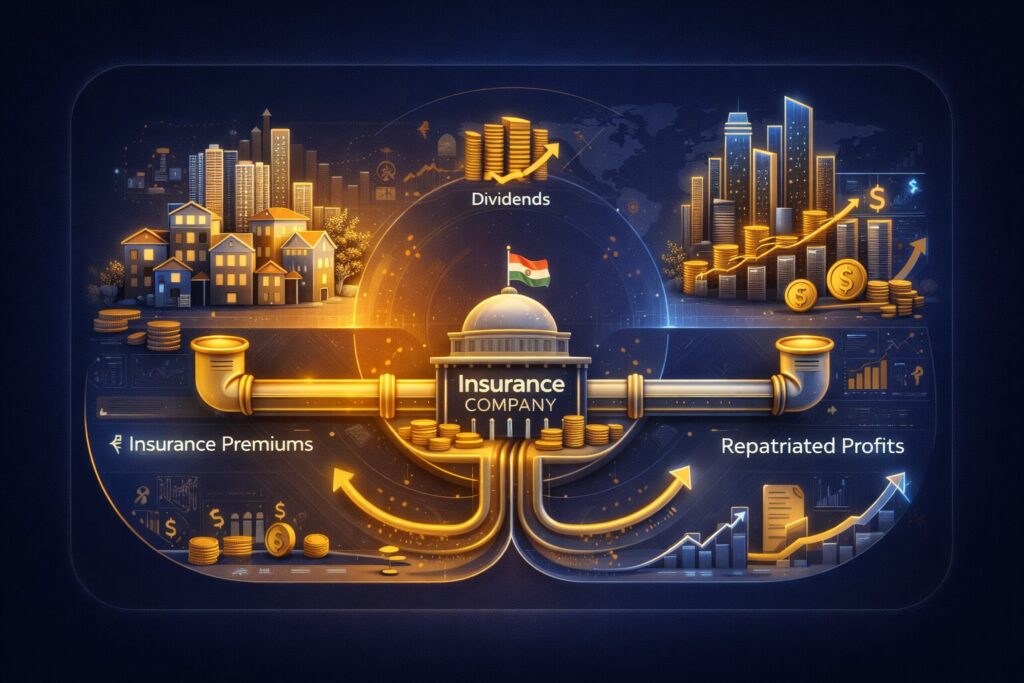
This is the core of the financial debate.
When an Indian consumer pays a ₹25,000 annual health premium to a company that is now 100% foreign owned, where does that money go?
Under the previous 74% regime, if the insurer made ₹100 crores of profit, ₹26 crores legally had to stay with the Indian partner.
Under the 100% regime, the foreign parent company effectively owns the entire premium pool.
As global insurers enter deeper into India, financial literacy will determine how well consumers benefit from new products
Yes, the money is collected in Indian bank accounts first. Yes, they must pay Indian taxes, Indian salaries, and adhere to IRDAI’s solvency margins (money kept aside to pay claims).
However, the surplus profits, the dividends, can now be repatriated 100% back to the parent company’s headquarters overseas. The financial plumbing has changed to allow the ultimate economic benefit to flow entirely out of India, in exchange for the capital investment brought in today.
The Power Struggle: The “Resident CEO” Paradox
To assuage fears of foreign dominance, the government included the mandatory “Resident Indian CEO” clause. But in the high stakes world of global finance, where does real power lie?
We must view the Resident Indian CEO rule as a regulatory seatbelt, not a steering wheel.
The Indian CEO has significant responsibilities. They ensure compliance with Indian laws. They are personally liable for regulatory breaches. They handle local grievances. They are the face of the company to the government and the people.
But they are not owners. Ownership is the ultimate power.
The Indian CEO cannot refuse a strategic directive from global headquarters. If the HQ decides that insuring diesel vehicles in India does not fit their global ESG goals, the Indian CEO must implement that policy. If HQ demands higher profitability over market share, prices will rise.
Analysts believe foreign ownership expansion could improve insurance penetration and product reach across India.
The CEO is a powerful employee, but they serve the pleasure of a foreign board.
Conclusion: The Benefactor Scorecard
This liberalization is not a simple story of “India selling out” or “India modernizing.” It is a complex trade off with different winners.
The Exiting Indian Partners are immediate winners, sitting on massive, historically high valuations, ready to cash out their stakes for billions.
The Foreign Insurers are the long term strategic winners. They gain unfettered access to 1.4 billion people, 100% of future profits, and crucially, immense amounts of consumer data.
The Indian Government wins economically in the short term through massive FDI inflows and continued tax revenues on a growing sector.
The Indian Consumer faces a mixed bag. They will benefit from world class technology, faster service, and initial price wars. But they also face the risk of dealing with gigantic, depersonalized global corporations whose algorithms might exclude the riskier segments of the population in a way local players previously did not.
The long term impact of global capital on domestic financial ecosystems is something India has navigated before
India has opened the gates. The capital is rushing in. Only time will tell if the “Insurance for All” mission is achieved by empowering the average Indian, or by enriching global shareholders.
The long term success of 100% FDI in Indian Insurance Sector will ultimately depend on how well it balances capital inflow with consumer protection.
FAQs: 100% FDI in Indian Insurance Sector
1. What does 100% FDI in Indian Insurance Sector mean?
It means foreign companies can now fully own insurance businesses in India without needing an Indian joint venture partner. Earlier, foreign ownership was capped, but this reform allows complete control over operations, profits, and strategic decisions.
2. How will 100% FDI impact Indian policyholders?
Consumers may benefit from better technology, faster claim settlements, innovative products, and improved service standards. However, stricter AI-based underwriting could make coverage more selective for high-risk individuals.
3. Will insurance premiums become cheaper after this reform?
In the short term, increased competition among global insurers may trigger price wars and promotional pricing. Over the long term, premiums will depend on claims data, risk profiling, and market consolidation.
4. Can foreign insurers repatriate profits earned in India?
Yes. Under 100% FDI in Indian Insurance Sector rules, foreign companies can repatriate dividends and profits to their parent headquarters after meeting Indian tax obligations and regulatory solvency requirements.
5. Who regulates foreign-owned insurance companies in India?
All insurers, regardless of ownership, remain regulated by the Insurance Regulatory and Development Authority of India (IRDAI). They must follow Indian compliance norms, capital requirements, and consumer protection rules.