If you’re wondering how to start investing, you’re not alone. Most people wait too long to begin.
The Ultimate Guide to Building Wealth: Why “Starting Small” is the Only Secret You Need
We have been lied to about what it takes to be wealthy.
Pop culture and social media have painted a picture of investing that involves mahogany desks, six screens flashing green numbers, and a “wolf-like” instinct for timing the market. Because of this, the average person—the teacher, the engineer, the barista—waits. They wait until they have “enough” money. They wait until they “understand” the Greeks of options trading. They wait for a “market dip.”
But while they wait, they lose the only resource that is truly finite: Time.
Learning how to start investing is one of the most important financial decisions you’ll make.
In this comprehensive guide, we are going to deconstruct the myths of the financial world and build a roadmap that anyone can follow. Whether you have $50 or $50,000, the principles of wealth creation remain the same.
1. The Psychology of the “Waiting Room”

Most people don’t have a math problem; they have a psychological one. We suffer from Analysis Paralysis.
Think about the last time you wanted to start a new habit—perhaps going to the gym. Did you wait until you were an expert on human anatomy? No. You put on your shoes and walked out the door. Investing is no different.
Many beginners delay how to start investing because of fear and confusion, not lack of money.
The “Not Enough” Myth
The most common excuse is: “I don’t have enough money to make a difference.” Let’s look at the math of $100. If you invest $100 a month with an 8% return, in 30 years, you have nearly $150,000. If you wait 10 years to start because you wanted to wait until you could invest $200 a month, you actually end up with less money in the long run.
The “Waiting Room” is the most expensive place on earth. Every month you sit there, you are paying a “procrastination tax.”
If you’re wondering how to start investing for beginners, it starts with one simple shift in mindset.
2. Build Your Foundation (Learn the Basics First)
In the beginning, your goal isn’t to beat the S&P 500. Your goal is to build the muscle of consistency.
If you’re serious about learning how to start investing, this is where your journey actually begins.
Understanding the Basics
To understand investing terms clearly, you can refer to this beginner guide on Investopedia.
Before you buy your first share, you need to understand the landscape. You don’t need a PhD, but you should know the difference between a stock (owning a piece of a company) and a bond (loaning money to a company or government).
- Low-Risk Entry Points: For those who are terrified of losing their hard-earned cash, starting with low-risk investments is the best way to get skin in the game without losing sleep.
- The Power of Mutual Funds: Instead of betting on one horse, you bet on the whole stable. Mutual funds allow you to pool your money with other investors to buy a diversified basket of assets.
3. The Strategy: The “Coffee Out” Method
If you can afford a premium coffee twice a week, you can afford to be an investor. Start by automating a $25 weekly transfer to a brokerage account. By the time you realize the money is gone, you’ve already started your journey.
Once you have started, the game changes. You are no longer a “beginner”; you are a “wealth builder.” This is where the magic of Compound Interest takes center stage.
This is where people who understand how to start investing early begin to see real results.
The Eighth Wonder of the World
Albert Einstein reportedly called compound interest the eighth wonder of the world. It is the process where your earnings begin to earn their own earnings.
Real Life Investing Examples for Beginners
Why starting early matters more than starting big
Imagine two people.
Alex starts investing at 22 and invests $200 every month consistently.
Ben waits until 35 because he feels he needs a higher salary first. At 35, he starts investing $400 every month.
At first, Ben feels ahead because he invests more money. But Alex has one major advantage: time.
Compound interest rewards consistency and patience. The earlier investments get more time to grow, earn returns, and build momentum over decades.
This is why many beginner investors fail by waiting for the “perfect” moment instead of simply starting small.
Beginners who are nervous about market risk can start by learning about low-risk investments for beginners before moving into more advanced strategies.
The real power of investing becomes clear when you understand compound interest and long-term wealth building.
A beginner should also understand portfolio diversification because it helps reduce the risk of depending too heavily on one investment.
Long-term investors can also explore passive income ideas for wealth building once they understand the basics of investing.
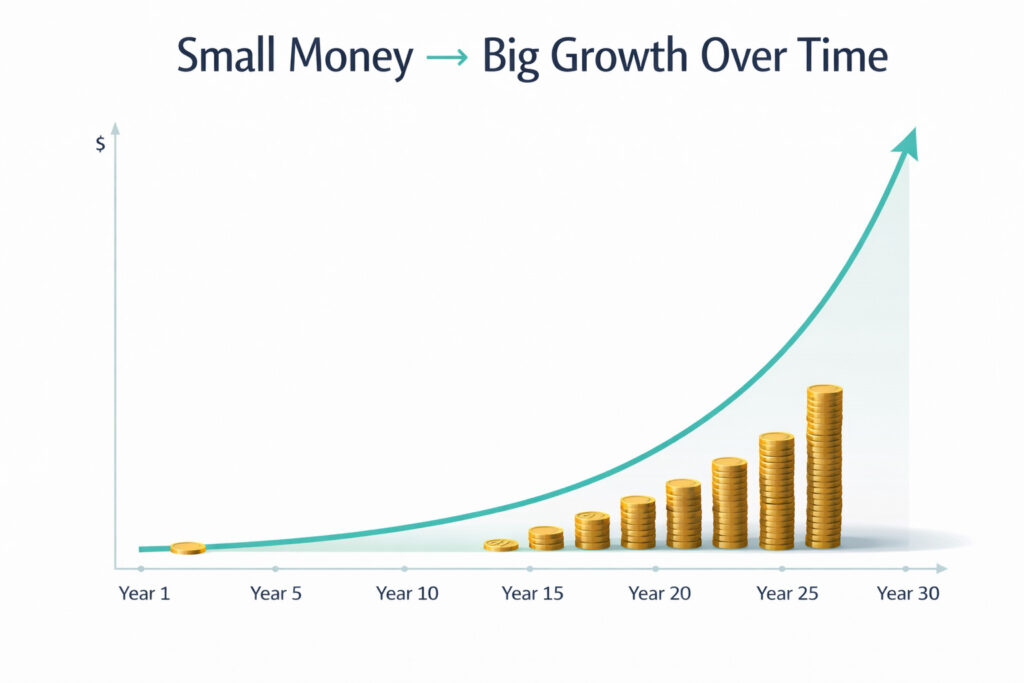
In the first five years, compounding feels like watching paint dry. In years 15 through 30, it feels like a vertical rocket ship. You can see how this works in detail through this wealth creation chart.
4. Grow Your Wealth (Compounding + Diversification)
Don’t Put Your Eggs in One Basket
As your “pile” grows, protection becomes as important as growth. This is called Diversification. If you own nothing but tech stocks and the tech sector crashes, your lifestyle is at risk. By spreading your investments across different sectors and asset classes, you ensure that one bad day in the market doesn’t wipe you out.
Learn how to balance your “basket” with this guide on investment portfolio diversification.
5. Scale and Protect Your Wealth (Passive Income + Mistakes to Avoid)

This is the stage where your money starts working harder than you do. At this point, you aren’t just “saving”; you are building Systems of Passive Income.
Leveraging Modern Technology
We live in an era where you don’t need a personal broker on Wall Street.
- Robo-Advisors: These are AI-driven platforms that automatically rebalance your portfolio and harvest tax losses. Explore how Robo-Advisors in 2025 are leveling the playing field.
- AI vs. Human Intuition: Is AI better at picking stocks? The debate is heating up. While humans have emotional intelligence, AI has raw data. See the breakdown of Human vs. AI investing.
Generating Income While You Sleep
The ultimate goal of scaling is Passive Income. This could be through dividends, real estate investment trusts (REITs), or even high-paying side hustles that you reinvest into the market.
Inflation: The “hidden tax” that makes your cash worth less every year. Investing is the only way to outpace it.
- High Fees: A 1% management fee might sound small, but over 30 years, it can eat up 25% of your total wealth. Always look for low-cost index funds.
- The “Noise”: Financial news is designed to make you panic so you keep watching. Ignore the daily headlines and focus on the decade-long trends.
- Taxes: Understanding how to invest tax-efficiently can save you hundreds of thousands of dollars.
But even a strong strategy can fail if you ignore the silent risks that slowly destroy wealth.
The Enemies of Wealth (Silent Killers)
What to Do in the Next 24 Hours
If you finish this article and don’t take action, the 15 minutes you spent reading were wasted. Here is what you do in the next 24 hours:
- Audit Your Spending: Find $100 this month that you don’t need.
- Open a Brokerage Account: It takes 10 minutes on your phone.
- Pick Your “Pillar” Investment: Use our Investment Guide for Beginners to choose your first asset.
- Set Up Auto-Pay: Treat your investment like a bill that you must pay to your future self.
Conclusion: The Best Time to Plant a Tree
There is an old proverb: “The best time to plant a tree was 20 years ago. The second best time is today.”
Investing is the “tree” that will provide shade for your retirement. It doesn’t matter if you feel “ready.” It doesn’t matter if the market is at an all-time high or a temporary low. What matters is that you are in the game.
Wealth is not a destination; it is a series of small, consistent decisions made over a long period. Stop waiting for the perfect moment. The perfect moment is a myth. The profitable moment is right now.
If you truly understand how to start investing, you realize it’s not about timing, it’s about consistency.
Start small, stay consistent, and let time do the heavy lifting. That’s how real wealth is built.
Frequently Asked Questions (Deep Dive)
Q: Is the stock market basically gambling? A: Gambling is a zero-sum game with no underlying value. Investing is owning a piece of a company that produces goods, services, and profits. Over long periods, the market has historically trended upward as human productivity increases.
Q: Should I pay off debt before investing? A: High-interest debt (like credit cards at 20%+) should be paid off first. However, low-interest debt (like a mortgage at 3-4%) can often be managed while you simultaneously invest to take advantage of compounding.
Q: How do I know which AI stocks are worth it? A: AI is the future, but it’s also full of hype. Focus on companies with real revenue and “moats.” Check out our analysis of the best AI stocks for 2026.
Ready to take the next step?
- Step 1: Read the Full Wealth Building Strategy for 2025.
- Step 2: Understand the Power of Compounding visually.
- Step 3: Start your first Passive Income Stream.