
Indian Rupee Fall 2026 is no longer just a market headline.
For many people, the falling Indian rupee still sounds like something only economists, traders, or TV anchors discuss.
But over the last few months, it has slowly started affecting ordinary middle-class families in very real ways.
“The Indian Rupee Fall 2026 is now becoming part of everyday financial conversations across middle-class households.”
Fuel prices feel higher.
Groceries quietly cost more.
Travel expenses rise.
Construction costs increase.
And eventually, housing loans become more expensive too.
After spending years working in banking and housing finance, I have learned something important:
Most financial pressure does not arrive suddenly.
It builds quietly.
People usually notice it first through small daily expenses before realizing the larger economic cycle happening underneath.
Recently, even the 1 liter milk packet I regularly purchase moved from around $0.60 to nearly $0.63 within just a few days.
Individually, that increase may not look huge.
But when fuel, groceries, school expenses, electricity bills, transport costs, and EMIs start rising together, middle-class families begin feeling financial stress emotionally, not just mathematically.
This emotional side of money pressure is becoming increasingly visible across working professionals today.
And this is where the falling rupee becomes important.
Why Is the Indian Rupee Falling in 2026?
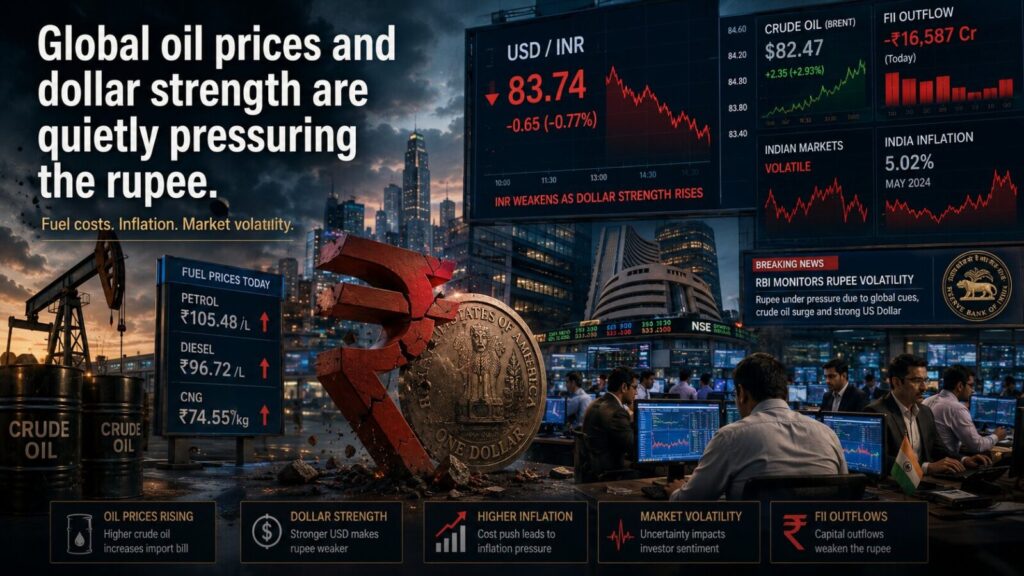
Several global and domestic factors are currently putting pressure on the rupee.
1. Rising Crude Oil Prices
India imports a major portion of its crude oil requirements.
“Official data from India’s Ministry of Petroleum and Natural Gas also highlights the country’s heavy dependence on crude oil imports.”
When geopolitical tensions rise in the Middle East, global oil prices usually increase sharply.
That creates higher dollar demand because India must pay more dollars to import oil.
As demand for dollars rises, the rupee weakens further.
This also directly affects:
- Petrol prices
- Diesel prices
- Transportation costs
- Logistics expenses
- Manufacturing costs
Eventually, inflation spreads across the economy.
2. Foreign Investors Pulling Money Out
Foreign Institutional Investors (FIIs) have also been pulling money out of Indian equities and bonds in recent months.
When foreign investors exit Indian markets, they convert rupees into dollars before leaving.
That creates additional pressure on the rupee.
This cycle often increases market volatility and creates uncertainty for ordinary investors.
3. Strong US Dollar and Higher Treasury Yields
During periods of global uncertainty, investors usually move toward safer assets like US Treasury bonds.
This strengthens the US dollar globally.
A stronger dollar often weakens emerging market currencies, including the Indian rupee.
Even if domestic conditions remain stable, global capital flows can still impact India significantly.
How a Weak Rupee Quietly Affects Everyday Life

A realistic grocery shopping scene showing how inflation and rising daily expenses are affecting middle-class families in India during 2026.
Many people assume currency movements only affect international travel or imported electronics.
But the impact goes much deeper.
A weaker rupee slowly increases the cost of living across multiple areas:
- Fuel becomes expensive
- Airline tickets rise
- Imported products cost more
- Online services priced in dollars become expensive
- Construction materials become costly
- Business operating costs increase
Over time, inflation quietly reduces the real value of monthly salaries even when income technically increases.
And once inflation rises broadly, it begins affecting household budgets.
“According to global inflation trends tracked by the World Bank, rising inflation continues affecting household affordability across multiple economies.”
This is where middle-class pressure becomes visible.
People may still be earning salaries.
But emotionally, financial comfort starts reducing.
Families begin postponing:
- vacations
- investments
- property purchases
- discretionary spending
And financial anxiety quietly grows.
How Indian Rupee Fall 2026 Affects Home Loans

This is one of the most important areas many people overlook.
The Indian Rupee Fall 2026 is also increasing pressure on floating-rate borrowers and first-time homebuyers.
The falling rupee itself does not directly increase your home loan EMI overnight.
But it creates inflationary pressure across the economy.
To control inflation, the Reserve Bank of India (RBI) may tighten monetary policy by increasing repo rates.
“The Reserve Bank of India repo rate updates are closely watched because they directly influence borrowing costs and floating-rate home loans across India.”
When repo rates rise, banks usually increase lending rates too.
This affects:
- Floating-rate home loans
- New borrowers
- Existing floating-rate borrowers
- Property affordability
As EMIs rise, many salaried families suddenly realize they stretched their budgets too aggressively while purchasing homes.
During my years in housing finance, I often saw borrowers focus only on “loan eligibility.”
But eligibility and affordability are not the same thing.
A bank may approve a higher loan amount.
That does not automatically mean it is financially comfortable long term.
And in uncertain economic cycles, this difference becomes extremely important.
The Emotional Side of Housing Loans
One thing people rarely discuss openly is the emotional burden of financial pressure.
Home loans are not just numbers.
They affect:
- stress levels
- family decisions
- career flexibility
- savings behavior
- mental peace
Many young professionals today are simultaneously managing:
- rising EMIs
- inflation
- AI-related job uncertainty
- school expenses
- healthcare costs
- lifestyle expectations
Many first-time buyers also feel pressure to purchase property early because of rising prices and social expectations.
This creates silent pressure inside many households.
And honestly, this pressure is becoming more visible across urban India now.
Why Some NRIs Actually Benefit
Interestingly, a weaker rupee can create advantages for Non-Resident Indians (NRIs).
For NRIs earning in:
- US Dollars (USD)
- British Pounds (GBP)
- Dirhams
- Euros
their rupee-denominated home loan EMIs effectively become cheaper.
They need fewer foreign currency units to pay the same Indian EMI amount.
This allows some NRIs to:
- prepay loans faster
- reduce outstanding balances quickly
- invest more aggressively in Indian property markets
This is one reason why NRI real estate activity sometimes increases during periods of rupee weakness.
Practical Lessons for People Planning Home Loans
This is where financial discipline becomes extremely important.
Based on my banking and housing finance experience, here are some practical things that genuinely help borrowers during uncertain economic cycles.
1. Avoid Taking the Maximum Eligible Loan
Many borrowers make this mistake.
If the bank approves a large amount, they assume they should use the full limit.
But during inflationary cycles, even small EMI increases can pressure monthly budgets heavily.
Keep breathing room in your finances.
2. Maintain Emergency Savings First
Before buying property, build an emergency fund.
At least:
- 6 to 12 months of expenses
- EMI reserves
- basic household expenses
This creates financial stability during uncertain periods.
3. Make Partial Prepayments Whenever Possible
Even occasional prepayments can reduce:
- principal outstanding
- interest burden
- loan tenure
Bonuses, incentives, or surplus savings can help significantly over long loan periods.
4. Compare Refinancing Options Carefully
Many borrowers never review their loan structure after disbursement.
But refinancing or balance transfers may help reduce spreads and interest burden during volatile periods.
However, always compare:
- processing fees
- legal costs
- hidden charges
- long-term savings
before switching lenders.
5. Focus on Long-Term Affordability
Property buying is often emotional.
People compare themselves with friends, relatives, or social media lifestyles.
But financial peace matters more than social validation.
A slightly smaller but affordable home is often financially healthier than a larger emotionally driven purchase.
Indian Rupee Fall 2026 and Middle-Class Pressure

The current environment is not only about the rupee.
It is also about how technology, inflation, AI disruption, and global uncertainty are reshaping middle-class financial life.
“The broader AI economy is also changing how professionals think about income stability and long-term career security.”
Many professionals now feel uncertain about:
- future salaries
- job stability
- long-term affordability
- retirement planning
And that uncertainty changes financial behavior.
People become more cautious.
Savings priorities change.
Risk-taking reduces.
This is why financial literacy matters more than ever today.
Final Thoughts
The falling Indian rupee may look like a technical economic issue on television.
But in reality, it slowly enters ordinary life through:
- inflation
- fuel costs
- groceries
- property affordability
- home loan EMIs
And over time, middle-class families feel the pressure deeply.
The Indian Rupee Fall 2026 is ultimately becoming a real affordability challenge for ordinary salaried families.
“This is one reason many working families feel financially weaker today despite still earning stable incomes.”
The good news is that financial discipline still creates stability even during uncertain cycles.
Smart borrowing, emergency savings, controlled lifestyle inflation, and long-term thinking can make a major difference.
Because in uncertain economies, financial flexibility becomes more valuable than status.
And that lesson becomes very visible during housing finance cycles.
FAQs
1. Does a falling rupee directly increase home loan EMIs?
Not directly. But it can increase inflation, which may lead the RBI to raise repo rates, eventually increasing floating-rate home loan EMIs.
2. Why do fuel prices rise when the rupee weakens?
India imports most of its crude oil in US dollars. A weaker rupee makes oil imports more expensive.
3. Can NRIs benefit from a weak rupee?
Yes. NRIs earning in stronger foreign currencies may find Indian rupee-denominated EMIs relatively cheaper.
4. Should borrowers choose fixed-rate home loans now?
It depends on interest rate expectations and financial stability. Fixed-rate loans can provide predictability during volatile periods.
5. What is the biggest mistake first-time homebuyers make?
Taking the maximum eligible loan without considering long-term affordability and future financial uncertainty.
6. How can borrowers reduce home loan pressure?
Maintaining emergency savings, making partial prepayments, avoiding excessive borrowing, and refinancing carefully can help reduce pressure over time.
“I write about how money, inflation, AI, and economic changes quietly affect everyday life for students and working professionals.”