AI economy 2026 is changing how money works across the world.
Not because of a crisis. Not because of a sudden crash.
But because of something far more powerful happening in the background.
Artificial Intelligence is no longer just a technology story. It is becoming a money story.
Across the world, from the United States to India to Europe, people are starting to feel it in different ways. Some are earning more using AI tools. Others feel their salaries are not growing the way they used to. Businesses are making more profit with fewer people. Investors are chasing AI like the next big gold rush.
And most people don’t even realize how fast it’s already affecting their money.
And whether you are a student, a working professional, or an investor, this shift is already affecting your financial future.
AI Economy 2026: What Is Really Changing?
Before we go deeper, let’s understand what this really means in simple terms.
What Is the AI Economy (Simple Explanation)
Let’s keep this simple.
The AI economy means:
👉 AI is becoming part of how money is created, saved, and invested
Earlier:
- Humans created most value
- Companies hired more people to grow
Now:
- AI helps create value faster, and companies can now grow without hiring at the same pace.
That changes everything.
It changes:
- how people earn
- how companies operate
- how investors think
And most importantly, it changes who benefits from money growth
This is why the AI economy 2026 is becoming one of the biggest financial shifts globally.
Where AI Is Changing Money the Most
1. Jobs and Income Are Shifting
This is the first place people feel the impact.
AI is not just replacing jobs.
It is replacing tasks inside jobs.
This is also why many people feel financially stuck, which we explained in detail in why the middle class feels poorer today.
In the AI economy 2026, jobs are not disappearing completely, but they are changing faster than before.
For example:
- Writing, design, research, customer support
- Basic coding, data analysis
These were once done fully by humans.
Now:
👉 AI can do 50–70% of these tasks faster
This creates two types of people:

1. People who adapt
- Use AI tools
- Work faster
- Earn more per hour
2. People who don’t
- Compete with AI
- Face slower salary growth
This is why many people feel:
👉 “I’m working the same… but money feels tighter”
2. Investing Is Moving Toward AI
Look at where global money is going.

Investors are pouring billions into:
- AI chips
- Data centers
- Cloud infrastructure
- AI software companies
According to global reports, AI is expected to add trillions of dollars to the world economy in the coming years.
This is similar to:
- the internet boom in early 2000s
- the mobile boom after 2010
But this time, the scale is bigger.
Retail investors are also entering this trend.
Many beginners today are asking:
- Which AI stocks to buy?
- Is AI a bubble?
- How to invest in AI safely?
This shows one thing clearly:
👉 AI is becoming a core investment theme globally
3. Businesses Are Becoming Leaner
This is one of the biggest silent changes.
Earlier:
- Growth = hiring more people
Now:
- Growth = using smarter systems
Companies are:
- automating operations
- reducing manual work
- improving efficiency
That means:
👉 Higher profits
👉 Lower costs
👉 Fewer employees needed
For investors, this looks great.
For employees, this creates uncertainty.
4. A Global Power Shift Is Happening
The AI race is not just about companies.
It is about countries.
Major economies like:
- United States
- China
- European Union
- India
are all investing heavily in AI.
Why?
Because AI controls:
- data
- infrastructure
- future industries
Countries that lead in AI:
👉 will control future economic growth
Behind this shift, massive investments are going into AI infrastructure, which we explained in our detailed breakdown of the AI infrastructure race.
This is why we are seeing:
- massive investments in AI infrastructure
- partnerships between tech companies and governments
A Real-Life Example
Let’s take a simple example.
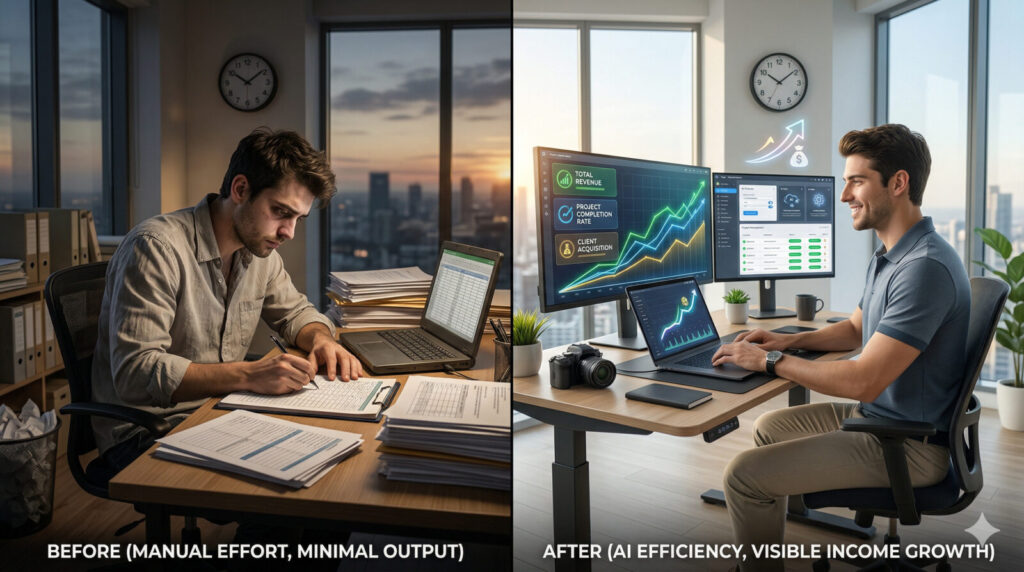
A 25-year-old marketing professional earning $800 per month.
Before AI:
- Writes content manually
- Works 8–10 hours daily
- Limited output
After using AI tools:
- Creates content faster
- Handles more clients
- Starts freelancing
Within 6 months:
👉 Income grows to $1,500–$2,000 per month
Same person. Same skills. But different tools.
Now compare this with another person:
- Same job
- Same experience
- Does not use AI
Result:
👉 Salary remains almost the same
This is the real shift.
AI is not just replacing people.
It is rewarding those who adapt faster
Risks of the AI Economy
Every opportunity comes with risk.
1. Job Uncertainty
Some roles will shrink.
Especially:
- repetitive work
- low-skill digital tasks
This creates anxiety, especially for middle-class workers.
2. Income Inequality
People using AI effectively:
👉 earn more
Others:
👉 struggle to keep up
This gap may increase over time.
3. AI Investment Bubble Risk
Whenever money flows too fast into one sector:
👉 there is always a risk of overvaluation
Some AI companies may:
- grow strongly
- others may fail
So blind investing is risky.
What This Means for You
This is the most important section.
Because this is not just theory.
This is about your money.
1. Learn Basic AI Tools
You don’t need to become an expert.
Start simple:
- content tools
- research tools
- productivity tools
👉 Focus on: “How can AI save me time?”
Because in today’s economy, time saved often becomes money earned.
2. Think in Terms of Income Growth
Ask yourself:
👉 “Can AI help me earn more, not just work faster?”
Examples:
- freelancing
- side income
- skill enhancement
3. Be Smart With AI Investing
Don’t chase hype.
Instead:
- understand the industry
- diversify investments
- think long-term
If you’re new to investing, understanding how to build wealth through investing is equally important.
4. Build Adaptability
The biggest skill now is:
👉 ability to adapt quickly
Because the AI economy is still evolving.
How This Connects to Your Everyday Money
This is where everything comes together.
You may not see AI directly in your daily life.
But you will feel it through:
- salary growth (or lack of it)
- job stability
- cost of living pressure
- investment opportunities
If you’ve been feeling this pressure, you can also read how inflation silently cuts your income in 2026 to understand the deeper reason behind it.
That’s why many people globally are saying:
👉 “Why does money feel tighter even when I earn?”
Because the system is changing faster than most people realize.
The AI economy 2026 is still evolving, but the people who understand it early will have a clear advantage.
In the AI economy 2026, even everyday financial decisions are being influenced by technology and automation.
Final Thought
The AI economy 2026 is not just a trend, but a long-term shift in how money and opportunities are created.
The AI economy is not coming in the future.
It is already here.
You don’t need to panic.
You don’t need to rush.
But you do need to stay aware.
Because in the coming years:
👉 Money will not just depend on how hard you work
👉 It will depend on how smartly you adapt
If you understand this early,
you are not behind.
You are actually ahead.
FAQs: AI Economy & Money
1. Will AI replace jobs or create new ones?
Both.
AI will replace repetitive tasks but also create new opportunities for those who adapt and learn new skills.
2. How can beginners benefit from the AI economy?
Start by using simple AI tools in daily work, explore freelancing, and understand basic AI investment trends.
3. Is AI a good investment theme in 2026?
Yes, but with caution. AI is a strong long-term trend, but short-term hype can create risks.
4. Which industries will grow because of AI?
Technology, finance, healthcare, education, and logistics are expected to see major growth due to AI integration.
5. How does AI affect salaries?
AI increases productivity. People who use AI effectively may earn more, while others may see slower salary growth.
If you want to go deeper into how this affects your money, start here:
👉 Related Articles
👉 How Inflation Silently Cuts Your Income in 2026
👉 Why the Middle Class Feels Poorer Today
👉 AI Infrastructure Race Explained
👉 How to Build Wealth Through Investing
I write about how AI, money, and technology are quietly changing everyday life. If you want simple, real insights like this, stay connected.