🎧 Listen to this article: For readers who prefer audio, you can listen to the full blog post version here.
Introduction
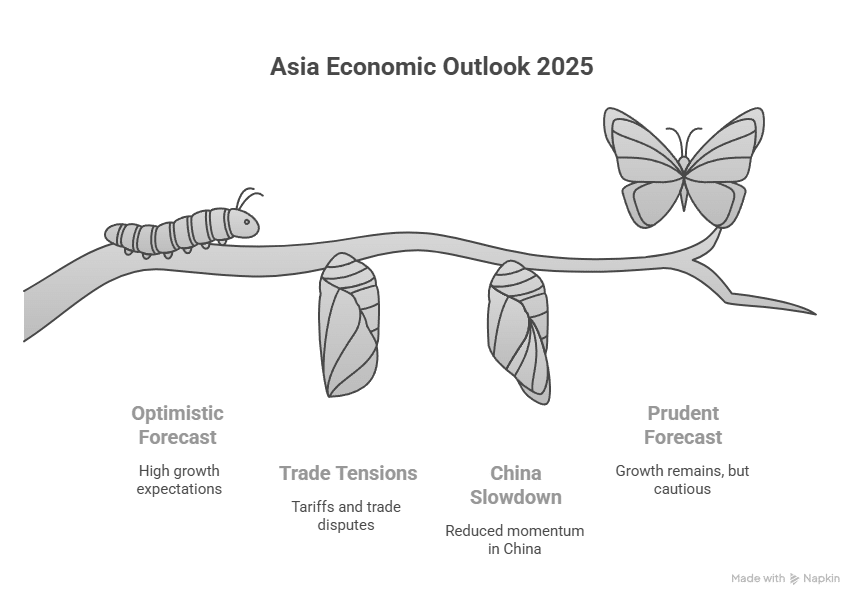
“The Asia Economic Outlook 2025 is under close watch as the IMF and ADB update their forecasts.”
The Xinhua Silk Road report when I first reported about the prospects of growth of Asia in March of the year 2025 predicted a gradual increase and the region was to develop at a higher rate in the world economy than the average. The atmosphere was optimistic then and it was justified by the growing influence of Asia in the international economy and the high domestic demand in a number of destinations.
These are now some months later and new reports by the Asian Development Bank (ADB) and the International Monetary Fund (IMF) give a somewhat different view. Even though growth remains on track, tariffs, trade tensions, and a slowing momentum exhibited by China are influencing a more prudent forecast.
The new article brings us through the reductions that were predicted back then, and the new figures and how it applies to the future of Asia in 2025 and beyond.
“The slowdown in Asia also mirrors trends in the U.S., where corporate profits have shown signs of pressure in 2025.”
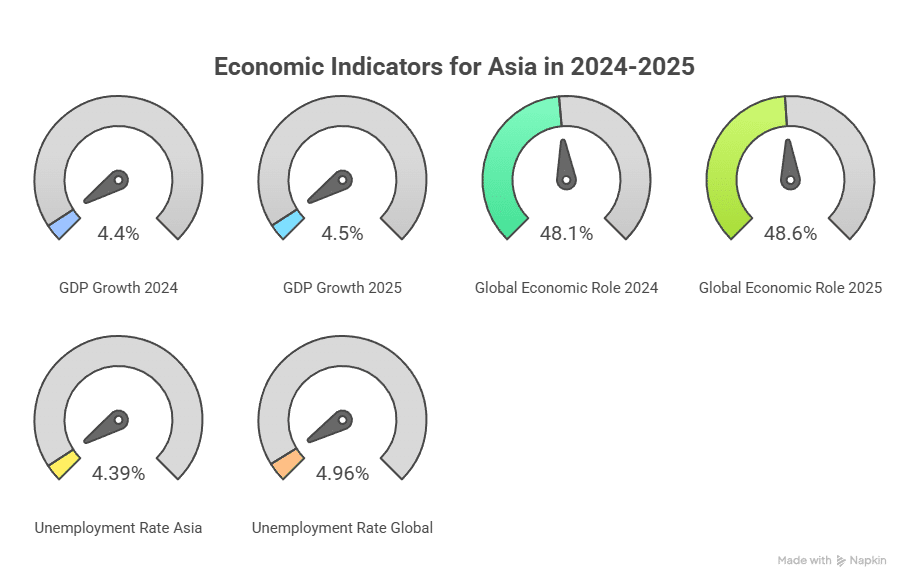
The March 2025 Economic Outlook of Asia – The Xinhua Forecast
The Xinhua Silk Road report projected at the time in March that Asia would have a weighted real GDP in 2025 of 4.5 percent as compared to 4.4 percent in 2024. The report also highlighted the growing contribution of Asia in accounting the global economy where its role increased in years 2024 to that of 2025 by increasing to 48.1 percent in 2024 as compared to 48.6 percent in 2025 when measured with purchasing power parity (PPP).
Another good sign was unemployment. The jobless rate of the region was not expected to go higher than the global average which was 4.39 per cent against the global 4.96 per cent. This supported the story of Asia being the engine of growth in the world with a flavor of brisk domestic demand and better regional trade links then.
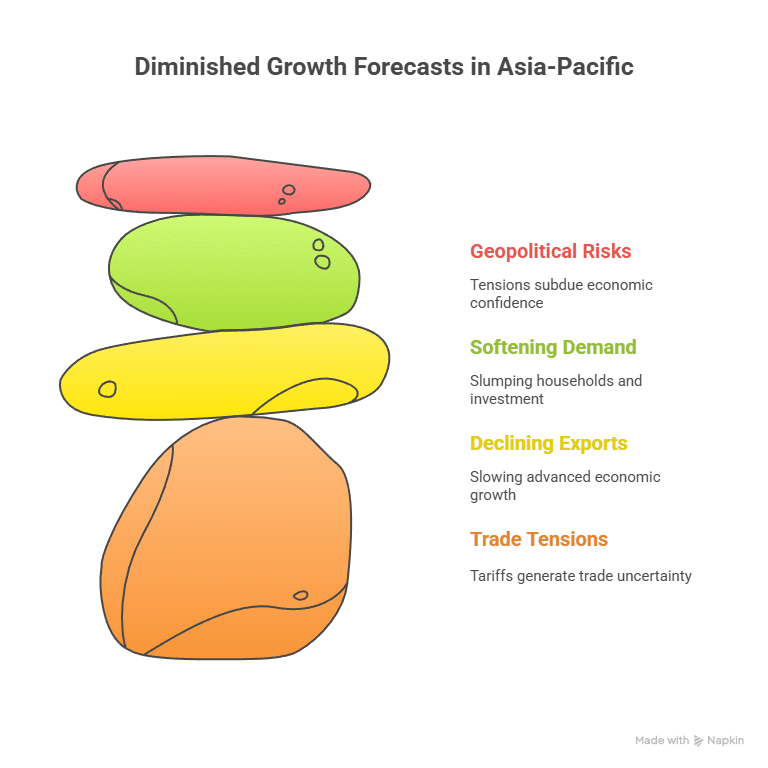
The Mid-Year Update – ADB Forecast, July 2025
The March optimism has been dampened out. In July, the Asian Development Bank published its new Asian Development Outlook which reduced the outlooks to developing Asia and the Pacific.
The ADB forecasts that the regional GDP will rise by 4.7 percent a year in 2025 as compared to the earlier forecast of 4.9. It predicts growth in 2026 of 4.6 percent. Although they continue being above the world averages, the fact that they reduced indicates a negative future.
Important Reasons of the Revision
- Trade potential and tariffs: Tensions surrounding the increased tariffs imposed by the United States on the exports of the Asian countries are generating uncertainty, decreasing competitiveness, and burdening the foundation of trading volumes.
- Lower exports: Declining exports growth has been seen in Asia due to the slowing advanced economic growth.
- Softening at home: Slumping households and investment are being experienced in some economies.
- Geopolitical risks: The geopolitical risks are subduing confidence as there are hotspots and supply chains being threatened with increase in tensions.
The Southeast part of Asia seems to be more vulnerable, and its outlook is reduced to 4.2% in 2025, mostly because of export and touristic dependence.
A Global Outlook – IMF’s July 2025 Outlook
In late July the International Monetary Fund revised its forecasts as well. It predicts global growth levels to hit 3.0 percent in 2025 and 3.1 percent in 2026. Although these are not giant strides relative to previous projections, they underscore the fact that Asia continues to grow much more rapidly by comparison to the average global growth rates.
The IMF opinion supports a central idea which is that Asia still remains a world growth driver despite the emergence of new issues and contributes almost 50 percent to the global economic growth.
“Country Highlights Driving the Asia Economic Outlook 2025”
China – Cooling Down
The economy of China is stuttering and in July industrial output growth moved down to 5.7 per cent, the lowest in late 2024. There is the drag that is being caused by further decline in the property market and fixed investment. Nevertheless, there are still bright spots, in high-tech and strategic sectors which are maintaining activity at high levels with government backing. Slowness notwithstanding, China is the single biggest source of growth of the entire Asian growth.
Singapore – A Bright Spot
Singapore came as an upside surprise in the second quarter as the GDP increased by 4.4 percent year on year. On a quarterly basis, growth was 1.4% and the economy adjusted upwards its 2025 forecast to the range of 1.5 to 2.5 percent. The robust services and diversification in trade has assisted to counter the outside impacts, with the increasing U.S. tariffs being a threat.
Thailand – Cooling Indicators
The economy of Thailand slowed down in the second semester as the country recorded a 2.5 percent growth on a yearly basis, the lowest in the first quarter of 2012. The slowdown was caused by a lack of household spending, a more restrained tourism receipts, and low investment. The response to the decline was the reduction of its benchmark interest rate by the central bank to 1.50 percent in an attempt to stimulate domestic economic activity.
Kazakhstan – Faster With Inflation Threats
Kazakhstan is a leader in growth in the region of Central Asia. It is forecasted that GDP will pace up to 5.5 percent in 2025 with the help of state initiatives on infrastructure as well as improved performance of the oil sector. On the other hand, there is the increasing inflation which indicates an increase in consumer price of almost 12%, which is dangerous to household purchasing power.
In a Nutshell: Asia Growth Outlook
Asia has in the recent past experienced a growth outlook, which has seen more and more international investments made in the region.
Projections at a Glance
| Country / Agency | Future Outlook 2025 | Comments |
| Xinhua Silk Road (March) | 4.5% | A first approximation scenario; lower unemployment than world average |
| ADB July update | 4.7% | Revised downwards to 4.9% because of pressure on trade and demand |
| IMF (Global view) | 3.0% (global) | Confirms Asia will be ahead of the rest of the world |
| Country snapshots | Different | Singapore robust, China slowing, Thailand less robust, and Kazakhstan gaining momentum with threats to inflation |
“The IMF’s Regional Economic Outlook: Asia and Pacific, April 2025 revised its regional growth forecast to 3.9% for 2025, down from 4.6% in 2024, due to lingering external risks.”
“Key Risks in the Asia Economic Outlook 2025”
The worldview of 2025 in Asia is still positive, although not quite positive as in the first part of the year. The region continues to perform well against other regions on a global scale but it is more exposed to headwinds than it was previously.
Three Takeaways
- It is high time to find out that Asia remains the engine of global growth but exposures are increasing.
- The policy decisions will be essential, the state that increases the domestic demand and enhances the intra-Asian trade will be in good shape.
- Disparity between nations is increasing – economies such as Singapore and Kazakhstan are performing well, whereas others such as China and Thailand are having trouble in overcoming structural issues.
Conclusion
“Overall, the Asia Economic Outlook 2025 shows resilience but requires careful policy support.”
Asia in 2025 is a story of enduement under the uncertainties. The growth is a little lower than previously projected but the region takes the lead in the world. Despite the looming risk in terms of trade wrangles, inflation, and structural weaknesses, good fundamentals in Asia and its central position on global trade make it the engine of the global economy.
The next part of the year is bound to be the question of whether Asia will be able to strike the right balance between the external challenges and their internal potentials–will we be able to keep the tempo going past 2026?
FAQs
1. Explain why ADB has revised down its forecast on the growth of Asia in the year 2025?
ADB reduced its projection predominantly because of the increased American tariff, declining export market and slower local spending in various Asian economies.
2. Is Asia still going on at a faster rate as compared to the other parts of the world?
Yes. Although global growth is expected to be approximately 3.0 percent in 2025, the Asia region is expected to grow between 4.5 percent and 4.7 percent hence it is the fastest growing region in the whole world.
3. What are the other Asian countries doing well against all these odds?
Singapore has revised its growth perspective on the upwards and Kazakhstan is speeding up due to the investment in infrastructure and oil. The two are defying the slowdown in the region.
4. What are considered the primary threats to the development of Asia in 2025?
The greatest threats are that the U.S. may increase tariffs, that the worldwide trade is going to weaken, that the property sector of China faces a problem and that the geopolitical tensions grew too far to break the supply chain.
5. What would it take to keep Asia economically on the move?
In order to stay energized, Asia must concentrate on enforcing domestic demand and enhancing intra-regional trade and investment, technology and infrastructure, and also policies coordination across the borders.