🎙️ Audio Intro Script for Blog Article Title: “Cash-Only Challenge 2025: Ditching Plastic for Financial Control”
“Welcome to this audio edition of PennyPowerPlay.com. Today’s feature: ‘Cash-Only Challenge 2025: Ditching Plastic for Financial Control’—a look into how more Americans are breaking free from credit card debt by switching to cash-only lifestyles. Whether you’re commuting, relaxing, or multitasking, sit back and listen as we explore the growing financial trend that’s helping people take back control of their money—one dollar bill at a time.”
Introduction: Credit Cards Got Us Here—Now Cash Might Be Our Escape Route
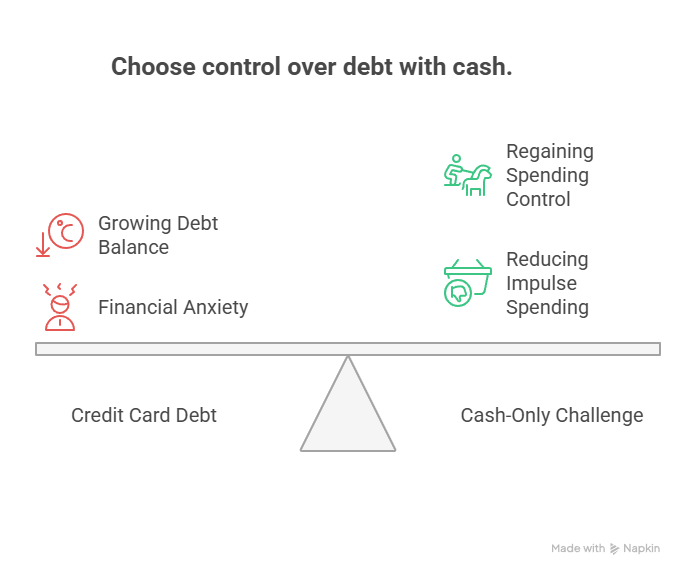
“The Cash-Only Challenge 2025 is more than a savings trick—it’s a mindset shift.”Ever feel like your credit card balance is growing faster than your wildest dreams (or your actual paycheck)? If so, trust me, you’re not alone. Here in 2025, American credit card debt has hit some truly eye-watering highs. It seems like more and more families are juggling rising interest rates, the relentless march of inflation, and that nagging knot of financial anxiety. so .that’s why many Americans are turning to the cash-only challenge 2025—a simple method that helps reduce impulse spending and rebuild savings.”
But amidst all this pressure, something pretty cool is happening. A growing number of Americans are actually going back to basics, embracing something called “cash-only challenges.” And this isn’t just about stashing a few extra bucks; it’s about reclaiming a sense of control.“If you’re overwhelmed with debt, try the Cash-Only Challenge 2025 to regain spending control.”
So, What Exactly Is a Cash-Only Challenge?
It’s pretty much what it sounds like! For a set period – maybe 30, 60, or even 90 days – you commit to using only physical cash for your everyday spending. Think groceries, dining out, grabbing gas, or catching a movie. Debit cards? Nope. Credit cards? Absolutely not. Venmo? Forget about it.
Why this old-school approach? Because let’s be honest, swiping a card is ridiculously easy. It’s almost too easy. But when you’re physically handing over real dollars, you feel that money leaving your hand. And that “ouch” moment? That’s the whole point – it makes us way more mindful about our spending.
Want a simple budgeting tip that’s going viral with Gen Z? Check out our post on The $100 Rule: Gen Z’s Smartest Budget Hack and see how micro-budgets are helping young Americans save big.
Why Is This Old-School Method Making a Huge Comeback in 2025?
You might be wondering why something so “retro” is suddenly trending on social media in 2025. Here’s what’s driving the shift:
1. The Digital Spending Trap: Apps, credit cards, and all those “buy now, pay later” options have made spending incredibly frictionless. It’s almost too easy to part with our money when we don’t physically see it go. Before you know it, those little digital transactions really add up.
2. Inflation’s Bite: Grocery bills, gas prices – they’re still higher than we’d like them to be compared to pre-pandemic days. Using cash helps people put a firm cap on their spending before it spirals out of control.
3. An Emotional Reset: There’s something truly empowering about a cash challenge. It offers a tangible sense of financial control, which is a huge relief for anyone feeling overwhelmed by debt or constantly worried about bills.
“The cash-only challenge 2025 is gaining serious traction as inflation forces people to rethink plastic.”
Meet Sarah: One Month, No Card, $480 Saved
Let me tell you about Sarah, a 34-year-old single mom from Ohio. She felt stuck. “I wasn’t blowing money on big purchases,” she shared. “It was just $12 here, $8 there… all those small things quietly added up.”
So, she decided to try a 30-day cash-only challenge. She withdrew $400 for her groceries, gas, and a few small extras. The outcome?
“I actually ended the month with $80 left over,” she said, sounding genuinely surprised. “That has never happened before.”
“For many, this shift is about more than money—it’s about taking back emotional control.” 👉 Dive deeper into this mindset with our article on Revenge Saving in America, the emotional finance trend that’s redefining how Gen Z and Millennials save in 2025.
“How to Start a Cash-Only Challenge 2025 (Step-by-Step)”
“Let’s break down how to start your own Cash-Only Challenge 2025 in just a few steps.”
Ready to Try It? Tips to Stay on Track During Your Cash-Only Challenge 2025
Feeling inspired? Here’s a simple guide to running your own cash experiment:
Set a Timeframe: Don’t feel like you have to go all-in for 90 days right away. Start small! Try it for just one week. You can always extend it if it feels good.
Budget Your Categories: Decide exactly where you’ll be using cash. For example:
Groceries: $300
Gas: $100
Fun/Eating out: $100 Then, withdraw the full amount in cash at the very beginning of your challenge.
Embrace Envelopes (or a Binder): This is key! Separate your cash into labeled envelopes for each category. When an envelope is empty, that’s it – you’re done spending in that area until your next cash refill.
Track Every Single Dollar: Even though you’re using cash, it’s super helpful to jot down what you’re spending. A small notebook or even your phone’s Notes app works perfectly. The goal here is awareness.
Reflect Weekly: Take a few minutes at the end of each week to think about your experience. Ask yourself:
What surprised me this week?
What felt really challenging?
Where did I maybe overspend (or almost overspend)? This is where the real “aha!” moments happen.
“The beauty of the Cash-Only Challenge 2025 lies in its simplicity.”
Unexpected Perks: It’s About More Than Just Saving Money
“Try the Cash-Only Challenge 2025 for one week and see how much you can save.”
While saving is a huge motivator, people doing cash-only challenges report much deeper changes:
“I totally stopped impulse shopping. I had to genuinely think twice about that Starbucks run or a random Target trip.”
“My kids actually got involved! We turned it into a family game to see how far we could stretch our grocery budget.”
“I’m sleeping so much better knowing I’m not adding to my credit card balance every single day.”
What to Steer Clear Of (Common Mistakes)
Want your challenge to be a success? Avoid these pitfalls:
Not budgeting clearly: If you don’t set limits for each category, you’ll likely run out of cash too quickly.
“Just one swipe”: Trust me, one “quick” swipe turns into five. Don’t break your momentum!
Forgetting emergencies: Keep a small, separate emergency fund on hand. You don’t want an unexpected expense to derail your entire cash challenge.
Want to Supercharge Your Savings? Add a “No Spend Weekend”
Many people doing cash challenges also layer on “no-spend weekends.” This means absolutely no spending on Saturdays and Sundays. Plan free activities, get creative with meals at home, and just enjoy a break from opening your wallet. Combining these two strategies can truly boost your savings.
You’re Not Broken—The System Is Designed to Keep You in Debt
It’s important to remember this: Credit card companies make billions of dollars from revolving balances and late fees. If you’re struggling with debt, it doesn’t mean you’re weak. It often means you’re simply reacting normally to a system that’s designed to encourage overspending.
Taking back control, even with something as seemingly small as a $100 grocery envelope, is a powerful act of rebellion – in the best possible way.
Ready to Get Started? Grab Our Free Cash Budget Tracker!
If you’re feeling ready to take charge of your money and hit that financial reset button, check out our free printable Cash Envelope Tracker. It’s designed to help you stay organized and on track throughout your cash-only challenge.
“In 2025, with inflation and debt still looming, the Cash-Only Challenge 2025 might be the reset button your budget needs.”
The cash-only challenge isn’t just about counting dollars and cents; it’s about intention. It forces you to slow down your spending, makes you incredibly aware of where your money goes, and reminds you that you are in charge of your finances.
In a world constantly pushing “buy now, pay later,” choosing to pay now, in cash, with purpose, is one of the most empowering financial moves you can make.
Have you ever tried a cash-only challenge? We’d love to hear about your experience in the comments below! Let’s build a community that supports smart money moves, one envelope at a time.
1. What is the Cash-Only Challenge 2025? The Cash-Only Challenge 2025 is a personal finance experiment where individuals commit to using only physical cash for daily expenses—no credit cards, debit cards, or digital payments—for a set period like 30, 60, or 90 days. The goal is to reduce impulse spending and rebuild savings through intentional, tangible money management.
2. How does using cash help reduce credit card debt? When you use cash, you physically feel the money leaving your hand, making you more mindful of each purchase. This emotional connection often discourages overspending. Unlike credit cards, cash doesn’t create revolving debt or interest, so you stay within your budget.
3. Can I still pay bills or rent during the challenge? Yes. The cash-only challenge typically applies to discretionary spending like groceries, dining out, entertainment, and gas. Essential fixed expenses like rent, utilities, and insurance can still be paid online or through traditional methods unless you decide to include them.
4. What’s the difference between the envelope method and a cash-only challenge? The envelope method is a budgeting tool often used within a cash-only challenge. It involves dividing your cash into separate labeled envelopes (like “groceries” or “entertainment”) to ensure you stay within spending limits. The cash-only challenge is the broader commitment to using cash as your primary spending method for a period.
5. Is the cash-only method practical in today’s digital world? While it may not work for every expense, many Americans find that combining cash for daily purchases with traditional banking for bills offers the perfect balance. In 2025, rising debt and inflation have pushed more people to adopt this old-school yet effective method to take back financial control.
To provide the best experiences, we use technologies like cookies to store and/or access device information. Consenting to these technologies will allow us to process data such as browsing behavior or unique IDs on this site. Not consenting or withdrawing consent, may adversely affect certain features and functions.
Functional
Always active
The technical storage or access is strictly necessary for the legitimate purpose of enabling the use of a specific service explicitly requested by the subscriber or user, or for the sole purpose of carrying out the transmission of a communication over an electronic communications network.
Preferences
The technical storage or access is necessary for the legitimate purpose of storing preferences that are not requested by the subscriber or user.
Statistics
The technical storage or access that is used exclusively for statistical purposes.The technical storage or access that is used exclusively for anonymous statistical purposes. Without a subpoena, voluntary compliance on the part of your Internet Service Provider, or additional records from a third party, information stored or retrieved for this purpose alone cannot usually be used to identify you.
Marketing
The technical storage or access is required to create user profiles to send advertising, or to track the user on a website or across several websites for similar marketing purposes.