How Inflation Silently Cuts Your Income in 2026 is no longer just an economic theory. It’s something millions of households are experiencing in real life as rising prices quietly reduce purchasing power.
If you’ve walked through a grocery store lately and felt a phantom pain in your wallet, you aren’t alone. Prices of essentials like food, fuel, rent, and utilities continue to rise faster than most salaries.
To understand the direct paycheck impact, you can read my detailed breakdown on how inflation affects your salary, where I explain how raises often fail to keep up with real living costs.
In this article, we’ll explain why your salary feels smaller, why prices keep rising, and how you can protect your money.
This is exactly how inflation silently cuts your income in 2026 without most people realizing it.
The 2026 Inflation Landscape: Why is Everything Still So Expensive?
For a while, we were told inflation was “cooling.” But as of early 2026, the U.S. inflation rate is stubbornly hovering around 2.7% to 3%, remaining above the Federal Reserve’s 2% target.
For official inflation data tracking real price changes across categories, you can review the latest Consumer Price Index reports published by the U.S. Bureau of Labor Statistics.
Why hasn’t it dropped further? There are three main culprits hitting us all at once:
1. The “Tariff Hangover”
Many of the trade policies and tariffs implemented over the last year are finally hitting the “final boss” phase: the consumer. Businesses spent most of 2025 burning through old inventory they bought at lower prices. Now that those warehouses are empty, they are restocking at higher costs and passing every cent of that increase onto you. Experts call this the “Tariff Transmission Lag,” and we are feeling the peak of it right now in the first half of 2026.
2. The Great Housing Lock-In
If you’re trying to buy a home in 2026, it feels like a rigged game. Millions of homeowners are sitting on 3% mortgage rates from years ago and refuse to sell because a new mortgage would cost them double that. This has created a massive housing shortage, keeping home prices and “Owners’ Equivalent Rent” artificially high.
This is one of the clearest examples of how inflation silently cuts your income in 2026 without any visible salary reduction.
3. The Energy and Utility Surge
This is a major pain point for 2026. While gas prices have seen some relief, electricity and natural gas costs have skyrocketed. Electricity is up nearly 7% over the last year, and piped natural gas is up over 10%. Whether it’s the strain on the grid from AI data centers or shifting energy policies, your monthly utility bill is now a major “silent” income cutter.
A Personal Reality Check: The $18 Cup of Coffee
I want to get real for a second. A few weeks ago, I met a friend at a local diner in suburban Virginia, not a fancy brunch spot, just a regular “eggs and bacon” joint.
When the bill came, I stared at it for a good ten seconds. Two breakfasts, two coffees, and a tip came to $54. I remember when this exact meal was $28. As I sat there, I realized I wasn’t just paying for the food. I was paying for the cook’s higher wage (because of labor shortages), the diner’s tripled electricity bill, and the increased cost of the beef which is up over 16% this year.
That’s the “silent cut.” My income hasn’t gone down. In fact I got a small raise this year but that raise was swallowed by the diner bill before I even left the parking lot. It’s a psychological weight. You feel like you’re running on a treadmill that’s slowly speeding up; you’re working harder just to stay in the same place.
How Inflation Specifically Erodes Your Wealth
To fight back, you have to understand exactly how the “leak” is happening. It’s not just about the price of eggs.
How Inflation Silently Cuts Your Income in 2026: The Hidden Mechanisms
Purchasing Power Is a Leaky Bucket
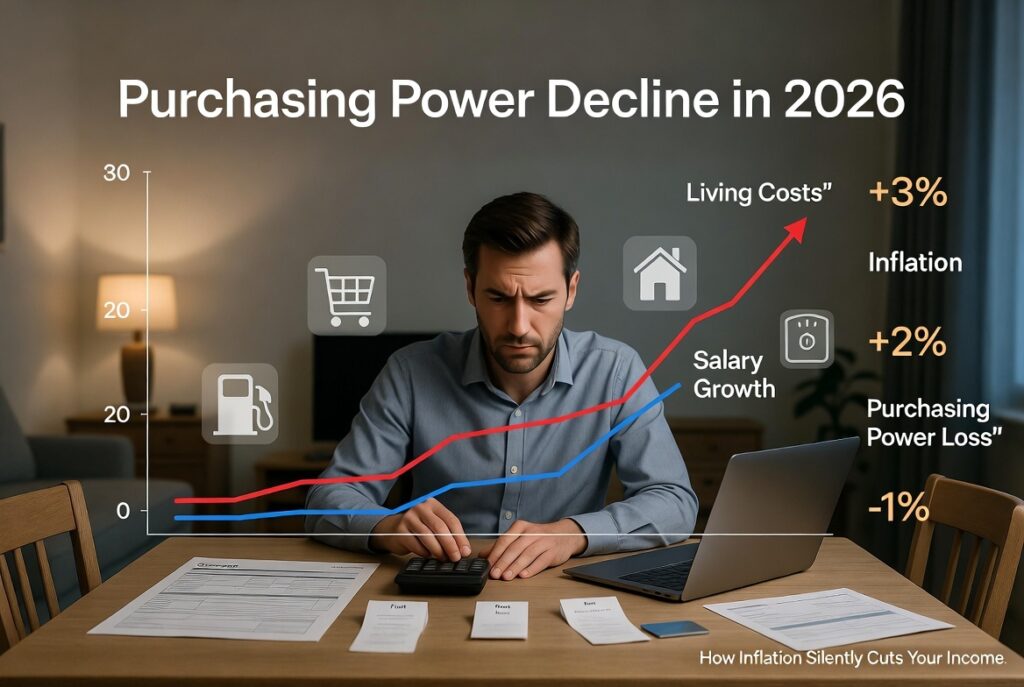
If inflation is 3% and your raise is 2%, you didn’t get a raise. You took a 1% pay cut. Over five years, that “small” gap can reduce your standard of living by a massive margin. This is why 69% of middle-income Americans now say their income is falling behind the cost of living.
This financial squeeze is one reason the middle class feels financially stuck, something I explored deeper in my analysis on why the middle class feels poorer despite earning more.
The Healthcare “Cliff”
In 2026, many families are feeling an extra pinch because the Affordable Care Act (ACA) subsidies expired at the end of last year. For many, this has led to a “sticker shock” in monthly premiums that aggregate inflation data doesn’t always highlight.
The Savings Trap
The biggest victim of inflation is the “Cash Under the Mattress” crowd. If you have $10,000 in a traditional savings account earning 0.01% interest, and inflation is at 3%, you are effectively losing $300 a year in buying power. Your balance stays the same, but your money buys less “stuff” every single day.
Understanding how inflation silently cuts your income in 2026 is critical if you want to protect long-term wealth.
Before you plan investments, you must understand how inflation silently cuts your income in 2026 at every level of spending.
Many households are also turning to alternative income streams, and these passive income ideas for long-term wealth creation show how to reduce dependence on a single salary.
How Inflation Silently Cuts Your Income in 2026: Protection Strategies
Survival Strategies: How to Protect Your Income in 2026
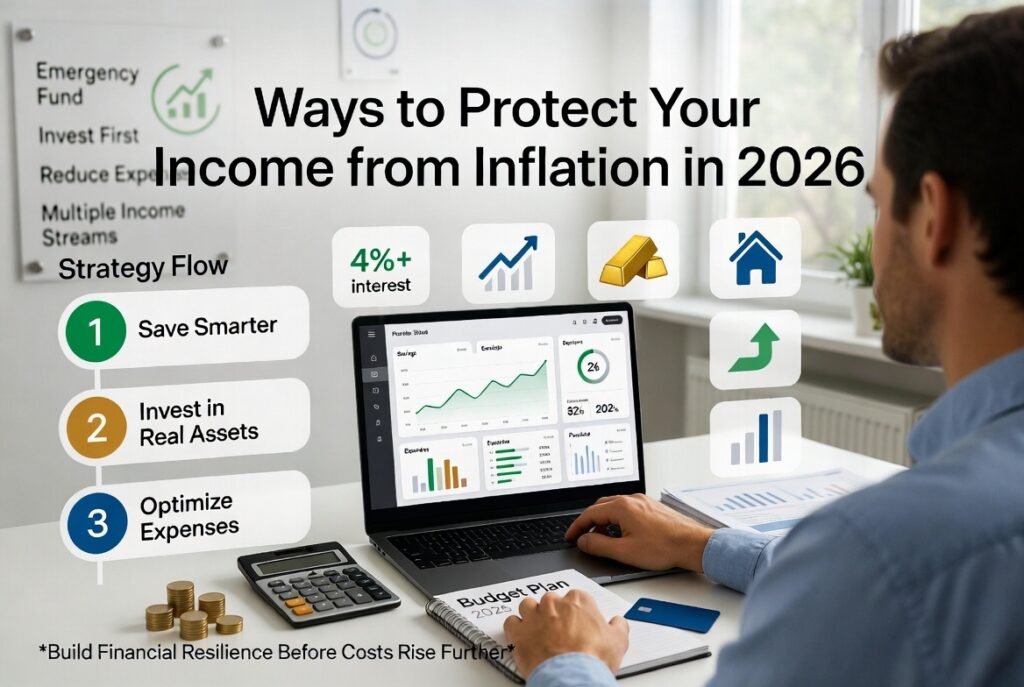
You can’t control the Federal Reserve, but you can control your own “micro-economy.” Here is how savvy Americans are pivoting this year:
Once you realize how inflation silently cuts your income in 2026, you start making smarter financial decisions.
1. Kill the “Lazy” Cash
Stop keeping anything beyond your emergency fund in a standard big-bank savings account. In 2026, High-Yield Savings Accounts (HYSAs) and Money Market Funds are still offering solid rates. If your money isn’t earning at least 4% right now, you are voluntarily losing money.
2. Embrace “Real Assets”
Inflation is the devaluation of paper money. Therefore, you want to own things that aren’t paper.
Equities: Look for companies with “pricing power” businesses like healthcare or consumer staples that can raise prices without losing customers.
Long-term investors are countering inflation by focusing on asset growth, which I’ve explained step-by-step in this guide on building wealth through investing even in volatile markets.
Gold and Commodities: These have remained popular in 2026 as a hedge against a weaker dollar and geopolitical uncertainty.
3. The “Substitution” Audit
It’s time for a 2026 budget audit. We often have “subscription creep” $15 here, $20 there. More importantly, look at your big fixed costs. With insurance premiums and utility bills soaring this year, a single afternoon of shopping around or installing a smart thermostat can “earn” you back hundreds in annual purchasing power.
If rising prices are straining your monthly cash flow, these practical budgeting tips to manage expenses during inflation can help you regain control quickly.
The sooner you recognize how inflation silently cuts your income in 2026, the faster you can build protection strategies.
Frequently Asked Questions (FAQs)
1. Is the U.S. currently in a recession in 2026?
As of February 2026, the U.S. is not officially in a recession, but growth has slowed to about 2%. Many economists see a “35% probability” of a recession later this year as consumer spending downshifts.
2. Why are grocery prices still rising if the “inflation rate” is coming down?
Inflation measures the rate of increase, not the price level itself. Even if inflation drops to 2%, it means prices are still rising, just more slowly. Additionally, specific items like coffee (+19%) and beef (+16%) are still being hit by supply chain issues and higher labor costs.
3. Will the Federal Reserve cut interest rates soon?
The Fed is in a “wait and see” mode. While they maintained rates around 3.5%–3.75% in early 2026, they are balancing the risk of a cooling job market against “sticky” inflation. Most experts expect very gradual cuts later in the year.
4. How do tariffs affect my daily expenses?
Tariffs act like a consumption tax. When the U.S. taxes imported goods, the companies importing them eventually pass those costs to you. We are seeing this most in electronics, machinery, and apparel in early 2026.
5. Is a High-Yield Savings Account (HYSA) still worth it?
Absolutely. With inflation around 3%, a HYSA earning 4% or 4.5% is one of the few ways to ensure your cash doesn’t lose value. It’s the simplest way to “fight back” against the silent income cut.
6. Does the “2% Inflation Target” actually matter to me?
The 2% target is the Federal Reserve’s goal for a healthy economy. When inflation is higher than that, it usually means your cost of living is rising faster than the long-term average, making it harder to plan for retirement or big purchases like homes.