🎧 For those who prefer listening, you can enjoy the full audio version of this blog article.
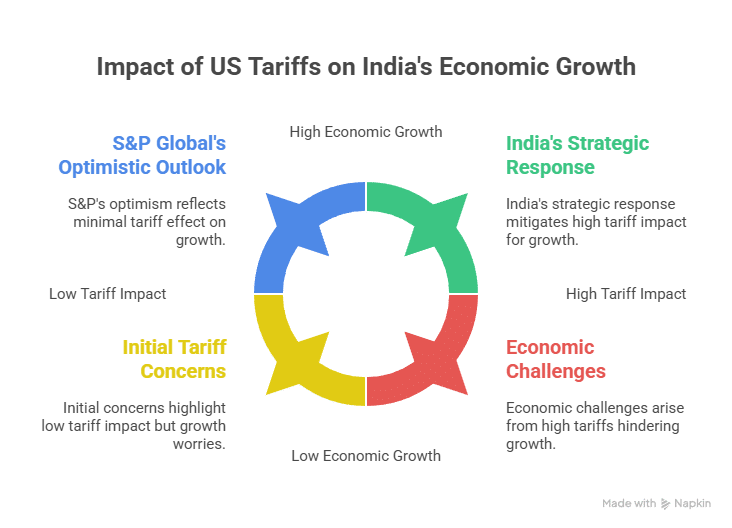
“The recent US tariff measures have raised concerns across global trade circles. Understanding the India US tariffs impact 2025 is crucial for businesses and policymakers, as these tariffs affect billions in exports and millions of jobs.”
Introduction
The effect of the India US tariffs impact 2025 has left shakes throughout international trade talks. Although such tariffs are viewed negatively as a source of economic challenge it would seem that yet another approach is offered by S&P Global Ratings suggesting that there is little or no danger to the economic advancement of India. This article outlines the tariffs, the analysis by S&P and strategic response by India in relation to the effect of the tariffs between India US in 2025.
India US Tariffs 2025 Impact: Deep Dive
“How the India US Tariffs Impact 2025 Affects Indian Exporters”
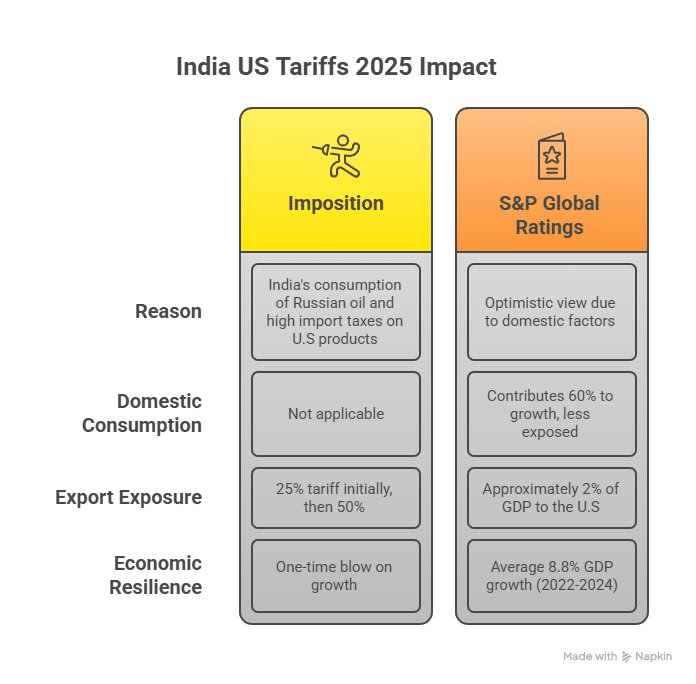
On August 7, 2025, the U.S. imposed a 25 percent tariff on different Indian products. On August 27, 2025, an additional 25 percent tariff will be imposed, making it 50 percent. The main reason behind these tariffs is India’s continued consumption of Russian oil and high import taxes on U.S products. The geopolitical undercurrent of this initiative also reflects U.S. concerns over India’s role in BRICS, which is part of the India US tariffs 2025 impact scenario.
S&P Global Survey: Unperturbed Growth, India US tariffs impact 2025.
In spite of the imminent tariffs, S&P Global Ratings has upgraded India sovereign credit rating to BBB- to BBB which is the first upgrade in 18 years. This optimistic view is due to a number of factors as indicated by the agency:
Domestic Consumption Dominance
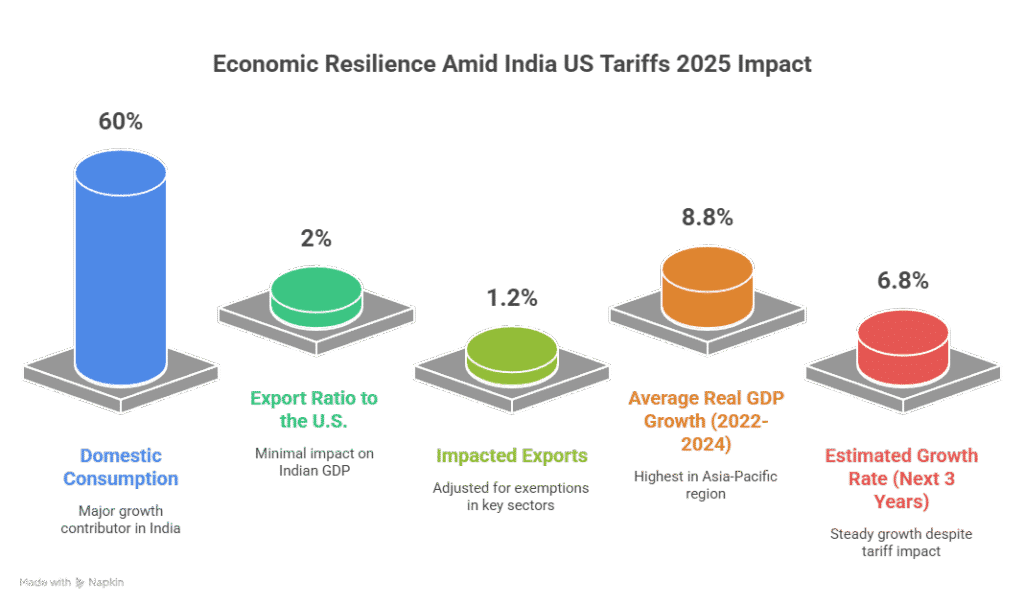
Domestic consumption contributes about 60 percent to the growth of the Indian economy and thus, it is less exposed to foreign shocks of trade.
Low Export Exposure
The ratio of exports to the U.S is approximately 2 percent of the GDP of India. Once exemptions in such sectors as pharmaceuticals and consumer electronics are taken into consideration, the impacted exports total only about 1.2 percent of GDP.
Economic Resilience Amid India US Tariffs 2025 Impact
India recorded average real GDP growth of 8.8 percent in the years between fiscal 2022 and 2024, which is the highest in the Asia-Pacific. S&P also estimates the steady growth rate of 6.8% per annum in the coming three years.
YeeFarn Phua, S&P Director added that although the tariffs may translate to a one-time blow on growth, its impact will be marginal and will not halt the long-term growth prospects of India.
“To understand how US trade decisions affect India’s exports specifically, read our detailed article on Trump Tariffs 2025: Trade Impact on India.”
Responses in the Market and Industry Impact
“Sector-Wise Analysis of the India US Tariffs Impact 2025”
Sensitive Export Industries
Textiles, apparels, gems and jewelry, and auto parts industries are foreseen to suffer a serious setback because of the lack of competitiveness.
Financial Market Volatility
Indian rupee has depreciated in offshore markets and there is risk of imported inflation and likely capital outflows. There have also been volatility of foreign institutional investor (FII), which has gagged risks of capital flight.
Stock Market Demands
After the tariff announcement, industries such as gems and jewelry, auto and textile industries experienced tremendous pressure in the Indian stock markets.
Conversely, IT services, Fast-Moving Consumer Goods (FMCG) and banking industries are somewhat insulated since they do not have much direct tariffs exposure in the U.S. Remarkably, Nifty Pharma index had increased by 2.73 percent with tariff exemptions on pharmaceuticals.
“To see how US tariff policies are influencing Asian markets, you can read our article on US Auto Tariffs 2025: Impact on Asian Markets.”
India as Strategic Response
India has vehemently opposed the tariffs as being unfair, unjustified and unreasonable and has affirmed that it has a sovereign right in making its own independent energy choices. India is also pronged in minimising the economic cost of not retaliating:
Diplomatic Engagement
The government has decided to strike a bilateral balanced trade agreement, and has set a deadline on itself, to October 2025, to get it signed. Nevertheless, there are recent events that undermine the possibility of meeting this objective within the stipulated time limit.
Sector-wise Effects of India US Tariffs 2025 Impact
Although direct subsidies are not an option, the Commerce Minister Piyush Goyal has suggested sector-specific support in the form of interest subsidies, guaranteeing loans, and lowering certification cost to the MSMEs.
Market Diversification
Those at the helm of the industry led by Anand Mahindra are suggesting that new export markets should be explored so as to reduce India reliance on the U.S.
Domestic Resilience
Prime Minister Narendra Modi has encouraged the use of local products as a way of insulating the economy against shocks of global demand.
Calling out Double Standards
India has also called out the western hypocrisy citing that the U.S. and EU are trading with Russia but are pressuring India to make energy choices.
Geopolitical and Trade Talks
A U.S. delegation was to have visited India to hold the sixth round of trade deal negotiations (August 25-29), but this has been postponed. This is mostly blamed on the tariff and the strong resistance of India to provide more market to its sensitive agriculture and dairy sectors. India has been categorical in indicating that it would not compromise on these vital matters as it seeks to safeguard the interest of its farmers and cattle rearers.
The present trade tension highlights the shortcomings of international organizations such as World Trade Organization (WTO) in offering immediate solutions.
“According to a recent analysis by the Indian Council for Research on International Economic Relations (ICRIER), approximately 70% of India’s goods exports to the U.S., valued at around $60.85 billion, are now subject to a 50% tariff imposed by the U.S. administration. “
Looking Ahead: Self Reliance and Diversification
On a longer-term perspective, these tariff issues can prompt India to work more on self-reliance and sell their products to more countries, which will make them less susceptible to such cases in the future. Notwithstanding the existing tensions, India and the U.S. continue to have the hope of concluding the first phase of a Bilateral Trade Agreement (BTA) by Fall (September-October) 2025. Their greater goal is to increase bilateral trade by more than twofold to USD 500 billion in 2030, which is a massive leap as compared to the current USD 191 billion.
Conclusion
“Despite the India US tariffs 2025 impact, India’s strong domestic consumption and strategic measures will maintain long-term growth.”
Although it is clear that the U.S. tariffs pose immediate and economic strains on Indian individual sectors, the report by S&P Global is a vital view of the overall economic strength of India. India with its robust domestic consumption, somewhat small direct exposure to tariffs and a multi-pronged strategic response anchored by diplomacy, sectoral support and market diversification should be in a good position to adjust to these headwinds without derailing its long-term growth story. The current trade tussle also highlights the Indian determination to safeguard its fundamental national interests in the process of pursuing the course of greater economic independence.
FAQ’s
1. Which Indian goods are subject to the US tariffs?
The US customs tax focuses on Indian products that are diverse such as textiles, apparel, gems and jewelry and auto parts. Nevertheless, important industries such as the pharmaceutical industry and consumer electronics are not subject to these duties.
2. What percentage of the Indian GDP is under the threats of this US tariff?
Exports of India to the US are approximated to 2 percent of their GDP. Considering sectoral exemptions, the immediate effect on the economy is decreased to about 1.2 per cent of GDP, which limits the macroeconomic impact.
3. Will these tariffs kill India as far as its economic growth is concerned?
S&P Global notes that the tariffs will cause a slight impact. India has high levels of domestic consumption, and this makes it unresponsive to external shocks in the trade. Its long-term growth path has hardly been affected.
4. What are the most susceptible Indian industries to the tariffs?
The most affected industries by the tariffs are industries like textiles, apparel, gems and jewelry and auto parts. The small and medium enterprises (MSMEs) in these industries are especially vulnerable to incompetitiveness in the US market.
5. What is India doing with the US tariffs?
India is taking a multi-pronged strategy like promotion of fair trade agreement through diplomatic relations, special support to MSMEs, market diversification to lessen the reliance on US, encouragement of domestic consumption and pointing out to western trade hypocrisy.