Robo-advisors are quietly changing how everyday people invest in 2025. What once felt confusing, expensive, and stressful is now becoming simple, automated, and accessible to anyone with a smartphone.
🎧 If you enjoy learning through audio, you can now listen to the full story in a clear, engaging Deep Dive format.
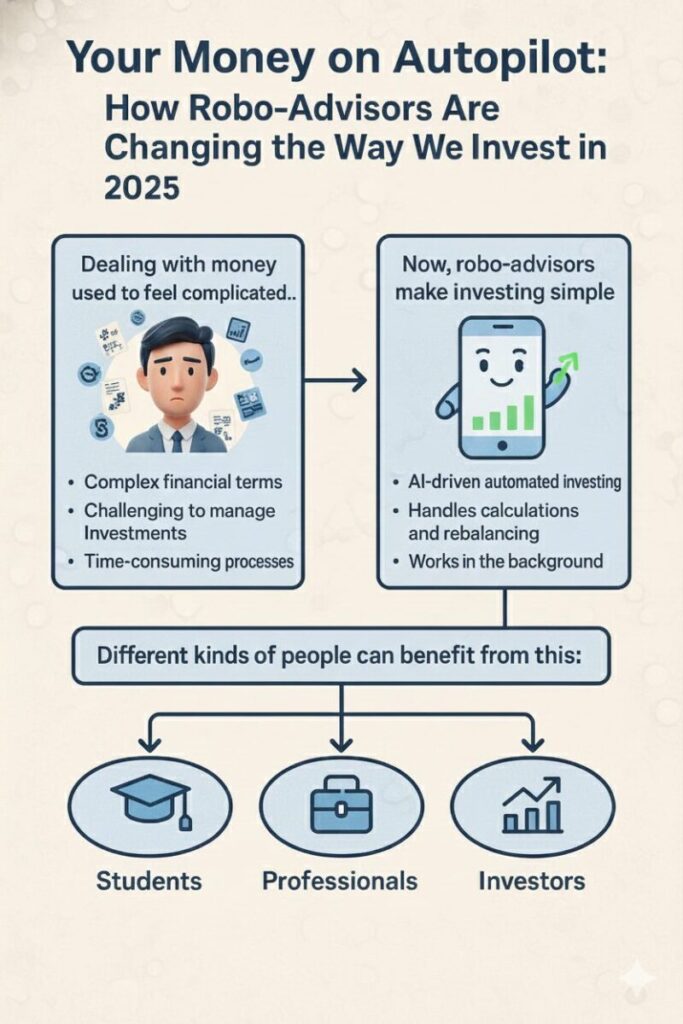
Many people are turning to robo advisors 2025 because the old complicated investing style feels outdated, and these tools are now becoming one of the biggest changes in how people manage money today.
Your Money on Autopilot: How Robo-Advisors Are Changing the Way We Invest in 2025
There was a time when dealing with money felt like walking into a conversation where everyone else understood the rules and you were just trying to keep up. I remember attending financial meetings in the past, trying to appear confident, but half the time I barely knew what people were talking about.
Words like “market exposure” and “asset allocation” sounded heavy, and to be honest, I used to pretend I understood more than I actually did. It almost felt like some hidden club where only a few people knew the secret handshake.
Thankfully, that whole world has started opening up. You don’t need big money to begin. You don’t need to sound like an investment banker. And you definitely don’t need to stress over charts or complicated financial terms. Today, money management has become something you can do from your phone while sitting in a café or lying on your bed.

Robo-advisors are a big reason behind this shift. They’ve quietly changed the way ordinary people invest. When you see how simple they make the entire process, you might even feel a little surprised that you didn’t start earlier.
Robo-advisors started gaining popularity after 2008 when platforms like Betterment and Wealthfront introduced automated investing for everyday people. What began as a tool for simplifying portfolios has now evolved into AI-driven systems that make investing easier than ever.
Many new investors are searching for simple tools, and robo advisors 2025 are leading that shift.
Think of a robo-advisor like a co-pilot for your money. It takes care of the parts that most of us find confusing or tiring the calculations, automatic rebalancing, adjusting your investments when needed, and even protecting you from emotional decisions.
You don’t have to check the markets every day or react to every rise or fall. The system works in the background while you go on with your life.
Let’s look at how different kinds of people are using this to make their money work smarter.
Students & Robo Advisors 2025: Learning Money Without Pressure
If you’re a student, you probably already have enough things to worry about. Classes, projects, exams, maybe a part-time job, and figuring out your future. So investing usually sits way down the list. I get it. When I was a student, saving even a little felt like a big deal.
But starting early really pays off. Even a small amount can grow into something meaningful if you stick with it. Here’s what it looks like in simple terms. You download an app, choose a weekly or monthly amount maybe ₹500 or ₹1,000 select your comfort level, and the rest happens on its own. The robo-advisor spreads your money across different investments without you having to study anything. You don’t need to track it daily or do any math. You just show up consistently.
For readers who are completely new and want a clear foundation before starting, this beginner-friendly investment guide explains the basics without any complex language.
Even small amounts help because you’re building a money habit, and that habit becomes confidence. By the time you graduate, you’ll not only have savings but you’ll also feel more in control of your finances than most people your age.
With automated investing, beginners can invest without stress or heavy financial knowledge.
For young beginners, robo-advisory platforms make it easy to start with small amounts.
AI is becoming a part of everyday money decisions, and I explained this shift in detail in my article on AI in personal finance in 2025
Professionals: Letting Automation Handle the Stress
Most working professionals are short on time. Between commuting, office work, family responsibilities, and trying to squeeze in some personal life, there’s hardly any energy left to sit and study financial statements. And the truth is, money sitting in a savings account doesn’t grow in fact, inflation eats into it a little every year.
This is where robo-advisors really shine.
You answer a few questions things like whether you’re saving for a house, your child’s education, or retirement and the system creates a plan based on your goals. After that, everything runs automatically.
The robo-advisor keeps your risk level balanced, reinvests your dividends, adjusts your investments when needed, and even looks for tax-saving opportunities if the platform supports that. Most importantly, it removes emotional decisions. When markets fall, many people panic. When markets rise fast, people jump in without thinking. Automation removes all that drama. You’re not trying to beat the market. You’re simply being consistent and consistency is what builds wealth over the long run.
Busy professionals prefer AI-driven investing tools because they remove the stress of tracking markets.
For long-term planning, I’ve also written about how to build wealth through investing in 2025, which connects well with how robo-advisors support disciplined growth
Investors: A Reliable Foundation
Even experienced investors get emotional sometimes. When markets fall suddenly, fear takes over. When everyone talks about a “hot stock,” FOMO kicks in. I’ve seen this happen even to people who know the markets well.
If emotional decisions affect your money habits, you may like my article on the psychology of saving where I share simple ways to stay consistent
Robo-advisors don’t react emotionally. They stick to rules. That’s why a lot of investors now use robo-advisors as the stable foundation of their portfolio. The automated part stays calm and steady. On the side, they still invest in individual stocks, crypto, or other assets but their base is managed with discipline. It’s a smart balance: the stability of automation and the freedom to explore personal strategies.
Even experienced investors rely on robo advisors 2025 as the disciplined core of their portfolios.
This balance between automation and personal choice becomes clearer when you compare human decision-making with AI-driven investing, which I’ve explained in detail in this article on human vs AI investing.
Bankers: Working With Technology, Not Competing Against It
When robo-advisors first came out, a lot of bankers were skeptical. Some thought technology might replace them. But things changed quickly. Today, many financial institutions use robo-technology to handle basic and repetitive tasks, while human advisors focus on more complex things like estate planning or business-related financial decisions. It’s become a partnership. Technology handles the routine part. Humans handle cases that need deep understanding. And clients get better service without the high costs that traditional advisory used to demand.
According to Investopedia’s explanation of robo-advisors, these automated tools help remove emotional decision-making and make investing simpler for everyday users.
2025 Market Insights: The Rise of Robo Advisors 2025
Let’s bring everything into today’s context because 2025 is a big year for automated finance.
The global rise of robo advisors 2025 shows how quickly money habits are changing.
1. Global Market Growth
Worldwide, robo-advisors are expected to cross almost $2.9 trillion in assets this year. A big reason is younger investors who want simple apps, low fees, and a system that keeps them on track without emotional decisions. People prefer spending their time on their career, family, and personal goals instead of financial stress.
2. AI-Driven Personal Finance Tools Are Everywhere
Budgeting apps, tax-saving tools, SIP trackers, and investment automation have become part of daily life for many people. These tools help avoid mistakes, reduce emotional reactions, and make money management feel less heavy.
Many banking apps in 2025 now have built-in AI features. This is one of the biggest reasons the whole industry is shifting so fast.
3. India’s Adoption Is Growing Fast And Groww Leads the Way

India is seeing a huge rise in new investors. Better access to the internet, rising income levels, and easy-to-use apps have created a new wave of first-time investors.
One platform that stands out is Groww.
Groww’s recent IPO became a massive talking point across India. The listing attracted strong demand and performed extremely well, which says a lot about how much people trust the brand.
Why Groww is leading this wave:
- very beginner-friendly design
- simple automation for SIPs, ETFs, mutual funds
- low fees
- strong track record
- all investment options under one roof
Groww’s rise shows exactly where Indian investing is heading towards more automation, more simplicity, and more accessibility.
In India,robo-advisory platforms adoption is rising as platforms like Groww make automation easy.
If you want to explore some of the top platforms globally, CNBC has a helpful guide on the best robo-advisors you can check out here: https://www.cnbc.com/select/best-robo-advisors/
Stories of Real People
Sometimes numbers don’t explain everything, so here are a couple of real situations.
Maria Feeling More Relaxed About Money
Maria is a 28-year-old teacher. She had around ₹8,00,000 saved up but was scared of investing it. She worried she might lose it. Once she moved part of her savings into a robo-advisor, she said she felt lighter. Her investments grew more than 22% in two years, and she didn’t have to constantly check her phone or track the markets.
James and Ben Business Owners With No Time
James and Ben run a digital agency. Their business grew fast, but their personal finances were stuck because they had no time to manage them. After switching to a hybrid robo-advisor, their money started growing in the background, and they finally felt like their finances were catching up with their business.
Should You Use a Robo-Advisor? A Simple Checklist
If you find yourself nodding at a few of these, then yes a robo-advisor might be right for you:
- You want your money to grow without daily effort
- You prefer simple tools over complex charts
- You’re busy and can’t track markets every day
- You want lower fees
- You panic or overthink during market swings
- You’re new to investing and want guidance
- You’re looking for long-term stability
If you said “yes” to even three or four of these, automation can make your financial life much easier.
If most of these points match your situation, robo advisors 2025 may be the right choice for you.
I also compared some of the latest AI money management apps that are helping people budget and invest with less effort.
The Bottom Line
Money management is moving into a new era. Technology isn’t replacing people it’s helping them make better decisions without stress. Whether you’re a student starting with ₹500, a busy professional, or an experienced investor looking for discipline, robo-advisors make the entire process simple.
You don’t have to know everything. You just have to take the first step and stay consistent. And honestly, your future self will be glad you did.
As 2025 continues, automated investing will keep growing and helping everyday people build wealth with less stress and more confidence.
As investing tools evolve, robo advisors 2025 continue to offer a calm, disciplined way to build wealth without daily stress.
FAQ’s
1. Is my money safe?
Yes. Your investments are held by regulated custodians, not the robo-advisor itself. Even if the company has issues, your money stays safe.
2. Can a robot understand my personal situation?
For simple long-term goals, yes. For more complex situations like inheritance planning or business finances, a human advisor still helps.
3. What does it cost?
Usually between 0.25% and 0.50% a year much lower than traditional advisors.
4. Can I start with ₹100?
Yes. Many platforms allow small amounts. What matters most is the habit, not the starting point.
5. How does the portfolio grow?
A well-diversified portfolio grows with the market over time, and automation keeps your investments balanced.
6. What happens when markets fall?
The system rebalances automatically and often buys more units at lower prices, which helps your long-term returns.