Introduction: When Big Money Changes Direction, Pay Attention
SoftBank AI investment is no longer just a headline. It marks a fundamental shift in how global capital views artificial intelligence as core economic infrastructure.
For years, artificial intelligence was treated like an exciting add-on. A promising technology. A future story. Something to experiment with but not necessarily bet the company on.
That phase is ending.
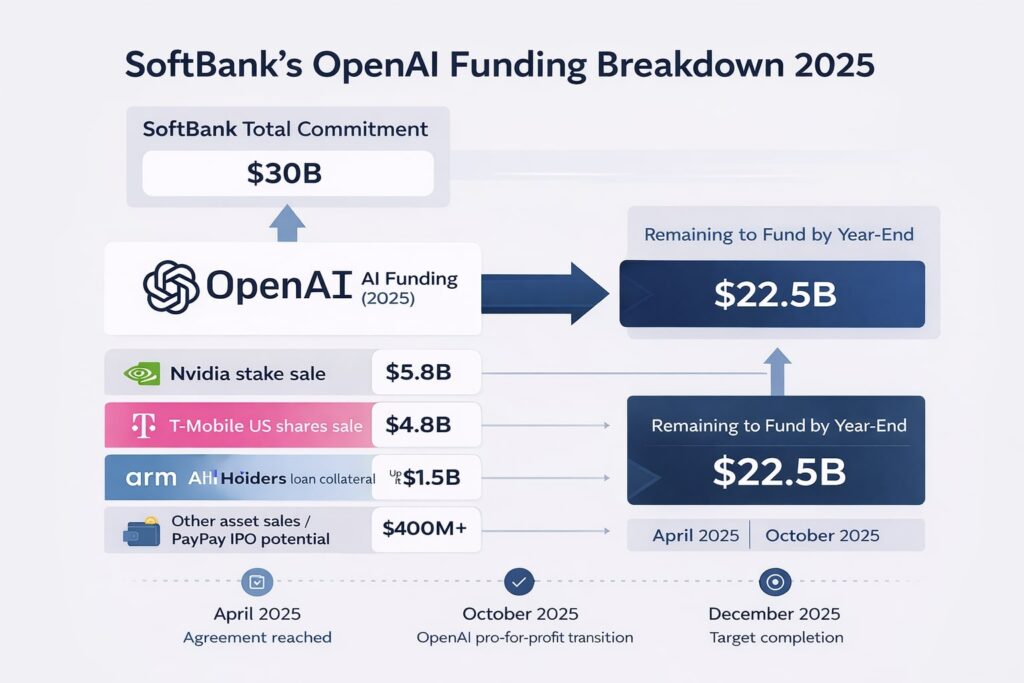
SoftBank’s reported plan to raise around $22.5 billion to deepen its exposure to AI, with OpenAI at the center, marks a clear shift. This is not a press release designed to impress markets. This is a balance-sheet level decision.
To raise this money, SoftBank is reportedly willing to sell parts of its existing portfolio and even use its stake in Arm Holdings as collateral for loans. That is a strong signal. When a group like SoftBank is ready to reshape its legacy holdings to fund AI, it tells us something important.
AI is no longer a side bet.
It is becoming the core.
This matters not just for investors, but also for students choosing skills and professionals planning their careers. When capital moves at this scale, it usually reshapes industries, job markets, and economic power for years.
Understanding the SoftBank Move in Simple Terms
Let’s first break down what is happening without technical language.
SoftBank is one of the world’s most influential technology investors. Through its Vision Funds, it has backed companies across e-commerce, ride sharing, semiconductors, and software.
Now, SoftBank is reportedly looking to raise $22.5 billion. The goal is to significantly increase exposure to AI, especially OpenAI. To do this, it is considering three major steps:
- Selling parts of its existing investments
- Taking loans backed by its stake in Arm Holdings
- Concentrating capital into fewer but higher conviction AI bets
This is not about diversification. It is about focus.
SoftBank is effectively saying that AI deserves more capital than some of its older bets. That is a big statement.
According to SoftBank AI investment disclosures and OpenAI’s expansion plans, capital is clearly moving toward large-scale AI infrastructure.
Why Using Arm as Collateral Is a Big Signal
Arm is not just another asset. It is one of the most strategic semiconductor companies in the world. Its designs power smartphones, servers, and increasingly AI infrastructure.
Using Arm as collateral for loans is like putting a crown jewel on the table.
This tells us two things:
First, SoftBank believes the upside from AI exposure is worth the financial risk.
Second, SoftBank sees AI as deeply connected to hardware, chips, and infrastructure, not just software.
AI models do not run in the cloud magically. They run on chips, data centers, and energy systems. Arm sits at the heart of that ecosystem.
By tying Arm to AI financing, SoftBank is effectively linking hardware power with AI intelligence.
Masayoshi Son’s Long-Term Thinking Finally Aligns With Reality
Masayoshi Son has spoken about AI for decades. In the past, many dismissed his vision as too early or too optimistic.
But timing matters.
Today, AI is no longer theoretical. It is already changing how companies operate, how people work, and how capital flows.
Large language models are being integrated into businesses. AI chips are in short supply. Data center spending is exploding. Governments are discussing AI as a national priority.
This time, Son’s vision aligns with real-world adoption.
That is why this move feels different from previous hype cycles.
This Is Not Fundraising. This Is Conviction

Companies raise money all the time. What makes this different is the trade-off.
SoftBank is not raising money while keeping everything else intact. It is actively reshaping its balance sheet. It is willing to reduce exposure to some legacy bets to increase exposure to AI.
That is conviction.
Big money does not behave emotionally. It moves after months of internal debate, scenario planning, and risk analysis. When it finally moves, it usually sees something that retail investors are only beginning to notice.
While some still debate whether AI is overheated, this SoftBank AI investment suggests large institutions are moving past bubble fears and focusing on long-term infrastructure dominance.
What This Means for Investors
For investors, the lesson is not to blindly chase AI stocks.
The real lesson is about capital rotation.
Money is moving away from older growth stories and toward AI-driven platforms, infrastructure, and ecosystems.
This SoftBank AI investment mirrors what we’ve already seen with Nvidia, where massive capital inflows followed real AI revenue growth, not just future promises.
This does not mean every AI company will succeed. It does mean AI as a sector will attract a disproportionate share of global capital.
Investors should start asking better questions:
The SoftBank AI investment reinforces why understanding AI-driven capital cycles matters more than short-term market noise or emotional investing decisions.
- Which companies enable AI rather than just market it
- Which firms control data, chips, or distribution
- Which businesses are integrating AI into revenue, not just demos
SoftBank’s move suggests that the next decade’s winners will be those closest to the AI engine, not those orbiting it.
What This Means for Professionals

For professionals, this is a wake-up call.
AI is no longer a tool you can ignore and still remain competitive long term. When capital reallocates, job markets follow.
We are already seeing this shift:
- Companies prioritizing AI literacy over traditional experience
- Management roles requiring AI decision-making skills
- Productivity expectations rising due to AI tools
You do not need to become a data scientist. But you do need to understand how AI affects your industry, your workflow, and your value.
The professionals who adapt early usually earn more, move faster, and face less career risk.
SoftBank’s move confirms that AI skills are no longer optional at the top.
What This Means for Students

Students often ask a simple question. What should I learn so I do not become irrelevant?
This move offers a clear answer.
AI is not replacing learning. It is reshaping it.
Beyond careers, the SoftBank AI investment highlights how AI will increasingly shape personal finance tools, income opportunities, and long-term financial planning.
Students who combine domain knowledge with AI understanding will stand out. This applies to finance, marketing, engineering, healthcare, law, and even creative fields.
The future will favor those who know how to work with AI, question its outputs, and use it responsibly.
SoftBank’s bet is a signal to students that AI literacy is becoming foundational, like computer literacy once was.
The Bigger Picture: AI as Economic Power
This is where the story becomes even more important.
AI is not just a productivity tool. It is becoming a form of economic power.
Countries that control AI infrastructure, data, and models will influence global markets. Companies that control AI platforms will shape entire industries.
SoftBank understands this. That is why it is willing to restructure its holdings to gain leverage in AI.
This is not about short-term returns. It is about long-term positioning.
The SoftBank AI investment fits into a broader global trend where Big Tech is racing to secure AI infrastructure across key markets, including emerging economies.
Why This Matters Beyond SoftBank
SoftBank is rarely alone.
When one large institution moves, others watch carefully. If AI investments continue to show real returns, more capital will follow.
This could lead to:
- Higher valuations for AI infrastructure companies
- Increased competition for AI talent
- Greater pressure on traditional businesses to adapt
The ripple effects will be felt across markets, careers, and education systems.
Risks Still Exist and They Matter
This does not mean AI investing is risk-free.
There are real concerns:
- Regulatory pressure on AI models
- High energy and infrastructure costs
- Concentration of power in a few firms
- Overestimation of near-term profits
Even Masayoshi Son has experienced painful losses when bets were mistimed.
But risk does not stop capital from moving. It simply reshapes how carefully it moves.
The fact that SoftBank is still willing to place such a large bet suggests it believes the risk is worth taking.
The Signal Everyone Should Notice
You do not need to invest in SoftBank or OpenAI to learn from this.
The signal is this:
AI is now important enough to restructure portfolios, careers, and strategies around it.
That is what makes this moment different.
When capital shifts at this level, the future is already being priced in.
Final Thoughts: Follow the Money, But Understand the Meaning
SoftBank’s reported $22.5 billion move is not about hype. It is about alignment.
AI adoption, infrastructure, and capital are converging at the same time. That rarely happens by accident.
For investors, this means thinking long term, not chasing headlines.
For professionals, this means upgrading skills with intention.
For students, this means preparing for a world where AI is embedded everywhere.
Big money does not move like this unless it believes the future has already arrived.
And this time, it probably has.
FAQs
1. Why is SoftBank raising such a large amount specifically for AI?
SoftBank believes AI will shape the next global growth cycle. By raising $22.5 billion, it wants to increase its exposure to AI platforms like OpenAI, which it sees as foundational technology rather than a short-term trend.
2. Why is using Arm as collateral such a big deal?
Arm is one of SoftBank’s most valuable and strategic assets. Using it as loan collateral signals strong confidence that AI investments could deliver higher long-term returns than holding onto legacy positions unchanged.
3. Is this move risky for SoftBank?
Yes, there is risk. AI is capital-intensive and faces regulatory and competition challenges. However, SoftBank appears willing to take this risk because it believes the long-term payoff from AI leadership outweighs short-term uncertainty.
4. What does this mean for individual investors?
It doesn’t mean copying SoftBank’s trades. It means understanding where large capital is moving. AI-related infrastructure, platforms, and enablers may continue to attract long-term investment interest.
5. How does this affect professionals working outside tech?
AI is spreading across all industries. Professionals in finance, marketing, operations, healthcare, and management will increasingly be expected to understand and use AI tools in daily decision-making.
6. What should students learn from this shift?
Students should focus on building AI literacy alongside their core subjects. Knowing how AI works, how it’s applied, and where its limits are will be a major advantage in future job markets.
7. Does this mean AI is guaranteed to succeed?
No technology is guaranteed. But moves like this show that AI is now considered critical infrastructure. Even if individual companies fail, AI as a sector is likely to remain central to economic and technological growth.