SpaceX q4 2025 update: Summary for Analysts
SpaceX Q4 2025 update: Key developments in defense contracts, Starlink momentum, and the Starship timeline for analysts and investors.
On October 3, 2025, the U.S. Space Force awarded SpaceX approximately $714 million for five national security launches under the National Security Space Launch (NSSL) Phase 3 Lane 2 program. These missions are scheduled for fiscal year 2027, with Falcon Heavy expected to handle the most demanding payloads. This latest contract award solidifies SpaceX’s position as the dominant player in America’s national security space launch market.
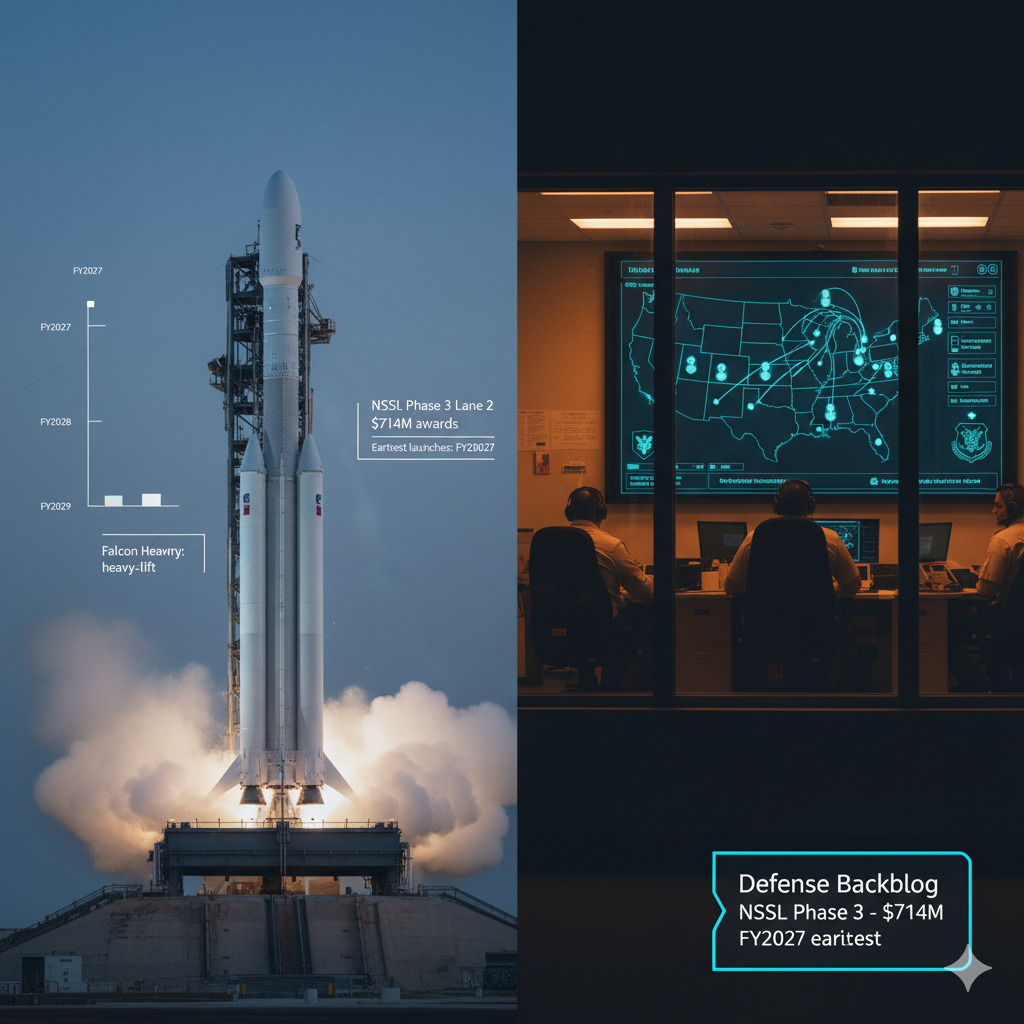
Why Defense Backlog Matters for Financial Stability
Having locked-in government contracts several years out fundamentally changes SpaceX’s revenue visibility and financial planning capabilities. This predictability opens up better financing options and reduces investor risk across multiple dimensions. When you can point to guaranteed Department of Defense revenue for five NSSL Phase 3 Lane 2 missions through FY2027, that’s the kind of certainty that improves credit ratings and lowers cost of capital.
This dynamic mirrors how other system-level technology leaders have benefited from predictable demand, as seen in Nvidia’s AI-driven financial growth reshaping investor expectations.
The strategic importance extends beyond simple revenue recognition. Defense contracts provide stable cash flows that can be leveraged to fund more speculative R&D initiatives like Starship development. They also serve as powerful validation signals to commercial customers and international partners who are evaluating SpaceX’s long-term viability. In an industry where multi-billion dollar satellite constellations require decade-long commitments, this kind of government backing matters enormously.
Moreover, the inclusion of Falcon Heavy in these awards demonstrates the Space Force’s confidence in SpaceX’s heavy-lift capabilities for the most sensitive national security payloads. These missions typically involve reconnaissance satellites, secure communications infrastructure, and other classified systems that demand absolute reliability. Each successful launch further cements SpaceX’s reputation and competitive moat against rivals like United Launch Alliance.
According to reporting from Air & Space Forces Magazine, the inclusion of Falcon Heavy
Starlink Deployment: 125 Falcon 9 Launches and Counting
Starlink deployment is moving at an unprecedented pace that continues to reshape expectations for what’s operationally achievable in the space industry. SpaceX has completed about 125 Falcon 9 launches as of early October 2025, with a recent mission deploying 28 V2 Mini satellites to densify global coverage and improve service quality across existing markets.
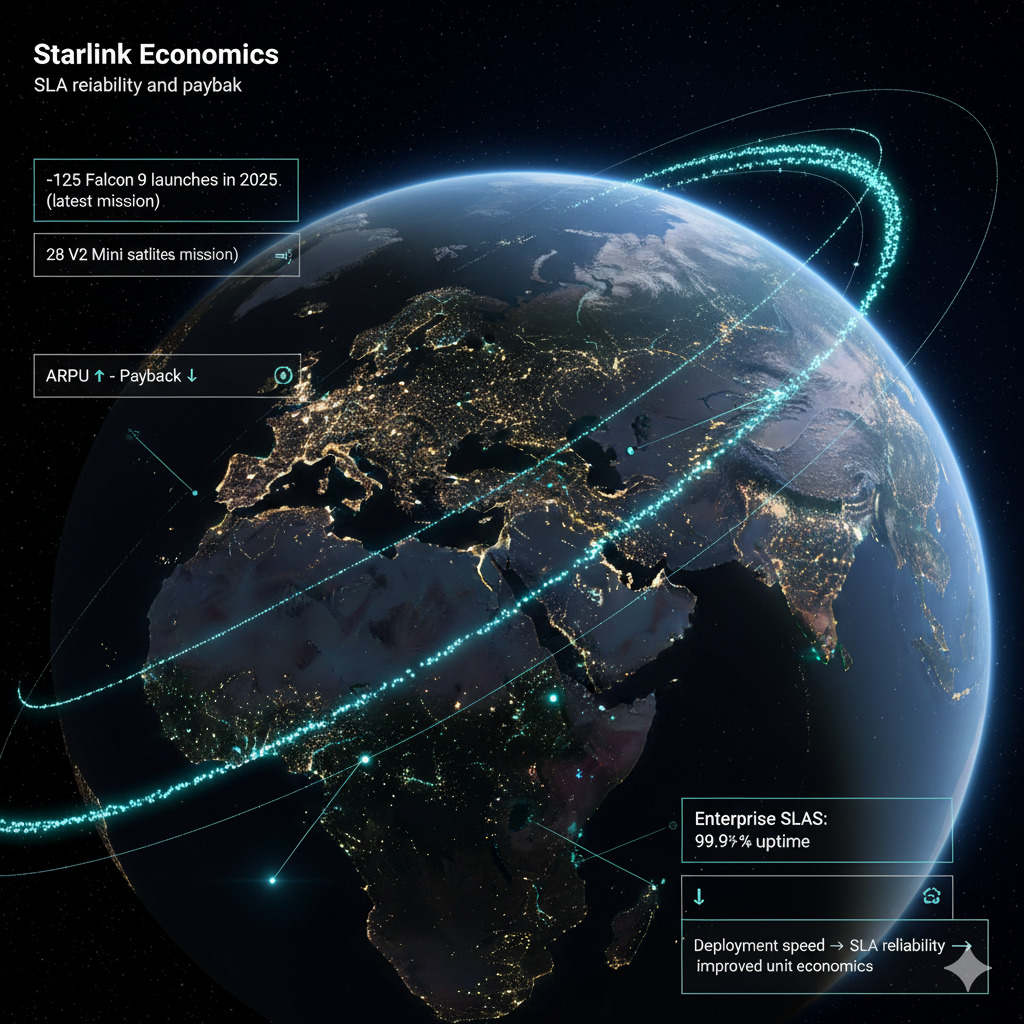
Enterprise Economics Drive Deployment Speed
This relentless launch cadence isn’t just about raw constellation size. It’s directly tied to fundamental business metrics like average revenue per user (ARPU) and the increasingly valuable enterprise service-level agreements that Starlink is securing with corporate clients worldwide. Every batch of satellites that reaches orbit shortens the overall capex payback period and steadily improves the unit economics of the entire system.
Premium enterprise contracts that demand 99.9% uptime guarantees or better command significantly higher pricing than standard consumer plans, dramatically accelerating return on investment timelines. These corporate SLAs represent a crucial inflection point in Starlink’s business model evolution transforming it from a consumer broadband service into mission-critical business infrastructure that companies depend on for operations.
This shift toward infrastructure-style economics is part of a broader trend explaining why big technology firms are investing heavily in long-duration, capital-intensive platforms.
The Competitive Advantage of Rapid Deployment
The faster SpaceX deploys new satellites, the faster it can deliver on the stringent performance requirements embedded in corporate service-level agreements. This creates a powerful competitive moat that traditional satellite operators simply cannot match. Legacy geostationary satellite systems require years of planning and billions in upfront capital for each satellite. Starlink’s model of rapid iteration with smaller, mass-produced satellites allows for continuous improvement and much faster response to market demands.
For enterprise customers in industries like maritime shipping, aviation, remote resource extraction, and emergency services, Starlink’s deployment speed translates directly into earlier access to reliable connectivity in previously underserved regions. This first-mover advantage in emerging markets creates customer lock-in effects that compound over time. Learn more about SpaceX’s space economy impact
Starship Flight 11: October 13 Test Could Reshape Launch Economics
SpaceX is targeting October 13, 2025, for Starship Flight 11, which represents the final test of the Version 2 configuration before transitioning to the next generation of hardware improvements. This mission focuses heavily on refining heat shield performance during reentry and validating the landing systems that are essential for achieving true operational reusability.
What’s at Stake with Reusability
If SpaceX successfully demonstrates reliable reentry thermal protection and controlled landings on this flight, the economic implications for the entire space industry become profound. We’re talking about a fundamental collapse in the cost curve for orbital access that could reshape what’s economically viable across every segment of the space economy.
Industry analysts suggest that fully reusable super heavy launch systems could reduce launch costs by one to two orders of magnitude compared to current expendable or partially reusable vehicles. This isn’t just incremental improvement it’s the kind of step-function change that fundamentally alters payload economics across all market segments, from satellite deployment to deep space exploration.
Beyond Cost: Opening New Markets
The implications extend far beyond simply making existing missions cheaper. Dramatically lower launch costs open entirely new categories of space-based business models that aren’t economically viable at current pricing levels. Consider large-scale space manufacturing, orbital tourism infrastructure, point-to-point cargo delivery via suborbital trajectory, or in-space resource processing facilities. All of these concepts become potentially viable when launch costs drop by 90% or more.
Version 3 on the Horizon
Success with Flight 11 sets the stage for Version 3 upgrades, which promise substantially increased payload capacity and further improved thermal protection systems. The Version 3 roadmap includes larger propellant tanks, more powerful engines, and advanced materials that should push performance even further beyond current capabilities.
This iterative development approach flying hardware, gathering data, implementing improvements, and flying again stands in stark contrast to traditional aerospace development cycles that can take a decade or more between major vehicle versions. SpaceX’s rapid iteration philosophy means that breakthrough capabilities can reach operational status in years rather than decades.
Macro Context: $613B Market Racing Toward $1 Trillion
All of these SpaceX developments are unfolding against a backdrop of explosive growth in the overall space economy. The global space industry reached approximately $613 billion in 2024, with credible projections from leading industry analysts pointing toward a $1 trillion valuation by 2030. This expansion trajectory creates massive ripple effects throughout entire supplier ecosystems impacting component manufacturers, ground station operators, data analytics firms, insurance providers, and countless other supporting industries. Read about Starlink’s expansion in India
Many of these spillover effects resemble what’s happening across the AI hardware stack, where scale, compute intensity, and capital access are determining long-term winners.
M&A Activity and Risk Premium Compression
We’re witnessing accelerated merger and acquisition activity as larger, well-capitalized players move to consolidate critical capabilities while smaller startups face the stark choice between getting acquired or struggling to compete in an increasingly capital-intensive environment. This consolidation wave reflects the industry’s maturation and the growing recognition that space infrastructure requires substantial scale to achieve sustainable economics.
For institutional investors and financial analysts, this growth trajectory is fundamentally reshaping how risk premia get allocated across the space sector. What was once categorized as highly speculative deep-tech investment is increasingly being evaluated using the frameworks typically applied to terrestrial infrastructure assets telecommunications networks, logistics systems, and utility-scale infrastructure.
Capital Flows Following Momentum
The institutional capital is clearly following the momentum. Pension funds, sovereign wealth funds, and other long-term investors who historically avoided space investments are now actively seeking exposure to space infrastructure assets. This shift in investor sentiment both reflects and reinforces the sector’s legitimacy as an established infrastructure category rather than speculative technology.
The implications for companies like SpaceX are substantial. Access to deeper pools of lower-cost capital accelerates the timeline for ambitious projects and provides cushion against the inevitable setbacks that occur in cutting-edge aerospace development. It also enables more aggressive competitive positioning and faster market share capture during these crucial formative years when the industry’s long-term structure is being determined.
This SpaceX q4 2025 update consolidates near-term catalysts and valuation drivers.
Key Takeaways & Questions
Analyst Perspectives:
- Defense revenue visibility: With five NSSL Phase 3 missions locked through FY2027, how does multi-year Department of Defense backlog affect SpaceX’s cost of capital and valuation multiples when compared to traditional aerospace primes like Lockheed Martin or Northrop Grumman? Does this stable revenue base justify premium valuation multiples?
- Starlink unit economics: At current deployment rates exceeding 125 Falcon 9 launches annually, when does the Starlink constellation reach full capex payback on the initial investment? How significantly do enterprise service-level agreements with 99.9% uptime guarantees accelerate that payback timeline versus revenue derived solely from consumer subscriptions?
- Starship inflection point: If Flight 11 successfully validates thermal protection systems and landing capabilities, what’s the realistic timeline for securing commercial payload contracts at scale? Which market segments satellite constellation deployment, lunar cargo missions, or point-to-point terrestrial cargo are positioned to capture economic value first, and what does that sequence tell us about near-term revenue potential?