🎧 Prefer listening instead of reading?
If you’d like to hear this topic as a short podcast-style conversation, you can listen to the full audio version here. It covers the key points of
Updated Outlook: How the 2025 Trump Trade War Triggered a Global Market Shakeup
How the 2025 US–China Tariff Shock Shook Markets
Introduction :
This report explains the Trump Trade War 2025 Market Impact and why it triggered one of the biggest global market shakeups of the decade.
In 2025, the world witnessed a financial earthquake triggered by a fresh wave of trade tensions between the United States and China. Known as the “Trump Trade War 2025,” this crisis evolved from earlier disputes into a full-blown global shakeup, touching everything from Wall Street to Wipro, affecting the fortunes of families and the direction of economies. Recent developments including a new trade deal struck between President Trump and President Xi Jinping have signaled a cautious hope for stability. But for investors, governments, and everyday families, the aftermath is far from over.
Many analysts now refer to this period as the 2025 US–China tariff shock, which reshaped supply chains and global sentiment.
This article dives deep into the origins, evolution, and repercussions of the Trump Trade War 2025, how world stock markets reacted from October through November, how India is coping, and what lies ahead in a world where trade, technology, and trust have been put to the ultimate test.
This report offers a clear breakdown of the Trump Trade War 2025 Market Impact so readers understand why markets turned volatile so quickly.
Background: What Triggered the Trump–Xi tariff crisis
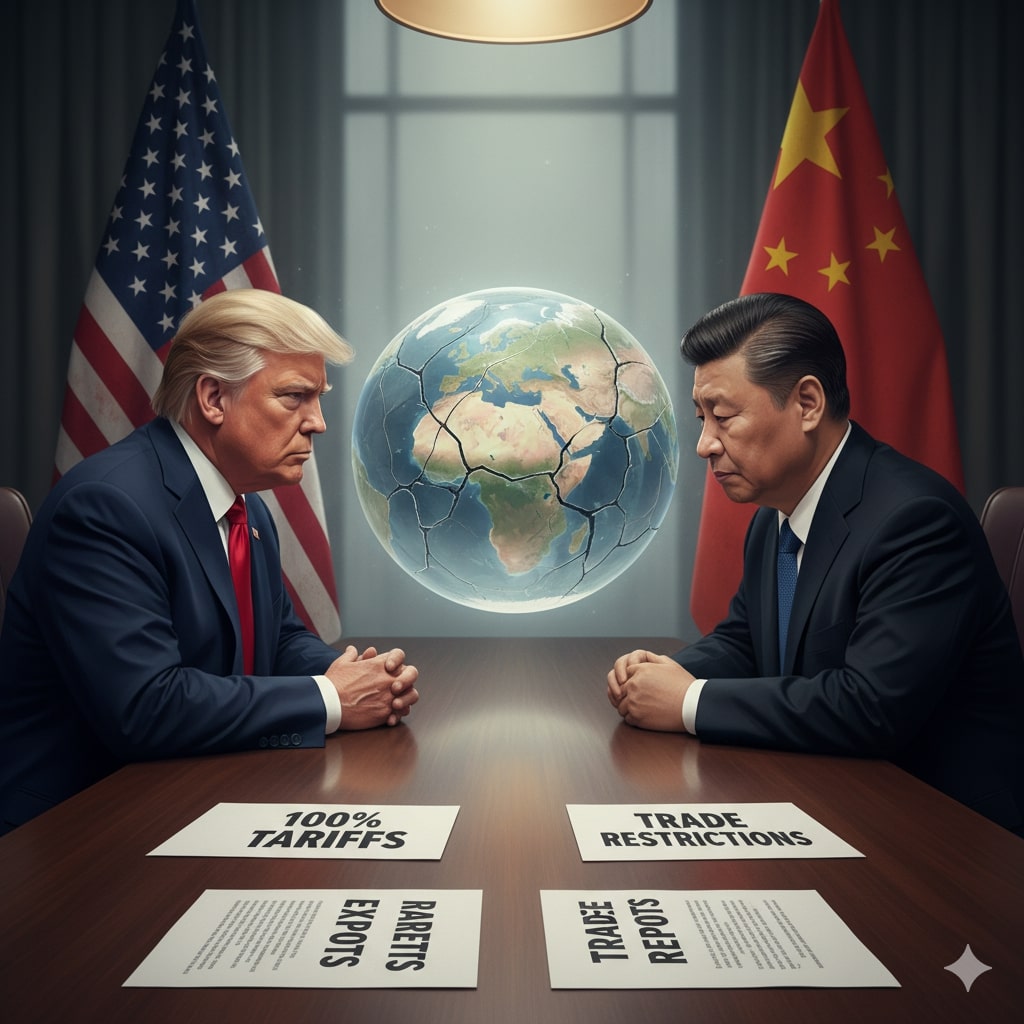
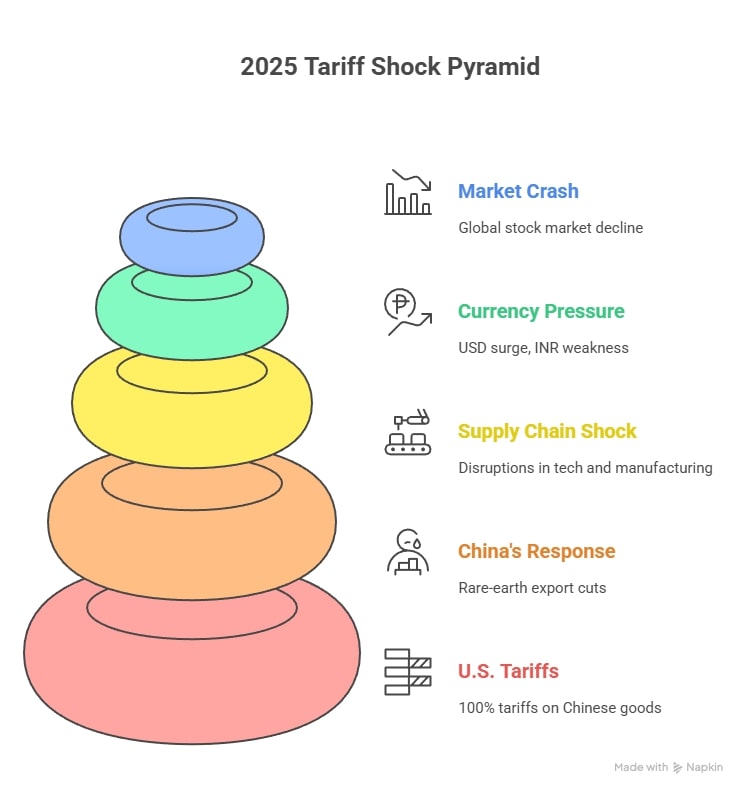
The seeds were sown in late summer 2025, as talks between Washington and Beijing hit fresh deadlocks. By early October, rumors of escalation swirled, only to be confirmed when President Donald Trump announced a stunning 100% tariff on all Chinese imports. It was an unprecedented move more than a tax hike, it was an effective embargo that roiled trading desks worldwide.
China shot back, weaponizing rare earth exports (essential for chips, electric vehicles, and smartphones) suspending new controls but threatening further restrictions as negotiations flared and calmed. These mutual volleys laid bare the vulnerability of global supply chains, causing companies and countries to scramble for solutions.
For more context on the geopolitical tensions shaping this crisis, explore our detailed report on US Fear of China 2025.
👉 https://pennypowerplay.com/us-fear-of-china-2025/
The result? A global stock sell-off from New York to New Delhi, the wipeout of billions in value in mere hours, and a tense new “risk-off” mood gripping investors and institutions.
The Trump Trade War 2025 Market Impact became visible the moment global indices reacted to the sudden tariff shock.
Market Panic: How the 2025 Tariff War Hit Global Indices
October’s Market Crash
- The S&P 500, Nasdaq, Nikkei 225, Hang Seng, and European indices tumbled fiercely tech, manufacturing, and exporters leading losses.
- Defensive sectors showed resilience, but volatility spiked to six-month highs globally.
- Asian and emerging market indices suffered disproportionately, especially those tied to exports and raw materials.
- Indian markets felt the acute pain: the Nifty IT Index plunged almost 11%, leading to swift market-wide corrections, while export-heavy sectors tanked.
- These sharp moves highlight how deeply the 2025 tariff shock is influencing global volatility, especially in tech and manufacturing sectors.
- The Trump Trade War 2025 Market Impact continues to create pressure on global supply chains and investor sentiment.
For a deeper look at how volatility unfolded during the same period, you can also read our analysis on the Market Correction of 4th November 2025.
👉 https://pennypowerplay.com/market-correction-4th-nov-2025/
November’s (Tentative) Recovery
- The trend remains fragile. After the initial crash, global headlines improved when a trade truce emerged mid-November.
- The U.S. reduced tariffs from 100% to 10% temporarily, while China suspended rare earth controls for a year sparking brief rallies in Asia, Europe, and the U.S.
- Indices like Nifty50 rebounded above 25,550, reflecting renewed optimism despite persistent sectoral weakness; Sensex tracked similar gains.
- Markets continue to react sharply to every news item fear and hope walking hand in hand.
Notable Data Points
- The global “fear gauge” (VIX) touched six-month highs, with bouts of bottom-fishing by savvy investors.
- Currency volatility lingered, with USD/INR hitting ₹88.82 and the rupee facing pressure amid ongoing uncertainty.
- Export data from India indicated a 37.5% year-on-year drop in US-bound shipments, affecting engineering, gems, textiles, chemicals, and leather.
According to the IMF’s latest World Economic Outlook report, released in November 2025, global growth prospects remain under pressure as prolonged trade tensions, high import costs, and supply chain disruptions continue to weigh on both advanced and emerging economies. IMF World Economic Outlook
India’s Plight: India’s Struggle Under

India, a major global participant, felt the full force of the crash. Markets, businesses, and regular families confronted a new reality:
Corporates and SMEs
- Exporters scrambled for alternative destinations amid collapsing US demand and expensive imports.
- Technology and manufacturing, especially IT giants like Infosys, HCL Tech, and Wipro, faced eroded margins and job cuts.
- SMEs received emergency relief packages, tax support, and logistical upgrades from the government.
- India has emerged as one of the most exposed markets in the US–China 2025 trade tensions, with pressure showing across exports, currency trends, and corporate margins.
Trade pressure has also spilled into manufacturing and autos; our article on US Auto Tariffs 2025 and Asian Markets breaks down this sector-wide impact.
👉 https://pennypowerplay.com/us-auto-tariffs-2025-asian-markets/
For India, the Trump Trade War 2025 Market Impact has translated into falling exports, corporate pressure, and deep currency volatility.
Households and Investors
- Mutual fund investors, like Mumbai retiree Rajesh Sharma, saw decades of savings diminished in days, driving a wave of panic and an urgent move toward safe assets.
- Households prioritized basic savings and risk management reducing discretionary spending on technology, travel, and luxury items.
Policymakers
- The RBI responded with liquidity measures and rupee stabilization actions; the government launched new trade pacts and “self-reliance” initiatives.
- Talks with the U.S. focused on easing tariff pressure, while outreach to Gulf and APAC countries intensified for diversified export markets.
Everyday Resilience
- Entrepreneurs–like Priya Menon, who faced layoffs pivoted to side hustles or reskilling.
- The mantra: agility, adaptability, and diversification. DIY investing rose, with individuals exploring international ETFs, gold, and bond ladders.
According to recent coverage from Reuters, global markets remain sensitive to every new trade announcement, with analysts warning that prolonged tariff uncertainty could continue weighing on growth in both advanced and emerging economies.
https://www.reuters.com/world
Anatomy of the Trade Truce: The Latest Developments
November 2025 Deal Highlights
- Post-APEC summit, Trump and Xi agreed to roll back a majority of duties for one year U.S. tariffs reduced to 10% instead of 100%.
- China suspended and softened rare earth export controls, restoring partial supply lines for chipmakers and tech manufacturers.
- Both sides vowed continued negotiation, with future summits planned before year-end. Soybean, log, and selective tech imports resumed.
Global Market Response
- Markets breathed a sigh of relief, triggering rebounds. Yet the consensus remains: volatility is here to stay until long-term trust is rebuilt.
- IMF trimmed growth forecasts to 3.2% the slowest in years citing “downside risks” from protectionism and supply chain headaches.
Lessons Learned: Why Is This Crash Unique?
This 2025 global trade disruption is unique because.
- Tariff Scale: Never before have 100% duties been imposed across such a broad swath of global trade. The impact is systemic businesses and consumers are squeezed.
- Resource Weaponization: China’s rare earth export controls exposed latent risks in “digital” economies physical resources still rule.
- Double-Dip Volatility: Unlike past crash-rebound patterns, the current environment remains risk-off, with few clear trends.
- Revenue, Not Relief: U.S. government tariff revenue soared, but at the direct expense of business margins and consumer costs.
Understanding the Trump Trade War 2025 Market Impact helps investors recognize how fragile global systems become during high-tariff environments.
For more insights on financial resilience during volatile periods, read our guide on Financial Resilience 2025 Strategies.
👉 https://pennypowerplay.com/financial-resilience-2025-strategies/
Understanding the 2025 tariff shock helps investors stay grounded during unpredictable market cycles.
The Outlook: What Should You Do?
- Diversify not just portfolios, but income streams and export partners.
- Track announcements closely; react, but don’t panic.
- Stay realistic: Bottom-fishing can be rewarding, but true bear-market recoveries are slow and unpredictable.
- Focus on adaptation: Learning new skills, shifting markets, and keeping expenses lean.
- Going forward, the Trump–Xi tariff crisis will continue shaping investment behavior, policy decisions, and global market sentiment.
- Understanding the Trump Trade War 2025 Market Impact helps investors stay prepared for ongoing volatility.
Staying prepared for the Trump Trade War 2025 Market Impact is crucial, especially as negotiations remain unpredictable.
These FAQs help simplify the Trump Trade War 2025 Market Impact for everyday investors.
6 Frequently Asked Questions (FAQs)
Q1: Has the trade deal ended the crisis for good?
A1: No. While tariffs were reduced and rare earth restrictions suspended, it’s a temporary truce. Markets remain volatile, and long-term structural problems linger.
Q2: Which sectors are most impacted?
A2: Technology, manufacturing, exports, and sectors relying on imported materials like electronics and energy have been hardest hit.
Q3: How are Indian investors coping?
A3: By diversifying portfolios, prioritizing defensive asset classes, shifting to safer bonds/gold, and exploring international ETFs.
Q4: What should small businesses in India do?
A4: Seek government support, diversify markets, optimize logistics, and focus on domestic value addition while lobbying for further relief.
Q5: Will global markets stabilize soon?
A5: Unlikely in the short term. Volatility will persist till trade relations normalize, supply chains are restored, and lasting agreements are reached.
Q6: Is this a good time to “buy the dip”?
A6: Bottom-fishing is risky. While some sectors may recover, true opportunities will emerge only after volatility subsides and fundamentals improve.