Why Big Tech is investing in India is a question the world didn’t bother asking twenty years ago. For decades, India was seen as a place where software was built for someone else. Code was written here, profits flowed elsewhere, and talent was exported like a commodity.
That story is now ending, as global technology giants begin treating India not just as a workforce, but as a strategic foundation for artificial intelligence and cloud computing.
Over the past three years, a quiet but powerful technology shift has been unfolding. Amazon, Microsoft, and Google have committed more than $67 billion in combined investments into India. These are not marketing spends or short-term expansions.
To understand how India’s private sector is accelerating AI infrastructure, you can also read our breakdown of the TCS–TPG partnership and its $1.5B AI data center bet: TCS–TPG AI Data Center Investment in India
The money is going into AI data centers, cloud infrastructure, semiconductor-ready facilities, and large-scale computing capacity, the backbone required to train and run modern AI systems.
🎧Prefer listening? Here’s a short audio summary of this article on why Big Tech is investing in India’s AI future.
If you’re curious about how NVIDIA is fueling the hardware behind this AI revolution, explore how NVIDIA’s financial growth is reshaping the global compute race:
👉https://pennypowerplay.com/nvidia-ai-financial-growth-2025/

Why Big Tech is Investing in India and Why the World Suddenly Needs It
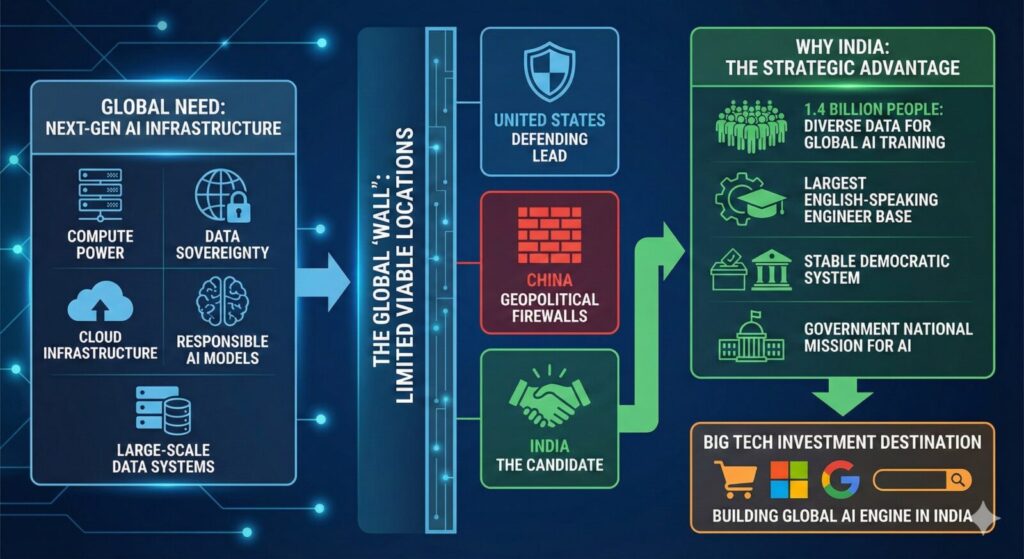
Technology used to be built around software. Today, it is built around something far more powerful:
- Compute power, Data sovereignty, Cloud infrastructure, Responsible AI models.
Large-scale data systems
The next generation of businesses will not run on code alone. They will run on computational capacity the ability to train, deploy, and govern AI at scale. And this is where the world hit a wall.
There are only three places with enough talent, political stability, and growth potential to build AI infrastructure at global scale: the United States, China, and India.
The US is busy defending its lead. China is locked behind geopolitical firewalls. That leaves just one candidate India.
A country with:
- 1.4 billion people producing data diverse enough to train global-grade AI
The world’s largest base of English-speaking engineers
A stable democratic system
A government that views AI as a national mission
A rapidly maturing digital infrastructure
What did the world’s biggest tech companies do after realizing this?
They didn’t clap from their place, They wired billions in Indian AI
The Great Indian Tech Gold Rush
The combined $67 billion flowing into India is not a marketing budget or expansion cost. It is infrastructure money the kind of investment nations get once in a century.
Let’s see who is building what.
Microsoft: The Architect of India’s AI Backbone

Microsoft’s $17.5 billion investment is not just the largest bet it has ever made in Asia. It is a signal that the AI industrial base of the world is shifting eastward. Timeline from 2026 to 2029.
Primary Focus
- Build hyperscale AI data centers
Deploy sovereign cloud infrastructure
Train millions of Indians in AI and cloud expertise
This work is anchored in Hyderabad, Bengaluru, and Pune, cities that are already the beating heart of India’s tech economy.Microsoft isn’t just setting up servers. It is constructing the computational spine required for India to run high-stakes AI systems from digital finance to public health platforms
This shift explains why Big Tech is investing in India instead of expanding infrastructure elsewhere.
To understand the scale of Microsoft’s commitment, you can read their official announcement detailing the $17.5 billion investment in India’s AI infrastructure here: https://news.microsoft.com/source/asia/2025/12/09/microsoft-invests-us17-5-billion-in-india-to-drive-ai-diffusion-at-population-scale/
Core Projects
- AI compute infrastructure for enterprises, Azure cloud regions purpose-built for India’s regulatory needs, Data-governed cloud frameworks for banks, healthcare, and government programs, AI model deployment environments with security and audit systems.
Key Technologies
- Responsible AI models, Data governance workflows, Cloud compliance infrastructure, High-performance compute clusters
Job Impact
This creates high-skill roles, not low-cost outsourcing work:
- Cloud administrators, Data architects, AI engineers, Privacy and governance analysts.
The beneficiaries are students, developers, research institutions, and government agencies who now get access to global-grade AI systems inside India’s borders.
Strategic Impact
Microsoft is turning India from a consumer of AI into a producer of AI infrastructure.
For the first time, India won’t depend on someone else’s computing power. It will manufacture it.
That is not an upgrade.
That is a rebirth.
Microsoft’s strategy proves why Big Tech is investing in India rather than scaling infrastructure elsewhere.
Amazon: The Factory of Digital India
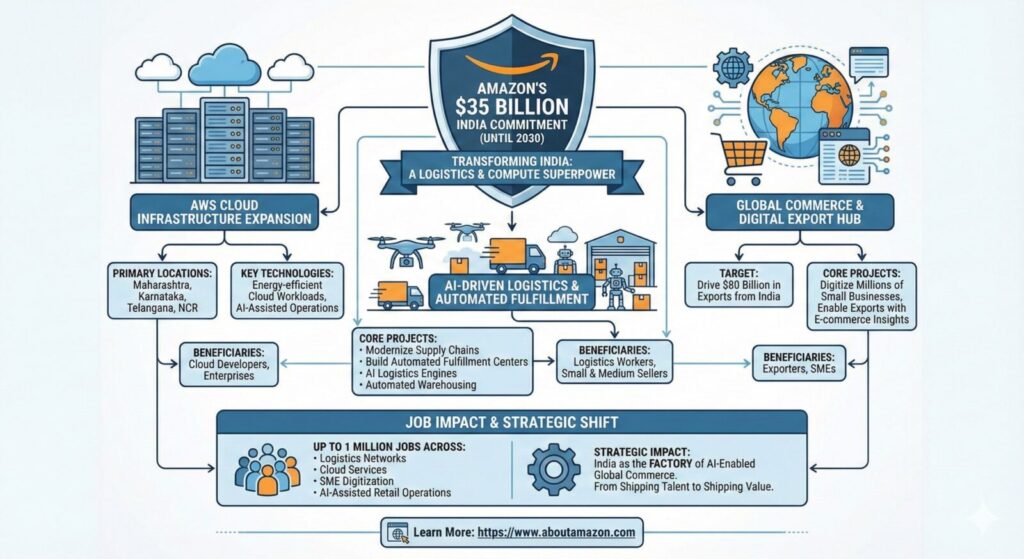
Amazon’s $35 billion commitment runs until 2030, and it’s larger than many national budgets. It is transforming India into something Amazon understands better than anyone: A logistics and compute superpower.
Primary Locations, Maharashtra, Karnataka, Telangana, NCR
Amazon’s logistics play is a key reason why Big Tech is investing in India as a global supply chain hub.
To learn more about Amazon’s global investment plans, visit their official site: https://www.aboutamazon.com
Core Projects
- Expand AWS cloud infrastructure
- Modernize logistics with AI-driven supply chains
- Build automated fulfilment centers
- Digitize millions of small businesses
- Enable exports powered by e-commerce data insights
Amazon is not betting on consumption. It is betting on production.
It wants Indian businesses to sell globally and has set a target of driving $80 billion in exports from India.
Key Technologies
- Automated warehousing
AI logistics engines
Energy-efficient cloud workloads
Cross-border digital commerce systems
Job Impact
Up to 1 million jobs across:
- Logistics networks, Cloud services, SME digitization, AI-assisted retail operations.
Who Benefits
- Small and medium sellers, Logistics workers, Cloud developers, Exporters
Strategic Impact
Amazon is turning India into the world’s digital supply chain not just a market, but a factory of AI-enabled global commerce.
India is no longer shipping talent. It is preparing to ship value.
Amazon’s investment alone shows why Big Tech is investing in India as the center of the global AI supply chain.
Google: The Deep-Tech Powerhouse

Google’s $15 billion investment sets the stage for India’s entry into the highest layer of the technology stack: deep AI infrastructure.
Timeline: 2026–2030. Location: Visakhapatnam the home of India’s first full-scale AI campus
Core Projects
- Build large-scale AI compute regions, Deploy cloud-native AI platforms, Support global model training from Indian soil, Enable startups to build products directly on top of Google’s AI systems.
- Google’s AI hub in Visakhapatnam highlights why Big Tech is investing in India’s deep-tech foundation.
Key Technologies
- AI workloads and training platforms, Deep-learning compute networks, Scalable data processing systems, Cloud-native AI deployment pipelines.
Job Impact
Specialized high-paying roles in:
- AI research, Data center operatins, Power and energy engineering, Cloud connectivity systems.
Who Benefits
- Deep-tech companies, Research labs, AI product developers, Global cloud businesses.
Strategic Impact
Google is not outsourcing work to India.
It is outsourcing the future.
Visakhapatnam will become one of the nodes where the world’s most powerful AI models are trained.
India, for the first time, becomes part of the core compute geography of the world.
Google’s strategy reinforces why Big Tech is investing in India to power the core compute layer of the future.
To understand why Big Tech is investing in India at such scale, we need to see how these changes affect individual careers.
To understand why Big Tech is investing in India, we must look at the opportunities these shifts create.
“The following is a fictional scenario based on real market trends and emerging AI roles.”
Alex The Accidental Millionaire of the AI Age
Alex is a 45-year-old systems engineer from Ohio, USA. For most of his career, his work was safe but predictable maintaining servers, handling network tickets, chasing certifications.
Many professionals are now pivoting toward AI-powered opportunities. Here’s how India’s AI investment wave is creating new money-making paths for everyday people:
👉 https://pennypowerplay.com/ai-investment-bubble-2025-alliance-explained/
Then everything changed.
The companies he worked with began shifting workloads to India, not because it was cheaper, but because the new AI data centers being built there had higher compute efficiency and access to sovereign cloud tools unavailable elsewhere.
Within months, Alex realized that the companies running these systems needed specialists who could:
- Optimize AI compute clusters
Manage data governance
Configure sovereign cloud environments
He had a skill most didn’t: experience.
Alex transitioned from support engineer to AI infrastructure consultant, working remotely with Indian cloud teams building Microsoft’s and Google’s new stacks.
Today, he makes $25,000 a month consulting, not coding.
Alex didn’t study AI. He learned how AI systems are deployed. That single shift changed the value of his time.
Alex is not an outlier. He is the first wave.
Why This Matters for Every Indian Student, Professional, and Investor
We are entering a world where:
- Coding is not the main skill.
Understanding AI infrastructure is.
Cloud operations, model governance, and data compliance will matter as much as algorithms.
Jobs won’t be outsourced compute will be.
India, for the first time, sits where the power really flows:
At the source of computation.
Students who learn cloud and AI operations will be the new engineers.
Professionals who understand AI deployment will become global talent.
Investors who understand infrastructure will own the future.
The Hidden Lesson No One Is Talking About
AI is not about intelligence.
It is about capacity who controls the machines that teach the machines.
India is building those machines.
Whoever owns AI infrastructure owns the future markets of:
- Health, Education, Governance, Finance, Commerce, Defense
This is why the world’s richest companies are not selling to India anymore.
They are building from India.
To understand how geopolitical tensions are reshaping global trade and pushing companies to diversify away from China, you can explore our detailed analysis here:
👉 https://pennypowerplay.com/us-fear-of-china-2025/
A Final Thought
Countries rarely get moments like this. Moments when the world’s most powerful companies bet not on customers, but on capabilities.
India has never been here before. It has always been the workshop, Now it is becoming the headquarters.
The next decade will answer one question: Why Big Tech is investing in India and not anywhere else.
The future won’t be built in Silicon Valley alone.
It will be trained in Hyderabad
processed in Visakhapatnam
distributed through AWS clouds across India
and
governed by sovereign systems India controls
We are not witnessing a technology upgrade, We are watching a geopolitical shift. The AI era will have many leaders.
But its foundations the pipes, the power, the compute, the cloud are being poured here.
In India.
And when a nation controls the foundation of a new age, it does not participate in history.
It writes it.
Frequently Asked Questions (FAQs)
1. Why are companies like Amazon, Microsoft, and Google investing so heavily in India?
They are investing in India because the country offers a unique combination of engineering talent, a massive data ecosystem, a stable democratic environment, and the regulatory push for sovereign cloud systems. India is becoming the only scalable alternative to China for global AI and cloud expansion, making it a strategic long-term base for technology infrastructure.
2. What does sovereign cloud mean, and why is it important for India?
A sovereign cloud is a cloud infrastructure built inside India that ensures all data, operations, and governance follow Indian laws. It protects sensitive information, supports national security, and allows AI models to train and operate without depending on foreign jurisdictions.
3. How will this $67 billion investment impact jobs in India?
These investments will create high-skill jobs in AI operations, cloud deployment, logistics automation, data governance, cybersecurity, and AI product development. The focus shifts from low-cost coding roles to roles that design, manage, and run global AI systems.
4. Will AI take away jobs from traditional IT professionals?
AI will automate repetitive coding and support work, but it will create new roles that require cloud skills, AI deployment expertise, infrastructure understanding, and system governance. People who reskill will earn more and secure leadership roles in global technology.
5. Which cities in India will benefit the most from this tech wave?
Hyderabad, Bengaluru, Pune, Mumbai, Visakhapatnam, and parts of NCR will see the biggest growth because they are becoming hubs for cloud computing, AI data centers, logistics, export infrastructure, and deep-tech research ecosystems.
6. What should students learn today to benefit from these AI investments?
Students should focus on cloud computing, data engineering, AI ethics and governance, cybersecurity, DevOps, and infrastructure-related AI skills. These are the core areas where Microsoft, Google, and Amazon are building long-term technology capabilities in India.