Why middle class feels poorer is the question millions are asking today.
There’s a strange feeling many of us carry now. Everywhere we look, the headlines say the economy is “growing.” GDP is rising. Markets are hitting records. Governments talk about progress. Yet in daily life, it feels harder to breathe financially.
This gap between what the news says and what life feels like is not imaginary. It is the quiet truth of our time. Across the U.S., Europe, and India, millions of middle-class families are asking the same question in different accents:
In my opinion, this gap is the most misunderstood economic issue of our time. I’ve spent the last few years analyzing how macro headlines translate into everyday money decisions, and the disconnect keeps widening.
“If the economy is doing well, why do I feel poorer?”
Why Middle Class Feels Poorer Despite Economic Growth
GDP measures how much a country produces. It does not measure how people live.
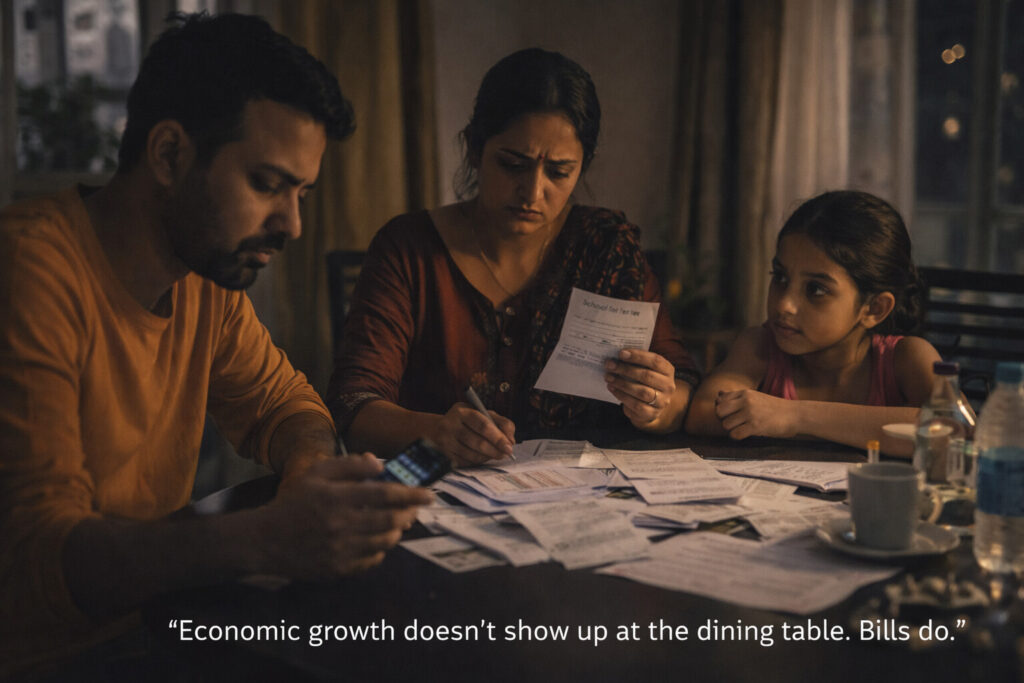
A nation can grow richer on paper while its people feel squeezed in real life. New skyscrapers rise. Tech companies expand. Stock markets rally. But at the household level, the story looks different:
- Rent climbs faster than salary
- Grocery bills rise every month
- School fees feel heavier each year
- EMIs eat a bigger share of income
- Healthcare feels unaffordable
Economic growth flows upward first. It takes time to reach kitchens, classrooms, and living rooms. And in many cases, it never reaches them at all.
That is why the middle class feels trapped between two worlds.
Too rich to receive support. Too stretched to feel secure.
The U.S. and Europe: When a “Good Salary” Isn’t Enough
In the United States, a six-figure income once meant comfort. Today, in cities like New York, San Francisco, or even Austin, it often means survival with style.
- Rent can swallow 40–50% of income
- Healthcare premiums feel like another tax
- Student loans follow people into their 40s
- Childcare costs rival home EMIs
Europe tells a similar story in a different tone.
Energy bills, housing shortages, and high taxes are reshaping middle-class life.
In London, Paris, Berlin, and Amsterdam:
- Young professionals share homes longer
- Families delay children
- Home ownership moves from dream to fantasy
People are working harder than their parents, yet building less.
This is not because they are careless.
When I analyzed household budgets across the U.S. and Europe, one pattern kept repeating: fixed costs now consume income before people even get a chance to make choices.
It is because the system has changed.
Wages move slowly.
Prices move fast.
That is how the middle class becomes poorer without a single dramatic event.
A Personal Note From India
From where I sit in India, this gap feels even sharper.
In cities like Mumbai, Pune, Bengaluru, and Delhi:
- Rent jumps every year
- School fees rise without warning
- Groceries cost more each month
- EMIs lock people into decades
A ₹50,000 salary once felt stable.
Today, it feels tight.
From my experience speaking with salaried professionals in India, this is the number where anxiety begins. Not panic, but constant mental math.
Even families earning ₹1–1.5 lakh a month feel anxious.
Not poor. Not rich. Just… stretched.
People don’t dream of luxury anymore.
They dream of stability.
And that is the quiet shift no GDP chart shows.
A Common Man’s Story
Last month, I spoke to a cab driver in Pune.
He drives 10–12 hours a day.
His monthly income is around ₹35,000.
He told me, “Sir, five years ago, this was enough. Today, it only runs the house.”
His rent went from ₹6,000 to ₹11,000.
Milk, vegetables, gas, school books, everything costs more.
He is not lazy.
He is not irresponsible.
He is doing everything “right.”
Yet the finish line keeps moving.
That is the middle-class story today.
That feeling is exhausting in ways spreadsheets never capture.
Where the Pressure Comes From
The pressure comes from four invisible forces working together:
- Inflation
Prices rise quietly every year. Even 5–6% compounds into pain over time. - Housing Costs
Homes are no longer shelters. They are investment assets. That pushes prices beyond reach. - Debt Culture
EMIs make life look affordable today and expensive forever. - Lifestyle Inflation
We don’t just buy more. We are expected to live better to “keep up.”
Each one alone is manageable.
Together, they change the emotional shape of life.
You earn more.
But you feel poorer.
This pressure is not just personal. It’s part of a much larger global shift in how money behaves today. To understand the full picture, read Global Inflation Explained: Why Money Feels Tight in 2026.
The Hidden Tax on Every Salary
How Inflation Quietly Shrinks a Middle-Class Salary (Illustrative Example)
| Monthly Income | Inflation Rate | Real Value After 1 Year | Real Value After 5 Years |
|---|---|---|---|
| $3,000 | 5% | $2,857 | $2,351 |
| $4,000 | 5% | $3,810 | $3,134 |
| $6,000 | 6% | $5,660 | $4,486 |
I created this table to show how small inflation numbers feel harmless in headlines but brutal in household budgets. The math is simple. The impact is not.
According to a recent analysis on Yahoo Finance, inflation in 2025 pushed up essential costs like food and housing faster than many middle-class incomes, contributing to real income erosion even as headline economic growth continued.
Inflation is the silent tax no one announces.
When I ran the numbers for a typical middle-class household, the loss wasn’t dramatic in one year. It was devastating over five.
You don’t get a bill.
You just notice that money ends sooner.
A 6% inflation rate means:
- Your ₹50,000 salary feels like ₹47,000 next year
- Your $4,000 monthly income feels like $3,760
Unless your salary rises faster than inflation, you are moving backward.
Most people don’t lose money suddenly.
They lose it quietly.
That is why the middle class feels poorer without a single dramatic event.
The Housing Trap
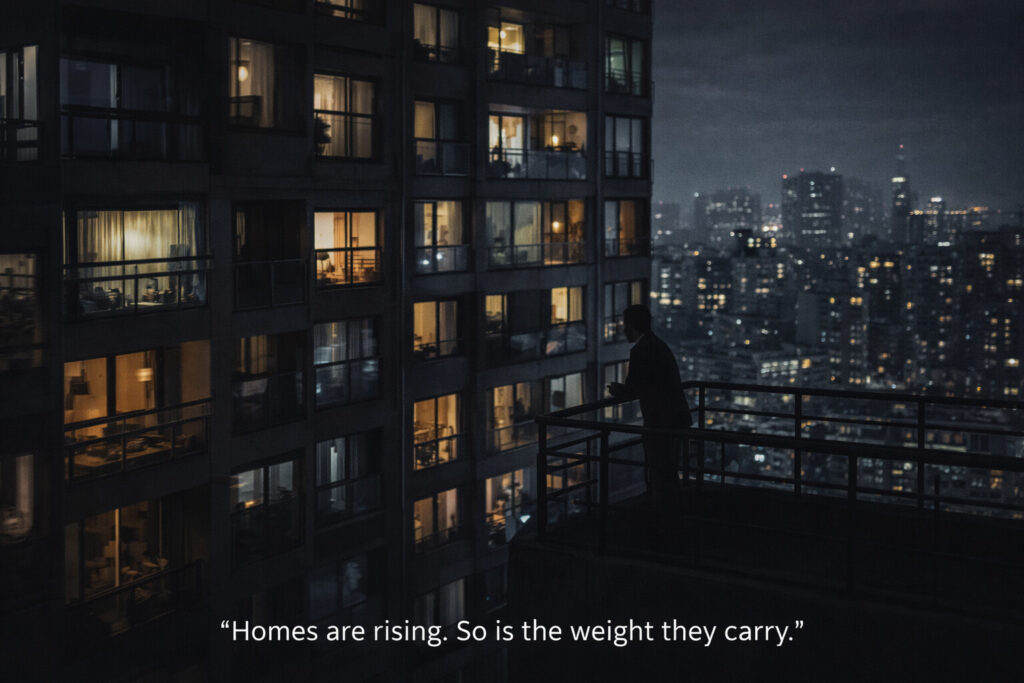
Housing used to be a basic need.
Today, it is a financial battlefield.
In the U.S. and Europe:
- Home prices grew faster than wages
- Mortgage rates rose
- Renting became long-term
In India:
- Property turned into an investment vehicle
- Cities expanded, but affordability shrank
- Families stretch 20–30 years into the future
A home is no longer just shelter.
It is a lifetime commitment.
And every EMI reduces emotional freedom.
What Vietnam Reveals About the Future
Recently, I came across a short video about Vietnam that made me pause.
A country with GDP per capita far lower than the U.S., Europe, or even India, yet building cities that look like tomorrow.
So what’s happening?
Vietnam is not “richer” than these nations. But it is earlier in its growth cycle.
- Land is still affordable
- Labor is still cheap
- Urban dreams are still fresh
- The middle class is just being born
In mature economies, growth now benefits systems more than people.
In emerging economies, growth still feels like opportunity.
The pain you feel today is not personal failure.
It is what happens when an economy grows up.
The middle class is strongest when growth is young.
It struggles when growth becomes complex.
Why the Gap Keeps Widening
Three long-term forces are reshaping the middle class everywhere:
- Capital Moves Faster Than Labor
Money travels instantly. Wages do not. - Assets Grow Faster Than Income
Homes, stocks, and land rise faster than salaries. - Technology Compresses Opportunity
Fewer people capture more value.
This creates a world where:
- Owners feel richer
- Earners feel tighter
- Savers feel left behind
The middle class lives in between.
The Emotional Cost
The hardest part is not the math.
It’s the feeling.
- “I did everything right.”
- “I studied.”
- “I work hard.”
- “Why does it still feel fragile?”
This is not weakness.
It is awareness.
This growing financial anxiety in 2025 is not just about income, but rising costs and uncertainty. Many readers who feel this pressure also resonate with what I wrote in my article on financial anxiety in 2025, where I explain how money stress silently shapes daily decisions.
A generation ago, stability was promised.
Today, stability must be built.
That shift changes everything.
What the Middle Class Can Actually Do
My strategy has been simple: protect cash first, grow skills second, and only then think about returns. In this environment, survival comes before optimization.
There is no magic solution.
But there is a new mindset.
- Build Cash Resilience
Emergency funds are not optional anymore.
If you’re unsure where to start, this guide on financial resilience in 2025 shows simple ways to build safety without feeling overwhelmed.
- Think in Skills, Not Just Degrees
Income must grow faster than inflation.
Tools and systems are changing fast. I shared practical ways to adapt in my post on AI in personal finance, which explains how technology can become an ally instead of a threat.
- Own Something That Grows
Even small investments create alignment with growth.
For beginners, I’ve broken this down in simple terms in my article on low-risk investments for beginners, especially for those who fear losing money.
- Control Lifestyle Creep
Not to live smaller. To live freer. - Accept That the Old Map Is Gone
New world. New rules. New strategies.
The middle class is not dying.
It is being asked to evolve.
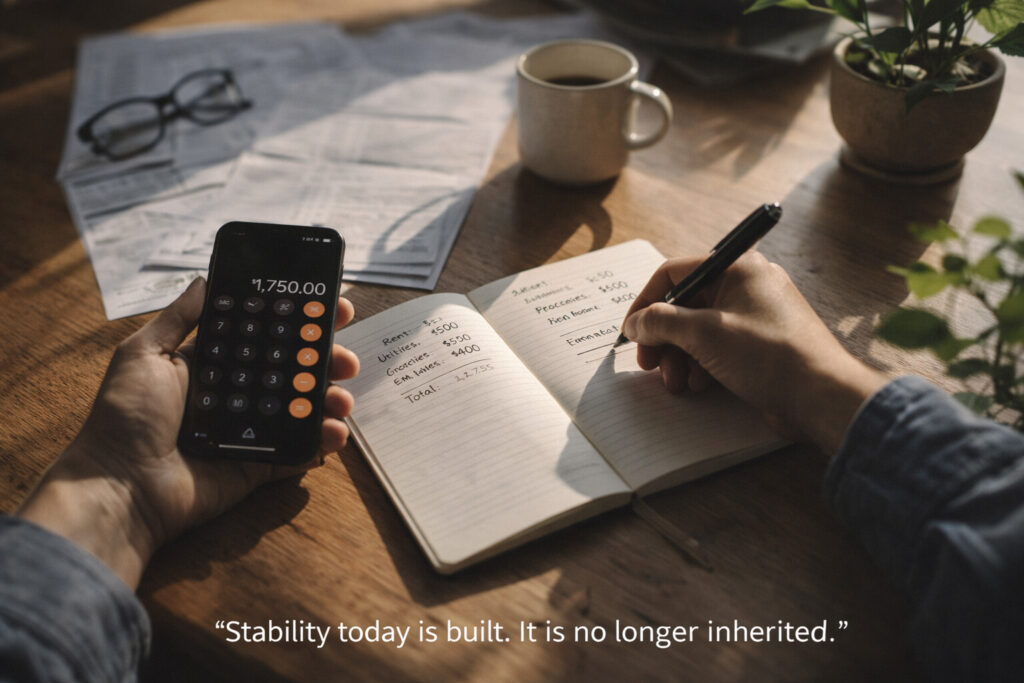
Many people begin this journey by rethinking small habits. If you want a starting point, this piece on budgeting tips for 2025 can help you regain a sense of control.
A Final Thought
You are not imagining it.
Life is heavier.
Not because you failed.
But because the world shifted quietly.
The middle class was built for a slower economy.
Today’s economy moves faster than habits, systems, and expectations.
The future belongs not to the richest,
but to those who adapt early.
I write about how technology, AI, and money quietly reshape everyday life.
FAQs
1. Why does the middle class feel poorer in 2025?
Because living costs are rising faster than salaries. Inflation, housing, healthcare, and education quietly reduce purchasing power even when income grows.
2. Why does GDP growth not improve daily life?
GDP measures production, not comfort. Growth often benefits corporations and asset owners first, not households.
3. Is the middle class disappearing?
Not disappearing, but reshaping. Stability is no longer automatic. It must be designed.
4. Why is housing such a big problem everywhere?
Homes became investment assets. That pushes prices beyond what salaries can follow.
5. What can middle-class families do today?
Focus on cash buffers, skill growth, controlled spending, and long-term ownership of assets.