What if your personal financial advisor never slept, never charged a fee, never judged your spending habits, and knew your exact bank balance at every moment of every day?
That advisor exists today. It is artificial intelligence and in 2026, it is no longer a luxury for Silicon Valley billionaires or Wall Street firms. It is sitting in your phone, available to anyone with a ₹0 subscription.
Real Life AI Money Examples
How students use AI for budgeting
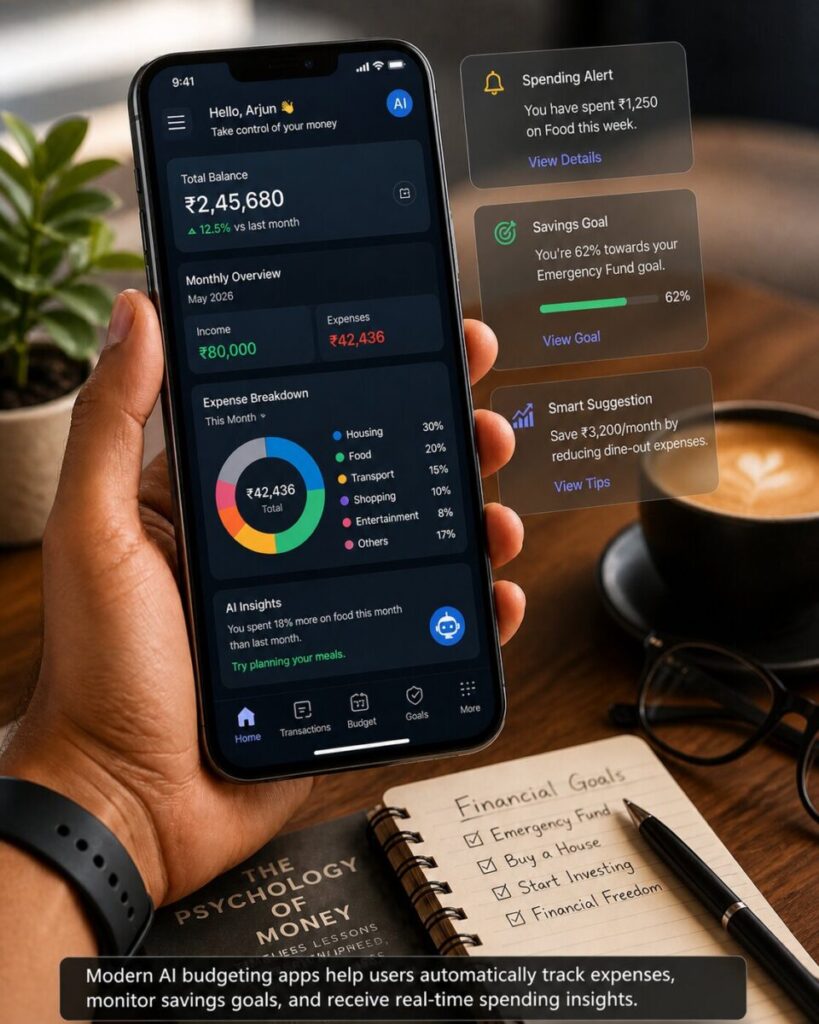
A student may not have a big income, but small spending mistakes can still hurt. AI budgeting tools can help track daily expenses, separate needs from wants, and show where money quietly disappears every month.
For example, if a student spends on food delivery, subscriptions, transport, and small online purchases, AI can group those expenses and show simple patterns. This makes money management feel less confusing.
For example, many students now use AI budgeting tools to track food delivery spending, subscriptions, transport expenses, and small online purchases that quietly affect their monthly savings.
How freelancers use AI to manage irregular income
Freelancers do not always earn the same amount every month. One month can be strong, and the next month can feel uncertain.
AI tools can help freelancers estimate monthly cash flow, plan taxes, track invoices, and avoid spending too much after a good income month. This is useful because freelancers need discipline more than perfect financial knowledge.
How AI helps track subscriptions
Many people lose money through small subscriptions they forget about. Streaming apps, cloud storage, software tools, and trial plans can quietly reduce savings.
AI-based money apps can detect recurring payments and remind users when something is no longer useful. This small habit can save money without requiring major lifestyle changes.
How AI helps compare investments
AI cannot guarantee profits, but it can help beginners compare investment options more clearly.
For example, someone can use AI to understand the difference between index funds, robo-advisors, mutual funds, and individual stocks. The final decision should still be made carefully, but AI can reduce confusion and help people ask better questions.
AI personal finance 2026 has quietly transformed from a buzzword into a practical, powerful set of tools that everyday people students in Mumbai, salaried professionals in Bengaluru, small business owners in Pune are using right now to budget smarter, invest automatically, earn more, and stop leaking money month after month.
Someone who is completely new to investing can start by learning the basics through this simple guide on AI investing for beginners before making long-term financial decisions.
But here is the honest truth: most people do not know where to start. There are hundreds of AI finance tools, dozens of robo-advisors, and an overwhelming number of ChatGPT prompts floating around the internet most of them vague, incomplete, or written for a Western audience that earns in dollars.
This AI personal finance 2026 guide is different. It is built specifically for you the person who wants to use AI personal finance 2026 tools to build real wealth, whether you are starting from zero or already investing and want to do it smarter.
By the end of this article you will know exactly which AI tools to use, how to use them, what to watch out for, and how to take your first step today not someday.
| 📌 What You Will Learn in This Guide This AI personal finance 2026 roadmap is designed for beginners, professionals, freelancers, and long-term investors alike. |
| → What AI personal finance actually means in practical terms |
| → The best AI budgeting tools available in India in 2026 |
| → How robo-advisors work and which ones to use |
| → How to use AI to find extra income streams |
| → How AI helps you manage debt and automate savings |
| → The real risks of AI in finance nobody talks about |
| → A step-by-step action plan to start using AI for your money this week |

Section 1: What Is AI Personal Finance 2026 and Why This Year Is the Tipping Point
Artificial intelligence in personal finance simply means software that uses machine learning, data analysis, and natural language processing to help you make better financial decisions faster and more accurately than you could on your own.
But here is what makes 2026 different from five years ago: the AI tools available today do not just analyze your data. They talk to you in plain language, explain their recommendations, and learn from your specific spending patterns over time. They are genuinely useful for non-technical people, not just engineers and data scientists.
There are three broad categories of AI in personal finance:
| Category | What It Does | Example Tools | Who It Is For |
| AI Budgeting | Tracks spending, identifies patterns, gives real-time alerts | Cleo, Walnut, INDmoney | Everyone start here |
| AI Investing | Builds and manages your portfolio automatically | Zerodha Coin, Groww, Wealthfront | Anyone with ₹500+/month to invest |
| AI for Earning | Helps you create content, find gigs, write pitches | ChatGPT, Jasper, Canva AI | Freelancers, side hustlers, entrepreneurs |
The 2026 tipping point comes down to three things: AI became dramatically more accurate, dramatically easier to use, and dramatically cheaper (often free). According to a recent report by McKinsey & Company on AI adoption in financial services, AI-powered financial tools are now used by over 42% of millennials in emerging markets.
For India specifically, the combination of UPI’s digital payment infrastructure, the rise of SEBI-regulated fintech platforms, and the explosion of affordable smartphones has created the perfect environment for AI finance tools to thrive. India is not behind the curve on this. In many ways, with its mobile-first fintech ecosystem, India is ahead of it.
“If you are reading this from outside India the UK, US, UAE, Canada, or Singapore everything in this guide applies to you too. Swap INDmoney for your local equivalent (Mint, Personal Capital, or Emma), and replace Zerodha with Vanguard or Fidelity. The AI principles are identical. The tools just wear different names.”
Why AI Personal Finance 2026 Is Growing So Fast
“Three forces are driving this shift simultaneously: AI accuracy has improved dramatically, the cost has dropped to zero for most tools, and India’s UPI infrastructure has made digital finance accessible to 500 million+ people who previously had no access to financial services. The result is a perfect storm and you are in the right place at the right time.”
Section 2: AI Personal Finance 2026: Budgeting Tools That Actually Work
Budgeting is where most people’s financial journey breaks down. It is not that people do not know they should budget. They do. The problem is that manual budgeting is boring, time-consuming, and easy to abandon after three weeks.
In AI personal finance 2026, budgeting tools solve this problem by automatically tracking spending patterns and improving financial awareness.
Cleo The AI Budgeting Assistant That Actually Talks Back
Cleo is an AI-powered financial assistant available via app and web. You connect your bank account, and Cleo immediately starts analyzing your spending. What makes Cleo different from a basic budgeting app is that it uses conversational AI you can literally ask it questions like ‘How much did I spend on food last month?’ or ‘Can I afford a ₹8,000 purchase right now?’ and it answers in plain language, with context.
Cleo also has a ‘Roast Mode’ it humorously calls out your worst spending habits and a ‘Hype Mode’ that celebrates your wins. It sounds gimmicky but it works. Behavioural finance research consistently shows that emotional engagement improves financial follow-through.
Availability: Cleo works globally and is accessible in India. Free tier available; Cleo Plus is approximately $5.99/month.
INDmoney India’s Most Complete AI Finance Dashboard
INDmoney is arguably the most powerful all-in-one financial AI tool built specifically for the Indian market. It connects to your bank accounts, credit cards, mutual funds, stocks, EPF, PPF, and even your LIC policies giving you a single net worth dashboard updated in real time.
Its AI layer analyses your entire financial picture and gives specific, actionable recommendations: ‘You are paying ₹3,200/month in credit card interest switching to this SBI card would save you ₹38,400/year.’ That is the level of personalisation that used to require a paid financial advisor.
INDmoney is SEBI-registered, free to use, and handles everything from mutual fund investments to US stock purchases. For Indian users, this is the single most important AI finance app to download.
“For a deeper comparison of AI money management apps available in India right now, read our detailed breakdown of the best AI money management and budgeting apps“
ChatGPT as Your Personal Budget Coach
Do not underestimate ChatGPT as a budgeting tool. While it does not connect to your bank account, it is extraordinarily powerful when you give it your numbers manually. Here is an example prompt you can use today:
| 💬 Sample ChatGPT Budget Prompt Copy and Use This |
| “I earn ₹55,000/month after tax. My fixed expenses are: Rent ₹14,000, EMI ₹8,500, phone ₹799, gym ₹1,200. My variable expenses last month were: food ₹9,800, transport ₹3,200, entertainment ₹4,100, shopping ₹6,500. I want to save ₹12,000/month and start a SIP. Create a realistic monthly budget for me, identify my top 2 spending leaks, and suggest one specific thing to cut or reduce.” |
| When you paste your real numbers, ChatGPT will give you a detailed, personalized budget for free. |
| AI Budgeting Tool | Monthly Cost | Best Feature | India Availability | Best For |
| INDmoney | Free | Complete net worth dashboard, all Indian accounts in one place | ✅ Yes India-first | All Indian users |
| Cleo | Free / $5.99 | Conversational AI, spending personality insights | ✅ Yes (global) | Young earners, first-time budgeters |
| Walnut | Free | Automatic SMS-based expense tracking, no bank login needed | ✅ Yes India-first | Privacy-conscious users |
| YNAB (You Need A Budget) | ~₹1,200/month | Zero-based budgeting system with AI insights | ✅ Yes (global) | Serious budgeters, debt elimination |
| ChatGPT (GPT-4) | Free / ₹1,650 Plus | Custom analysis, budget creation, Q&A | ✅ Yes (global) | DIY finance, learning, planning |
Section 3: AI Personal Finance 2026: Robo-Advisors and Smart Portfolios
Investing is the part of personal finance where AI delivers its most dramatic results and where most people in India are still leaving enormous wealth on the table.
The average Indian who ‘invests’ keeps 60–70% of their savings in a fixed deposit earning 6–7% annually. Meanwhile, the Nifty 50 has delivered approximately 13–14% CAGR over the last 20 years. The difference over a 25-year period on a ₹5,000/month investment is the difference between ₹67 lakhs and ₹1.98 crore. That gap ₹1.31 crore is the cost of fear, inertia, and lack of guidance.
AI-powered robo-advisors solve all three of those problems.
One of the biggest shifts in AI personal finance 2026 is the rise of low-cost robo-advisors for beginner investors.

Beginners who want to understand how automated investing works can explore our Smart AI Investing for Beginners in 2026 guide, where we explain robo-advisors, AI investing apps, portfolio automation, and how to start investing step by step.
What Is a Robo-Advisor?
A robo-advisor is an AI-powered investment platform that automatically builds and manages a portfolio for you based on your financial goals, risk tolerance, and investment timeline. It does what a human financial advisor does analyzes your situation, selects appropriate funds, rebalances periodically but at a fraction of the cost and without the minimum investment requirements that make human advisors inaccessible to most people.
“We have written a complete hands-on guide to robo-advisors and automated investing if you want to go deeper on how these platforms work before choosing one.”
| Robo-Advisor | Platform | Minimum Investment | Annual Fee | Best For |
| Zerodha Coin | Coin by Zerodha | ₹100 SIP | 0% (direct funds) | Low-cost index fund investing |
| Groww | Groww App | ₹1 SIP | 0% (direct funds) | Beginners, ease of use |
| INDmoney AI Advisor | INDmoney | ₹500 | Free / Premium ₹999/yr | Holistic goal-based planning |
| ET Money Genius | ET Money | ₹500 SIP | ₹299/month | Tax-optimised portfolios |
| Scripbox | Scripbox.com | ₹3,000 SIP | 0.3–0.5% AUM | Curated portfolio, hands-off investing |
How a Robo-Advisor Actually Works Step by Step
- You answer 8–12 questions about your income, goals, timeline, and risk comfort.
- The AI analyses thousands of fund combinations and builds a personalised portfolio typically a mix of equity, debt, and gold funds in proportions matched to your profile.
- Your money is automatically invested each month via SIP.
- The AI monitors market movements and rebalances your portfolio quarterly selling over-allocated assets and buying under-allocated ones keeping you on track without emotion.
- You receive plain-language reports explaining how your investments are performing and whether you are on track for your goals.
A Real Example: Priya’s SIP Transformation
Priya, 28, a marketing executive in Pune, had been keeping ₹8,000/month in a savings account for three years because she found investing ‘too complicated.’ She signed up with Groww’s AI advisor, answered the onboarding questions in 11 minutes, and had her first SIP active the same evening split across a Nifty 50 index fund (60%), a flexi-cap fund (25%), and a liquid fund for emergency access (15%).
Eighteen months later, her ₹1.44 lakh corpus had grown to ₹1.71 lakh a 18.7% return in a period when her savings account would have earned ₹9,216 at 6.4% interest. The difference was ₹52,584. The time investment: 11 minutes to set up, zero ongoing effort.
That is what AI investing does. It removes the barrier between knowing you should invest and actually investing.
“Never invested before and not sure where to begin? Our step-by-step guide on how to start investing and build wealth walks you through your first SIP from scratch.”
Section 4: Using AI to Find and Grow Extra Income in 2026
The most underused application of AI in personal finance is income generation. Most people think of AI as a tool for managing existing money. Smart people also use it to make more money.
The AI side hustle economy is real and growing rapidly. In 2025, a survey by Fiverr found that freelancers who actively used AI tools earned an average of 38% more than those who did not — not because AI replaced their work, but because it allowed them to take on more clients, produce higher-quality output faster, and offer new services they previously could not. We have already reviewed the top performers in detail — see our full list of the best AI tools to make money online in 2026 for specific earning estimates, pricing, and setup guides for each tool.
AI personal finance 2026 is not only about saving money. It is also about increasing your income through AI-assisted work and the barrier to entry has never been lower.
AI Tools for Freelancers and Content Creators
| AI Tool | What It Does | Monthly Cost | Earning Application |
| ChatGPT Plus | Write, edit, brainstorm, code, analyse in any language | ₹1,650/month | Blog writing, email marketing, social media content for clients |
| Canva AI (Magic Studio) | Design graphics, presentations, videos with AI prompts | Free / ₹4,000/yr | Social media management, pitch decks, YouTube thumbnails |
| Jasper AI | Professional marketing copy, ad scripts, landing pages | ~$39/month | Copywriting freelance work, content marketing agency services |
| ElevenLabs | AI voice generation for podcasts and videos | $5–$22/month | YouTube voiceovers, podcast production, audiobook narration |
| Midjourney / Adobe Firefly | AI image generation for commercial use | $10–$30/month | Selling AI art, creating visual content for brands |
| Notion AI | Research synthesis, note-taking, report generation | ₹830/month | Research as a service, knowledge work, virtual assistance |

3 AI Side Hustles You Can Start This Month
1. AI-Assisted Blog Writing for Businesses
Hundreds of small businesses in India need blog content but cannot afford a full-time writer. Using ChatGPT, you can research, outline, draft, and edit a 1,500-word blog post in under 90 minutes. Charge ₹2,000–₹5,000 per post. With 8 posts/month, that is ₹16,000–₹40,000 in additional income. Platforms to find clients: LinkedIn, Trello, Upwork, Fiverr.
2. AI Social Media Management
Local businesses restaurants, clinics, coaching institutes, retail shops desperately need social media content but have no time to create it. Use ChatGPT to write captions, Canva AI to design posts, and Buffer to schedule them. Offer a monthly package of 20 posts for ₹6,000–₹12,000/month. Managing three clients gives you ₹18,000–₹36,000 extra per month on a part-time basis.
3. AI-Powered Resume and LinkedIn Optimization
Job seekers will pay ₹1,500–₹3,500 for a professionally rewritten resume and optimized LinkedIn profile. ChatGPT can produce a high-quality resume in 30 minutes when given the right information. You provide the human touch understanding the client’s goals, asking the right questions, and tailoring the output. This side hustle requires zero technical skills beyond prompting.
Section 5: AI for Debt Management and Automated Savings
Debt reduction has become a major use case within AI personal finance 2026 platforms.
Two of the most damaging financial habits are: (1) carrying expensive debt without a plan, and (2) trying to save what is ‘left over’ at the end of the month. Both can be solved with AI.
How AI Helps You Eliminate Debt Faster
AI debt management tools work by analysing your complete debt picture all your loans, credit cards, and EMIs and calculating the mathematically optimal repayment strategy. They can run thousands of scenarios in seconds that would take hours to calculate manually.
Here is what AI will tell you about the two primary debt repayment strategies:
| Strategy | How It Works | Best For | AI Tool to Use |
| Debt Avalanche | Pay minimum on all debts, put every extra rupee toward the highest-interest debt first. Mathematically saves the most money in interest. | Anyone who can stay motivated saves the most money overall | ChatGPT (run the calculation), Undebt.it |
| Debt Snowball | Pay minimum on all debts, put every extra rupee toward the smallest balance first. Psychological wins keep you motivated. | Anyone who needs emotional momentum credit card clutter, multiple small loans | Undebt.it, YNAB |
“If the Snowball method feels right for your situation, read our complete guide on the snowball debt reduction method with a month-by-month payoff plan.”
You can ask ChatGPT to compare both strategies for your exact debt situation. Here is the prompt:
| 💬 ChatGPT Debt Elimination Prompt |
| “I have the following debts: Credit Card 1: ₹45,000 balance, 36% annual interest, minimum payment ₹2,250. Personal Loan: ₹1,20,000 balance, 18% annual interest, EMI ₹5,800. Two-wheeler loan: ₹28,000 balance, 14% interest, EMI ₹2,100. I can put an extra ₹4,000/month toward debt repayment. Show me a month-by-month repayment schedule using both the Avalanche and Snowball methods, and tell me how much total interest I save with each strategy.” |
| ChatGPT will produce a complete repayment plan something a financial advisor would charge ₹2,000–₹5,000 to create. |
AI-Powered Automated Savings. The Set-and-Forget Wealth Builder
The single most effective savings strategy is automation paying yourself first before you have a chance to spend the money. AI makes automation smarter than ever before.
- Round-up savings: Apps like Jar (India) automatically round up every UPI transaction to the nearest ₹10 and invest the difference in digital gold. You invest without noticing.
- Goal-based automated SIPs: INDmoney and ET Money allow you to create named goals (Emergency Fund, Holiday, Home Down Payment) and automatically invest the right amount in the right fund for each goal.
- Salary-day automation: Set your SIP date to the 1st or 2nd of each month the day after your salary arrives. This removes the decision entirely. You invest before you can spend.
- AI savings nudges: Apps like Cleo analyse your spending and send intelligent nudges: ‘You have spent less on dining out this week want to move ₹500 to your Emergency Fund?’
Section 6: The Real Risks of AI in Finance. What Nobody Tells You
This section is important. Every article about AI in finance will tell you about the opportunities. Fewer will tell you about the genuine risks. You deserve both.
Like every technology trend, AI personal finance 2026 also comes with risks users should understand clearly.
Risk 1: Data Privacy and Security
Before investing through any robo-advisor or fintech app, users should verify whether the platform is registered with the Securities and Exchange Board of India (SEBI).
Every AI financial tool that connects to your bank account has access to sensitive data. Before you grant any app access to your financial accounts, verify: Is the app SEBI-registered or RBI-approved (for Indian apps)? Does it use 256-bit bank-level encryption? What exactly does it do with your transaction data and does it sell it to advertisers?
For Indian users: INDmoney, Groww, Zerodha, and ET Money are all regulated and have strong security records. Be cautious with lesser-known apps that promise financial analysis without clear regulatory backing.
Risk 2: AI Bias in Financial Recommendations
AI models learn from historical data. If that historical data reflects biases for example, lower credit scores for certain demographics or geographies the AI may perpetuate those biases in its recommendations. This is particularly relevant for credit scoring and loan approval AI systems. Always get a second opinion on any AI-generated recommendation involving significant financial commitments.
Risk 3: Over-Reliance and the Illusion of Certainty
AI tools can sound extremely confident even when they are wrong. A robo-advisor cannot predict market crashes. ChatGPT’s financial calculations, while usually accurate, can make errors with complex tax scenarios. No AI tool should be your only source of advice for major decisions buying property, taking a large loan, planning retirement, or making a significant single-stock investment. Use AI to inform and educate, not to make the final call.
Risk 4: Subscription Creep
It is easy to sign up for five AI finance tools, each charging ₹200–₹1,500/month, and end up spending more on finance apps than you save using them. Be deliberate. For most people, INDmoney (free) + ChatGPT free tier + one robo-advisory SIP is completely sufficient. Add tools only when you have genuinely outgrown what you have.
| ⚠️ Golden Rule: AI Is a Co-Pilot, Not the Pilot |
| Use AI finance tools to: understand your money better, automate routine decisions, learn faster, find options you did not know existed. |
| Do NOT use AI to: replace professional advice for complex tax or legal situations, make panic decisions during market downturns, invest money you cannot afford to lose based on AI recommendations alone. |
Section 7: Your Step-by-Step Action Plan Start Using AI for Your Money This Week
Everything above means nothing if you do not act. Here is your precise, no-overwhelm action plan one step per day for your first week.
| Day | Action | Time | Tool |
| Day 1 | Download INDmoney and link all your financial accounts bank, cards, investments. Review your first net worth report. | 20 minutes | INDmoney (free) |
| Day 2 | Use the ChatGPT budget prompt from Section 2 with your real numbers. Identify your top 2 spending leaks. | 30 minutes | ChatGPT (free) |
| Day 3 | Sign up for a robo-advisory SIP on Groww or Zerodha Coin. Start with as little as ₹500/month. Just start. | 15 minutes | Groww / Zerodha |
| Day 4 | Ask ChatGPT to calculate your debt payoff plan using the prompt in Section 5. Identify which debt to attack first. | 20 minutes | ChatGPT (free) |
| Day 5 | Set up one automated savings rule either a SIP on the 1st of the month or round-up savings via Jar. | 10 minutes | INDmoney / Jar |
| Day 6 | Explore one AI income tool from Section 4. Write one piece of AI-assisted content (a blog post, a social post, a resume) and show it to someone who might pay for it. | 60 minutes | ChatGPT / Canva AI |
| Day 7 | Review your week. Calculate: how much did you spend? How much did you invest? How much did you save? Set a monthly money date 30 minutes every month to review your INDmoney dashboard. | 15 minutes | INDmoney + calendar |
Seven days. Seven steps. By the end of this week, you will have a live net worth dashboard, an active SIP, a debt elimination plan, an automated savings rule, and your first experiment with AI-powered income. That is more financial progress than most people make in a year.
Related AI Finance Guides
If you want to explore this topic deeper, read these next:
- AI Investing for Beginners
- Human vs AI Investing
- Robo-Advisors in 2025
- AI Money Management Apps
- ChatGPT Shopping Research
Frequently Asked Questions About AI Personal Finance 2026
Q: Is AI personal finance safe to use in India?
Yes, provided you choose SEBI-registered or RBI-approved platforms. Apps like INDmoney, Groww, Zerodha, and ET Money use bank-level 256-bit encryption and are regulated by India’s financial authorities. Always read the privacy policy before connecting your bank account, and avoid lesser-known apps without clear regulatory disclosure. For ChatGPT-based financial planning, you can share your numbers without connecting any accounts, keeping your data completely offline.
Q: Can AI really replace a human financial advisor?
For everyday budgeting, SIP-based investing, and basic tax planning, AI robo-advisors in 2026 match or exceed what a typical human advisor offers at zero or near-zero cost. However, for complex situations estate planning, business finance, NRI taxation, inheritance, or making large single-stock bets a qualified human Certified Financial Planner (CFP) is still the right choice. Think of AI as your always-on financial assistant and a human advisor as the specialist you consult for major decisions.
Q: What is the best free AI finance tool for beginners in India?
INDmoney is the best starting point for Indian users it is free, SEBI-registered, and connects all your Indian financial accounts (bank, mutual funds, EPF, stocks) into a single net worth dashboard. Pair it with the free version of ChatGPT for budgeting, planning, and learning, and you have a powerful financial management system that costs nothing.
Q: How does a robo-advisor make money if the service is free?
Indian robo-advisors like Groww and Zerodha Coin primarily earn through the direct fund structure (a small platform fee on some transactions) or through premium subscription tiers. Scripbox and ET Money Genius charge an annual AUM-based fee or subscription. The key is to check whether the platform invests you in ‘direct’ mutual fund plans (lower expense ratio, better returns) or ‘regular’ plans where they earn distributor commissions. Always prefer direct plans Zerodha Coin and Groww both use these by default.
Q: Can I use ChatGPT for tax planning in India?
ChatGPT is excellent for understanding tax concepts explaining Old vs New Tax Regime, calculating HRA exemptions, understanding 80C deductions, or comparing ELSS vs PPF. However, for actually filing your ITR or making complex tax optimization decisions, always verify ChatGPT’s output with the official Income Tax website (incometax.gov.in) or a CA. ChatGPT’s training data has a cutoff and may not reflect the most current budget changes.
Q: What is the minimum amount needed to start AI-powered investing in India?
You can start with as little as ₹1 on Groww and ₹100 on Zerodha Coin. The actual minimum that makes meaningful long-term impact is ₹500/month, compounded consistently. The point is not the amount it is the habit. A ₹500/month SIP started at age 24 and increased by ₹500 each year will significantly outperform a ₹5,000/month SIP started at age 34. Start now with whatever you have.
Q: Are AI side hustles using ChatGPT ethical and legal?
Using AI to assist your work writing, design, analysis is completely legal and increasingly standard practice in the industry. The ethical line is transparency: if a client specifically asks for work written entirely by a human, disclose your use of AI. For most freelance and content work, AI is treated like any other tool using Microsoft Word to write does not make the content less yours, and neither does using ChatGPT. Always deliver value, review AI output carefully before submitting it, and bring your own judgment, expertise, and personality to the work.
Q: What happens to my money if an AI fintech app shuts down?
Your money is safe. When you invest through Groww, Zerodha, or INDmoney, your mutual fund units are held with CAMS or KFintech (India’s registrar and transfer agents) not with the app. If the app shuts down, your investments remain in your name and can be accessed through the fund house directly or transferred to another platform. This is why SEBI requires all investment platforms to use these independent depositories. Your money is always yours, regardless of what happens to the technology company.
Over the past year, I have tested multiple AI budgeting and investing tools while building PennyPowerPlay. Some tools genuinely save time and improve financial awareness, while others overcomplicate simple money habits. The biggest lesson I learned is that AI works best when it supports consistent financial behaviour instead of replacing human judgment.
Final Thoughts: AI Personal Finance 2026 Is Not the Future It Is the Present
There is a common misconception that using AI for personal finance is complicated, risky, or only for tech-savvy people. Every section of this guide disproves that idea.
INDmoney is free and takes 20 minutes to set up. A ChatGPT budget analysis costs nothing and takes 30 minutes. A Groww SIP starts at ₹1 and takes 15 minutes to activate. An AI-assisted freelance service can earn you extra income this month.
The real barrier to using AI for your finances is not complexity. It is starting. And the reason most people do not start is that they keep waiting for the perfect moment, the perfect amount, the perfect understanding. That moment never comes.
Your 2026 self will look back on the financial decisions you make today not the ones you planned to make. Start with one tool. One SIP. One automated savings rule. Let AI handle the complexity while you focus on the habits.
The gap between people who build wealth and people who struggle is rarely intelligence or income. It is consistency, automation, and increasingly knowing which tools to use.
Now you know. The next step is yours.
| 🔗 What to Read Next Continue Your AI + Money Journey |
| → Best AI Tools to Make Money Online in 2026 (Proven Picks) pennypowerplay.com |
| → How to Start Investing in 5 Simple Steps (Build Wealth) pennypowerplay.com |
| → The Complete Financial Education Roadmap: 90 Days to Financial Literacy pennypowerplay.com |
| → Why Financial Education Means More Than Ever in 2025 pennypowerplay.com |
| → The Complete Guide to Financial Psychology pennypowerplay.com |
Did this guide help you? Drop a comment below I read every one. And if you are already using an AI tool for your finances, share which one is making the biggest difference for you.