Understanding the hidden costs of buying a home in India can help buyers prepare for expenses that are often overlooked.
Most people think buying a home is simple.
Find a property.
Arrange the down payment.
Get a home loan approved.
Pay the EMI.
Move in.
Unfortunately, real life is rarely that straightforward.
During my eight years in the housing finance industry, I met hundreds of home buyers. Many carefully planned their down payment and monthly EMI but completely overlooked several additional expenses that appear during the home-buying process.
I still remember one first-time buyer who found a property worth ₹50 lakh. He had managed to save ₹10 lakh for the down payment and was relieved when his home loan was approved.
Everything seemed perfect until the registration process started.
Suddenly, he was asked to pay stamp duty, registration charges, legal verification fees, processing charges, and other expenses he had never budgeted for.
The total additional amount came close to ₹4 lakh.
Since most of his savings had already gone toward the down payment, he had to borrow money from relatives just to complete the purchase.
The surprising part is that his situation was not unusual.
Many buyers focus entirely on the property’s listed price and forget that the true cost of buying a home is often much higher.
A ₹50 lakh property may require significantly more cash than expected before you can comfortably move in.
How Much Extra Cash Do You Need Besides the Down Payment?
Before looking at the individual expenses, here’s a quick estimate of how much extra cash home buyers typically need beyond the down payment.
| Property Value | Estimated Extra Cash Needed |
|---|---|
| ₹30 Lakh | ₹3–6 Lakh |
| ₹50 Lakh | ₹6–10 Lakh |
| ₹1 Crore | ₹12–20 Lakh |
Understanding the hidden costs of buying a home in India can help you avoid financial stress and make better decisions before signing a property agreement.
In this guide, we will explore the hidden costs of buying a home in India, how much money you may need besides the down payment, which expenses are negotiable, and how to prepare financially for one of the biggest purchases of your life.
Why Most Buyers Underestimate the True Cost of Home Ownership
Many buyers focus on loan approval without asking whether the monthly payment will comfortably fit their budget. Before choosing a property, it’s important to understand how much home loan EMI you can really afford.
One of the biggest mistakes first-time home buyers make is assuming that the property’s listed price represents the total amount they need to pay.
In reality, the property price is only one part of the overall cost.
Let’s assume you are purchasing a property worth ₹50 lakh.
You may think your financial planning looks something like this:
- Property Price: ₹50 lakh
- Down Payment: ₹10 lakh
- Home Loan: ₹40 lakh
Many buyers stop their calculations here.
However, the actual expenses do not end with the down payment.
You may also need funds for:
- Stamp duty
- Registration charges
- Processing fees
- Legal verification charges
- Technical inspection charges
- GST on service fees
- Interior work
- Furniture and appliances
- Society deposits
- Moving expenses
- Emergency savings
By the time everything is completed, the actual cash requirement can be significantly higher than expected.
This is why many buyers experience financial stress immediately after purchasing a home.
They spend all their available savings on the property and leave no room for unexpected expenses.
The goal is not just to buy a home.
The goal is to buy a home without damaging your financial stability.
Hidden Cost #1: Stamp Duty Charges
Stamp duty is one of the largest hidden costs involved in purchasing a property in India.
This is a government tax that must be paid when registering the property.
The amount varies by state and may differ depending on factors such as:
- Property location
- Property type
- Buyer category
- State government regulations
Many buyers underestimate how significant this expense can be.
For example, if stamp duty is 6% and the property value is ₹50 lakh:
₹50,00,000 × 6% = ₹3,00,000
That means you need an additional ₹3 lakh beyond your down payment.
Unlike your home loan EMI, stamp duty generally requires upfront payment.
This is often the first major financial surprise for many buyers.
Stamp duty rates vary across states and buyers should verify the latest charges through their respective state government registration departments.
Is Stamp Duty Negotiable?
No.
Stamp duty is a government charge and is generally non-negotiable.
Before finalizing any property purchase, always check the latest stamp duty rates applicable in your state.
Hidden Cost #2: Registration Charges
After paying stamp duty, the property must be officially registered in your name.
Property registration creates a legal ownership record and is mandatory for completing the transaction.
Registration charges are typically around 1% of the property’s value, although rates vary by state.
For a ₹50 lakh property:
₹50,00,000 × 1% = ₹50,000
Many buyers focus so heavily on the down payment that they forget about registration expenses until the final stage of the transaction.
Is Registration Charge Negotiable?
No.
Like stamp duty, registration charges are government-imposed and cannot usually be negotiated.
Hidden Cost #3: Home Loan Processing Fees
When applying for a home loan, most banks and housing finance companies charge a processing fee.
This fee covers the cost of evaluating your loan application, reviewing documents, conducting checks, and processing the loan.
Depending on the lender, processing fees typically range from 0.25% to 1% of the loan amount.
For example:
Loan Amount: ₹40 lakh
Processing Fee: 0.50%
Cost: ₹20,000
While ₹20,000 may seem small compared to a ₹40 lakh loan, it is still a cost that should be included in your budget.
Home buyers can also review home loan-related consumer information available from the National Housing Bank.
Is Processing Fee Negotiable?
Sometimes, yes.
During my years in housing finance, I often saw lenders offer reduced processing fees during promotional campaigns.
Existing customers, salaried professionals with strong credit profiles, and customers bringing large loan amounts may sometimes negotiate lower fees.
Always ask before accepting the first offer.
Hidden Cost #4: Legal Verification Charges
Before approving a home loan, lenders conduct legal verification of the property.
This process helps confirm:
- Ownership records
- Property title
- Legal approvals
- Encumbrance status
- Compliance with local regulations
The objective is to ensure there are no legal issues that could affect ownership rights in the future.
Depending on the property and lender, legal verification charges may range from ₹5,000 to ₹25,000.
Many buyers incorrectly assume these charges are included in the loan amount.
In reality, they are often billed separately.
Hidden Cost #5: Technical Inspection and Valuation Charges
Most lenders also conduct a technical inspection and valuation of the property before approving a loan.
A technical expert visits the property and assesses factors such as:
- Construction quality
- Property condition
- Market value
- Location factors
These inspections help lenders determine whether the property supports the requested loan amount.
Typical valuation and technical inspection charges range from ₹3,000 to ₹10,000.
Although these costs may seem minor individually, they contribute to the overall cost of buying a home.
Hidden Cost #6: GST on Loan-Related Charges
Many home buyers remember the processing fee but forget that GST is applicable on several services related to the home loan process.
While GST is not charged on the home loan amount itself, it may apply to:
- Processing fees
- Legal verification charges
- Technical inspection charges
- Documentation services
- Certain administrative charges
Let’s say your lender charges:
- Processing Fee: ₹20,000
- Legal Charges: ₹10,000
- Technical Charges: ₹5,000
At first glance, the total appears to be ₹35,000.
However, GST can increase the amount further.
Although this may not be the largest expense in the home-buying process, it is another example of why buyers should request a complete cost breakdown from the lender before proceeding.
Small charges often add up to a surprisingly large amount.
Hidden Cost #7: Interior and Furnishing Expenses
In my experience, this is one of the most underestimated expenses when buying a home.
Many buyers spend months comparing property prices and negotiating loan terms but give very little thought to what happens after possession.
The reality is that an empty flat does not immediately become a comfortable home.
You may need:
- Modular kitchen
- Wardrobes
- Beds and mattresses
- Sofa set
- Dining table
- Curtains and blinds
- Lighting fixtures
- Appliances
- Water purifier
- Air conditioners
- Painting and decorative work
I have seen buyers purchase a property worth ₹50 lakh and then spend another ₹3 lakh to ₹8 lakh just to make it move-in ready.
For premium properties, the amount can be even higher.
Can Interior Costs Be Reduced?
Yes.
Unlike stamp duty and registration charges, interior expenses are largely under your control.
You can:
- Furnish gradually
- Prioritize essential items first
- Compare quotations from multiple vendors
- Avoid luxury upgrades immediately after possession
Many buyers feel pressured to complete everything at once.
In reality, it is often better to move in with the essentials and upgrade gradually over time.
Hidden Cost #8: Society Deposits and Maintenance Charges
If you are buying an apartment in a gated community or housing society, there may be additional charges beyond the property’s listed price.
Common examples include:
- Advance maintenance charges
- Corpus fund contribution
- Clubhouse membership charges
- Parking charges
- Utility connection deposits
Depending on the project, these charges can range from ₹20,000 to over ₹1 lakh.
Many builders disclose these charges only during the later stages of the transaction.
That is why I always recommend asking for a complete cost sheet before paying the booking amount.
A cost sheet should clearly show every expense associated with the purchase.
Hidden Cost #9: Moving and Setup Expenses
Moving costs may seem insignificant when compared to the property’s value, but they still deserve a place in your budget.
Typical moving-related expenses include:
- Packers and movers
- Internet installation
- Gas connection
- Water connection
- Deep cleaning services
- Minor repairs
- Electrical work
Even a local move can easily cost ₹15,000 to ₹50,000.
Long-distance relocations may cost considerably more.
Many buyers underestimate these expenses because they occur after possession rather than during the purchase process.
However, they still affect your overall budget.
Hidden Cost #10: The Emergency Fund Most Buyers Forget
If there is one lesson I learned during my years in housing finance, it is this:
Never use every rupee of your savings to buy a home.
Many buyers believe that once they have enough money for the down payment, registration charges, and interiors, they are ready to buy.
But life does not stop after you become a homeowner.
Unexpected events can happen at any time:
- Medical emergencies
- Job loss
- Vehicle repairs
- Family obligations
- Major household repairs
Unfortunately, many buyers enter home ownership with almost no cash reserves left.
This creates stress at the exact moment when buying a home should feel rewarding.
What Percentage of Savings Should You Keep Aside?
As a practical rule:
- Avoid using 100% of your savings for the purchase.
- Try to keep at least 15% to 20% of your total savings untouched.
- Maintain an emergency fund equal to six months of household expenses.
For example:
If your monthly household expenses are ₹50,000, your emergency fund should ideally be:
₹50,000 × 6 = ₹3,00,000
This provides a financial safety net after purchasing the home.
One-Time Costs vs Recurring Costs

Understanding the difference between one-time and recurring costs can help you budget more effectively.
One-Time Costs
- Down payment
- Stamp duty
- Registration charges
- Processing fee
- Legal verification charges
- Technical inspection charges
- Interior setup
- Moving expenses
Recurring Costs
- Society maintenance charges
- Property tax
- Home insurance
- Repairs and maintenance
- Utility bills
Many buyers prepare for one-time costs but forget about recurring expenses that continue every year.
How Much Cash Do You Need Besides the Down Payment?
This is one of the most common questions home buyers ask.
While every property is different, the following estimates provide a practical guideline.
| Property Value | Approximate Additional Cash Required* |
|---|---|
| ₹30 Lakh | ₹3 lakh to ₹6 lakh |
| ₹50 Lakh | ₹6 lakh to ₹10 lakh |
| ₹1 Crore | ₹12 lakh to ₹20 lakh |
*Includes stamp duty, registration, fees, interiors, moving costs, and basic emergency reserves.
These numbers will vary depending on location, state taxes, property type, and personal preferences.
However, they demonstrate why focusing only on the down payment can be dangerous.
Real Example: The True Cost of Buying a ₹50 Lakh Home
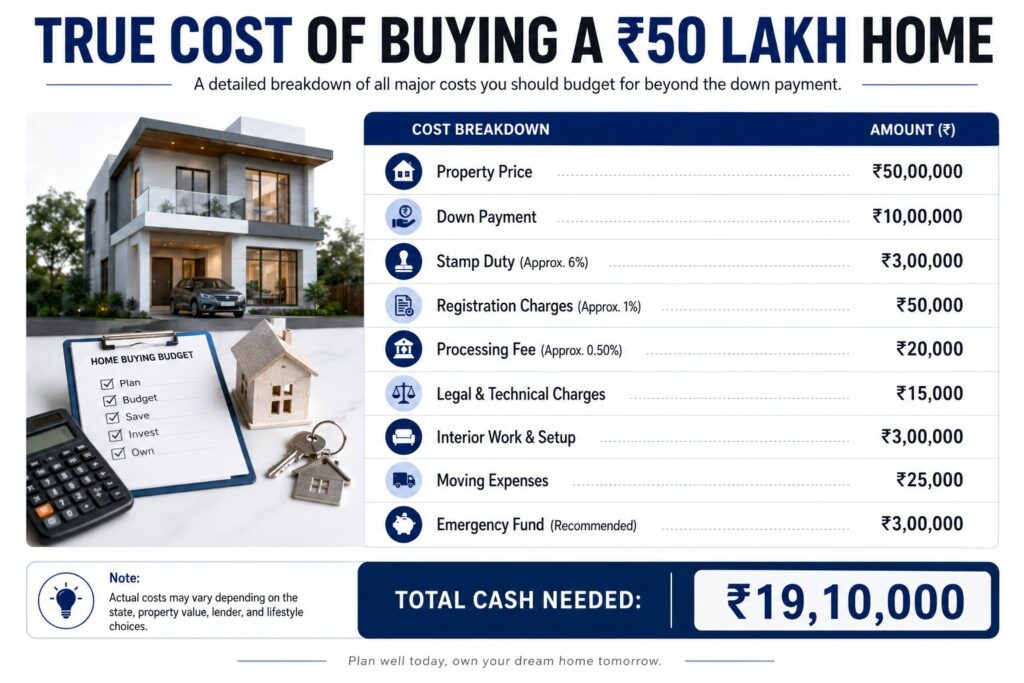
Let’s look at a realistic example.
| Expense | Amount |
|---|---|
| Property Price | ₹50,00,000 |
| Down Payment (20%) | ₹10,00,000 |
| Stamp Duty | ₹3,00,000 |
| Registration Charges | ₹50,000 |
| Processing Fee | ₹20,000 |
| Legal & Technical Charges | ₹15,000 |
| Interior Work | ₹3,00,000 |
| Moving Expenses | ₹25,000 |
| Emergency Fund | ₹3,00,000 |
| Total Cash Needed | ₹19,10,000 |
Many buyers are surprised by this calculation.
A property advertised at ₹50 lakh may require nearly ₹19 lakh in available funds before you can comfortably move in.
This is why understanding the true cost of buying a home is so important.
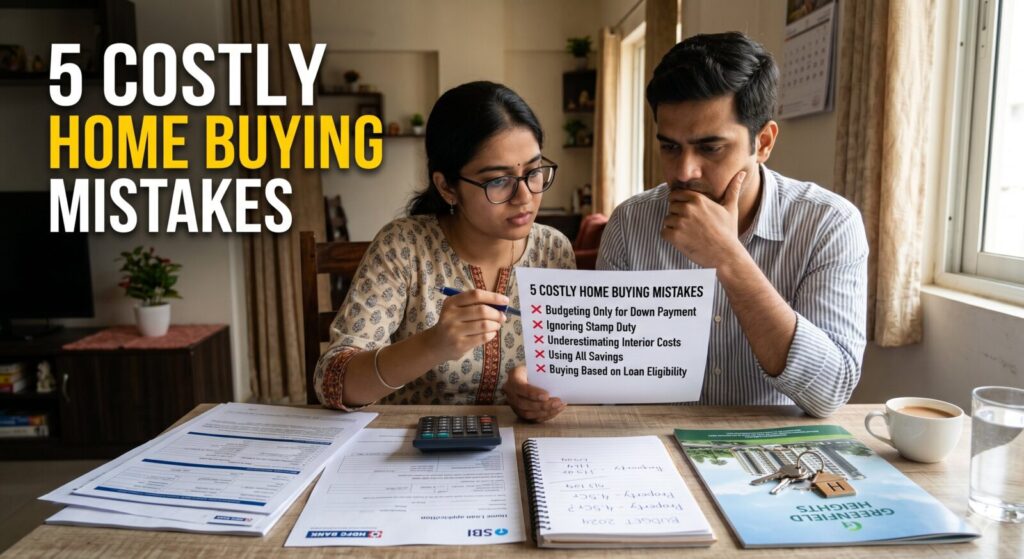
5 Mistakes First-Time Home Buyers Make
If you’re buying your first property, you may also want to read about the most common home loan mistakes first-time buyers make and how to avoid them.
1. Budgeting Only for the Down Payment
Many buyers assume the down payment is the only major upfront expense.
This can lead to financial stress later.
2. Ignoring Stamp Duty and Registration Charges
Government charges can easily add several lakhs to the total cost.
3. Underestimating Interior Costs
A home often requires significant spending after possession.
4. Using All Available Savings
Leaving no emergency fund increases financial risk.
5. Buying Based on Loan Eligibility Instead of Affordability
Just because a bank approves a certain loan amount does not mean it is comfortable to repay.
This is a good place to internally link to your article:
“How Much Home Loan EMI Can You Really Afford?”
Home Buying Budget Checklist
Before purchasing a home, make sure you have funds for:
☐ Down payment
☐ Stamp duty
☐ Registration charges
☐ Processing fee
☐ Legal verification charges
☐ Technical inspection charges
☐ GST on service fees
☐ Interior work
☐ Furniture and appliances
☐ Society deposits
☐ Moving expenses
☐ Emergency fund
If you cannot tick every box, it may be worth delaying the purchase until your finances are better prepared.
Key Lessons for First-Time Buyers
The biggest lesson is simple:
The property’s listed price is not the true cost of buying a home.
Many first-time buyers focus entirely on the down payment and EMI while ignoring several additional expenses that appear during the purchase process.
Before buying a property:
- Calculate all one-time costs.
- Plan for recurring expenses.
- Maintain an emergency fund.
- Leave room in your budget for interiors and moving expenses.
- Focus on affordability, not just loan eligibility.
A well-planned purchase can save years of financial stress.
By understanding the hidden costs of buying a home in India, buyers can prepare for expenses that are often overlooked and avoid financial surprises after purchasing a property.
The hidden costs of buying a home in India can significantly increase the total cash required before moving into a property.
Conclusion
Buying a home is an exciting milestone, but it is also one of the largest financial commitments most families will ever make.
After spending eight years in housing finance, I have seen many buyers carefully plan for the down payment and EMI while completely overlooking the hidden costs that come with home ownership.
Stamp duty, registration charges, loan-related fees, interior expenses, maintenance deposits, moving costs, and emergency savings can significantly increase the amount of cash required before moving into your new home.
The good news is that these surprises can be avoided.
By understanding the true cost of buying a home and planning for every expense in advance, you can make smarter financial decisions and enjoy home ownership with greater confidence.
Remember, the goal is not just to buy a house.
The goal is to buy a home without putting your financial future at risk.
Once you’ve purchased a property, you may eventually wonder whether switching lenders can reduce your interest costs. In that situation, understanding when a home loan balance transfer actually saves money can be useful.
Frequently Asked Questions (FAQs)
1. What are the hidden costs of buying a home in India?
Hidden costs may include stamp duty, registration charges, processing fees, legal verification charges, technical inspection fees, interior expenses, society deposits, moving costs, and emergency savings.
2. How much money should I keep besides the down payment?
A practical estimate is an additional 10% to 20% of the property’s value depending on location, taxes, interiors, and emergency fund requirements.
3. Can stamp duty and registration charges be included in a home loan?
In most cases, buyers arrange these expenses separately. Some lenders may offer higher financing under specific conditions, but standard home loans generally focus on the property’s value.
4. Which home-buying expenses are negotiable?
Processing fees, builder charges, brokerage fees, and interior expenses may sometimes be negotiated. Government charges such as stamp duty and registration fees are generally non-negotiable.
5. How much emergency fund should I maintain after buying a home?
A good rule is to keep at least six months of household expenses in an emergency fund after completing the purchase.
6. What is the biggest mistake first-time home buyers make?
One of the most common mistakes is budgeting only for the down payment and ignoring the many additional costs involved in purchasing and setting up a home.
Understanding the hidden costs of buying a home in India helps buyers avoid financial surprises.