Fixed vs Floating Home Loan Interest Rates is one of the most important decisions home buyers face before taking a home loan.
One bank offers 8.40%.
Another offers 8.55%.
A third lender promises a special discount for salaried professionals.
Naturally, borrowers focus on finding the lowest interest rate possible.
During my eight years in housing finance, I noticed something interesting.
Many borrowers spent hours comparing interest rates but never asked a much more important question:
Should I choose a fixed interest rate or a floating interest rate?
I remember meeting a borrower who selected a floating-rate home loan because it offered a lower interest rate than the fixed-rate option.
At the time, it looked like the smarter choice.
His EMI was lower and the monthly savings seemed attractive.
A few years later, interest rates started increasing.
His EMI increased.
The total interest payable increased.
Suddenly, the loan that looked cheaper no longer felt so affordable.
The problem wasn’t the lender.
The problem wasn’t the loan.
The problem was that he never fully understood how floating interest rates work.
This is one of the most common mistakes home buyers make.
They compare interest rates but don’t compare the type of interest rate.
The difference may affect your EMI for the next 20 years.
Before comparing fixed and floating interest rates, it’s also important to understand whether the EMI fits comfortably within your budget. Many buyers focus on loan approval but overlook affordability. You can use our guide on How Much Home Loan EMI Can You Really Afford? to evaluate whether your future EMI is financially comfortable.
In this guide, we’ll explain fixed and floating home loan interest rates, compare their advantages and disadvantages, look at real examples, and help you decide which option may be more suitable for your financial situation.
Choosing between a fixed and floating interest rate is only one part of planning your home loan. For a complete understanding of eligibility, EMI affordability, documentation, hidden costs, repayment options, and other important factors, read our detailed Home Loan Guide for India.
Fixed vs Floating Home Loan Interest Rates: What Is a Fixed Rate Home Loan?
A fixed-rate home loan is exactly what it sounds like.
The interest rate remains fixed for a specified period.
Since the interest rate remains unchanged, your EMI usually remains stable as well.
For example:
Loan Amount: ₹50 lakh
Interest Rate: 8.50%
Loan Tenure: 20 Years
Your EMI remains largely predictable throughout the fixed-rate period.
This predictability is the biggest reason some borrowers prefer fixed-rate loans.
They know exactly how much money will leave their bank account every month.
This makes budgeting easier and reduces uncertainty.
However, fixed-rate loans are not always as flexible as floating-rate loans.
We’ll discuss that shortly.
Fixed vs Floating Home Loan Interest Rates: What Is a Floating Rate Home Loan?
A floating-rate home loan does not remain fixed.
The interest rate changes based on market conditions and lender benchmarks.
When interest rates fall, your loan rate may decrease.
When interest rates rise, your loan rate may increase.
As a result:
Your EMI may change.
Or
Your loan tenure may increase.
The exact method depends on the lender’s policy.
Most floating-rate loans in India are linked to benchmark rates that move according to broader interest-rate trends.
This means borrowers benefit when rates fall but also face higher costs when rates rise.
Fixed vs Floating Home Loan: Key Differences
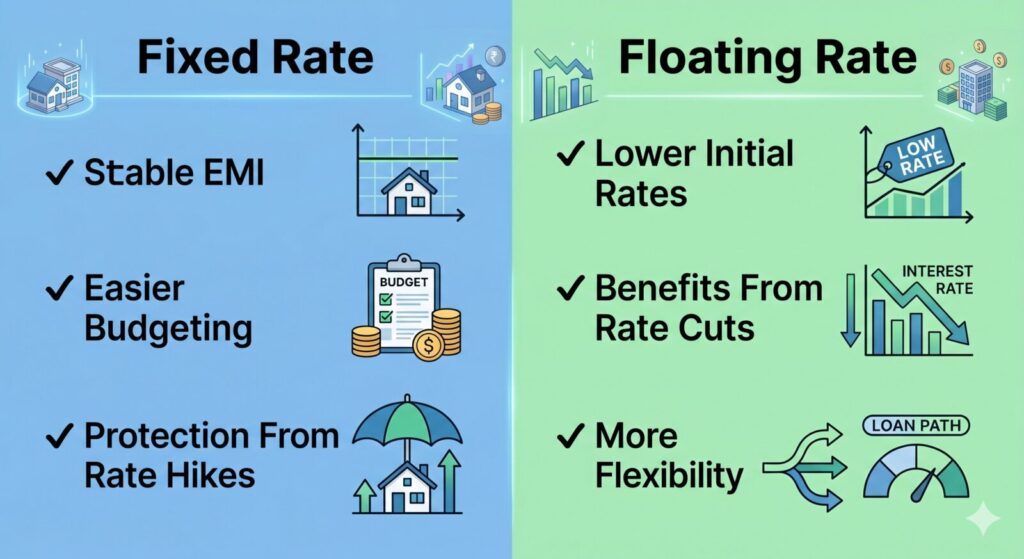
| Feature | Fixed Rate | Floating Rate |
|---|---|---|
| EMI Stability | High | Medium |
| Budget Planning | Easy | Less Predictable |
| Benefit From Rate Cuts | No | Yes |
| Impact Of Rate Hikes | Low | High |
| Long-Term Flexibility | Lower | Higher |
| Initial Interest Rate | Usually Higher | Usually Lower |
| Risk Level | Lower | Higher |
Understanding these differences is often more important than comparing two lenders offering slightly different interest rates.
Advantages of Fixed Interest Rates
1. Predictable EMI
The biggest advantage is certainty.
You know what your monthly payment will be.
There are fewer surprises.
2. Easier Financial Planning
Families can create long-term budgets more easily because housing expenses remain stable.
Stable EMIs can be particularly valuable for first-time buyers who are already managing several upfront expenses. If you’re planning a property purchase, you should also understand the Hidden Costs of Buying a Home in India that many buyers overlook before moving into their new home.
3. Protection During Rising Interest Rates
If market rates increase, your fixed-rate loan remains protected.
Your EMI does not suddenly rise because of changes in the interest-rate environment.
4. Peace of Mind
Many borrowers simply prefer certainty.
They are willing to pay a slightly higher interest rate in exchange for stability.
Disadvantages of Fixed Interest Rates
1. Higher Initial Interest Rate
Fixed-rate loans often start at a higher interest rate than floating-rate loans.
2. No Benefit From Falling Rates
If market interest rates decline, your loan may continue at the original fixed rate.
You may miss opportunities to save money.
3. Less Flexibility
Some fixed-rate products offer fewer options when compared with floating-rate loans.
4. Potential Prepayment Restrictions
Certain fixed-rate products may include additional conditions regarding prepayments.
Borrowers should always verify the latest lender policies before signing any agreement.
Advantages of Floating Interest Rates
1. Lower Starting Rates
Floating-rate loans often begin with lower interest rates.
This can reduce your initial EMI.
2. Benefit From Rate Cuts
When interest rates decline, borrowers may enjoy lower borrowing costs.
3. Better Long-Term Flexibility
Floating-rate loans generally adjust with market conditions.
4. Potential Long-Term Savings
Historically, floating-rate borrowers have sometimes benefited during periods of falling interest rates.
Disadvantages of Floating Interest Rates
1. EMI Uncertainty
Your EMI may change in the future.
Budgeting becomes slightly more difficult.
2. Interest Rate Risk
Nobody knows exactly where interest rates will move over the next 10 or 20 years.
3. Longer Loan Tenure
Some lenders may increase the loan tenure instead of immediately increasing the EMI.
This can increase total interest costs.
4. Financial Stress During Rate Hikes
When rates rise rapidly, borrowers may feel pressure on monthly cash flow.
How RBI Interest Rate Changes Affect Home Loans
Interest rates across the economy are heavily influenced by decisions taken by the Reserve Bank of India (RBI).
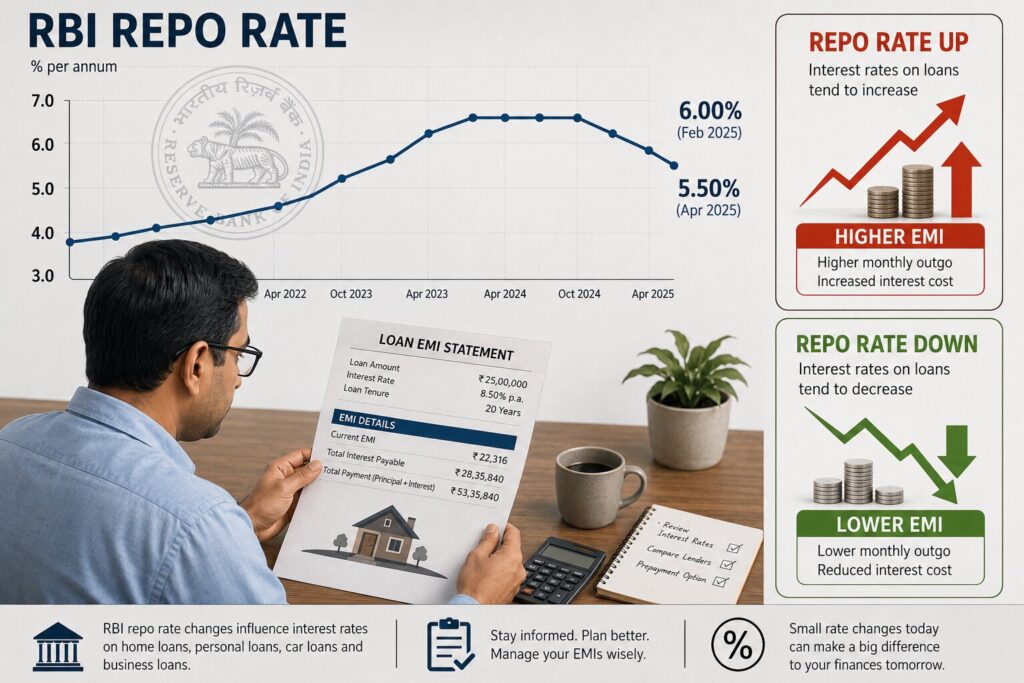
When interest rates rise:
- Home loan rates may increase
- EMIs may increase
- Total interest costs may increase
When interest rates fall:
- Home loan rates may decrease
- EMIs may reduce
- Borrowers may save interest
This is why floating-rate borrowers need to understand interest-rate cycles.
Small changes can create meaningful differences over a 20-year loan tenure.
Questions to Ask Your Lender Before Choosing Fixed or Floating Rates

Many home buyers compare interest rates but forget to ask important questions about how the loan actually works.
During my years in housing finance, I noticed that borrowers often focused on the headline interest rate while ignoring the loan terms hidden in the fine print.
Before signing any home loan agreement, consider asking your lender the following questions.
1. Is the Fixed Interest Rate Truly Fixed for the Entire Loan Tenure?
Some borrowers assume that a fixed-rate loan means the interest rate will remain unchanged for 20 years.
However, certain lenders may offer fixed rates only for a limited period before converting the loan to a floating rate.
Always ask how long the fixed rate will remain applicable.
2. Which Benchmark Is Used for Floating Interest Rates?
Floating-rate home loans are linked to benchmark rates.
Understanding the benchmark helps you know why your interest rate may increase or decrease in the future.
Ask the lender how often the benchmark is reviewed and how rate changes are communicated to borrowers.
3. What Happens If Interest Rates Increase?
If interest rates rise, lenders may:
- Increase your EMI
- Increase your loan tenure
- Use a combination of both
Understanding this in advance can help you prepare for future changes.
4. Are There Any Charges for Switching Between Fixed and Floating Rates?
Some lenders allow borrowers to convert a fixed-rate loan to a floating-rate loan or vice versa.
However, conversion charges may apply.
Ask about these costs before making your decision.
5. Are There Any Prepayment Restrictions or Charges?
Many borrowers plan to make extra payments whenever they receive bonuses, incentives, or salary hikes.
Ask whether there are any restrictions or charges on partial prepayments or loan foreclosure.
6. How Will Rate Changes Be Communicated?
Interest-rate revisions may affect your EMI or loan tenure.
Ask whether updates will be shared through email, SMS, internet banking, or mobile applications.
7. What Is the Total Cost of the Loan, Not Just the Interest Rate?
A lower interest rate does not always mean a cheaper loan.
Processing fees, legal charges, technical inspection fees, and other costs can increase the overall borrowing expense.
Always ask for a complete cost breakdown before signing the agreement.
The more questions you ask before taking a home loan, the fewer surprises you are likely to face later.
Once you understand the questions to ask your lender, it becomes easier to compare how fixed and floating interest rates can affect your monthly payments. Let’s look at a practical example using a ₹50 lakh home loan.
Real Example: ₹50 Lakh Home Loan Comparison
Calculate Your Home Loan EMI Before Choosing Fixed or Floating Rates
A small change in interest rates can affect your EMI, total interest cost, and long-term affordability.
Before selecting a fixed or floating home loan, it’s worth calculating how different interest rates may affect your monthly budget.
You can use the PennyPowerPlay Home Loan Planner to:
✓ Calculate EMI
✓ Check affordability
✓ Estimate prepayment savings
✓ Compare loan scenarios
✓ Understand the true cost of home ownership
Try the Home Loan Planner here:
https://pennypowerplaycom.lovable.app/
Let’s compare two scenarios.
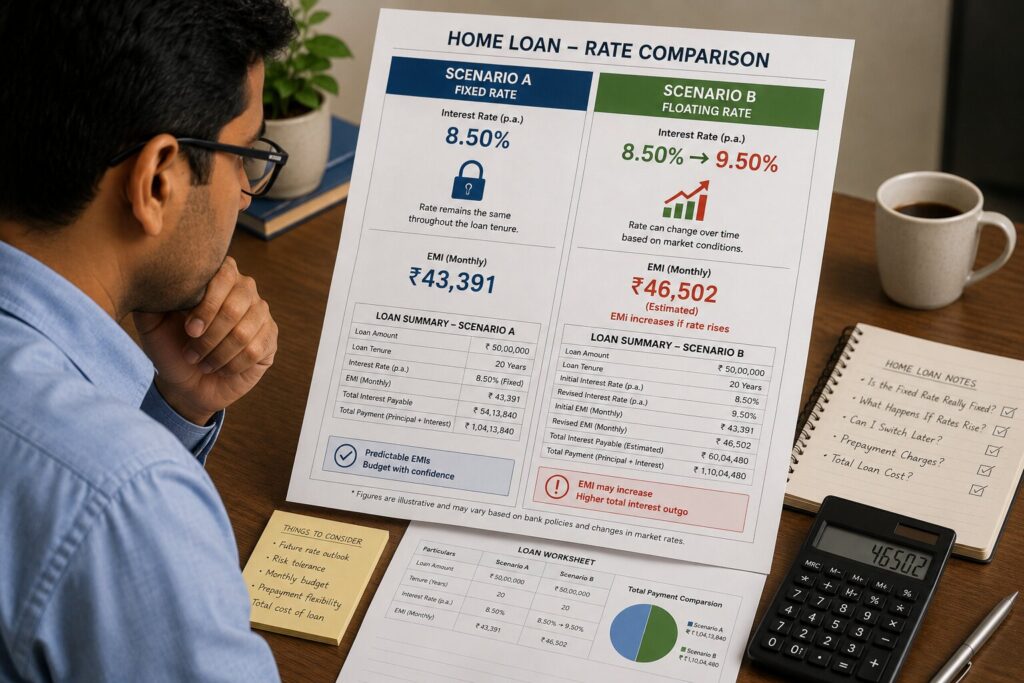
Scenario A: Fixed Rate
Loan Amount: ₹50,00,000
Interest Rate: 8.50%
Tenure: 20 Years
Approximate EMI: ₹43,391
The EMI remains predictable.
Scenario B: Floating Rate
Loan Amount: ₹50,00,000
Initial Interest Rate: 8.50%
Initial EMI: ₹43,391
Suppose interest rates increase to 9.50%.
Your EMI could increase significantly depending on the lender’s structure.
Even a 1% increase may result in thousands of rupees of additional payments every month.
This example demonstrates why borrowers should think beyond today’s interest rate.
Fixed vs Floating Home Loan Interest Rates: Which Option Is Better for Home Buyers?
The answer depends on your financial situation.
Fixed Rates May Suit You If:
✔ You prefer certainty
✔ You have a tight monthly budget
✔ You are a first-time home buyer
✔ You want predictable expenses
✔ Your household depends on a single income
Floating Rates May Suit You If:
✔ Your income is expected to grow
✔ You have a strong emergency fund
✔ You can handle EMI fluctuations
✔ You are comfortable with some uncertainty
✔ You want to benefit from future rate cuts
There is no universal winner.
The right choice depends on your financial goals and risk tolerance.
5 Common Mistakes Borrowers Make
1. Choosing Only the Lowest Interest Rate
The cheapest rate today may not remain the cheapest option tomorrow.
2. Ignoring Future Rate Changes
Borrowers should always consider what happens if rates rise by 1% or 2%.
3. Not Reading Loan Terms Carefully
Always understand how rate revisions work.
4. Comparing Lenders But Not Interest Rate Types
This is one of the most common mistakes.
In fact, comparing lenders without understanding the loan structure is one of several mistakes borrowers make during the home-buying journey. We discuss additional examples in 10 Home Loan Mistakes First-Time Buyers Make (And How to Avoid Them).
5. Focusing on Eligibility Instead of Affordability
Just because a bank approves a certain loan amount doesn’t mean it is comfortable to repay.
Fixed vs Floating Home Loan Interest Rates Checklist
Before choosing a home loan, ask yourself:
☐ Do I understand both options?
☐ Can I comfortably afford the EMI?
☐ Do I have an emergency fund?
☐ Am I comfortable with interest-rate fluctuations?
☐ Have I compared long-term costs?
☐ Have I reviewed lender terms carefully?
☐ Does this choice match my financial goals?
Key Lessons for Home Buyers
The biggest lesson is simple.
The lowest interest rate is not always the best home loan.
Before making a decision:
- Understand how the rate works.
- Consider your risk tolerance.
- Think about future income growth.
- Maintain an emergency fund.
- Focus on affordability rather than maximum eligibility.
A home loan should support your financial future, not create unnecessary stress.
Conclusion
Home buyers can also review housing finance information and consumer resources provided by the National Housing Bank.
Buying a home is one of the biggest financial decisions most families will ever make.
After spending eight years in housing finance, I learned that many borrowers focus heavily on the interest rate but overlook the structure behind it.
Fixed-rate loans offer stability and predictability.
Floating-rate loans offer flexibility and the possibility of benefiting from lower rates.
Neither option is universally better.
The right choice depends on your financial situation, income stability, future plans, and comfort with changing EMIs.
Before signing any loan agreement, take time to understand how your interest rate works.
A well-informed decision today could save you money and stress for years to come.
Before finalizing any home loan, consider running your numbers through the PennyPowerPlay Home Loan Planner. Understanding your EMI, affordability, and long-term repayment costs can help you choose a loan that supports your financial goals rather than creating future stress.
Home Loan Planner:
https://pennypowerplaycom.lovable.app/
Your interest rate choice is only one part of long-term home loan management. Once you’ve been repaying your loan for a few years, you may also want to evaluate whether switching lenders could reduce your borrowing costs. Our guide on Home Loan Balance Transfer: Does It Really Save Money? explains when a balance transfer makes financial sense.
You may also want to read:
- How Much Home Loan EMI Can You Really Afford?
- 10 Hidden Costs of Buying a Home in India
- 10 Home Loan Mistakes First-Time Buyers Make
- Home Loan Balance Transfer: Does It Really Save Money?
Frequently Asked Questions (FAQs)
1. Is a fixed or floating home loan better in India?
Neither option is universally better. Fixed rates offer stability, while floating rates provide flexibility and potential savings when interest rates fall.
2. Can I switch from a fixed rate to a floating rate later?
Many lenders allow conversion options, although terms and charges may apply.
3. Why are floating home loan rates usually lower?
Floating rates typically carry more uncertainty for borrowers, which is why they often start lower than fixed rates.
4. Does RBI affect home loan interest rates?
Yes. Changes in interest-rate policy can influence lending rates across the banking and housing finance sector.
5. Which option is safer for first-time home buyers?
Borrowers seeking stability and predictable payments often prefer fixed-rate loans.
6. Can a floating-rate EMI increase significantly?
Yes. If interest rates rise substantially, EMIs or loan tenure may increase depending on the lender’s policy.