Why companies buy instead of build is one of the most important business trends in 2026.
Introduction: A Pattern You Can’t Ignore

If you pay attention to global business news, you will notice a clear pattern. Companies across industries are increasingly choosing to acquire other businesses instead of building new products or capabilities from scratch.
This trend is visible everywhere. Technology companies are buying AI startups. Financial firms are acquiring data platforms. Large corporations are merging with smaller, innovative businesses.
This is not random. It reflects a deeper shift in how companies operate in today’s fast-moving and highly competitive world.
The decision to buy instead of build is no longer just a strategic option. In many cases, it has become a necessity.
To understand why this is happening, we need to look at how modern businesses think about time, risk, talent, and growth.
Understanding why companies buy instead of build helps investors and professionals spot future trends early.
The reason why companies buy instead of build is simple. Speed and survival matter more than control today.
The Buy vs Build Decision Explained
At its core, every company faces a simple question when entering a new space:
Should we build this internally, or should we acquire an existing company that already has it?
Building internally means developing everything from the ground up. It involves hiring teams, investing in research, and taking the time to create and test new products.
Acquiring, on the other hand, allows a company to instantly gain access to an existing solution, along with its team, technology, and customers.
While building offers control, it comes with uncertainty and time delays. Buying offers speed and proven results.
In today’s environment, speed often matters more than control.
Why Companies Buy Instead of Build Matters in 2026
Speed Has Become the Biggest Competitive Advantage
One of the main reasons companies prefer acquisitions is speed.
Markets today are evolving rapidly. New technologies emerge quickly, and consumer behavior changes faster than ever before.
If a company spends several years building a product, it risks entering the market too late. Competitors may already dominate the space.
Acquisitions eliminate this delay. Instead of spending years building, companies can achieve the same outcome in a matter of months.
This ability to move quickly can determine whether a company leads the market or struggles to catch up.
This is one of the biggest reasons why companies buy instead of build in fast-moving industries.
Real Story: Facebook and Instagram
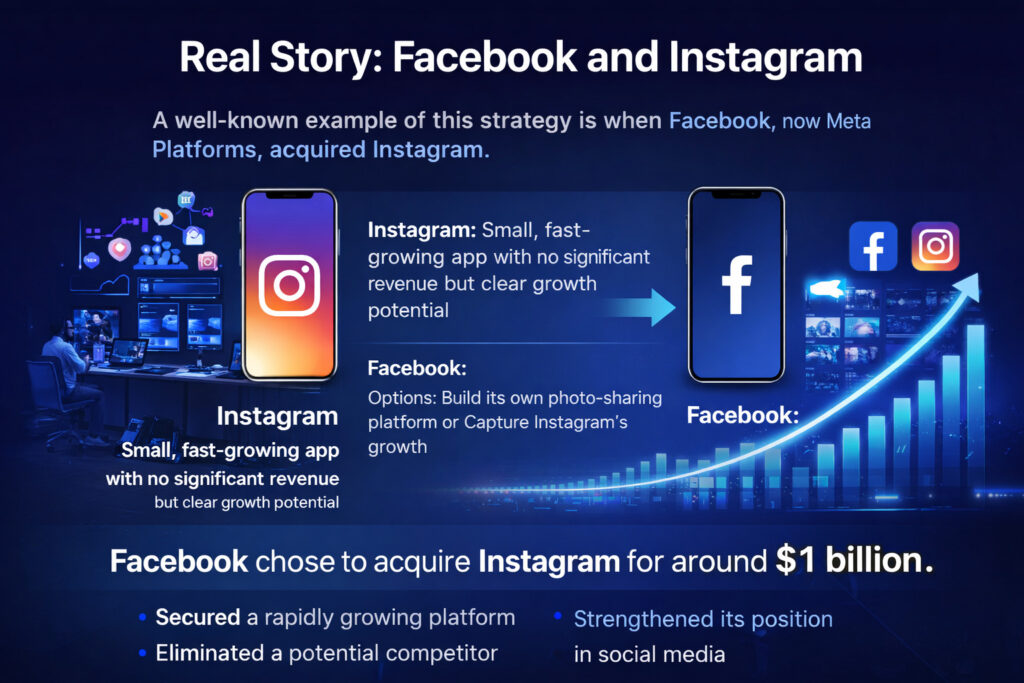
A well-known example of this strategy is when Facebook, now Meta Platforms, acquired Instagram.
At the time, Instagram was a small but fast-growing app with a strong user base. It was not generating significant revenue, but its growth potential was clear.
Facebook had two choices. It could build its own photo-sharing platform or acquire Instagram and capture that growth immediately.
Building a competing product would have taken time, and there was no guarantee users would switch. Meanwhile, Instagram was already gaining popularity.
Facebook chose to acquire Instagram for around $1 billion.
This decision allowed Facebook to secure a rapidly growing platform, eliminate a potential competitor, and strengthen its position in social media.
Today, Instagram is one of the most valuable parts of Meta’s business.
Talent Acquisition: Buying Teams Instead of Hiring Individuals
Another important reason behind acquisitions is access to talent.
Highly skilled professionals in areas like artificial intelligence, data science, and advanced engineering are limited and in high demand.
Hiring these individuals separately can take time and may not result in a cohesive team.
By acquiring a company, businesses gain an entire team that already works well together. This is often referred to as “acqui-hiring.”
This approach allows companies to quickly strengthen their capabilities without going through a lengthy hiring process.
Real Story: Microsoft and LinkedIn
Another strong example is Microsoft’s acquisition of LinkedIn.
Microsoft wanted to expand its presence in the professional and enterprise networking space. Instead of building a new platform from scratch, it chose to acquire LinkedIn.
This move gave Microsoft immediate access to a global network of professionals, valuable business data, and a well-established platform.
Over time, LinkedIn became an important part of Microsoft’s ecosystem, integrating with its products and contributing to its growth strategy.
This example shows how acquisitions can help companies enter entirely new markets quickly and effectively.
Reducing Risk in an Uncertain Environment
Building a new product always involves uncertainty. Companies cannot be sure whether the product will succeed, whether customers will adopt it, or whether it will generate revenue.
Acquisitions reduce this uncertainty.
When a company buys an existing business, it often acquires a product that has already been tested in the market. It may already have users, revenue, and a proven business model.
This makes acquisitions a safer option, especially in uncertain economic conditions.
Real Story: Google and YouTube
One of the most successful acquisitions in history is Google’s acquisition of YouTube.
At the time, online video was growing rapidly, but Google did not have a strong platform in that space.
Instead of building a competing service, Google acquired YouTube.
This gave Google immediate access to a massive user base and a dominant position in online video.
Today, YouTube is one of the largest platforms in the world and a major source of revenue for Google.
This example highlights how acquiring the right company at the right time can shape the future of an entire industry.
Real Story: Google and YouTube

One of the most successful acquisitions in history is Google’s acquisition of YouTube.
At the time, online video was growing rapidly, but Google did not have a strong platform in that space.
Instead of building a competing service, Google acquired YouTube.
This gave Google immediate access to a massive user base and a dominant position in online video.
Today, YouTube is one of the largest platforms in the world and a major source of revenue for Google.
This example highlights how acquiring the right company at the right time can shape the future of an entire industry.
This is exactly why companies buy instead of build when entering new markets or technologies.
Expanding Into New Markets Quickly

Acquisitions also help companies expand into new markets.
Entering a new country or industry from scratch requires time, resources, and local knowledge. It involves building infrastructure, understanding regulations, and gaining customer trust.
By acquiring an existing company, businesses can bypass many of these challenges.
They gain instant access to established systems, local expertise, and a ready customer base.
This makes acquisitions one of the fastest ways to achieve global expansion.
The Rise of AI Acquisitions
In recent years, one of the biggest drivers of acquisitions has been artificial intelligence.
Companies across industries are investing heavily in AI capabilities. However, building these capabilities internally can take time and requires specialized talent.
As a result, many companies are choosing to acquire AI startups.
These acquisitions allow them to quickly integrate advanced technology into their operations and stay competitive in a rapidly evolving market.
This trend is expected to continue as AI becomes increasingly important across industries.
Increasing Market Power and Competitive Advantage
Acquisitions also strengthen a company’s market position.
When a company acquires a competitor, it gains market share and reduces competition.
This can lead to greater control over pricing, distribution, and overall market dynamics.
In many industries, this has resulted in consolidation, where a few large companies dominate the market.
This is a natural outcome of the buy-over-build strategy.
Financial Efficiency and Long-Term Value
Although acquisitions may require a large upfront investment, they can be more efficient in the long run.
Building a product involves continuous spending on development, testing, and marketing, with no guarantee of success.
Acquiring a company provides immediate results and allows the acquiring company to generate returns more quickly.
In many cases, the long-term value created by acquisitions outweighs the initial cost.
Many of these strategies are also discussed in global research by McKinsey, which highlights how acquisitions drive long-term growth.
Why This Matters for You
Understanding why companies buy instead of build is not just important for business leaders. It is relevant for anyone interested in the future of work, investing, and economic trends.
When companies start acquiring businesses in a particular sector, it often signals where future opportunities lie.
For example, the rise of AI acquisitions indicates the growing importance of artificial intelligence in the global economy.
By observing these patterns, individuals can make better decisions about their careers, investments, and skill development.
If you understand why companies buy instead of build, you can better predict where money and opportunities are moving.
What You Can Learn From This Trend
There are a few key lessons you can take away from this strategy.
First, focus on areas that are in demand. Companies acquire capabilities that they need, which means these areas have high value.
Second, pay attention to trends. Where companies invest their money often indicates where growth is happening.
Third, think strategically. Whether in your career or business, consider whether it is better to build something from scratch or leverage existing opportunities.
Conclusion
The shift from building to buying reflects the realities of the modern world.
Companies today operate in an environment where speed, talent, and adaptability are critical.
Acquisitions allow them to move faster, reduce risk, and stay ahead of competitors.
As technology continues to evolve and markets become more competitive, this trend is likely to grow even stronger.
Understanding this strategy provides valuable insight into how businesses operate and where future opportunities may emerge.
In the coming years, why companies buy instead of build will define how industries evolve.
❓ FAQs
Q1: Why do companies buy instead of build?
Because buying saves time, reduces risk, and provides immediate access to technology, talent, and customers.
2. What is the buy vs build strategy?
It is a decision companies make between developing capabilities internally or acquiring them externally.
3. Are acquisitions always successful?
Not always, but they often provide faster results compared to building from scratch.
4. Why are AI acquisitions increasing?
Because AI is a fast-growing field, and companies want to gain capabilities quickly.
5. How does this affect investors?
Acquisitions often signal future growth opportunities and can influence market trends.