By Ashok K. Satpute / September 4, 2026
“Sir, CIDCO 12.5% property hai. Home loan toh mil jayega na?”
If you are searching for CIDCO 12.5% plot documents, the first thing to understand is that a home-loan approval depends not only on the borrower, but also on the property’s complete legal and document chain.
But there is another question that is even more important:
“Are the property documents complete enough for the bank’s legal team to accept the property as security?”
This is where many buyers get confused.
You may have a registered agreement. You may have a society share certificate. You may even be told that another person already got a home loan on the same property.
Still, your loan can get delayed or rejected if the CIDCO document chain is incomplete or inconsistent.
During my 8+ years of working in housing finance, I have seen that borrowers often concentrate heavily on their salary, CIBIL score and income documents.
For CIDCO 12.5% and Gaothan-origin properties, the property file itself can become the deciding factor.
Don’t find out that your property has a documentation problem after you have already paid a large token amount.
Quick Summary
| Document | Why it matters | What a buyer should check |
|---|---|---|
| Letter of Intent (LOI) | Earlier-stage allotment/intent document | What subsequent final document was issued? |
| Final Order / Final Allotment | Important milestone in CIDCO allotment/transfer chain | Name, plot, area and reference details |
| Agreement to Lease | Establishes the lease documentation | Registration and Index-II where applicable |
| Tripartite Agreement | Connects CIDCO, original allottee/PAP and developer/purchaser in applicable transactions | Correct parties and property details |
| Transfer Order | Shows approval/transfer of rights in applicable transactions | Name of transferee/developer and plot details |
| CIDCO Mortgage Permission/NOC | Allows mortgage/security creation where required | Whether current lender/property is covered |
| Society NOC | Confirms society has no objection to mortgage where applicable | Mortgage/security wording and correct addressee |
| Builder NOC | Relevant before society formation in applicable transactions | Correct property and mortgage language |
| Previous Loan Clearance | Shows earlier lender’s charge has been cleared | Clearance/NOC and charge release |
| Transfer payment receipts | Evidence of payments made to CIDCO/society | Official receipt/challan, not just broker confirmation |
Important: The exact document chain varies depending on whether you are dealing with an original allotment, developer transaction, resale, constructed premises, plot transfer or another CIDCO-approved transaction.
What Is a CIDCO 12.5% Property?
The CIDCO 12.5% scheme is associated with land provided to project-affected persons (PAPs) as part of the land acquisition and development process for Navi Mumbai.
The scheme has been operating for decades and involves developed plots being returned to eligible landowners/PAPs subject to the applicable scheme rules.
The “12.5%” therefore does not refer to a 12.5% interest rate or a 12.5% home-loan category.
It refers to the land-return mechanism.
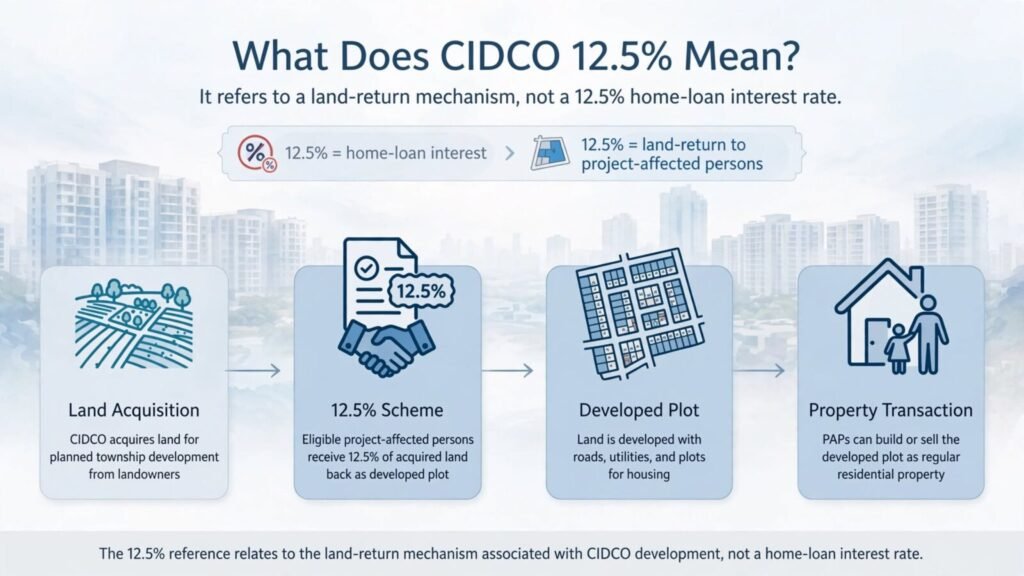
CIDCO’s current material continues to maintain a dedicated 12.5% scheme section and related processes.
For the latest information on the 12.5% scheme and related CIDCO processes, buyers should also refer to the official CIDCO 12.5% scheme information before making a property decision.
For a home buyer, however, the important question is different:
Can the property be legally transferred and mortgaged to the proposed lender?
That is where the document chain becomes critical.
Why Property Documents Matter So Much for a CIDCO 12.5% Home Loan
Suppose two people apply for a ₹60 lakh home loan.
Buyer A
- Salary: ₹1 lakh per month
- CIBIL: Excellent
- Stable employment
- Low existing EMI
Buyer B
- Salary: ₹85,000 per month
- CIBIL: Good
- Stable employment
Buyer B may still get approval.
But suppose Buyer A’s property file has:
- Only an old LOI
- Missing final order
- Unclear transfer history
- Missing transfer order
- No proper mortgage permission
- Society NOC that does not clearly cover mortgage
- Previous lender charge not properly cleared
The problem is no longer primarily the borrower’s income.
The problem is the security offered to the bank.
A home loan is secured against the property.
So the lender’s legal team needs to establish that the borrower has acceptable rights in the property and that the lender can create and enforce its security interest in accordance with the applicable documents and permissions.
CIDCO 12.5% Plot Documents: Complete Home Loan Checklist
A simplified document chain can look something like this:
CIDCO / Original Land Acquisition
↓
Letter of Allotment / LOI, where applicable
↓
Final Order / Final Allotment
↓
Agreement to Lease
↓
Tripartite Agreement, where applicable
↓
CIDCO Transfer Order / Transfer Permission
↓
Developer / Builder
↓
Construction / Society Formation
↓
Sale / Assignment / Transfer to Buyer
↓
Society NOC / Builder NOC, where applicable
↓
CIDCO Mortgage Permission / NOC, where applicable
↓
Bank Mortgage / Charge
This is only a simplified illustration.
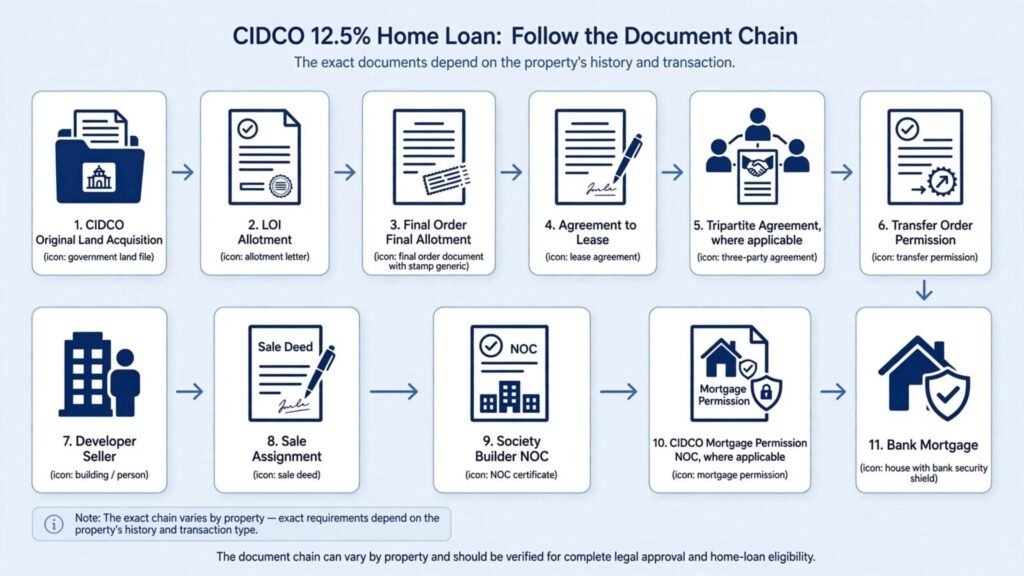
Not every CIDCO 12.5% property will have every document in exactly this sequence.
The actual chain depends on the history of that particular plot and transaction.
That is why a broker saying “Sir, all papers are there” is not enough.
You need to know which papers are there and how they connect to each other.
1. Letter of Intent (LOI) vs Final Order / Final Allotment
This is one of the most important distinctions for a buyer.
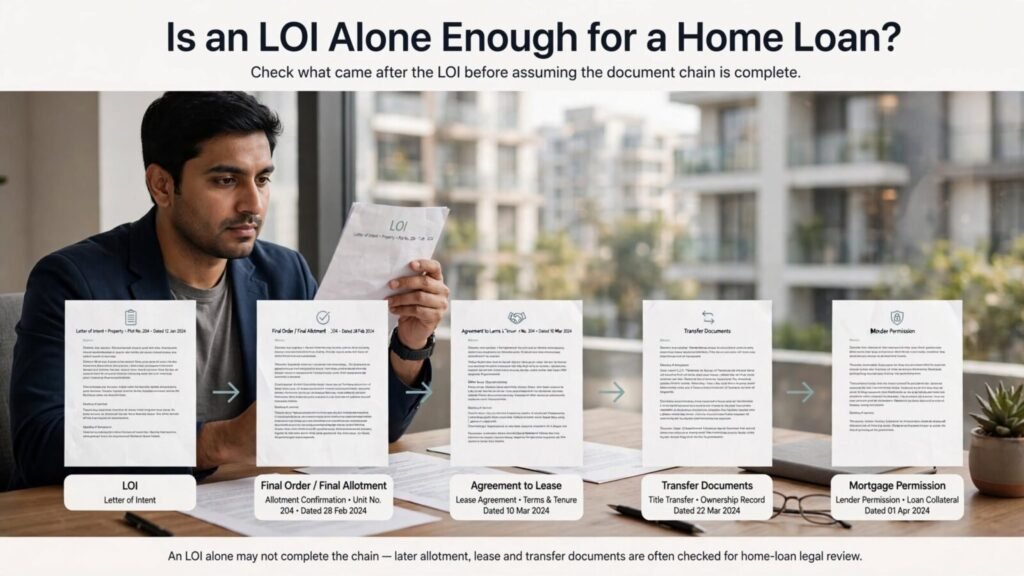
An LOI or Letter of Intent can be an earlier-stage document in the transaction.
It should not automatically be treated as the final document establishing the complete subsequent transfer/lease chain.
For example, imagine the seller gives you: “Here is the CIDCO LOI. Everything is clear.”
Your next question should be:
“What happened after this LOI?”
Ask for the subsequent CIDCO documentation.
Depending on the property history, this may include:
- Final Order
- Final Allotment
- Agreement to Lease
- Tripartite Agreement
- Transfer Order
- Permission to Transfer
- Other CIDCO correspondence/orders
CIDCO’s own checklist references combinations such as Agreement to Lease / Tripartite Agreement with Final Order for certain processes.
Why does the bank care?
Because the lender is not simply asking: “Does this property have a CIDCO paper?”
The legal team is asking: “Can we establish a satisfactory chain of rights from the development authority to the current owner and determine whether the property can be mortgaged?”
That is a much more important question.
Is an LOI Alone Enough for a Home Loan?
Do not assume that it is.
If the property file stops at an LOI, ask the seller or developer:
“What is the next CIDCO document after the LOI?”
Then ask for the complete chain.
A bank may raise a legal query if the available documents do not sufficiently establish the subsequent allotment, lease, transfer or ownership/interest position required for the proposed mortgage.
This does not mean that every property having an LOI is automatically unacceptable.
It means:
LOI should not be treated as the end of the documentation story without checking what followed it.
2. What Is an Agreement to Lease?
Many CIDCO-origin properties involve lease-related documentation.
The Agreement to Lease is therefore an important document in understanding the legal relationship between CIDCO and the allottee/holder.
For a home buyer, don’t just ask: “Agreement to Lease hai kya?”
Ask:
- Is it registered?
- Whose name is mentioned?
- What is the plot number?
- What is the sector?
- What is the plot area?
- Does it correspond with the subsequent documents?
- Is the Index-II available?
- Are there subsequent transfer documents?
- Are there any conditions or restrictions relevant to the proposed transaction?
CIDCO’s mortgage NOC checklist for plots specifically asks for an attested copy of Index-II of the registered Agreement to Lease.
That tells you something important:
The registered lease documentation can be directly relevant to the mortgage process.
3. What Is a Tripartite Agreement in a CIDCO 12.5% Property?
The term Tripartite Agreement creates a lot of confusion.
In applicable CIDCO 12.5% transactions, the three parties can involve:
- CIDCO
- Original allottee/PAP
- Developer / purchaser
The exact parties depend on the transaction structure.
One important clarification:
A CIDCO Tripartite Agreement is not automatically a three-party agreement between CIDCO + buyer + bank.
The bank may be involved in the later mortgage process, but the CIDCO tripartite document and a bank-related tripartite arrangement are not necessarily the same thing.
CIDCO’s own documentation references a Tripartite Agreement between CIDCO, PAP and Purchaser in its 12.5% checklist.
ICICI Bank’s current public legal checklist for applicable Navi Mumbai properties also specifically refers to a Tripartite Agreement between CIDCO, allottee and developer for certain Gaothan, Press Plot and Bungalow plot transactions.
Why Does the Bank Care About the Tripartite Agreement?
Because the document can help the legal team understand the relationship between:
CIDCO → Original Allottee → Developer
and the subsequent rights flowing from that arrangement.
The bank wants to know:
- Who originally received the plot?
- What authority allowed the developer to deal with it?
- What property is covered?
- What rights were transferred?
- Are the names consistent?
- Does the later agreement match the earlier CIDCO documents?
- Are there restrictions that affect transfer or mortgage?
Practical Example
Suppose the CIDCO document shows:
Mr. A
But the developer’s document refers to:
Mr. B
And the current purchaser agreement refers to:
Mr. C
That does not automatically mean the transaction is invalid.
But it creates a question:
“Show me the document connecting A → B → C.”
This is exactly why the complete paper trail matters.
Tripartite Agreement: What Should You Check?
| Check | Why it matters |
|---|---|
| Names of all parties | Avoid unexplained name differences |
| Plot number | Must match across documents |
| Sector/location | Must correspond |
| Area | Check consistency |
| CIDCO references | Establish connection to authority records |
| Registration details | Verify registered documents where applicable |
| Developer details | Confirm the developer’s role |
| Subsequent transfer documents | Establish the next step in the chain |
| Final Order references | Important where applicable |
Quick Tip: Never judge the quality of a property file by the number of documents.
A 100-page file can still have a missing link.
4. What Is a CIDCO Transfer Order?
A Transfer Order is an important document in applicable CIDCO transactions where rights are being transferred.
For example, a property may have originated with the original allottee/PAP and subsequently moved through a developer/builder.
The bank’s legal team may want to see the CIDCO document that establishes the relevant transfer.
ICICI Bank’s current Navi Mumbai legal-valuation checklist specifically lists:
“Transfer Order in favour of builder”
for applicable Gaothan Plot, Press Plot and Bungalow plot transactions.
This is a very useful practical point for buyers.
If the developer tells you: “Sir, CIDCO property hai, but transfer order baad mein de denge.”
Do not simply ignore it.
Ask:
“What is the current CIDCO transfer status, and what document establishes the developer’s rights?”
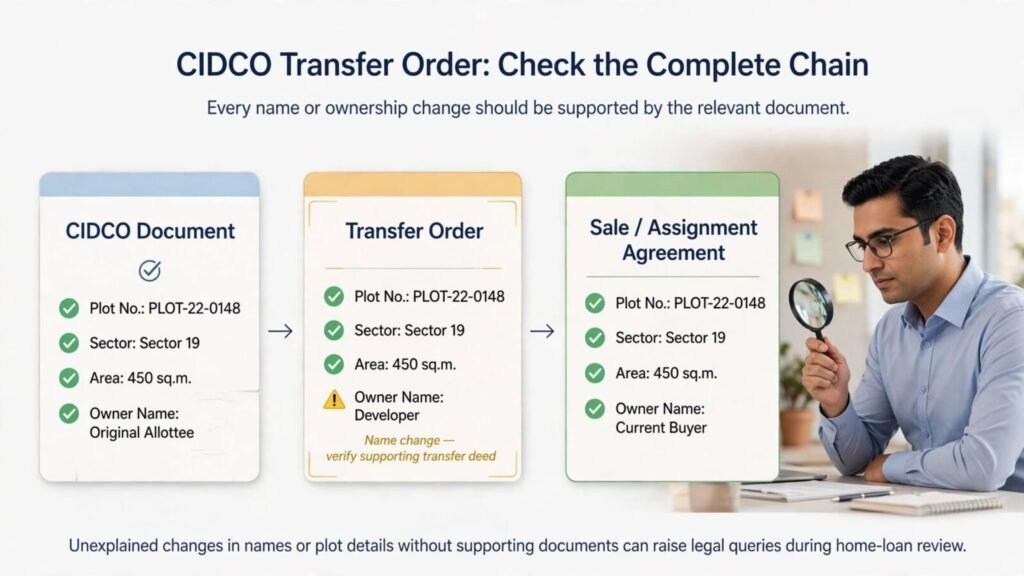
Why Name Mismatch in a Transfer Order Can Become a Problem
Suppose:
- CIDCO Final Order = Original Allottee A
- Tripartite Agreement = A + Developer B
- Transfer Order = Developer C
- Sale Agreement = Buyer D
The bank’s legal team may ask:
Who is C and how is C connected to B?
Again, this does not automatically mean rejection.
It means the chain needs to be explained and documented.
The rule I recommend:
Every name change should have a document behind it.
5. CIDCO Transfer Charges vs Society Transfer Charges
Another area where buyers get confused is transfer charges.
There can be different charges at different stages.
CIDCO-related charges
These can arise in connection with permissions, transfers or other CIDCO processes.
Society-related charges
Once a cooperative housing society is involved, the society may have its own transfer/admission-related charges or documentation requirements, subject to applicable law and society rules.
These are not the same thing.
So if a broker says: “Transfer charges paid ho gaye.”
Ask:
“To whom?”
Then ask for the receipt.
How Should You Verify Transfer Charges?
Don’t rely only on:
- WhatsApp screenshots
- Broker statements
- Seller’s verbal confirmation
- Photocopies without verification
Look for:
- Official demand/communication
- Payment receipt
- Challan where applicable
- CIDCO acknowledgment
- Society receipt where applicable
- Corresponding transfer approval/order
CIDCO’s checklists also refer to documentation such as clearances and supporting papers for transfer-related processes.
Quick Tip
A payment receipt is evidence that money was paid.
It is not necessarily proof that the underlying transfer has been completely approved.
Always check the corresponding approval/order.
6. What Is a Society NOC?
Once a housing society is formed, the society may become an important part of the mortgage documentation.
A Society NOC generally confirms that the society has no objection to the member/owner creating a mortgage/security interest in favour of the lender, where such NOC is required.
This is different from simply saying: “Society has no objection to the home loan.”
The bank may want the document to clearly address the mortgage/security.
CIDCO’s own plot mortgage NOC checklist specifically refers to a NOC from Society addressed to the Estate Officer, CIDCO, if applicable.
National Co-operative Bank’s current housing-loan documentation also lists NOC from Builder/Society/Apartment/MHADA/CIDCO among its property documents.
What Should a Society NOC Say?
There is no single universal wording that every bank must use.
The lender’s own prescribed format should prevail.
However, from a practical perspective, the NOC should clearly communicate that the society has no objection to the member/owner mortgaging the property in favour of the relevant bank/financial institution and that the lender’s charge/lien can be recorded where applicable.
Illustrative wording only “The Society has no objection to the member/owner mortgaging the said premises in favour of [Bank/Financial Institution] as security for the housing loan/credit facilities granted or to be granted to the member/owner, and has no objection to the Bank noting/recording its charge/lien as applicable.”
Important: This is only an illustration.
Do not ask your society to copy this wording blindly.
If the bank has provided a specific NOC format, use the bank’s format.
Why Generic “No Objection to Loan” Wording Can Cause Queries
Imagine the NOC says: “Society has no objection to Mr. X taking a home loan.”
The legal department may ask:
“Where does it say the society has no objection to the property being mortgaged?”
There is a difference between:
No objection to borrowing
and
No objection to creating mortgage/security over the property.
That distinction can matter during legal scrutiny.
7. Builder NOC vs Society NOC
These are not necessarily interchangeable.
Builder NOC
May be relevant where:
- Society is not yet formed
- Property is still with the developer
- Construction is under development
- The transaction structure requires developer confirmation
Society NOC
May be relevant where:
- Society has been formed
- The buyer/member is dealing with the society
- The lender requires society confirmation for mortgage
The exact requirement depends on the transaction and lender.
Simple rule
Before society formation → builder documentation may be relevant.
After society formation → society documentation may become relevant.
But don’t assume one automatically replaces every CIDCO permission or NOC.
8. CIDCO Mortgage Permission / Mortgage NOC
This is another document buyers should understand before taking a loan.
CIDCO has a formal mortgage NOC process for applicable properties.
Buyers can check the CIDCO’s official Mortgage NOC requirements to understand the documents and process applicable to their property.
For example, CIDCO’s current Mortgage NOC for plots checklist includes documents such as:
- Annexure G
- Loan sanction letter from the financial institution
- Society NOC addressed to the Estate Officer, CIDCO, if applicable
- Loan clearance certificate from the earlier financial institution, if applicable
- Final Order / NOC to transfer, if applicable
- Attested Index-II of the registered Agreement to Lease
This is important because it demonstrates that the mortgage process can involve more than simply getting a bank sanction letter.
Why the Bank’s Sanction Letter Matters
The CIDCO mortgage process may require a loan sanction letter from the financial institution.
So the sequence can involve:
Bank legal/credit process
↓
Loan sanction
↓
CIDCO mortgage permission/NOC where applicable
↓
Mortgage/security creation
The exact process can vary by property and transaction.
Therefore, don’t assume: “Bank has sanctioned the loan, so CIDCO formalities are finished.”
They may not be.
9. Previous Home Loan or Existing Mortgage: Check This Carefully
Suppose the seller tells you: “Sir, this property already had a home loan from a bank.”
That can actually be useful information.
But don’t stop there.
Ask:
Which bank financed it?
When was the loan closed?
Where is the loan-closure certificate?
Where is the previous lender’s NOC?
Has the earlier charge/lien been released as required?
CIDCO’s mortgage NOC checklist specifically refers to a Loan Clearance Certificate from earlier financial institutions, if applicable.
This is why an old home loan is not automatically proof that your transaction will be accepted.
The current file still has to be examined.
10. Which Banks Give Home Loans for CIDCO 12.5% Properties?
This is where I would be very careful.
There is no universal list that guarantees approval for every CIDCO 12.5% property.
A lender can finance one property and decline another because the documentation, title chain, construction status, valuation, permissions or legal risks are different.
ICICI Bank
ICICI Bank’s current publicly available legal-valuation checklist contains a specific Navi Mumbai section.
For applicable Gaothan, Press Plot, Bungalow Plot and Tender Plot transactions, it lists items including:
- CIDCO permission to transfer and mortgage
- RERA registration/completion documentation where applicable
- Development agreement/agreement of sale/POA
- Approved layout
- Commencement/Completion Certificate
- Tripartite Agreement between CIDCO, allottee and developer for applicable properties
- Transfer Order in favour of builder for applicable properties
For resale transactions, the same checklist also refers to items such as permission to transfer, permission to mortgage, title search, prior sale documents, registered agreement, share certificate where applicable, deed of assignment and relevant CIDCO documents.
This is strong evidence that CIDCO-origin Navi Mumbai properties can be considered within a lender’s legal framework when the required documentation is available.
But it is not a guarantee that every 12.5% property will qualify.
National Co-operative Bank
Its current housing-loan documentation also lists:
- Registered agreement with chain of documents
- Search/valuation/title-clear documentation
- NOC from Builder/Society/Apartment/MHADA/CIDCO
- Share certificate
- Other property documents
Again, this does not mean every CIDCO 12.5% property is automatically eligible.
It shows that CIDCO-related NOCs can form part of a lender’s property documentation requirements.
The bigger lesson
Don’t ask only: “Which bank gives loan for CIDCO 12.5%?”
Ask: “Which lender’s legal team is willing to examine my exact property file?”
That is a much more useful question.
Can One Bank Reject a CIDCO Property While Another Bank Approves It?
Yes, this can happen.
Why?
Because lenders can have different:
- Legal policies
- Risk appetite
- Property-location policies
- Approved-project policies
- Technical standards
- Documentation requirements
- Internal legal interpretations
- Loan-to-value policies
But don’t make the mistake of assuming: “Bank A rejected it, so Bank B will definitely approve.”
Neither is correct.
A second lender should conduct its own independent legal and technical assessment.
11. What Do Bank Legal Teams Commonly Look For?
Based on the documents required in current lender/CIDCO checklists, and the way property files are generally examined, these are some of the areas where queries can arise.
1. Name mismatch
Names differ between:
- CIDCO documents
- Agreement to Lease
- Tripartite Agreement
- Transfer Order
- Sale Agreement
- Society records
2. Missing Final Order
The file has an LOI but the subsequent final documentation is not available.
3. Missing Agreement to Lease
The lease documentation expected for the particular transaction is unavailable or unclear.
4. Missing Transfer Order
The developer’s rights are being relied upon but the corresponding CIDCO transfer documentation is missing.
5. Missing Mortgage Permission
The property requires permission to mortgage but the relevant CIDCO document is not available.
6. Weak Society NOC
The society NOC talks about a loan but does not clearly address mortgage/security.
7. Previous mortgage not properly cleared
The seller says the old loan is closed but the required clearance/release documentation is incomplete.
8. Construction documentation problem
For a constructed property, the lender may need relevant:
- Approved plans
- Commencement Certificate
- Completion Certificate
- Occupancy Certificate
- RERA documentation, where applicable
9. Chain of documents is incomplete
You have individual documents, but they don’t connect.
This is one of the biggest practical problems.
12. CIDCO 12.5% Plot Documents: Complete Home Loan Checklist
Before paying a substantial token amount, I recommend creating a checklist like this.
A. CIDCO Documents
Ask for applicable documents such as:
- Letter of Allotment
- LOI, where applicable
- Final Order / Final Allotment
- Agreement to Lease
- Registered Agreement to Lease
- Index-II
- Tripartite Agreement
- Transfer Order
- Permission to Transfer
- Permission to Mortgage
- CIDCO Mortgage NOC
- Maveja/other applicable clearance
- Relevant CIDCO payment receipts
- Previous lender clearance, where applicable
CIDCO’s published checklists show that different processes can require different combinations of these documents.
B. Developer / Builder Documents
Depending on the property:
- Development Agreement
- Agreement to Sell
- Power of Attorney
- Approved Layout
- Commencement Certificate
- Completion Certificate
- Occupancy Certificate
- RERA registration/completion documentation, where applicable
- Previous land/title documents
- Builder constitution documents where relevant
ICICI Bank’s current Navi Mumbai checklist specifically references several of these documents for applicable transactions.
C. Society Documents
Where applicable:
- Society Registration Certificate
- Share Certificate
- Society NOC
- Society No-Dues Certificate
- Relevant transfer/admission documentation
- Society records relating to the property
D. Seller Documents
Check:
- PAN
- Identity documents
- Previous agreements
- Previous sale/transfer documents
- Existing loan documents
- Loan closure/NOC
- Payment receipts
- Relevant CIDCO correspondence
13. A Simple Decision Tree Before You Pay the Token
Use this simple test.
Step 1
Is the property CIDCO 12.5% / Gaothan-origin?
↓
YES
↓
Step 2
Do you have the complete CIDCO document chain?
↓
NO
→ Stop and obtain the missing documents.
YES
↓
Step 3
Does the chain connect the original allottee to the current seller?
↓
NO
→ Ask for the missing transfer/assignment documents.
YES
↓
Step 4
Does the proposed lender accept this property category for legal evaluation?
↓
NO / UNKNOWN
→ Ask the lender before paying a large token.
YES
↓
Step 5
Does the lender’s legal team clear the property?
↓
NO
→ Do not assume another lender will automatically approve.
YES
↓
Step 6
Are CIDCO/society/builder mortgage permissions and NOCs complete where applicable?
↓
YES
→ Proceed with the next stage of the transaction.
14. The 10 Questions I Would Ask Before Buying a CIDCO 12.5% Property
If I were buying one today, these are the questions I would ask the seller or developer.
Question 1
Where is the original CIDCO allotment document?
Question 2
Is there a Final Order / Final Allotment after the LOI?
Question 3
Where is the registered Agreement to Lease and Index-II?
Question 4
Is there a Tripartite Agreement? If yes, who are the parties?
Question 5
Where is the CIDCO Transfer Order?
Question 6
Has CIDCO permitted the relevant transfer?
Question 7
Can the property be mortgaged to my proposed lender?
Question 8
Where is the CIDCO Mortgage NOC/permission, if applicable?
Question 9
If there was an earlier home loan, where is the previous lender’s clearance?
Question 10
Can my proposed bank’s legal team review the complete property file before I make a large payment?
That last question can save you a lot of trouble.
15. Don’t Confuse “Bank Loan Available” With “Your Property Is Bankable”
This is a very important distinction.
A broker might tell you: “Sir, same building mein 10 loans hue hain.”
That sounds reassuring.
But your property could have a different:
- Seller
- Transfer history
- Document chain
- Agreement
- CIDCO permission
- Existing charge
- Construction status
- Society record
Therefore:
Previous financing is useful information, but it is not a substitute for current legal verification.
The proposed lender should examine the exact property and documents being offered as security.
16. My Practical Rule for CIDCO 12.5% Properties
Here is the rule I would like every buyer to remember: Don’t buy the property first and then ask the bank whether it is financeable.
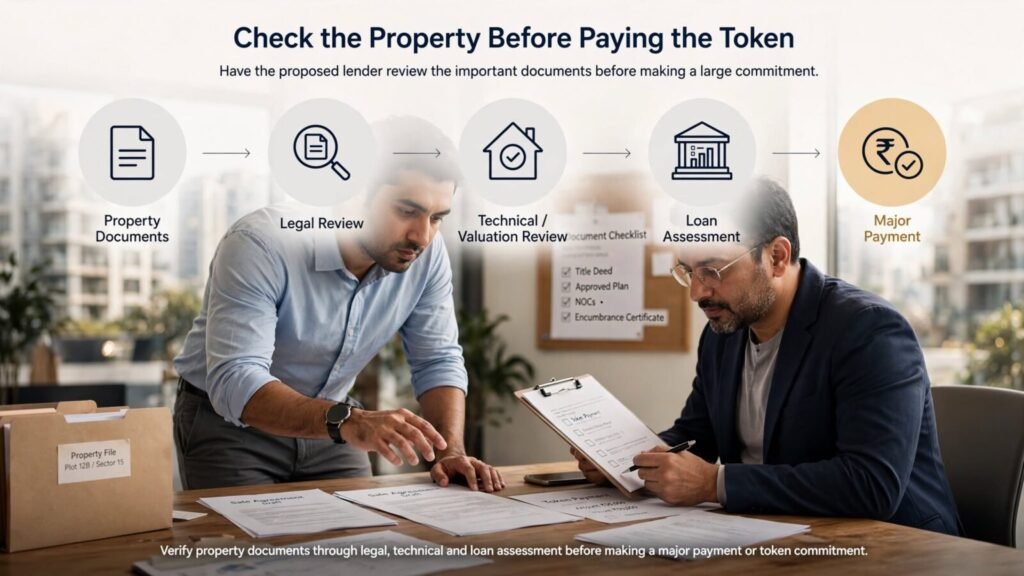
Instead:
Property documents
↓
Proposed lender’s legal review
↓
Technical/valuation review
↓
Loan assessment
↓
Then make major financial commitments
This is particularly important when you are dealing with a property that has a long historical document chain.
CIDCO 12.5% Property: What If the Builder Says “Everything Is Clear”?
Ask for documents.
Not explanations.
Not assurances.
Not WhatsApp messages.
Not: “Sir, don’t worry. Everyone is taking loan.”
Ask for the actual documents.
Then ask the proposed lender’s legal team to examine them.
This is one of the biggest differences between buying a standard property and dealing with a property having a more complicated CIDCO-origin history.
Frequently Asked Questions
Is an LOI enough to get a home loan for a CIDCO 12.5% property?
Not necessarily.
An LOI may be an earlier-stage document. Depending on the property’s history, the lender may need subsequent documentation such as Final Order/Final Allotment, Agreement to Lease and transfer-related documents.
The correct approach is to verify the complete chain rather than assuming the LOI alone is sufficient.
What is a Tripartite Agreement in a CIDCO 12.5% property?
In applicable transactions, it can involve CIDCO, the original allottee/PAP and the purchaser/developer.
It helps establish the relationship and rights involved in the transaction.
It is not automatically the same as a three-party agreement involving CIDCO, buyer and bank.
Is a CIDCO Transfer Order mandatory for every 12.5% property?
You should not apply a single rule to every property.
The requirement depends on the transaction and property history.
However, where rights have moved through a developer/builder, the relevant CIDCO transfer documentation can be extremely important. ICICI Bank’s current Navi Mumbai checklist specifically refers to a Transfer Order in favour of the builder for applicable properties.
What is the difference between CIDCO transfer charges and society transfer charges?
They arise from different processes.
CIDCO-related charges relate to applicable CIDCO permissions/transfers.
Society-related charges arise from society-level transfer/admission processes.
Always ask who received the payment and obtain the official receipt.
Does Society NOC replace CIDCO Mortgage NOC?
No, not automatically.
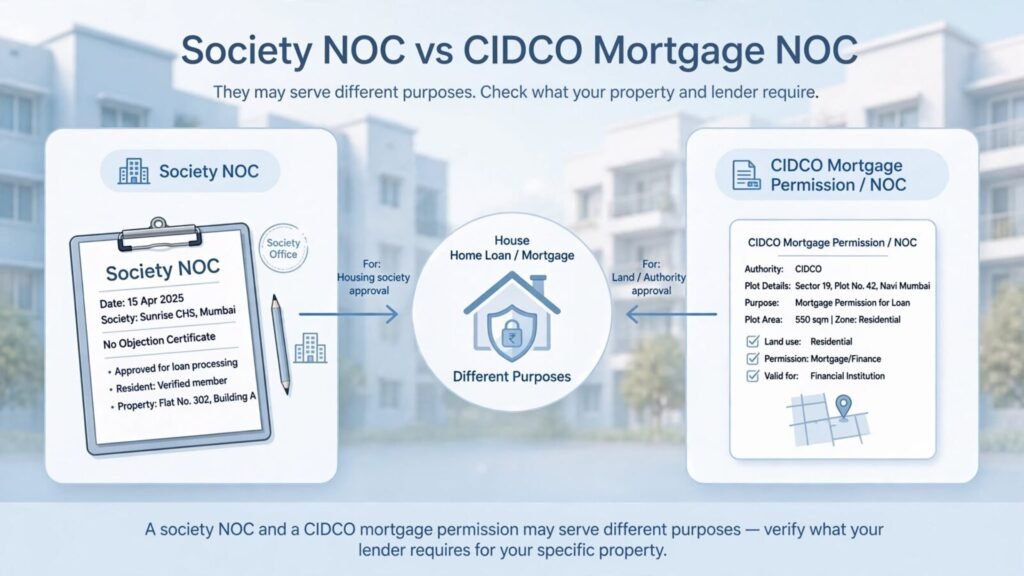
They serve different purposes and may come from different authorities.
If the transaction requires both, obtaining one does not automatically eliminate the need for the other.
CIDCO’s mortgage checklist itself refers to society NOC where applicable in addition to other CIDCO documents.
What should a Society NOC say for a home loan?
There is no single universal wording.
The bank’s prescribed format should be followed.
Practically, the NOC should clearly deal with the society’s objection, if any, to the property being mortgaged in favour of the lender and the lender’s security/charge being recorded where applicable.
Can one bank reject a CIDCO property while another bank approves it?
Yes.
Different lenders can have different legal, technical and risk policies.
But don’t assume another lender will automatically approve it.
The second lender should independently examine the property.
If another person already got a home loan on the property, does that guarantee my loan?
No.
It is useful evidence that the property may have been financed previously, but it is not a guarantee.
Your lender will assess the current transaction and current documentation.
Should I pay a token before my bank checks the CIDCO documents?
My practical advice is:
Avoid making a large, non-refundable commitment before the proposed lender’s legal team has reviewed the important property documents.
If you must sign an agreement or pay a token, understand the refund and subject-to-loan/legal-clearance conditions before committing.
A Better Way to Think About CIDCO 12.5% Home Loans
Most buyers ask: “Will the bank give me a loan?”
I would change that question to: “Can the bank establish a clean and mortgageable document chain for this property?”
That change in thinking is important.
Your:
- Salary
- CIBIL score
- Employment
- Income
- Existing EMI
determine whether you may qualify for the loan.
But the:
- CIDCO documents
- Final Order
- Agreement to Lease
- Tripartite Agreement
- Transfer Order
- Sale/assignment chain
- Society documents
- Mortgage permissions
- Construction documents
- Previous lender clearance
help determine whether the property can be accepted as security.
Both sides have to work.
Related CIDCO Home Loan Guide
If you want to understand the bigger picture before approaching a bank, read my detailed guide:
CIDCO 12.5% Gaothan home loan rules
It covers CIDCO 12.5% Gaothan home loans, eligibility, documents, lender considerations and the approval process.
Final Takeaway
A CIDCO 12.5% property is not automatically a bad property for a home loan.
But it is also not a property where I would recommend relying only on the seller’s statement that: “Sir, papers complete hai.”
Before paying a large token amount, understand the complete chain:
CIDCO allotment
→ LOI, where applicable
→ Final Order / Final Allotment
→ Agreement to Lease
→ Tripartite Agreement, where applicable
→ Transfer Order / Transfer Permission
→ Developer / Seller
→ Sale / Assignment
→ Society / Builder NOC, where applicable
→ CIDCO Mortgage Permission / NOC, where applicable
→ Bank Mortgage
If one important link is missing, don’t panic.
But don’t ignore it either.
Get the missing document.
Ask why it is missing.
Have the proposed lender’s legal team review the file.
And if the transaction is complicated, take an independent property lawyer’s opinion before committing substantial money.
Because with a CIDCO 12.5% property, the question is not simply whether a bank gives home loans.
The real question is:
“Will the bank accept this particular property, with this particular document chain, as mortgageable security?”
That is the question you should answer before you buy.
About the Author
Ashok K. Satpute is the founder of PennyPowerPlay.com and a Home Loan Specialist with over 8 years of experience in India’s banking and housing finance industry.
During his career, he has worked with leading financial institutions, including ICICI Bank, HDFC, Axis Bank and PNB Housing Finance, assisting borrowers with home-loan eligibility, loan processing, documentation, CIBIL analysis, balance transfers and other aspects of housing finance.
Through PennyPowerPlay.com, he shares practical, experience-based home-loan guides designed to help Indian home buyers understand the lending process and make better-informed financial decisions.
Disclaimer: This article is for educational and informational purposes only. Home-loan approval, property eligibility, legal acceptance, valuation, interest rates, documentation requirements and lender policies can vary by borrower, property and lender. CIDCO 12.5% properties and Gaothan properties can involve property-specific legal and technical considerations. Always verify the latest requirements with CIDCO, your lender and an independent qualified property lawyer before making a financial commitment.