By Ashok K. Satpute / September 3, 2026
“Can I get a home loan for a CIDCO 12.5% Gaothan property in Navi Mumbai?”
This is a question I would want answered before paying even ₹1 as a token amount.
If you are looking at property in Navi Mumbai, you have probably heard terms such as:
CIDCO 12.5% plot.
12.5% Gaothan property.
CIDCO Gaothan property.
12.5% scheme plot.
And you may also have heard a broker or seller say: “Don’t worry. Banks give loans on these properties.”
But here is where I want you to slow down.
A CIDCO 12.5% property is not automatically the same as a normal residential property.
And “CIDCO 12.5% home loan” does not mean that there is a special home loan carrying a 12.5% interest rate.
The 12.5% refers to CIDCO’s land-return scheme, not the interest rate on your home loan.
Before applying for a CIDCO 12.5% home loan, however, you should first confirm that the exact property can be legally transferred and mortgaged.
CIDCO introduced the 12.5% scheme for eligible project-affected persons whose land was acquired for the development of Navi Mumbai and related areas. Under the scheme, 12.5% of acquired land is returned as developed plots, subject to the scheme’s rules. CIDCO states that 30% of the returned area is used for roads, open spaces and social/public facilities, resulting in an effective land return of 8.75%.
So if you are a home buyer searching for a property described as a CIDCO 12.5% or Gaothan property, your real question is:
“Will a bank give me a home loan against this particular property?”
The answer is:
It may. But don’t assume it will.
I say this because I have spent years working in India’s housing-finance industry, and one lesson becomes very clear when dealing with property loans:
The bank is not only evaluating you. It is also evaluating the property.
You can have:
- A good salary
- A strong CIBIL score
- Stable employment
- A large down payment
- No major existing loans
and still face a problem if the property’s legal or technical documents don’t satisfy the lender.
This becomes especially important with properties involving CIDCO documentation, Gaothan land, transfer permissions, mortgage permissions, development agreements and building approvals.
In this guide, I will explain CIDCO 12.5% properties, Gaothan properties, home-loan eligibility, documents, bank verification, LTV, down payment, common rejection reasons, the application process and the questions you should ask before paying a token amount.
If you are planning to buy a home in Navi Mumbai, I also recommend reading my detailed Home Loan Guide for India to understand the complete process from eligibility to disbursement.
What Is the CIDCO 12.5% Scheme?
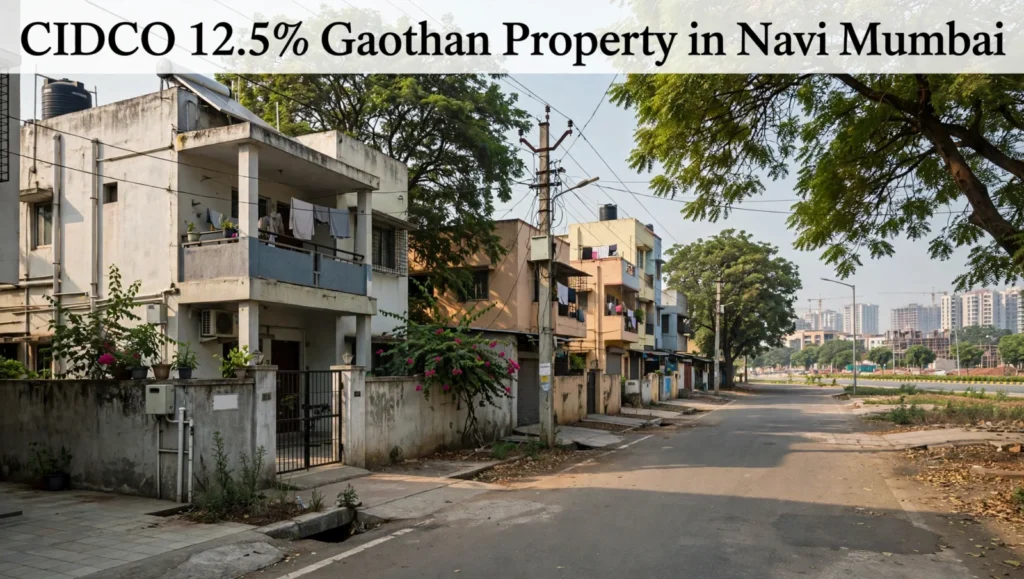
The CIDCO 12.5% scheme was introduced for the benefit of project-affected persons whose land was acquired for the development of Navi Mumbai and related areas.
CIDCO describes the scheme as having been started in 1990 for the upliftment and empowerment of the local population.
Under the scheme, 12.5% of the acquired land is returned as developed plots to eligible project-affected persons.
However, there is an important detail.
CIDCO states that 30% of the returned area is used for roads, open spaces, social facilities and public facilities.
Therefore, the effective land return is stated by CIDCO as 8.75%.
CIDCO also states that these plots have a permissible commercial use of up to 15% and a Floor Space Index (FSI) of 1.5, subject to the applicable rules and permissions.
The scheme is therefore not simply a discounted housing scheme.
It is fundamentally connected with land acquired for development and the rehabilitation/benefit of project-affected persons.
This distinction is important when you are buying a property that someone describes as: “CIDCO 12.5% property.”
You need to verify the actual documents rather than relying on the description used by a broker or seller.
For the official scheme details, eligibility framework and current information, you can refer to CIDCO’s official 12.5% Scheme page
Why Is It Called the 12.5% Scheme?
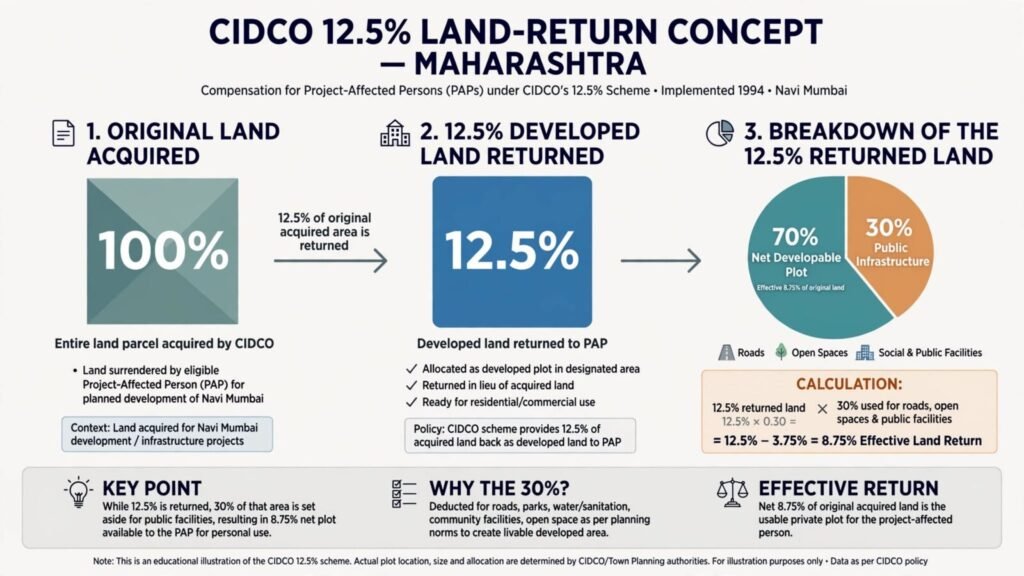
The name comes from the percentage of acquired land that was to be returned as developed plots.
In simple terms:
Suppose a project-affected person’s eligible land was acquired.
Under the scheme, the person could receive a developed plot representing 12.5% of the acquired land, subject to the scheme’s rules.
But because a portion of the returned area is used for roads, open spaces and facilities, CIDCO states that the effective land return is 8.75%.
This is why you may hear terms such as:
- CIDCO 12.5%
- 12.5% plot
- 12.5% scheme
- CIDCO 12.5% plot
- 12.5% Gaothan
- Gaothan plot
- Project-affected-person plot
These terms can appear in the Navi Mumbai property market.
But don’t assume that two properties described using the same term automatically have identical documentation.
The individual property’s title and approval documents are what matter.
What Is a Gaothan Property?
Gaothan generally refers to the traditional residential settlement area of a village.
In Maharashtra, Gaothan areas can contain:
- Old residential houses
- Ancestral properties
- Small residential buildings
- Local roads
- Shops
- Community facilities
- Properties that have existed for many years
A Gaothan property can therefore have a different documentation history from a modern apartment developed on a clearly approved urban plot.
This does not automatically mean that a Gaothan property is illegal.
It also does not mean that every Gaothan property is automatically acceptable to every bank.
For example, a current home-loan guide published by Utkarsh Small Finance Bank explains that home loans for Gaothan properties may be possible where the property satisfies the lender’s legal, technical and financial requirements. It also notes that documentation requirements can vary depending on the property and lender.
This is exactly why you should separate two questions:
Question 1: Is the property legally transferable?
and
Question 2: Will my chosen lender finance it?
They are related, but they are not identical.
CIDCO 12.5% Property vs Ordinary Gaothan Property
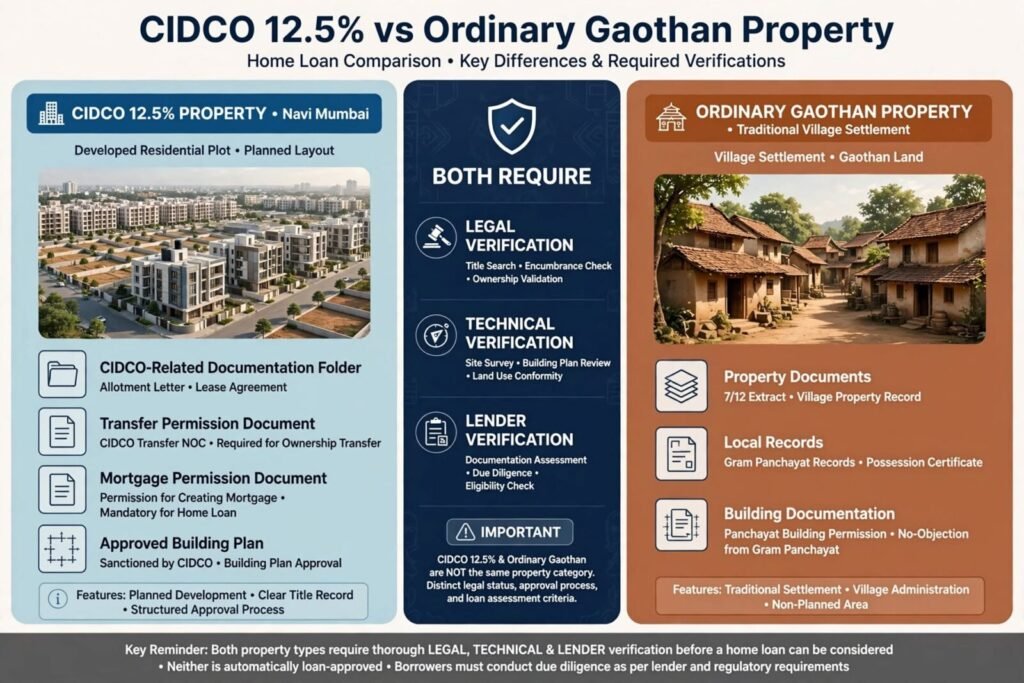
This is one of the most important distinctions in this article.
A property may be located in or around a Gaothan area without necessarily being a CIDCO 12.5% plot.
Similarly, a CIDCO 12.5% plot can have specific allotment and transfer documentation connected with CIDCO.
Therefore, don’t rely on the sentence: “Sir, this is Gaothan, but everyone here has a house.”
That is not enough for a home loan.
A lender wants documentary evidence.
| Factor | CIDCO 12.5% Property | Ordinary Gaothan Property |
|---|---|---|
| Basic connection | CIDCO 12.5% scheme | Traditional village habitation |
| Original ownership history | Linked to scheme/allotment and land acquisition history | Can be ancestral/private/local ownership |
| CIDCO documents | May be important/required | May or may not apply |
| Transfer requirements | May require CIDCO permissions depending on property | Depends on property/legal framework |
| Mortgage requirements | Lender must be satisfied mortgage can be created | Lender must be satisfied mortgage can be created |
| Building approvals | Must be verified where applicable | Must be verified where applicable |
| Loan availability | Lender-specific | Lender-specific |
| Legal verification | Important | Important |
| Technical verification | Important | Important |
The important lesson is:
Never buy a property only because the broker says “CIDCO 12.5%.”
Ask to see the documents.
Can You Get a Home Loan for a CIDCO 12.5% Property?
Yes, a home loan may be possible for a CIDCO 12.5% property.
But I would never tell a buyer: “CIDCO 12.5% property means guaranteed home loan.”
There is no such guarantee.
The lender will assess both:
You + Property
Your application may be financially strong but fail because of property documentation.
Or the property may be perfectly acceptable, but your loan may be rejected because your income, existing obligations or credit profile do not meet the lender’s criteria.
This is why home-loan approval has two sides.
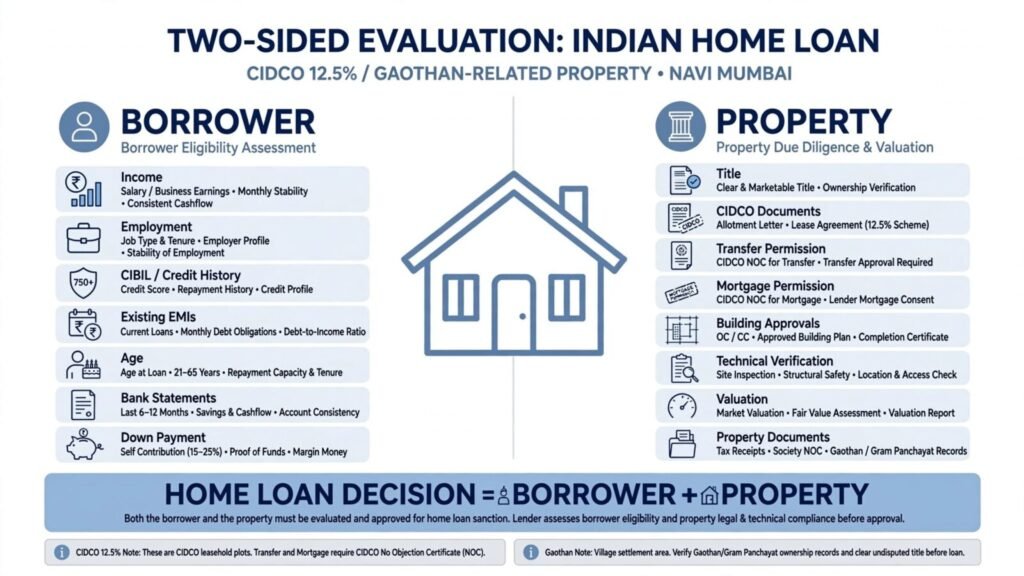
Borrower side
The lender examines:
- Income
- Employment
- Age
- CIBIL/credit history
- Existing EMIs
- Banking behaviour
- Repayment capacity
- Down payment
- Financial stability
Property side
The lender examines:
- Ownership
- Title
- Transferability
- CIDCO permissions
- Approved layout
- Development permissions
- Building plan
- Construction
- Property tax
- Encumbrances
- Valuation
- Mortgageability
You need both sides to work.
Why Property Documents Matter More Than You Think
Suppose you earn ₹1 lakh per month.
You have:
- Stable employment
- Good banking history
- Excellent CIBIL
- ₹20 lakh savings
- No major existing EMI
You find a CIDCO 12.5% property for ₹60 lakh.
You assume: “My profile is excellent, so the bank will give me the loan.”
Not necessarily.
During legal verification, the bank could identify a problem with:
- Title
- Transfer permission
- Development agreement
- CIDCO documentation
- Building approval
- Previous ownership
- Mortgage permission
- Construction approval
At that point, your personal financial profile cannot automatically fix the property problem.
This is why I always tell home buyers:
Don’t check only your loan eligibility. Check the property’s loan eligibility too.
What Banks Check Before Approving the Loan
When a lender receives a home-loan application for a property in Navi Mumbai, the property may go through legal, technical and valuation checks.
For example, ICICI Bank’s current legal valuation checklist specifically identifies additional documentation for Navi Mumbai transactions involving Gaothan plots, including CIDCO permission to transfer and mortgage, where applicable. It also lists documents such as development agreements, approved layout permissions and, in relevant cases, a tripartite agreement involving CIDCO, the allottee and developer.
This is extremely important.
It means that for certain Navi Mumbai Gaothan/CIDCO-related properties, the lender may need to establish not only ownership but also whether the property can actually be transferred and mortgaged.
Let’s look at the major checks.
1. CIDCO Allotment and Title Documents
The lender wants to understand: “How did this property come into existence?”
This is the starting point.
Depending on the transaction, the lender may examine documents such as:
- CIDCO allotment documents
- Allotment letter
- Lease-related documents
- Transfer orders
- Previous agreements
- Sale deeds
- Development agreements
- Title search reports
- Other supporting CIDCO documents
The exact documents depend on the property.
Do not assume that one document will be enough.
The legal team may want to understand the complete chain.
2. Transfer and Mortgage Permission
This is one of the biggest points for a CIDCO-related property.
A home loan is not just about buying the property.
The bank is lending you money against the property.
Therefore, the bank needs to know: “Can I legally create security over this property?”
For certain Navi Mumbai transactions, lenders can specifically require CIDCO permission to transfer and mortgage for Gaothan, Press Plot and Bungalow Plot transactions. ICICI Bank’s published legal checklist also refers to CIDCO transfer/mortgage permission for relevant properties.
For example, ICICI Bank’s legal and valuation checklist specifically lists documentation and permissions that may be required for certain Navi Mumbai properties, including CIDCO-related permissions for transfer and mortgage.
This is why you should never accept: “Sir, mortgage permission will come later.”
as a sufficient answer.
Ask:
Who will obtain it?
When will it be obtained?
Is it already available?
Does the permission cover the exact property I am purchasing?
Will my lender accept it?
3. Agreement and Ownership Chain
The lender’s legal team may examine the ownership history.
For example:
Original allottee
↓
CIDCO documentation
↓
Transfer
↓
Developer
↓
Society/association
↓
Current seller
↓
You
The actual chain will vary.
The important point is that the documents should tell a consistent story.
If the seller says: “My father got the plot.”
but the documents show another owner, you need to understand why.
If a developer claims development rights, the lender may want to examine the relevant development agreement.
If a property has changed hands several times, previous documents may become important.
4. Approved Layout and Building Permissions
Buying land and buying a legally approved residential building are not exactly the same thing.
The lender may examine:
- Approved layout
- Building plan
- Development permissions
- Commencement certificate, where applicable
- Completion certificate, where applicable
- Occupancy certificate, where applicable
- Local authority permissions
- Property tax records
- Other technical documents
The exact requirement depends on whether you are buying:
- A plot
- A ready house
- A flat
- An under-construction property
- A self-construction property
Do not assume that because several buildings exist in the neighbourhood, your particular building is approved.
5. Construction and Technical Verification
After legal verification, the property may also be technically assessed.
A technical officer or approved engineer can examine aspects such as:
- Location
- Plot dimensions
- Built-up area
- Construction
- Access road
- Building condition
- Approved plan
- Actual construction
- Property boundaries
- Overall marketability
This can create a problem when the actual construction does not match the documents.
For example:
Documented area:
1,000 sq. ft.
Actual construction:
1,400 sq. ft.
A buyer may think: “More area is better.”
But from a lender’s perspective, unauthorised or unsupported construction can create a serious issue.
6. Property Valuation
The bank also wants to know: “What is this property actually worth?”
Suppose:
Seller’s asking price = ₹70 lakh
But lender’s valuation = ₹60 lakh
You cannot assume the bank will finance the loan based on ₹70 lakh simply because that is the agreed purchase price.
The lender’s valuation process and LTV rules matter.
This is particularly important for properties where comparable transactions may be limited or documentation is unusual.
7. Your Income and Repayment Capacity
Now we come to your side of the application.
The lender will generally consider:
- Monthly income
- Employment
- Business income
- Age
- Existing obligations
- Bank statements
- Credit history
- Proposed tenure
- Repayment capacity
Suppose two people want the same ₹50 lakh CIDCO property.
Borrower A
Salary: ₹1,00,000
Existing EMI: ₹5,000
Stable employment
Good banking history
Adequate savings
Borrower B
Salary: ₹1,00,000
Existing EMI: ₹35,000
Recent job change
High financial obligations
Low savings
The property is identical.
But the applications are not identical.
This is why:
Property approval + borrower eligibility = home-loan decision
8. CIBIL and Credit History
Your credit profile still matters.
A CIDCO 12.5% property does not mean the bank ignores CIBIL.
A strong credit profile can help demonstrate responsible borrowing behaviour.
But a strong CIBIL score cannot make an unacceptable property acceptable.
Think about it this way:
Good CIBIL + bad property documents = problem
Good property documents + weak repayment capacity = problem
You need a reasonably strong combination.
9. Existing EMIs and FOIR
Suppose your salary is:
₹90,000
Existing EMI:
₹20,000
The lender does not simply calculate your home-loan eligibility using ₹90,000 as though the ₹20,000 EMI does not exist.
Existing obligations affect repayment capacity.
A common lender assessment concept is FOIR, or Fixed Obligations to Income Ratio.
The exact threshold varies by lender and borrower profile.
For example, if a lender’s internal assessment allows a certain percentage of income toward fixed obligations, your existing EMI consumes part of that capacity.
This is why: “I earn ₹90,000, so I should get a ₹60 lakh loan.”
is not a sufficient calculation.
10. Down Payment and LTV
The Reserve Bank of India has prescribed housing-loan LTV frameworks for banks. The broad regulatory framework includes lower maximum LTV percentages as loan size increases, with commonly cited limits of subject to the applicable regulatory framework and lender policy.
However, you should not interpret this as: “The bank will definitely give me 80% or 90%.”
Up to ₹30 lakh: up to 90% LTV
Above ₹30 lakh and up to ₹75 lakh: up to 80% LTV
Above ₹75 lakh: up to 75% LTV
The lender can apply its own credit, property and valuation policies within the applicable regulatory framework.
Also, stamp duty, registration and other documentation costs are not simply added to the financed property value for LTV purposes. RBI has specifically addressed this issue in its housing-finance guidance.
So you need your own funds for more than just the headline down payment.
CIDCO 12.5% Home Loan Eligibility
Your CIDCO 12.5% home loan eligibility will ultimately depend on both your financial profile and the lender’s assessment of the property.
A simplified assessment looks like this:
| Factor | Why It Matters |
|---|---|
| Age | Determines possible repayment period |
| Income | Determines repayment capacity |
| Employment | Shows income stability |
| Existing EMI | Reduces available repayment capacity |
| CIBIL | Indicates past credit behaviour |
| Bank statements | Shows financial behaviour |
| Down payment | Reduces lender exposure |
| Property value | Affects LTV |
| Property documents | Determines legal acceptability |
| CIDCO permissions | May be essential for transfer/mortgage |
| Technical approvals | Supports property acceptability |
| Valuation | Determines lender’s assessment of property value |
This is why there is no single answer such as: “CIDCO 12.5% property loan eligibility is ₹X lakh.”
Your eligibility is individual.
Example: ₹50 Lakh CIDCO Property
Let’s take a simple example.
Suppose:
Property price = ₹50 lakh
Your income = ₹80,000 per month
Existing EMI = ₹5,000
Age = 30
CIBIL = Good
Savings = ₹15 lakh
You may appear financially comfortable.
But now imagine the property documents have a problem.
For example:
- Transfer permission is unclear
- Mortgage permission is unavailable
- Building approval is incomplete
- Ownership chain is unclear
Your financial profile may be excellent.
But the property can still stop the transaction.
Now imagine the opposite.
Property documentation is acceptable, but:
Income = ₹80,000
Existing EMI = ₹30,000
Savings = ₹3 lakh
Then the lender may have concerns about your repayment capacity and down payment.
The lesson is simple:
Home loan approval is not only about the property price.
Example: ₹75 Lakh CIDCO Property
Suppose:
Property price = ₹75 lakh
Loan required = ₹60 lakh
Own contribution = ₹15 lakh
At first glance, the numbers may appear reasonable.
But the lender will still assess:
- Valuation
- LTV
- Income
- Existing obligations
- CIBIL
- Property title
- CIDCO documents
- Mortgageability
- Building approvals
- Transaction structure
If the lender’s valuation comes in lower than the purchase price, your required contribution can increase.
For example:
Purchase price = ₹75 lakh
Lender valuation = ₹68 lakh
You cannot simply assume the lender will calculate the loan against ₹75 lakh.
The actual funding depends on the lender’s valuation and applicable LTV policy.
This is why I always recommend having some financial buffer instead of arranging exactly the minimum amount.
How Much Home Loan Can You Get?
There are two different limits:
Your income-based eligibility
This depends on:
- Income
- Existing EMIs
- Age
- Tenure
- Interest rate
- FOIR
- Credit profile
Property-based eligibility
This depends on:
- Property value
- LTV
- Legal status
- Technical acceptability
- Mortgageability
Your final loan amount can effectively be limited by the weaker of the two.
For example:
Your income supports:
₹55 lakh
But property-based lending supports only:
₹45 lakh
Your loan may be limited closer to the property-based amount, subject to the lender’s policy.
Likewise, if the property supports ₹60 lakh but your income supports only ₹40 lakh, you may not receive ₹60 lakh.
This is why:
Loan eligibility ≠ property value
and
Property value ≠ loan eligibility
Documents Required for CIDCO 12.5% Home Loan
The exact list varies by lender and property.
However, you should be prepared for three categories:
- Personal documents
- Income documents
- Property documents
And CIDCO-related transactions can require additional documents.
CIDCO-Specific Property Documents
Depending on the transaction, the lender may request documents such as:
- CIDCO allotment letter
- CIDCO transfer order
- CIDCO permission for transfer
- CIDCO permission for mortgage, where applicable
- Lease-related documents
- Development agreement
- Agreement for sale
- Previous sale documents
- Tripartite agreement, where applicable
- Approved layout
- Approved building plan
- Commencement certificate, where applicable
- Completion certificate, where applicable
- Occupancy certificate, where applicable
- Property tax receipts
- Title search report
- Other CIDCO/local-authority documents
ICICI Bank’s current Navi Mumbai legal-document checklist specifically refers to CIDCO permission to transfer and mortgage for applicable Gaothan, Press Plot, Bungalow Plot and Tender Plot transactions, and to tripartite agreements between CIDCO, allottee and developer in relevant cases.
This is a good example of why you should ask the lender about the exact property before assuming that a normal home-loan process will apply.
Documents for Salaried Applicants
A salaried borrower may generally be asked for:
Personal Documents
- PAN
- Aadhaar or other accepted KYC
- Address proof
- Photographs
- Application form
Income Documents
- Latest salary slips
- Salary certificate, if required
- Form 16
- Bank statements
- Employment-related documents
Existing Loan Documents
- Existing loan statements
- EMI details
- Credit card details, where applicable
The exact requirements vary by lender.
Documents for Self-Employed Applicants
Self-employed applicants may need:
- PAN
- Aadhaar/KYC
- Income Tax Returns
- Profit and loss statements
- Balance sheets
- Business proof
- GST documents, where applicable
- Bank statements
- Business continuity documents
- Existing loan statements
Again, the exact requirements depend on the lender and business profile.
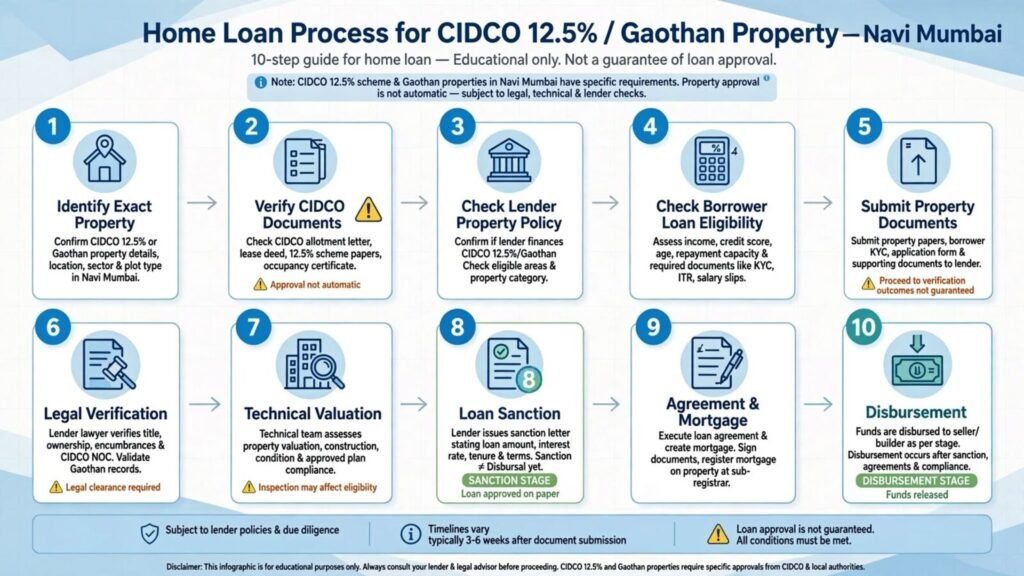
CIDCO 12.5% Home Loan Process: Step by Step
If I were buying a CIDCO 12.5% property myself, I would not start by signing the agreement.
I would first verify the property.
Here is the process I recommend.
Step 1: Identify the Exact Property
Don’t rely only on: “12.5% property.”
Get the exact details.
Ask for:
- Plot number
- Sector/node
- Property address
- Survey details, where applicable
- Area
- Current owner
- Property type
- Building/flat details
- CIDCO documents
You need to know exactly what you are buying.
Step 2: Verify the CIDCO Documents
Ask the seller to provide the available CIDCO documentation.
Check:
- Original allotment
- Transfer documents
- Lease documents
- Permissions
- Development agreement
- Previous transactions
- Mortgage-related permissions
Don’t simply look at whether the documents exist.
Check whether the documents match the property being sold.
Step 3: Check the Lender’s Property Policy
This is one of my strongest recommendations.
Don’t choose the property first and ask the bank later.
If you already know which property you want, approach the lender with the property documents.
Ask: “Will you consider this exact property for a home loan?”
Not: “Do you give home loans in Navi Mumbai?”
Those are completely different questions.
A lender may finance one property but not another because documentation and legal structure can differ.
Step 4: Check Your Loan Eligibility
Now calculate:
- Income
- Existing EMI
- Proposed EMI
- Loan amount
- Tenure
- Down payment
Don’t ask only: “How much can I get?”
Ask: “How much can I comfortably repay?”
You can use the PennyPowerPlay Home Loan Planner to estimate your EMI, affordability, loan amount and other home-loan calculations.
Step 5: Submit the Property Documents
Give the lender the complete property file.
The more organised the file is, the easier it becomes for the lender’s legal team to understand the transaction.
Avoid giving documents one by one over several weeks if you can provide a complete set initially.
Step 6: Legal Verification
The lender’s legal team reviews the documents.
They may check:
- Ownership
- Title
- Transferability
- Encumbrances
- Previous transactions
- CIDCO permissions
- Development rights
- Mortgageability
- Agreements
- Local authority records
This is one of the most important stages.
Step 7: Technical Verification
A technical assessment may examine:
- Location
- Construction
- Area
- Building condition
- Approved plan
- Actual construction
- Access
- Property boundaries
- Development
If the actual property differs significantly from the approved documents, the lender may raise questions.
Step 8: Sanction
If both:
Borrower + Property
satisfy the lender’s requirements, the lender may issue a sanction.
Read the sanction letter carefully.
Check:
- Loan amount
- Interest rate
- Benchmark
- Spread
- Reset terms
- Tenure
- EMI
- Processing charges
- Other fees
- Pre-disbursement conditions
Don’t treat the sanction letter as a formality.
Step 9: Agreement and Mortgage
The lender may require the relevant legal documents and mortgage/security creation steps to be completed before disbursement.
This is where the property’s ability to be legally mortgaged becomes extremely important.
For a CIDCO-related property, make sure you understand:
What permission is required?
Who is responsible for obtaining it?
Has it already been obtained?
Will the lender accept it?
Step 10: Disbursement
The final stage is disbursement.
Depending on the transaction, the lender may release funds after the required conditions have been satisfied.
Do not assume: “Sanction means money is guaranteed.”
Sanction and disbursement are different stages.
If a pre-disbursement property condition remains unresolved, disbursement can be delayed.
Why Some CIDCO 12.5% Properties Get Rejected
A common mistake is thinking: “The property is in Navi Mumbai and everyone knows about 12.5%, so the bank must finance it.”
That’s not how property lending works.
A lender can raise concerns because of:
1. Unclear title
The ownership chain is not sufficiently established.
2. Missing CIDCO permission
The required transfer or mortgage permission is unavailable.
3. Unclear development rights
The person selling the property cannot establish the right to sell it.
4. Construction mismatch
The actual building differs from approved documentation.
5. Missing approvals
Required building or development permissions are unavailable.
6. Valuation issue
The lender’s valuation is significantly lower than the agreed purchase price.
7. Mortgageability problem
The lender cannot establish a satisfactory legal security interest.
8. Incomplete documentation
Important documents are missing or inconsistent.
9. Existing encumbrance
The property has an existing charge or other legal issue.
10. Lender policy
Even where a property may be legally valid, a particular lender may choose not to finance that type of property under its internal policy.
This last point is important.
A property being legally transferable does not automatically mean every bank will finance it.
7 Mistakes to Avoid When Buying CIDCO 12.5% Property
Mistake 1: Paying a Token Before Checking the Loan
This is one of the biggest mistakes.
You pay:
₹1 lakh
Then approach the bank.
The bank says: “We cannot finance this property.”
Now you may be forced to arrange another lender or negotiate the token refund.
Check financing feasibility before committing significant money.
Mistake 2: Believing the Broker’s “Loan Guaranteed” Statement
A broker may say: “Sir, this property is already financed by many people.”
That is not the same as: “Your lender has approved this exact property.”
Ask for documentary confirmation.
Mistake 3: Checking Only Your CIBIL
A good CIBIL score is helpful.
But it does not solve property documentation problems.
Check both:
Your credit profile
and
the property’s legal profile.
Mistake 4: Assuming All CIDCO 12.5% Properties Are Identical
They aren’t.
Different properties can have different:
- Owners
- Agreements
- Development structures
- Permissions
- Building approvals
- Transfer history
- Mortgage conditions
Verify the exact property.
Mistake 5: Ignoring the Valuation
Suppose:
Purchase price = ₹80 lakh
Valuation = ₹70 lakh
You may need significantly more own contribution than expected.
Don’t arrange only the minimum amount.
Mistake 6: Assuming Existing Construction Is Automatically Approved
You may see a four-storey building.
That doesn’t automatically prove that every floor or every part of the construction has approval.
Ask for the relevant documents.
Mistake 7: Borrowing the Maximum Possible Amount
Even if a bank says you qualify for ₹60 lakh, you don’t necessarily need to borrow ₹60 lakh.
Think about:
- EMI
- Interest cost
- Job stability
- Children’s education
- Emergency fund
- Other financial goals
- Retirement
- Future expenses
Your home loan should fit your life.
CIDCO 12.5% Property Home Loan vs Normal Home Loan
Let’s compare the two at a high level.
| Factor | Normal Urban Property | CIDCO 12.5% / Gaothan-Related Property |
|---|---|---|
| Income assessment | Yes | Yes |
| CIBIL | Yes | Yes |
| Existing EMI | Yes | Yes |
| LTV | Yes | Yes |
| Property valuation | Yes | Yes |
| Legal verification | Yes | Yes |
| Technical verification | Yes | Yes |
| CIDCO documents | Usually not central | May be central |
| Transfer permission | Depends on property | May be important |
| Mortgage permission | Depends on property | May be important |
| Development agreement | Depending on transaction | May be required |
| Tripartite agreement | Depending on transaction | May apply |
| Property-specific lender policy | Yes | Particularly important |
The biggest difference is often the complexity of property documentation and permissions.
This is why I would approach a CIDCO 12.5% transaction more cautiously than a straightforward apartment purchase in an established approved project.
Should You Buy a CIDCO 12.5% Property?
My answer is:
Don’t ask whether CIDCO 12.5% is good or bad in general.
Ask whether the specific property you are buying is:
- Legally clear
- Properly documented
- Transferable
- Mortgageable
- Technically acceptable
- Properly valued
- Financeable by your chosen lender
- Affordable for you
A property that passes these checks can be very different from a property where the seller simply says: “Don’t worry, everyone lives here.”
When you are investing ₹50 lakh, ₹70 lakh, ₹1 crore or more, don’t replace documentation with verbal assurance.
Questions to Ask the Seller or Builder
Before paying a token amount, ask these questions.
Property
- What is the exact plot/flat number?
- What is the carpet/built-up area?
- Who is the legal owner?
CIDCO
- Is this actually a CIDCO 12.5% property?
- Can I see the original CIDCO allotment documents?
- Is the transfer permission available?
- Is mortgage permission available where required?
- Are there any restrictions on transfer?
Construction
- Is the building plan approved?
- Is the construction as per the approved plan?
- Is the required completion/occupancy documentation available?
Ownership
- Can I see the complete previous ownership chain?
- Is there any existing mortgage?
- Is there any litigation?
- Are there outstanding dues?
Home Loan
- Which lenders have financed this exact property?
- Can I submit the documents to my preferred lender before paying the token?
- Has the property already been legally and technically verified by the lender?
These questions can save you from a very expensive mistake.
Check Your Home Loan Readiness Before Paying a Token
Before you commit to the property, I recommend checking four things.
1. Check Your Loan Eligibility
Calculate:
- Monthly income
- Existing EMI
- Proposed EMI
- Loan amount
- Tenure
- Down payment
Use the PennyPowerPlay Home Loan Planner to estimate your affordability.
2. Check Your Credit Profile
Review your credit report.
Look for:
- Current loans
- Credit cards
- Outstanding balances
- Late payments
- Enquiries
- Incorrect accounts
Don’t wait until the loan application to discover an issue.
3. Check Your Down Payment
Your contribution should not be limited to: Property price − home loan.
You may also need funds for:
- Stamp duty
- Registration
- Processing charges
- Legal expenses
- Brokerage
- Interiors
- Moving
- Emergency reserves
And RBI’s LTV framework means stamp duty and registration charges should not simply be treated as part of the financed property value for calculating the regulatory LTV.
4. Check the Property Before Paying
This is the most important one.
Your checklist should include:
CIDCO documents → Title → Transfer → Mortgage → Approvals → Construction → Valuation → Lender acceptance
Only after you are comfortable with these should you move forward.
CIDCO 12.5% Home Loan: Frequently Asked Questions
Q1: What is the CIDCO 12.5% scheme?
The CIDCO 12.5% scheme is a land-return scheme for eligible project-affected persons whose land was acquired for development. CIDCO states that 12.5% of acquired land is returned as developed plots, with 30% of that returned area used for roads, open spaces and facilities, resulting in an effective 8.75% land return.
Q2: Is CIDCO 12.5% the same as a home loan?
No.
This is one of the biggest misconceptions.
12.5% refers to the CIDCO land-allotment scheme, not a home-loan interest rate or a special 12.5% home-loan product.
A buyer may seek a normal home loan to purchase or construct a property associated with the scheme, subject to lender policy and property verification.
Q3: Can I get a home loan for a CIDCO 12.5% property?
Potentially, yes.
However, approval depends on both your financial profile and the property’s legal, technical and mortgageability requirements.
Some lenders have specific documentation requirements for applicable Navi Mumbai Gaothan/CIDCO-related properties, including CIDCO permissions for transfer and mortgage.
Q4: Is every CIDCO 12.5% property eligible for a home loan?
No.
Do not assume that the phrase “CIDCO 12.5%” guarantees financing.
The lender may examine:
- Title
- CIDCO documents
- Transfer permission
- Mortgage permission
- Development rights
- Construction
- Approvals
- Valuation
- Overall marketability
Q5: Is a Gaothan property eligible for a home loan?
It may be.
Some lenders offer financing for eligible Gaothan properties subject to legal, technical and financial requirements. For example, Utkarsh Small Finance Bank currently describes a product that can cover certain homes in Gram Panchayat/Gaothan areas, subject to its conditions and documentation.
But this does not mean every Gaothan property is financeable.
Q6: Is a 7/12 extract required for a CIDCO 12.5% property?
Not necessarily in every case.
The required property documents depend on the property’s legal classification and the lender’s requirements.
Other documents such as:
- Property card
- Mutation records
- Allotment documents
- CIDCO records
- Lease documents
- Sale documents
- Development agreements
may become relevant.
Don’t assume that one particular document is universally mandatory.
Q7: What CIDCO documents should I check before buying?
Depending on the property, you may need to review:
- Allotment letter
- Transfer order
- Lease documents
- CIDCO permissions
- Development agreement
- Previous sale documents
- Tripartite agreement, where applicable
- Mortgage/transfer permission
- Approved plans
The exact list should be confirmed with your lender and property lawyer.
Q8: Does a good CIBIL score guarantee a CIDCO home loan?
No.
CIBIL is only one part of the borrower assessment.
The property must also satisfy the lender’s legal and technical requirements.
A strong borrower cannot automatically make a legally unacceptable property financeable.
Q9: Can I get a home loan if the property valuation is lower than the purchase price?
Possibly, but you may need to bring in more of your own funds.
For example:
Purchase price = ₹75 lakh
Valuation = ₹68 lakh
The lender’s funding calculation may be based on the applicable valuation and LTV rules rather than simply the purchase price.
This is why you should keep a financial buffer.
Q10: Can I use a personal loan for the down payment?
I would generally advise caution.
A personal loan creates another EMI and can reduce your home-loan repayment capacity.
It can also make your overall financial position more stretched.
Your home purchase should be structured around sustainable affordability.
Q11: Should I pay a token before the bank checks the property?
I would avoid committing a significant amount before understanding whether your preferred lender can finance the property.
If you do pay a token, make sure the agreement clearly addresses the consequences if the transaction cannot proceed because of legal or financing issues.
Get legal advice before signing.
Q12: Does one bank’s approval mean every bank will finance the property?
No.
Each lender has its own credit and property policies.
Even if another buyer obtained financing from one lender, your preferred lender may have different requirements.
Q13: Can I construct a house on a CIDCO 12.5% plot using a home loan?
Potentially, yes, subject to the lender’s product, your eligibility, the plot documentation and required construction approvals.
Construction loans can have different documentation and disbursement requirements from a ready-property purchase.
Q14: What is the biggest risk when buying a CIDCO 12.5% property?
In my view, the biggest mistake is assuming that the property is financeable before verifying the documentation.
A cheap property is not necessarily a good property.
A good property is one where:
Title + permissions + approvals + valuation + financing + affordability
all work together.
A successful CIDCO 12.5% home loan application therefore requires more than good income and CIBIL. The property itself must also satisfy the lender.
Final Thoughts
If you are looking for a CIDCO 12.5% or Gaothan property in Navi Mumbai, I understand why these properties can be attractive.
You may hear: “This is a CIDCO property.”
“It is much cheaper than a normal flat.”
“Everyone in the area has taken a loan.”
“The bank will approve it.”
“The documents are all fine.”
But when you are putting your savings into a property, don’t make your decision based only on what somebody tells you.
Verify it.
The CIDCO 12.5% scheme has a specific history and purpose. CIDCO itself describes it as a scheme under which developed plots are returned to eligible project-affected persons, with the scheme also extending to project-affected persons covered under Gaothan expansion schemes.
When you buy a property connected with this system, the documentation can be more important than the sales pitch.
Remember these five questions:
1. Is the property legally transferable?
2. Can the property be legally mortgaged?
3. Are the required CIDCO permissions available?
4. Will my chosen lender finance this exact property?
5. Can I comfortably afford the EMI?
If you can answer all five confidently, you are in a much stronger position.
But if the answer to any of them is: “The broker said it should be okay.”
Stop.
Get the documents checked.
Get the lender’s view.
Get independent legal advice where necessary.
And only then proceed.
Your home loan is going to stay with you for many years.
Your property should also be something you can own with confidence for many years.
Don’t choose a property only because the price looks attractive.
Choose it because the property, paperwork, financing and your finances all make sense together.
That is the difference between simply getting a home loan and making a financially sound home purchase.
Official References
- CIDCO – 12.5% Scheme: CIDCO’s official information explains the purpose of the scheme, the developed-plot return, the 30% utilisation of returned area for roads/open spaces/social and public facilities, and the effective 8.75% land return.
- CIDCO – 12.5% Services: CIDCO’s current website provides online 12.5% applications, notices, allotment information and 2026 results.
- ICICI Bank – Legal Valuation Checklist: The lender’s current checklist provides examples of documents that can be required for Navi Mumbai Gaothan and other applicable plot transactions, including CIDCO transfer/mortgage permission and relevant tripartite agreements.
- RBI – Housing Finance/LTV Framework: RBI’s housing-loan framework sets applicable LTV limits and addresses the treatment of stamp duty and registration charges in property valuation for housing loans.
- Utkarsh Small Finance Bank – Gaothan Home Loan: Provides an example of lender-specific financing and documentation requirements for eligible Gaothan properties.
Related Posts
- Home Loan Guide for India: Complete Guide for Indian Home Buyers
- Home Loan Eligibility for Salaried Persons in India
- Home Loan Eligibility for Self-Employed Individuals
- Home Loan Documents Checklist for Indian Buyers
- CIBIL Score for Home Loan: What Score Do You Need?
- Home Loan Fees and Charges in India
- Home Loan Balance Transfer Guide
- Home Loan Prepayment Guide
- Home Loan Tax Benefits in India
About the Author
Ashok K. Satpute is the founder of PennyPowerPlay.com and a Home Loan Specialist with over 8 years of experience in India’s banking and housing finance industry.
During his career, he has worked with leading financial institutions, including ICICI Bank, HDFC, Axis Bank and PNB Housing Finance, assisting borrowers with home-loan eligibility, loan processing, documentation, CIBIL analysis, balance transfers and other aspects of housing finance.
Through PennyPowerPlay.com, he shares practical, experience-based home-loan guides designed to help Indian home buyers understand the lending process and make better-informed financial decisions.
Disclaimer: This article is for educational and informational purposes only. Home-loan approval, property eligibility, legal acceptance, valuation, interest rates, documentation requirements and lender policies can vary by borrower, property and lender. CIDCO 12.5% properties and Gaothan properties can involve property-specific legal and technical considerations. Always verify the latest requirements with CIDCO, your lender and an independent qualified property lawyer before making a financial commitment.