Published on 09/09/2026
Imagine this.
You bought your dream home.
You paid your booking amount.
You arranged the down payment.
Your home loan was sanctioned.
The bank started disbursing the loan as construction progressed.
And then the possession date arrived.
But your home wasn’t ready.
One month passed.
Then six months.
Then another year.
Meanwhile, your financial commitments did not stop.
You may still have a home loan repayment to manage. You may also be paying rent where you currently live.
If you are wondering what happens to your home loan if the builder delays possession, you are not alone.
This is the reality many Indian homebuyers face when a housing project gets delayed.
A report released by the Forum for People’s Collective Efforts (FPCE) on September 9, 2026 estimates that around 27.6 lakh homebuyer families are stuck in delayed RERA-registered projects across India.
The report estimates that around ₹12.44 lakh crore of homebuyer money is trapped in undelivered projects, using March 2, 2026 RERA Tracker data from the Ministry of Housing and Urban Affairs and a conservative assumption of ₹45 lakh per family.
But there is an important point to understand:
The 27.6 lakh figure does not mean that all 27.6 lakh buyers have active home loans.
However, for buyers who have borrowed from a bank or housing finance company, builder delay can create a serious financial problem.
You could be dealing with:
- Home loan EMI or pre-EMI
- Rent for your current accommodation
- Interest on the amount already disbursed
- Delayed possession
- Construction uncertainty
- Increased financial pressure
- Questions about RERA compensation
- Difficult decisions about whether to continue or exit the project
So, what happens to your home loan if the builder delays possession?
Let’s understand it step by step.
Home Loan If Builder Delays Possession: What Happens Next?
This is the first question every borrower should ask.
The simple answer is:
Builder delay does not automatically cancel or suspend your home loan repayment obligation.
Your relationship with the builder and your relationship with the lender are separate contractual relationships.
If the lender has already disbursed money under your loan agreement, you generally remain responsible for servicing the loan according to its terms unless the lender agrees otherwise or a competent authority/court directs a different outcome.
This is why you should never simply stop paying your home loan EMI because the builder has delayed possession.
Doing so can potentially result in:
- Overdue amounts
- Penal charges where applicable
- Collection action
- Negative credit reporting
- Damage to your CIBIL/credit profile
- Difficulty obtaining future credit
The Reserve Bank of India has specifically highlighted risks associated with housing-loan structures where builders service borrowers’ interest/EMIs during construction, including the possibility that delayed payments by developers can affect borrowers’ credit scores. RBI has also advised that housing-loan disbursements should be closely linked to construction stages for relevant housing projects.
So if you are facing a builder delay after taking a home loan, don’t make a decision based purely on frustration.
First understand:
How much has the bank already disbursed?
Are you paying pre-EMI or full EMI?
What does your loan agreement say?
What does your Agreement for Sale say about possession?
What are your rights under RERA?
27.6 Lakh Homebuyers and the Delayed Property Possession Problem in India
The latest FPCE report has brought the scale of India’s delayed housing problem back into focus.
According to reports based on the FPCE study, around 27.6 lakh homebuyer families are affected by delayed RERA-registered residential projects. The report says the estimated value of money trapped in undelivered projects is approximately ₹12.44 lakh crore.
This is significant because buying a home is usually the largest financial commitment an Indian family makes.
A delayed project can therefore affect much more than your possession date.
It can affect:
Your cash flow.
Your rent.
Your loan repayment.
Your investment plans.
Your retirement planning.
Your children’s education planning.
Your ability to purchase another property.
And in some cases, your credit profile.
This is why delayed property possession in India is not merely a real-estate problem.
For a borrower, it can become a home-loan problem too.
Home Loan EMI and Rent During Possession Delay
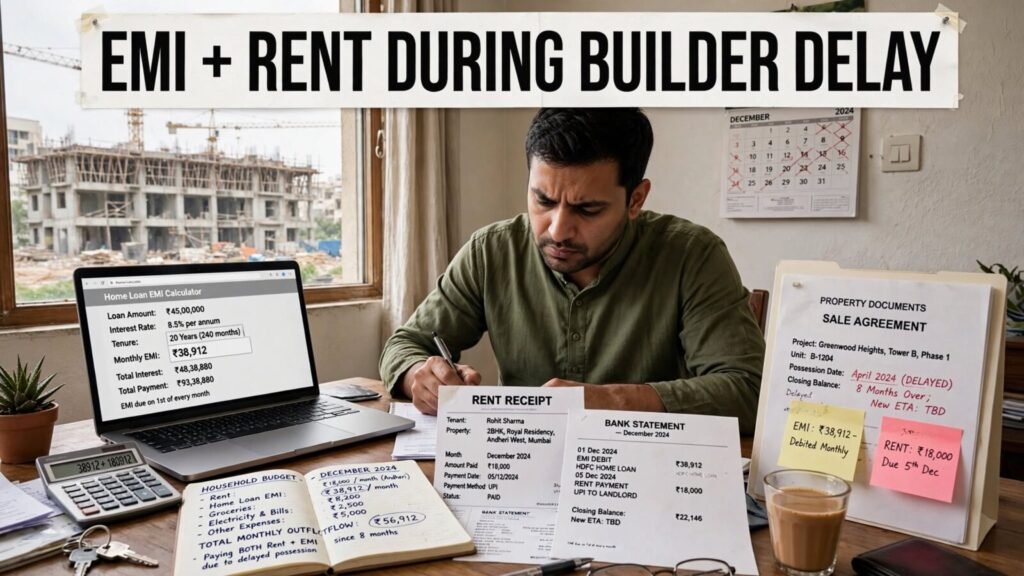
This is where the problem becomes particularly painful.
Suppose you purchased an under-construction property.
Your home loan EMI is:
₹50,000 per month
You are currently living in a rented apartment costing:
₹25,000 per month
Your property is delayed by 12 months.
Your monthly housing-related cash outflow could therefore be:
₹50,000 EMI + ₹25,000 rent = ₹75,000
Over 12 months:
₹75,000 × 12 = ₹9,00,000
That is ₹9 lakh of cash outflow during the delay period.
But remember one important point:
₹9 lakh is not automatically your financial loss.
Your EMI contains both interest and principal components. The principal portion is reducing your outstanding loan balance.
The point is different:
Your monthly cash-flow burden can become extremely high.
This is why you should calculate affordability based not only on the EMI you expect to pay after possession, but also on the possibility of a delayed possession period.
If your household budget cannot comfortably handle:
EMI + rent + maintenance + insurance + other EMIs + daily expenses
for several months, an under-construction property may create significant financial stress.
Pre-EMI During Construction Delay: What Borrowers Should Know
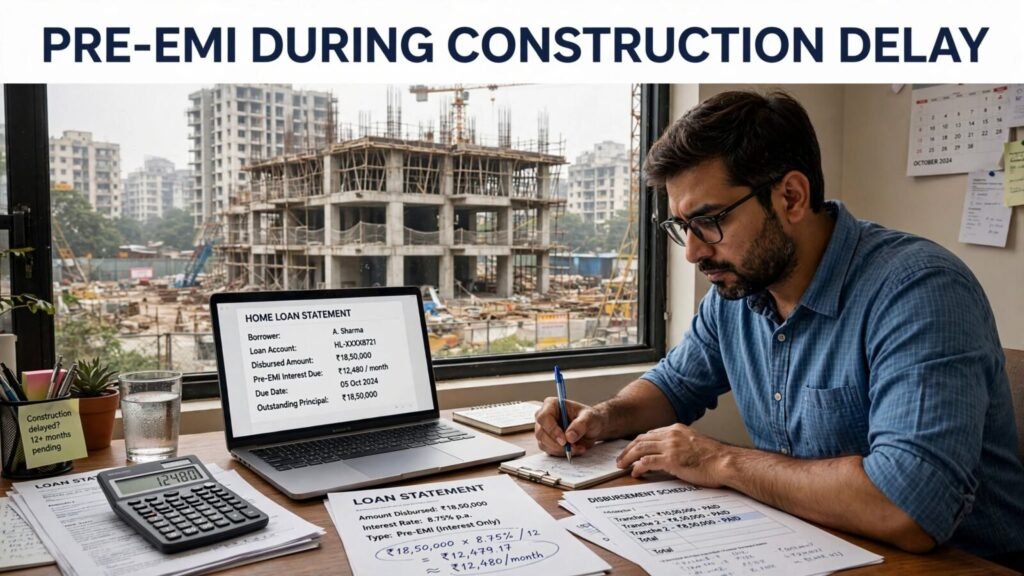
Many buyers of under-construction properties don’t initially pay the full EMI.
Instead, they may pay pre-EMI interest on the amount already disbursed by the lender.
The Reserve Bank of India explains that when a housing loan is disbursed in instalments based on construction stages, the borrower may be required to pay interest only on the portion already disbursed until regular EMI begins. This is commonly called pre-EMI interest.
For example:
Suppose your sanctioned home loan is:
₹50 lakh
But the bank has initially disbursed:
₹15 lakh
You may be paying interest on the ₹15 lakh already disbursed rather than EMI on the entire ₹50 lakh.
If another ₹10 lakh is disbursed later, the amount on which interest is calculated can increase.
This means a construction delay does not necessarily mean that your loan payment disappears.
In fact, if disbursements have already happened, you may continue carrying the financial cost of the loan while waiting for the property.
What should you check?
Ask your lender:
- How much has been disbursed?
- How much remains undisbursed?
- Am I currently paying pre-EMI or EMI?
- What triggers the transition to regular EMI?
- What is the current outstanding loan?
- What happens if construction is delayed?
- Is any further disbursement linked to actual construction progress?
RBI guidance has emphasized that housing-loan disbursements should be closely linked to construction stages and that upfront disbursement should not be made for incomplete/under-construction/greenfield housing projects in the circumstances covered by the guidance.
RERA Delayed Possession Home Loan: What Are Your Rights?
This is where RERA becomes important.
The Real Estate (Regulation and Development) Act, 2016 was introduced to regulate the real-estate sector and protect homebuyers.
Section 18 specifically deals with return of amount and compensation when the promoter fails to complete or is unable to give possession in accordance with the Agreement for Sale.
Under Section 18, if the allottee wants to withdraw from the project in circumstances covered by the section, the promoter is liable on demand to return the amount received, along with interest at the prescribed rate and compensation as provided under the Act.
If the allottee does not intend to withdraw, the promoter is required to pay interest for every month of delay until possession, at the prescribed rate.
This is extremely important.
It means the buyer’s options are not necessarily limited to:
“Wait for the builder forever.”
Depending on the facts, agreement, applicable state rules, and the order of the relevant authority, the buyer may have remedies involving:
- Continuing with the project and seeking applicable delay interest
- Seeking refund
- Seeking compensation
- Filing a complaint before the appropriate RERA authority
The exact remedy depends on the circumstances.
RERA Section 18 for Delayed Possession
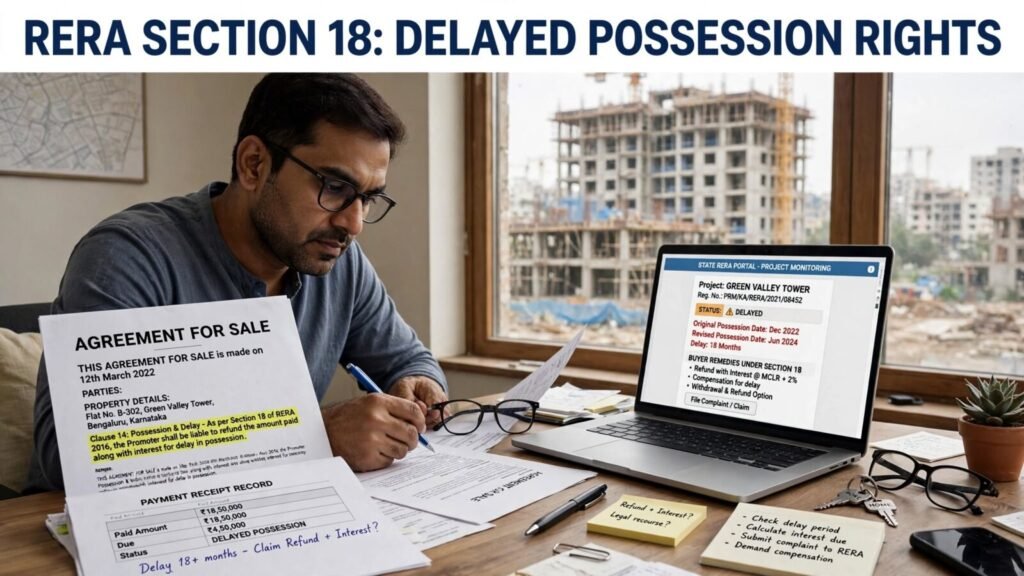
Section 18 is one of the most important provisions for a homebuyer facing delayed possession.
The law provides a framework for situations where the promoter fails to complete or is unable to give possession according to the Agreement for Sale.
If the allottee wishes to withdraw, Section 18 provides for return of the amount received by the promoter along with prescribed interest and compensation as provided under the Act.
If the allottee does not wish to withdraw, the law provides for interest for every month of delay until possession.
But don’t make one mistake:
Do not assume that every delayed project automatically produces the same compensation outcome.
Real-world cases can involve:
- The wording of the Agreement for Sale
- Promised possession date
- Extended possession date
- Force majeure claims
- Regulatory permissions
- Project-specific circumstances
- State RERA rules
- Previous RERA orders
- Supreme Court or High Court decisions
- The relief specifically requested by the buyer
Therefore, if the amount involved is significant, consider getting advice from a qualified real-estate lawyer or the appropriate RERA authority.
RERA Compensation for Delayed Possession
A common question is:
Can I get compensation for delayed possession?
Potentially, yes, depending on the facts and applicable law.
RERA Section 18 provides for prescribed interest in the circumstances described above, and compensation where applicable under the Act.
But don’t assume that compensation automatically means:
“The builder will pay all my EMI.”
That’s an important distinction.
You may have several different financial consequences:
- Loan interest
- Principal repayment
- Rent
- Registration-related costs
- Temporary accommodation
- Increased property expenses
- Other documented losses
Whether a particular amount can be recovered from the promoter depends on the applicable legal provisions, facts and relief granted by the competent authority.
So keep your documentation.
Save:
- Loan statements
- EMI statements
- Pre-EMI statements
- Rent agreements
- Rent receipts
- Payment receipts to builder
- Agreement for Sale
- Demand letters
- Builder emails
- WhatsApp communications
- Possession commitments
- RERA project information
- Bank correspondence
Documentation can become extremely important if you need to establish the financial impact of the delay.
Already Paying EMI? What Happens When the Property Is Delayed?
If you are already paying your full home loan EMI, the most important thing is:
Don’t stop paying blindly.
Instead, immediately create a three-way communication trail.
1. Speak to the builder
Ask for:
- Current construction status
- Revised completion timeline
- Reason for delay
- Updated possession date
- RERA extension details, if any
- Remaining approvals
- Construction milestones
2. Speak to the lender
Ask:
- Current loan outstanding
- Amount already disbursed
- Remaining sanctioned amount
- Current interest rate
- EMI amount
- Remaining tenure
- Future disbursement schedule
- Whether future disbursement is linked to construction progress
3. Check your RERA position
Look at:
- Registered possession date
- Current project status
- Approved extensions
- Complaints/orders
- Promoter information
- Project completion information
Do not rely only on what a salesperson tells you.
Home Loan Repayment When the Builder Delays Possession
The biggest misconception is: “If the builder hasn’t given me the house, why should I pay the bank?”
It sounds logical emotionally.
But your loan obligation may still continue.
The lender has already provided credit under the loan contract.
If the builder delays the property, that does not automatically rewrite your loan agreement.
This is why you should separate the two issues:
Issue 1: Builder delay
This concerns the property transaction and your rights against the promoter.
Issue 2: Home loan repayment
This concerns your contractual obligations to the lender.
You may have legal remedies against the builder, but that does not automatically mean you can stop servicing the bank loan.
The RBI has previously warned about risks associated with housing-loan products involving builders, including delayed project completion and the impact that loan-servicing problems can have on borrowers’ credit profiles.
My practical advice:
Never stop EMI without first taking proper advice and understanding the consequences.
If cash flow is becoming difficult, approach the lender early rather than waiting until the account becomes overdue.
Can You Stop Your Home Loan EMI Because of Builder Delay?
Generally, you should not assume that you can stop your EMI simply because the builder has delayed possession.
Your loan agreement remains relevant.
Stopping EMI without an agreed arrangement or legal basis can expose you to financial and credit consequences.
Instead:
- Inform the lender in writing about the project delay.
- Ask for the current loan statement.
- Ask how much has already been disbursed.
- Keep paying according to the loan terms unless you have formal advice or an arrangement that changes your obligation.
- Simultaneously pursue your remedies against the builder.
This distinction is critical for every borrower.
Can You Exit the Property and Get a Refund?
In certain delayed-possession circumstances, RERA Section 18 provides a route for an allottee who wishes to withdraw from the project to seek return of the amount received by the promoter along with prescribed interest and compensation as provided under the Act.
But exiting a property with a home loan can be more complicated than simply cancelling your booking.
You need to understand:
- How much you have paid the builder
- How much the lender has disbursed
- Outstanding loan balance
- Interest already paid
- Refund process
- How the lender’s outstanding loan will be settled
- Whether the refund is sufficient to clear the lender’s dues
- Applicable taxes and charges
- Legal proceedings, if any
Example
Suppose:
Property price: ₹60 lakh
Home loan disbursed: ₹45 lakh
Your own contribution: ₹15 lakh
The project is seriously delayed.
If you seek cancellation/refund, you cannot simply think:
“The builder will give me ₹60 lakh and I walk away.”
The actual settlement can involve the lender because the bank/HFC has a financial interest in the loan and outstanding amount.
Therefore, before signing any cancellation or settlement document, understand how the home loan will be closed and how the lender’s dues will be handled.
Can You Claim Rent From the Builder for Delayed Possession?
This is another common question.
A buyer facing delayed possession may want compensation for rent paid during the delay.
Whether such a claim succeeds and the amount recoverable depend on the applicable law, contractual terms, facts and orders of the competent authority.
Don’t assume that every month of rent will automatically be reimbursed.
However, you should maintain proper evidence of your rental expenses.
Keep:
- Registered rent agreement where applicable
- Rent receipts
- Bank transfers
- UPI records
- Landlord correspondence
- Monthly rent statements
Good documentation gives you a clearer record of the actual financial impact.
What to Do If Your Builder Delays Possession: 10-Step Checklist
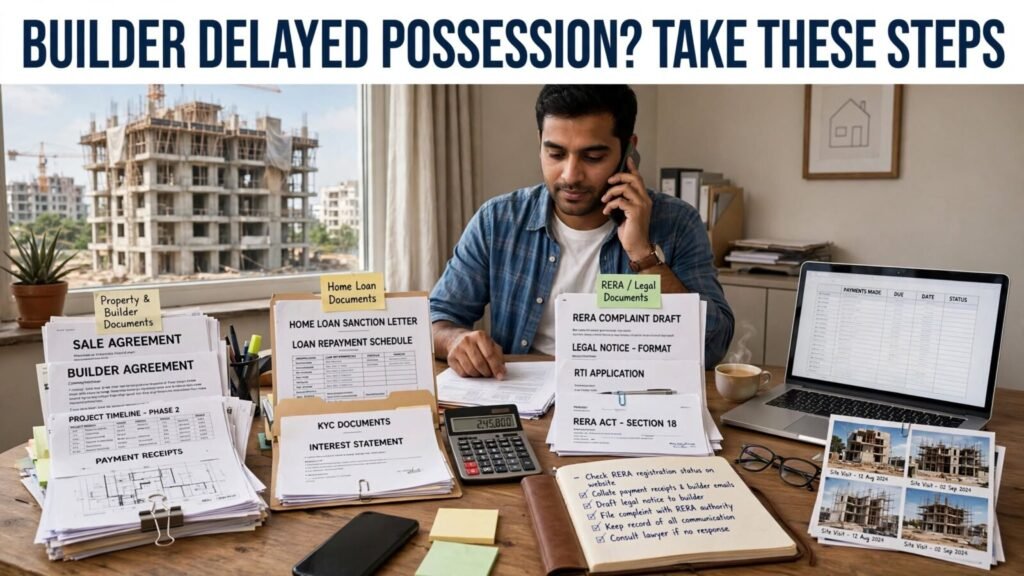
If your project is delayed, don’t just wait for another verbal promise.
Follow a structured process.
Step 1: Check your Agreement for Sale
Find the contractual possession date.
Don’t rely only on the brochure or sales representative’s statement.
Step 2: Check the RERA registration
Verify the project on the relevant state RERA website.
Step 3: Check project status
Look for:
- Construction progress
- Registered completion date
- Extensions
- Orders
- Complaints
- Promoter information
Step 4: Get the builder’s explanation in writing
Ask for the exact reason for delay and revised completion timeline.
Step 5: Review your home loan
Find out:
- Total sanctioned amount
- Total disbursed amount
- Outstanding principal
- Current EMI
- Interest rate
- Remaining tenure
Step 6: Determine whether you are paying EMI or pre-EMI
This can significantly change your cash-flow situation.
Step 7: Calculate your monthly delay cost
Add:
EMI + rent + maintenance + other EMIs + household expenses
Then calculate how long your savings can support the additional burden.
Step 8: Inform your lender
Do not wait until there is a payment problem.
Step 9: Understand your RERA remedies
Check whether continuing, seeking delay interest, refund or another remedy is appropriate for your circumstances.
Step 10: Take professional legal advice if required
Especially if:
- The delay is substantial
- The project is stalled
- The builder is refusing possession
- You want to exit
- A large refund is involved
- You are considering litigation/RERA proceedings
Homebuyer Rights Under RERA: Documents You Should Keep
Your strongest position comes from documentation.
Create a digital folder containing:
Property documents
- Booking form
- Allotment letter
- Agreement for Sale
- Payment receipts
- Demand letters
Loan documents
- Sanction letter
- Loan agreement
- Disbursement statements
- EMI schedule
- Interest certificates
- Account statements
Delay evidence
- Builder emails
- Letters
- WhatsApp messages
- Construction photographs
- Revised possession commitments
- RERA updates
Financial impact
- Rent agreement
- Rent receipts
- Bank statements
- Other directly relevant expenses
This information can help you understand your position and can be important if you need to pursue a formal complaint.
15 Questions to Ask Before Buying an Under-Construction Property
The best way to deal with a property delay is to reduce your risk before buying.
Ask these questions:
- What is the possession date in the Agreement for Sale?
- Is the project registered with RERA?
- What is the RERA registration number?
- What is the current construction progress?
- Has the project received all required approvals?
- Does the builder have a history of delayed projects?
- Has this project previously received an extension?
- What is the construction-linked payment schedule?
- When will the lender disburse the loan?
- Will disbursement be linked to actual construction stages?
- How much emergency cash can I maintain?
- Can I afford EMI plus rent if possession is delayed?
- What happens if possession is delayed by 12 months?
- What are my contractual remedies?
- What does RERA say about my rights?
A lower property price does not necessarily make a project cheaper.
And a lower home-loan interest rate does not make a delayed property financially safe.
EMI and Rent Due to Builder Delay: A Simple Stress Test
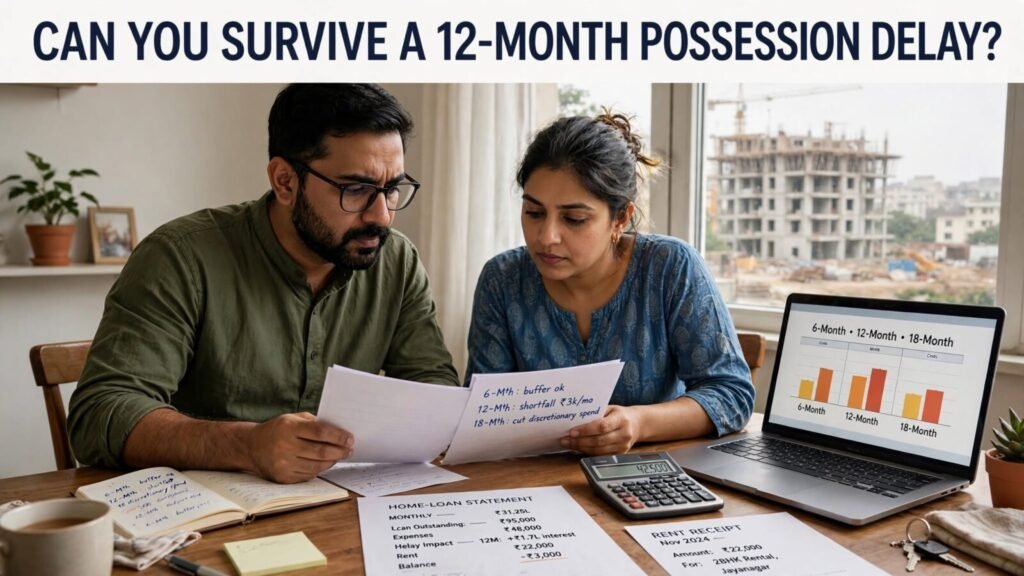
Before buying an under-construction home, run three scenarios.
Scenario 1: No delay
EMI: ₹45,000
Rent until possession: ₹20,000
Expected delay: 0 months
Scenario 2: 6-month delay
Additional rent:
₹20,000 × 6 = ₹1.20 lakh
Scenario 3: 18-month delay
Additional rent:
₹20,000 × 18 = ₹3.60 lakh
And that’s only rent.
You could also face:
- Increased EMI due to interest-rate changes
- Higher maintenance costs
- Increased living expenses
- Opportunity cost of blocked funds
- Additional travel expenses
- School or workplace location issues
This is why I recommend that homebuyers don’t calculate affordability using EMI alone.
Ask yourself:
“If my home is delayed by 12 months, can I still comfortably manage my finances?”
If the answer is no, reconsider the project or increase your financial safety buffer.
Builder Delay After Home Loan: What Borrowers Should Never Do
Here are five mistakes I would avoid.
Mistake 1: Stopping EMI immediately
Builder delay does not automatically cancel your loan obligation.
Mistake 2: Trusting verbal promises
Get important commitments in writing.
Mistake 3: Ignoring RERA
Check the official project record and understand the available remedies.
Mistake 4: Ignoring the lender
Your lender needs to know about material developments affecting the project and your repayment situation.
Mistake 5: Taking another loan to survive indefinitely
Using expensive personal loans or credit cards to manage an extended EMI-plus-rent burden can make the financial problem worse.
Pro Tips From a Home Loan Professional
After working in housing finance, one thing I have learned is that borrowers often focus heavily on the interest rate.
They ask: “Which bank is giving me the lowest rate?”
That’s important.
But it isn’t the only question.
For an under-construction property, you should also ask:
How safe is the project?
How reliable is the builder?
What is the possession track record?
How much will the lender disburse at each stage?
Can my finances survive a delay?
A 0.10% or 0.20% difference in the home-loan rate may save you some money.
But a multi-year project delay can create a much larger financial and emotional burden.
Remember:
The cheapest home loan is not always attached to the cheapest home.
Frequently Asked Questions About Builder Delay and Home Loans
1. What happens to my home loan if the builder delays possession?
Your home-loan obligation generally does not automatically disappear because the builder has delayed possession. The loan agreement with the lender continues to matter. You should contact the lender, understand the outstanding amount and continue servicing the loan according to its terms unless you have a formal arrangement or applicable legal direction.
2. Does home loan EMI continue if possession is delayed?
It can. If your loan has already moved into regular EMI repayment, builder delay does not automatically stop EMI. Your exact repayment schedule depends on your loan agreement and disbursement status.
3. Does pre-EMI continue if construction is delayed?
If loan amounts have already been disbursed and the loan remains in the pre-EMI stage, you may continue paying interest on the amount disbursed until regular EMI begins, depending on your loan terms. RBI describes pre-EMI as interest payable on the portion of a housing loan already disbursed before commencement of regular EMI.
4. Can I stop paying my home loan EMI if the builder delays possession?
Do not assume that you can. Stopping EMI without understanding the consequences can lead to overdue amounts and potentially affect your credit profile. Discuss the situation with your lender and obtain proper legal advice where necessary.
5. Can I get compensation for delayed possession under RERA?
Potentially. RERA Section 18 provides remedies in specified circumstances, including prescribed interest and, where applicable, compensation. The exact remedy depends on the facts and applicable law.
6. Can I claim home-loan interest because of builder delay?
You may seek appropriate relief depending on the facts and applicable legal provisions, but don’t assume that every rupee of home-loan interest will automatically be reimbursed by the builder.
7. Can I claim rent from the builder for delayed possession?
A buyer may seek appropriate compensation for losses arising from delay where legally available, but recovery of rent is not automatically guaranteed in every case. Maintain proper evidence of your rental expenses.
8. Can I cancel my home if the builder delays possession?
Depending on the circumstances, RERA Section 18 provides a mechanism for an allottee who wishes to withdraw in covered situations to seek return of the amount received along with prescribed interest and compensation as provided under the Act.
9. What is RERA Section 18 for delayed possession?
Section 18 deals with return of amount and compensation where the promoter fails to complete or is unable to give possession in accordance with the Agreement for Sale. It distinguishes between an allottee who wants to withdraw and one who does not want to withdraw.
10. What should I do if my builder is not giving possession on time?
Check your Agreement for Sale, verify the project’s RERA status, collect documentation, contact the builder in writing, inform your lender and understand your remedies under the applicable RERA framework.
11. What happens to a home loan when an under-construction property is delayed?
The loan generally continues according to its terms. Your repayment may be in the form of pre-EMI or regular EMI depending on the amount disbursed and the loan structure.
12. Who pays EMI when a builder delays possession?
The borrower remains responsible to the lender under the home-loan agreement unless the lender has formally agreed otherwise or a competent authority/court provides a different direction.
13. Can a builder charge interest when possession is delayed?
The rights and obligations of the promoter and allottee depend on the Agreement for Sale and applicable law. RERA also contains provisions dealing with interest and compensation in delayed-possession situations.
14. Can I get a refund if my flat possession is delayed?
In circumstances covered by Section 18, an allottee who wishes to withdraw can seek return of the amount received by the promoter along with prescribed interest and compensation as provided under the Act.
15. How does builder delay affect my home loan?
It can create a cash-flow problem because you may have loan repayment obligations while continuing to pay rent. It can also affect your future financial planning and create difficult decisions around continuing with or exiting the property.
Final Thoughts: Don’t Check Only the Home Loan
When people buy a home, they often compare:
Interest rate
EMI
Processing fee
Loan tenure
These are important.
But if you are buying an under-construction property, there is another question you should ask:
“What happens to my finances if the builder delays possession?”
The current estimate of 27.6 lakh homebuyer families affected by delayed projects shows why this question deserves serious attention.
A property delay can turn a manageable home purchase into a difficult financial situation.
You could be paying:
Home loan EMI + rent + household expenses + other EMIs
for months or even years.
That’s why I recommend looking at the complete picture before signing the Agreement for Sale.
Check the project.
Check the RERA record.
Check the builder.
Check the possession date.
Check the construction progress.
Check the loan disbursement structure.
And most importantly:
Check whether your finances can survive a delay.
Because a home is not just a property purchase.
It is a long-term financial commitment.
And your home loan should be planned with the same level of care.
Use the PennyPowerPlay Home Loan Planner
Before taking a home loan, don’t look only at the EMI.
Calculate your:
- Home loan eligibility
- EMI affordability
- Down payment requirement
- Prepayment impact
- Balance transfer savings
- Hidden property costs
You can use the PennyPowerPlay Home Loan Planner to understand your numbers before making a major borrowing decision.
Plan the loan before the loan plans your finances.
Related Home Loan Guides
If you are planning to buy a home, these guides can help you go deeper:
- Home Loan Guide in India: Complete guide to eligibility, EMI, documents, interest rates and application process
- Home Loan Eligibility for Salaried Employees: Understand how salary, existing EMIs and age affect eligibility
- Home Loan Eligibility for Self-Employed: Understand how ITR, income and business documentation affect eligibility
- Home Loan EMI Affordability: How much EMI can you realistically afford?
- Home Loan Down Payment: How much should you pay from your own pocket?
- Hidden Costs of Buying a Home: Expenses beyond the property price
- Home Loan Balance Transfer: When should you consider transferring your loan?
- Home Loan Prepayment: How prepayment can reduce your interest burden
Official References
- Real Estate (Regulation and Development) Act, 2016, India Code
- Reserve Bank of India housing-finance guidance
- Ministry of Housing and Urban Affairs RERA-related data
- FPCE report on delayed RERA projects
Important: This article is for educational and informational purposes only. RERA remedies, compensation, refund, interest and other legal outcomes depend on the facts of the individual case, the Agreement for Sale, applicable state rules and decisions of the competent authority. For a specific dispute, consult a qualified real-estate lawyer or the relevant RERA authority.
About the Author
Ashok Satpute is a Home Loan Expert and founder of PennyPowerPlay.com, helping Indian homebuyers understand home loans, eligibility, EMI affordability, documentation, property costs and borrowing decisions.
I am having 8+ years of experience in housing finance, including experience with ICICI Bank, HDFC Home Loans, Axis Bank, DHFL/Piramal Housing and PNB Housing.
My goal is simple:
Help Indian families make better home-loan decisions before they commit to decades of repayment.