If you’re applying for a home loan in India, the documents you typically need include identity proof, address proof, PAN, income documents, bank statements and property documents. Salaried employees may also need salary slips and Form 16, while self-employed borrowers may need ITRs, financial statements and business documents.
The exact home loan documents list can vary by lender, employment type, loan amount and property. However, preparing the documents below before applying can help reduce delays during KYC, income verification, legal verification and technical verification.
Quick checklist: PAN + Aadhaar/identity proof + address proof + recent salary slips + bank statements + Form 16/ITR where applicable + property documents.
This home loan documents list is based on what most banks and housing finance companies currently ask in 2026.
Documents required for a salaried home loan applicant
If you are a salaried employee, keep these documents ready:
| Document | Usually required |
|---|---|
| PAN Card | Yes |
| Aadhaar / Identity Proof | Yes |
| Address Proof | Yes |
| Latest 3 Salary Slips | Usually |
| Latest 6 Months Bank Statements | Usually |
| Form 16 | Usually |
| ITR | Depending on lender/profile |
| Employment Proof | Depending on lender |
| Property Documents | Yes, once property is selected |
Important: If you’re a salaried employee, this checklist gives you a quick starting point. The sections below explain what each document is used for, why the lender checks it, and what can cause delays during verification.
During my 8 years working in housing finance, I noticed that many customers believed the bank’s biggest concern was whether they earned enough money.
In reality, many applications were delayed because documentation wasn’t complete or because important information didn’t match across different documents.
Why Documentation Matters for Home Loan Approval
Your documents help the lender verify your identity, income, repayment capacity and the property you want to purchase. Understanding what each document is used for can help you identify missing information before submitting your application.
This Home Loan Application Checklist explains exactly what you need before applying for a home loan in India. Whether you’re buying your first apartment or upgrading to a larger home, this Home Loan Application Checklist will help you prepare every document with confidence.
Rahul’s Dream Home in Lower Parel
Rahul Mehta, a 34-year-old software engineer from Mumbai, had spent nearly eight years saving for one dream.
Buying his family’s first home.
After months of searching, he finally found a beautiful apartment in Lower Parel.
The location was close to his office.
His daughter’s school was only fifteen minutes away.
His parents loved the neighbourhood.
Everything felt perfect.
The builder smiled and said,
“Congratulations, sir. Now we just need your home loan documents so we can begin the process.”
Rahul nodded confidently.
As he walked back to his car, dozens of questions suddenly filled his mind.
Do I have every required document?
What if I forget something?
Will the bank reject my application?
How long will approval take?
Do they need only my salary slips?
What property documents should I collect from the builder?
Like many first-time home buyers, Rahul quickly realised that getting a home loan wasn’t only about eligibility.
That’s when he decided to create a Home Loan Application Checklist before submitting his loan application.
He soon realised that getting a home loan wasn’t only about eligibility. It was equally about preparation.
Why a Home Loan Application Checklist Matters
Most banks follow a structured verification process before approving a home loan.
Their objective is simple.
They want to verify:
- Your identity.
- Your income.
- Your repayment capacity.
- The property’s legal ownership.
- The property’s market value.
Every document you submit helps answer one of these questions.
If even one important document is missing, the bank may ask for additional clarification before moving your application forward.
That doesn’t always mean your loan will be rejected.
However, it can delay:
- Loan approval.
- Legal verification.
- Technical valuation.
- Loan disbursement.
- Property registration.
- Possession of your new home.
Preparing everything before applying saves time and reduces unnecessary stress.
While preparing your documents, it’s equally important to understand how much EMI you can comfortably afford. Before submitting your application, read our guide on How Much Home Loan EMI Can You Really Afford? to calculate a safe monthly payment based on your income and financial goals.
Although this Home Loan Application Checklist covers the documents commonly required by most lenders, some banks may request additional documents depending on your employment type, income profile, or the property you are purchasing.
My Experience After Working in Housing Finance for 8 Years
Over the years, I met hundreds of customers applying for home loans.
One thing surprised me.
Most people spent months comparing interest rates between different banks.
Very few spent even one hour preparing their documentation properly.
I remember many situations where customers had excellent salaries, stable jobs, and strong repayment capacity.
Yet their applications slowed down because:
- The address on Aadhaar didn’t match the current address.
- Salary credits didn’t match the salary slips.
- Property documents from the builder were incomplete.
- Income Tax Returns had not been filed where required.
- Bank statements contained large unexplained cash deposits.
These weren’t major financial problems.
They were preparation problems.
That’s exactly why I always recommend creating a Home Loan Application Checklist before submitting your application.
It saves time for both you and the lender.
Home Loan Expert Tip
Don’t wait until the bank asks for documents.
Start collecting and organizing your documents before you finalize the property. Keeping both printed copies and clearly named digital copies can make the application process smoother and help you respond quickly if the lender requests additional information.
Home Loan Documents List 2026: Complete Checklist
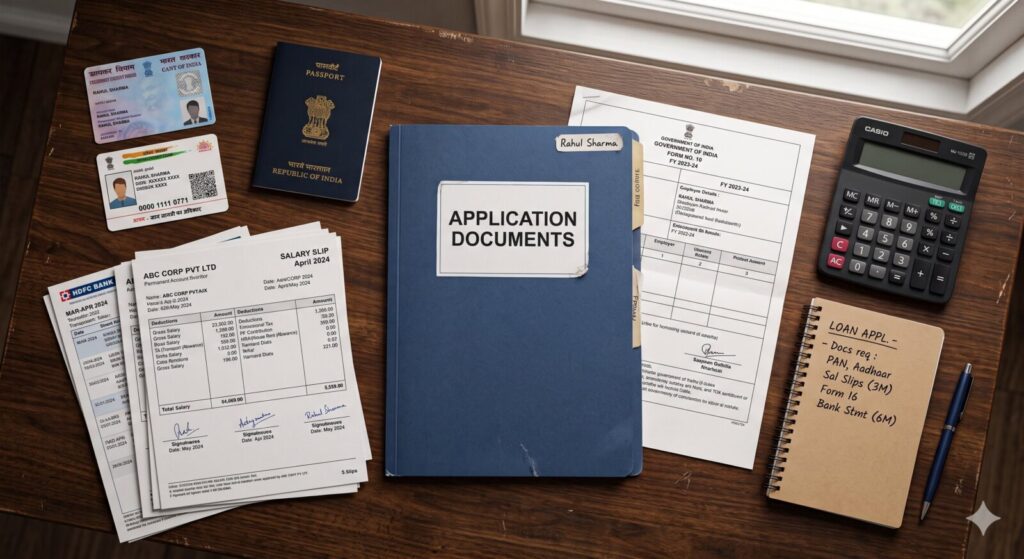
Although individual lenders may request additional documents depending on your profile, most leading banks ask for similar categories of information.
Our Home Loan Application Checklist covers the documents commonly requested by leading banks and housing finance companies in India. Keeping these documents ready can make your application process much smoother.
Let’s go through them one by one.
1. Identity Proof
Banks first need to verify your identity.
Commonly accepted documents include:
- PAN Card
- Aadhaar Card
- Passport
- Driving Licence
- Voter ID Card
Your name and date of birth should be consistent across all documents.
Any mismatch may require additional clarification.
2. Address Proof
The bank also verifies your residential address.
Accepted documents generally include:
- Aadhaar Card
- Passport
- Driving Licence
- Utility Bills
- Registered Rent Agreement
- Bank Account Statement showing current address
If you’ve recently moved, inform the lender and keep updated proof ready.
This helps avoid delays during verification.
3. Income Documents Required for Salaried Employees
For most salaried employees, income verification is one of the most important stages of the home loan approval process.
The bank wants to understand three things:
- Is your income stable?
- Can you comfortably repay the EMI?
- Has your salary been consistent over time?
Most leading lenders generally ask for the following documents.
Salary Slips
Usually the latest 3 months’ salary slips.
Banks compare these with your salary credits shown in your bank statement.
Bank Statements
Normally the latest 6 months’ salary account statements.
The lender checks:
- Regular salary credits
- Existing EMIs
- Credit card payments
- Spending habits
- Large cash deposits
- Returned cheques (if any)
Form 16
Form 16 helps verify your annual salary and tax deductions.
Income Tax Returns (if applicable)
Although many salaried applicants are approved using Form 16 and salary slips, some lenders may also request Income Tax Returns depending on the loan amount or applicant profile.
If you’re unsure whether your Income Tax Return has been filed correctly or need to access your tax records, you can verify them through the official Income Tax e-Filing Portal.
Employment Proof
Depending on the lender, this may include:
Employee ID
Appointment Letter
Latest Increment Letter
HR Confirmation (if required)
Use this Home Loan Application Checklist before submitting your salary documents to ensure your salary slips, bank statements, and Form 16 are consistent.
Rahul’s First Meeting with the Home Loan Officer
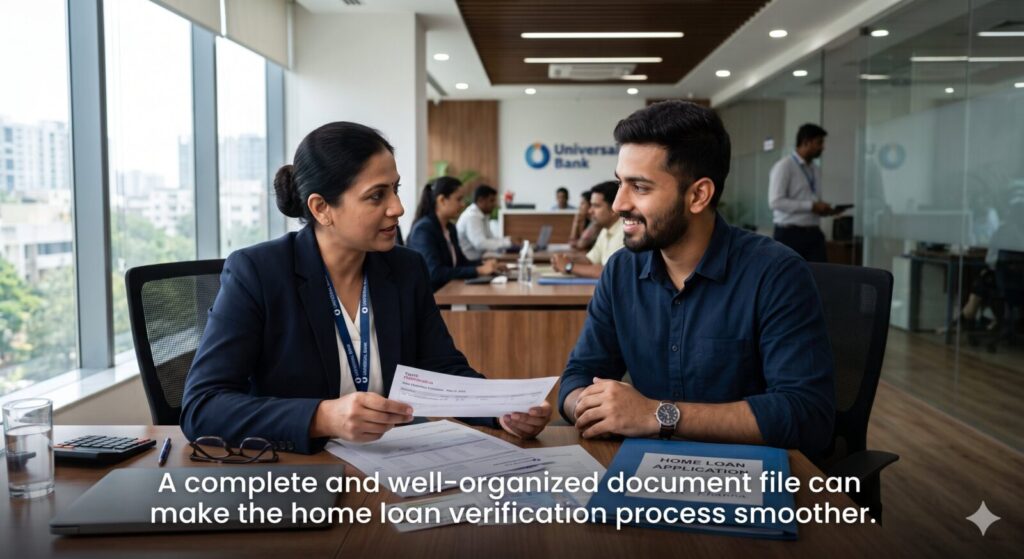
Rahul carried a thick folder to the bank.
He believed he had everything.
The relationship manager smiled and began checking each document carefully.
Everything looked perfect until she reached his salary slips.
“Rahul, your salary slips show your new salary after the annual appraisal, but your bank statement still contains the previous salary for two months.”
Rahul looked confused.
The manager explained,
“The salary revision happened recently. We just need one additional clarification from your employer.”
It wasn’t a rejection.
It was simply a verification.
This small incident taught Rahul that every document tells part of the financial story.
When all documents match, the approval process usually becomes much smoother.
4. Documents Required for Self-Employed Applicants
Self-employed professionals and business owners generally need to provide additional documents because their income isn’t fixed like a monthly salary.
Depending on the lender and business profile, common requirements include:
- PAN Card
- Aadhaar Card
- GST Registration (where applicable)
- Business Registration Certificate
- Shop & Establishment Certificate (if applicable)
- Partnership Deed (for partnerships)
- Memorandum & Articles of Association (for companies)
- Last 2–3 years’ Income Tax Returns
- Profit & Loss Account
- Balance Sheet
- Current Account Bank Statements
- GST Returns (where applicable)
The objective is the same.
The lender wants to understand whether your business generates stable income that can comfortably support the proposed EMI.
5. Property Documents Required
Many first-time buyers focus only on their own documents.
In reality, property documents are equally important.
The lender performs legal and technical verification before releasing the loan amount.
Commonly required property documents include:
- Agreement for Sale
- Allotment Letter (for under-construction properties)
- Registered Sale Deed (for resale properties)
- Previous Chain of Title Documents
- Approved Building Plan
- Commencement Certificate (where applicable)
- Occupancy Certificate (for completed projects, where applicable)
- Completion Certificate (where applicable)
- Property Tax Receipts
- No Objection Certificates required for the property
- Builder’s Demand Letter (for under-construction projects)
Some lenders may request additional documents depending on the property’s age, location, and legal history.
This section of the Home Loan Application Checklist is often overlooked by first-time buyers, but complete property documentation plays a major role in loan approval.
Many first-time buyers focus only on the loan amount but forget additional expenses like stamp duty, registration charges, interiors, and moving costs. Our guide on Hidden Costs of Buying a Home in India explains these expenses in detail.
Why Banks Carefully Verify Property Documents
During my years in housing finance, I often noticed that customers assumed the bank was only evaluating them.
In reality, the bank is also evaluating the property.
The lender wants to ensure that:
- The property’s ownership is legally clear.
- The title is marketable.
- Necessary approvals have been obtained.
- There are no major legal issues affecting the property’s value.
This protects both the borrower and the bank.
Home Loan Expert Tip
Don’t collect property documents at the last minute.
Request copies from the builder or seller as early as possible.
If any document is missing, you have enough time to resolve the issue before your planned registration date.
6. What Happens After You Submit Your Home Loan Application?
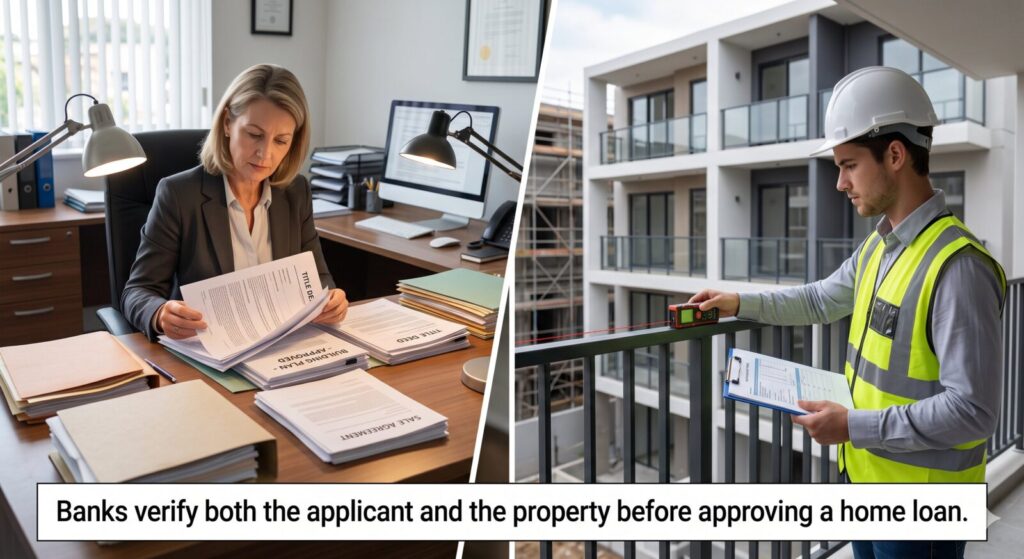
Many applicants believe the process ends after submitting their documents.
In reality, this is where the bank begins its detailed verification.
Although every lender follows its own internal procedures, the process generally includes the following stages.
Step 1: KYC Verification
The bank verifies:
- Identity proof
- Address proof
- PAN details
- Aadhaar details
- Photograph
- Signature verification
Any mismatch may require clarification before the application moves ahead.
Step 2: Income Verification
The lender evaluates whether your income can comfortably support the proposed EMI.
This includes checking:
- Salary credits
- Existing loan obligations
- Credit card dues
- Debt-to-income ratio
- Employment stability
- Income consistency
For self-employed applicants, lenders also review business income and financial statements.
Once your documents are ready, the next important decision is choosing the right type of interest rate. Learn the difference in our detailed guide on Fixed vs Floating Home Loan Interest Rates.
Step 3: Credit History Check
Your credit report helps the lender understand your past repayment behaviour.
They generally review:
- Credit Score
- Existing Home Loans
- Personal Loans
- Car Loans
- Credit Card Payments
- Missed EMI History
- Loan Settlements
A lower credit score doesn’t always mean rejection, but it may affect the loan amount or interest rate offered.
Step 4: Legal Verification
The bank’s legal team verifies whether the property’s ownership is legally clear.
They examine:
- Title documents
- Ownership history
- Sale agreement
- Encumbrance (where applicable)
- Government approvals
- Builder documentation
Step 5: Technical Verification
An engineer appointed by the lender usually inspects the property.
The objective is to verify:
- Property location
- Construction quality
- Stage of construction
- Market value
- Compliance with approved plans
Once both legal and technical verification are satisfactory, the bank proceeds toward loan sanction.
7. Common Mistakes That Delay Home Loan Approval
During my years in housing finance, I noticed that delays often happened because of avoidable mistakes rather than eligibility issues.
Here are some of the most common ones.
Even a well-qualified applicant can experience delays if they ignore important points covered in this Home Loan Application Checklist.
Many of these documentation errors are part of a bigger list of mistakes made by first-time buyers. Read 10 Home Loan Mistakes First-Time Buyers Make to avoid costly decisions before signing your loan agreement.
1. Different Names Across Documents
Your PAN, Aadhaar, bank account, and salary records should have consistent details.
2. Old Address Proof
Update your address if you’ve recently moved.
3. Missing Salary Credits
Banks compare salary slips with salary credits in your bank statement.
4. Large Unexplained Cash Deposits
If there are unusually large deposits, the lender may ask for an explanation.
5. Applying Immediately After Changing Jobs
Many lenders prefer applicants who have completed their probation period or have stable employment history.
6. Ignoring Your Credit Report
Checking your credit report before applying allows you to correct errors in advance.
7. Applying to Multiple Banks at the Same Time
Multiple loan applications can result in multiple credit enquiries. Before applying, compare lenders and avoid submitting unnecessary applications.
8. Incomplete Property Documents
Request all property documents from the builder or seller early in the process.
9. Not Disclosing Existing Loans
Always declare your existing financial obligations honestly.
10. Waiting Until the Last Minute
Preparing documents only after paying the booking amount often creates unnecessary stress.
Rahul’s Dream Finally Became Reality

A few weeks after submitting every required document, Rahul received a call from the bank.
“Congratulations, Mr. Mehta.
Your home loan has been sanctioned.”
Rahul smiled.
Months of saving.
Weeks of property visits.
Hours spent understanding documentation.
Everything had finally come together.
Standing on the balcony of his new apartment in Lower Parel with his wife, daughter, and parents, he realised something.
The home loan wasn’t the difficult part.
Preparing properly before applying had made the journey much smoother.
Use this home loan documents list as your final document check before submitting your application. Keep digital copies of your documents and verify that your name, address, income and other details are consistent.
Printable Home Loan Application Checklist
Before submitting your application, try the PennyPowerPlay Home Loan Planner to estimate your EMI, check affordability, compare loan options, and make a more informed home-buying decision.
Before applying, make sure you have:
Personal Documents
☐ PAN Card
☐ Aadhaar Card
☐ Passport-size Photographs
☐ Address Proof
☐ Identity Proof
Income Documents
☐ Last 3 Salary Slips
☐ Last 6 Months Bank Statements
☐ Form 16
☐ Income Tax Returns (if applicable)
☐ Employment Proof
Self-Employed Documents (if applicable)
☐ GST Registration
☐ Business Registration
☐ Balance Sheet
☐ Profit & Loss Statement
☐ Business Bank Statements
☐ Income Tax Returns
Property Documents
☐ Agreement for Sale
☐ Allotment Letter
☐ Approved Building Plan
☐ Sale Deed (where applicable)
☐ Property Tax Receipts
☐ Occupancy/Completion Certificate (where applicable)
☐ Builder Documents
☐ NOCs (where applicable)
Before Submission
☐ Review your Credit Score
☐ Verify all documents are up to date
☐ Ensure signatures are consistent
☐ Keep both digital and printed copies
Complete Home Loan Documents List 2026 (Salaried + Self-Employed)
Documents ready? Check your overall home-loan readiness too.
Having the required documents is important, but your application also depends on factors such as income, existing EMIs, CIBIL profile, down payment and repayment capacity.
Before approaching a lender, you can get a broader view of your position through the ₹499 Home Loan Readiness Review.
Frequently Asked Questions
What is the home loan documents list for a salaried person?
The home loan documents list for a salaried person generally includes PAN, Aadhaar or other identity proof, address proof, recent salary slips, bank statements, Form 16 and relevant property documents. Some lenders may request additional documents depending on the applicant and property.
What documents are required for a home loan in India?
Most lenders ask for identity proof, address proof, income documents, bank statements, PAN, Aadhaar, photographs, and relevant property documents.
How many months of salary slips are required?
Most banks generally ask for the latest three months’ salary slips.
Are Income Tax Returns compulsory?
Not always. Requirements vary depending on your employment type, loan amount, and lender.
What property documents are verified by the bank?
Commonly reviewed documents include the sale agreement, title documents, approved plans, and other applicable legal approvals.
Does the bank verify the property before approval?
Yes. Most lenders conduct legal and technical verification before sanctioning the loan.
Can I apply for a home loan without all the documents?
You can submit an initial home loan application with some documents depending on the lender, but complete documentation is generally required before final approval and disbursement. Missing or inconsistent documents can delay verification.
Can a missing document delay approval?
Yes. Missing or inconsistent documents can delay verification and the overall approval process.
How can I make my application process smoother?
Prepare all required documents in advance, check your credit report, and ensure the information across your documents is accurate and consistent.
Is a co-applicant required?
Not always. However, adding an eligible co-applicant may improve loan eligibility in certain situations.
If you already have a home loan and are considering switching lenders in the future, don’t miss our guide on Home Loan Balance Transfer: When Does It Really Save Money? to understand when a transfer can actually reduce your interest cost.
Looking for a complete understanding of the home loan journey? Explore our Home Loan Guide India, where you’ll find practical guidance on eligibility, EMI affordability, interest rates, documentation, approval process, common mistakes, balance transfers, hidden costs, and other essential topics to help you make informed home-buying decisions.
Final Thoughts
Buying your dream home should be an exciting experience, not a stressful one.
Preparing your documents before applying for a home loan can save valuable time, reduce delays, and help the approval process move more smoothly.
I hope this Home Loan Application Checklist helps you approach your home loan application with greater confidence and fewer surprises.
During my eight years in housing finance, I learned that successful home loan applications are often the result of good preparation rather than last-minute paperwork.
Treat this checklist as your starting point, not just another document list.
The better prepared you are, the more confidently you can move toward owning your dream home.
Use this complete home loan documents list as your final check before submitting the application.
Plan Before You Apply
After completing this Home Loan Application Checklist, use the PennyPowerPlay Home Loan Planner to estimate your EMI, compare loan options, and prepare your finances with confidence.
The more prepared you are today, the smoother your journey toward owning your dream home can be tomorrow.