“Home loan eligibility for salaried person is one of the first things you should understand before applying for a home loan in India.” Buying your dream home is one of the biggest financial decisions you’ll ever make, yet one question stops many people before they even begin:
This detailed guide on home loan eligibility for salaried person will help you understand exactly how banks calculate your eligibility in 2026.
“Am I eligible for a home loan?”
Whether you’re purchasing your first apartment or upgrading to a larger home, understanding how banks evaluate home loan applications can save you time, reduce stress, and improve your chances of approval.
Many salaried person believe that having a good monthly income automatically guarantees a home loan. In reality, lenders consider several factors beyond salary, including your credit score, employment stability, existing loan obligations, repayment capacity, and the quality of your documentation.
During my 8+ years of working in housing finance, I met many customers who earned excellent salaries but struggled to get the loan amount they expected because of existing EMIs, poor documentation, or credit history. On the other hand, I also saw borrowers with moderate salaries receive quick approvals because they maintained strong financial discipline and submitted complete documents.
This guide explains everything a salaried person should know before applying for a home loan in India. We’ll also compare the common eligibility requirements followed by leading banks, discuss real-life lending scenarios, and help you avoid common mistakes that could delay your application.
Quick Summary
Before approving a home loan, most lenders generally evaluate:
- Your monthly income
- Employment stability
- Credit score
- Existing EMIs
- Income documents
- Property details
- Down payment
If these factors are strong, your chances of home loan approval generally improve.
At a Glance: Estimated Home Loan Eligibility by Salary (8.5% for 20 Years)
| Net Monthly Salary | Max Permissible EMI (50% FOIR) | Estimated Loan with ₹0 Existing EMIs | Estimated Loan with ₹10,000 Existing EMIs |
|---|---|---|---|
| ₹30,000 | ₹15,000 | ₹17.3 Lakh | ₹5.7 Lakh |
| ₹50,000 | ₹25,000 | ₹28.8 Lakh | ₹17.3 Lakh |
| ₹75,000 | ₹37,500 | ₹43.2 Lakh | ₹31.7 Lakh |
| ₹1,00,000 | ₹50,000 | ₹57.6 Lakh | ₹46.1 Lakh |
Home loan eligibility for salaried person salary breakdown chart
Key Rule: Lenders apply the FOIR (Fixed Obligation to Income Ratio) benchmark, typically capping all monthly debt obligations between 40% and 55% of your net monthly income.
This guide explains Home Loan Eligibility for Salaried person in simple language so you can understand what lenders generally evaluate before approving a home loan application.
Home Loan Eligibility for Salaried Person
Home loan eligibility is the lender’s assessment of whether you have the financial ability to repay the borrowed amount over the agreed loan tenure.
When you apply for a home loan, the bank doesn’t simply ask, “How much do you earn?”
Instead, it asks questions like:

- Can you comfortably repay the EMI every month?
- Is your income stable?
- How long have you been employed?
- Do you already have multiple loans?
- Have you repaid previous loans on time?
- Does your income match the loan amount requested?
The answers to these questions help the lender decide:
- Whether your loan should be approved.
- The maximum loan amount you qualify for.
- The interest rate offered.
- The repayment tenure available.
Before You Apply, Calculate Your EMI
Before visiting a bank or submitting an online application, it’s a good idea to understand how different loan amounts, interest rates, and repayment tenures affect your monthly EMI.
The PennyPowerPlay Home Loan Planner allows you to compare multiple loan scenarios, estimate your monthly EMI, and understand the total interest payable over the loan tenure.
👉 Free Home Loan Planner: https://pennypowerplaycom.lovable.app/
Planning your loan before applying can help you choose an EMI that comfortably fits your monthly budget instead of relying solely on the maximum amount offered by the bank.
Not sure how much EMI you can comfortably manage? Read our detailed guide on How Much Home Loan EMI Can You Really Afford? to understand how salary, existing EMIs and monthly expenses affect your borrowing capacity.
Why Do Banks Check Home Loan Eligibility?
A home loan is usually one of the largest loans a bank provides to an individual. Depending on the property and city, the repayment period can extend up to 30 years.
Because of this long commitment, lenders need confidence that the borrower can continue repaying the loan even if financial circumstances change.
Their evaluation generally focuses on three key questions:
1. Can You Afford the EMI?
Banks compare your monthly income with your current financial commitments.
For example, if your salary is ₹80,000 per month but you’re already paying ₹35,000 in EMIs for a car loan and personal loan, your repayment capacity may be lower than someone earning ₹70,000 with no outstanding loans.
2. Is Your Income Stable?
Lenders prefer borrowers who have a stable employment history and regular salary credits into their bank account.
A consistent income gives banks greater confidence in your ability to make timely repayments throughout the loan tenure.
3. Have You Managed Credit Responsibly?
Your credit history reflects how you’ve handled previous loans and credit card payments.
A good repayment record demonstrates financial discipline, while frequent payment delays or loan defaults may reduce your chances of approval.
How Banks Evaluate Home Loan Eligibility for Salaried Person
Although every lender has its own credit policy, most banks and housing finance companies evaluate similar factors before approving a home loan.
The most important factors include:
- Monthly salary
- Employment type
- Age
- Work experience
- Credit score
- Existing EMIs
- Loan tenure
- Property value
- Down payment
- Documentation
Let’s understand each of these in detail in the next section.
Key Factors Affecting Home Loan Eligibility for Salaried Person

Every bank follows its own credit policy, but the basic eligibility criteria remain largely similar. Whether you apply through SBI, HDFC Bank, ICICI Bank, Axis Bank or another lender, your application is generally assessed using the following factors.
Think of these factors as a checklist that helps the lender answer one question:
“Can this borrower comfortably repay the loan over the next 20 to 30 years?”
Let’s understand each factor in detail.
1. Monthly Salary
Your monthly salary is one of the first things a lender evaluates because it directly affects your repayment capacity.
However, banks don’t simply approve a loan based on a high salary. They also assess your net take-home salary, existing EMIs, employment stability, and overall repayment capacity.
How Much Home Loan Can I Get on My Salary? (2026 Examples)
One of the most common questions I received during my years in housing finance was:
“How much home loan can I get on my salary?”
Banks do not approve loans based on salary alone. They mainly look at your repayment capacity after considering existing EMIs. This is measured through FOIR (Fixed Obligation to Income Ratio).
Most lenders usually keep the total EMI (existing + new home loan EMI) within 40% to 55% of your net monthly salary, depending on your income level and credit profile.
Here are practical examples based on common salary levels people search for:
1. Home Loan on ₹30,000 Salary
- Net monthly salary: ₹30,000
- Maximum recommended total EMI: Around ₹12,000 – ₹15,000
- If you have no existing loans, you may typically qualify for a home loan of ₹18–25 lakh (depending on tenure, interest rate and lender).
- If you already have other EMIs, the eligible amount will reduce.
2. Home Loan on ₹50,000 Salary
- Net monthly salary: ₹50,000
- Maximum recommended total EMI: Around ₹20,000 – ₹25,000
- With no existing loans, many borrowers can expect eligibility in the range of ₹30–45 lakh.
- This is one of the most searched salary levels for home loans in India.
3. Home Loan on ₹75,000 Salary
- Net monthly salary: ₹75,000
- Maximum recommended total EMI: Around ₹30,000 – ₹37,000
- Eligible loan amount often falls between ₹50–70 lakh, depending on age, credit score and tenure.
4. Home Loan on ₹1 Lakh Salary
- Net monthly salary: ₹1,00,000
- Maximum recommended total EMI: Around ₹40,000 – ₹50,000
- Eligible loan amount can go up to ₹70 lakh – ₹1 crore+ for strong profiles.
Important Note: These are approximate figures based on common lending practices in 2026. Actual eligibility depends on:
- Your CIBIL score
- Existing EMIs
- Age and remaining working years
- Interest rate offered
- Property value and down payment
- Individual bank policy
Always use a proper eligibility calculator and confirm with the lender before finalising any property.
How Banks Calculate FOIR (Simple Example)
FOIR stands for Fixed Obligation to Income Ratio. It tells the bank what percentage of your salary is already committed to existing EMIs.
Simple Formula:
FOIR = (Total Existing EMIs + Proposed Home Loan EMI) ÷ Net Monthly Salary × 100
Most banks prefer to keep FOIR between 40% and 55%, depending on your income level and credit profile.
Practical Example
Suppose your net monthly salary is ₹50,000.
- Existing Car Loan EMI: ₹8,000
- Existing Personal Loan EMI: ₹4,000
- Total Existing EMIs = ₹12,000
If the bank allows a maximum FOIR of 50%:
Maximum total EMI allowed = 50% of ₹50,000 = ₹25,000
Available EMI for Home Loan = ₹25,000 – ₹12,000 = ₹13,000
Based on this available EMI, the bank will calculate how much home loan you can get (depending on interest rate and tenure).
Key Takeaway: Even if your salary is good, high existing EMIs can significantly reduce your home loan eligibility. This is why reducing small loans before applying often helps.
*Actual eligibility varies depending on lender policies, existing liabilities, loan tenure, interest rates and credit profile.
A higher salary generally improves eligibility, but a borrower earning ₹80,000 with no existing loans may qualify for a higher amount than someone earning ₹1,20,000 but already paying multiple EMIs.
Your monthly salary is one of the biggest factors affecting Home Loan Eligibility for Salaried Person, but lenders also consider your overall financial profile.
2. Age of the Applicant
Age is another important factor because it influences the maximum repayment period.
Most banks generally accept applications from salaried individuals who are approximately:
- Minimum Age: 21 years
- Maximum Age: Around retirement age (often up to 60–65 years depending on lender policy)
For example:
Rahul is 28 years old.
He may qualify for a longer repayment tenure of up to 30 years, depending on the lender and retirement age assumptions.
Now consider another applicant who is 54 years old.
Even with a higher salary, the available tenure may be shorter because the lender expects the loan to be repaid before or around retirement.
A shorter tenure usually results in a higher monthly EMI.
3. Employment Stability
Banks prefer applicants with stable employment because consistent income reduces repayment risk.
Lenders commonly review:
- Current employer
- Total work experience
- Time spent with the current employer
- Industry stability
- Frequency of job changes
Generally, applicants with continuous employment history and regular salary credits are viewed more favorably than those with frequent employment gaps.
This doesn’t mean changing jobs is a problem. However, multiple job changes within a short period may require additional explanation.
4. Credit Score (CIBIL Score)
Your credit score reflects your borrowing and repayment history.
It helps lenders understand whether you’ve managed previous loans and credit cards responsibly.
Generally speaking:
| Credit Score | General Interpretation |
| 750 and above | Strong credit profile |
| 700–749 | Usually acceptable for many lenders |
| Below 700 | May require closer review depending on lender policies |
Your credit score can be affected by:
- Late EMI payments
- Credit card payment delays
- Loan defaults
- High credit utilisation
- Multiple recent loan enquiries
A strong credit history may improve your approval chances and, in some cases, help you obtain more competitive loan terms.
Your CIBIL score also plays a major role. Read our complete guide on [CIBIL score for home loan] to understand what score you actually need.
5. Existing EMIs and FOIR
One of the most important factors banks evaluate is your existing financial commitments.
This is commonly measured through FOIR (Fixed Obligation to Income Ratio).
FOIR represents the percentage of your monthly income already committed towards existing EMIs and fixed obligations.
For example:
Monthly Salary: ₹1,00,000
Current Car Loan EMI: ₹12,000
Personal Loan EMI: ₹8,000
Total Existing EMIs = ₹20,000
This means part of your monthly income is already committed before taking a new home loan.
Every lender follows its own internal FOIR guidelines, and the acceptable ratio may vary depending on the borrower’s profile, income level and credit assessment.
Keeping your existing debt under control generally improves your home loan eligibility.
Already know your salary-based eligibility?
Your salary is only one part of the home-loan assessment. Existing EMIs, CIBIL profile, employment profile, down payment and documents can also affect your application.
If you’re planning to apply soon, you can explore the ₹499 Home Loan Readiness Review to understand your overall position before approaching a lender.
Quick Tip
Before applying for a home loan, consider paying off small personal loans or credit card balances if possible.
Reducing existing obligations may improve your repayment capacity and increase the amount you qualify for.
6. Down Payment
Banks generally finance only a portion of the property’s value.
The remaining amount must be contributed by the buyer as a down payment.
Having a larger down payment can:
- Reduce the loan amount
- Lower monthly EMI
- Reduce total interest payable
- Improve lender confidence
Many first-time buyers focus only on EMI and forget to plan for the down payment.
This is one of the most common mistakes I have seen during my years in housing finance.
Besides the down payment, many first-time buyers underestimate additional expenses such as registration charges, stamp duty, legal fees and interior costs. Learn more in our guide on Hidden Costs of Buying a Home in India.
Regulatory Note on LTV Caps & Rules:
The minimum down payment you must pay is governed by RBI Loan-to-Value (LTV) limits (up to 90% funding for loans under ₹30 lakh, and 75% for loans above ₹75 lakh). To understand these caps alongside borrower consent protections and benchmark resets, read our complete breakdown of the RBI home loan rules 2026.
7. Property Evaluation
Approval doesn’t depend only on the borrower.
The property also plays an important role.
The lender usually verifies:
- Legal ownership
- Approved building plans
- Market value
- Technical valuation
- Location
- Builder reputation (for under-construction projects)
Even if the borrower is eligible, issues with the property can delay or affect loan approval.
Common Documents Required for Salaried Person
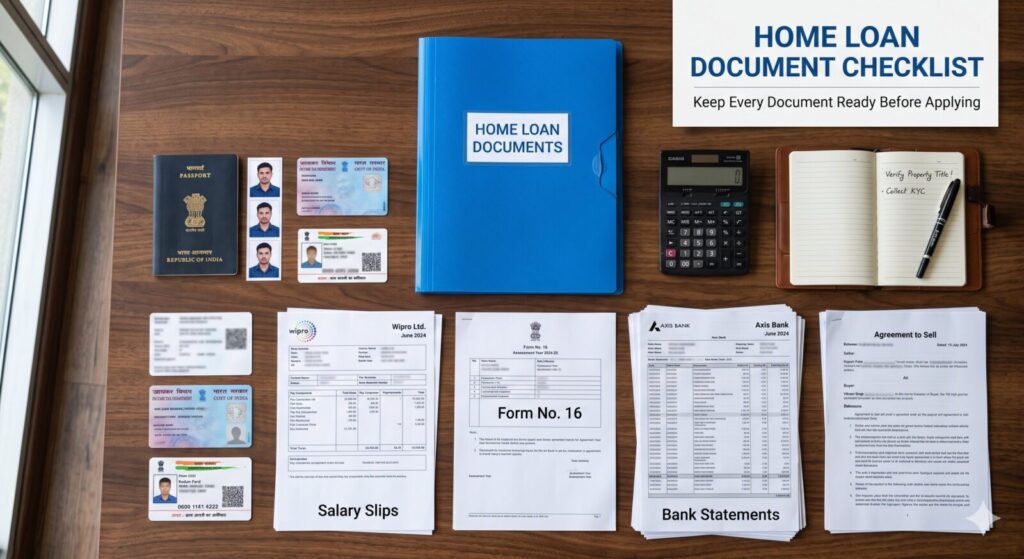
Although documentation requirements may vary slightly from one lender to another, most banks ask for the following:
Essential Document Checklist for Salaried Borrowers
| Document Category | Required Papers | Verification Red Flag to Avoid |
|---|---|---|
| KYC & Identity | PAN Card, Aadhaar Card, Passport, Voter ID, or Driving License | Name or date of birth mismatches between PAN and other KYC proofs. |
| Income Proof | Latest 3 to 6 months’ salary slips + Form 16 (Part A & B for last 2 years) | Salary slips showing deductions not reflected in gross compensation. |
| Banking Records | Last 6 months’ original salary account statements | Frequent cheque bounces, high cash deposits, or unlisted EMI debits. |
| Employment Continuity | Official appointment letter, valid work ID, and official corporate email verification | Recent probation status or employment gaps exceeding 30–60 days without documentation. |
| Property Papers | Stamped Agreement for Sale, Allotment Letter, Mother Deed/Chain Deeds, Approved Sanction Plan & OC/CC | Unapproved floor deviations or missing chain of title deeds. |
Note for self-employed readers: If you operate a proprietorship, partnership, or freelance practice without standard corporate payroll slips, refer to our dedicated companion guide: [Home Loan Document Checklist & Eligibility for Self-Employed Individuals].
Before submitting your application, make sure you’ve collected every required document. Our detailed Home Loan Application Checklist will help you verify everything before visiting your lender.
Common Eligibility Checklist Followed by Major Indian Banks
While every lender has its own internal credit policy, most banks evaluate similar parameters before approving a home loan.
✔ Stable monthly salary
✔ Regular salary credited into a bank account
✔ Good repayment history
✔ Healthy credit score
✔ Manageable existing EMIs
✔ Stable employment
✔ Complete KYC documents
✔ Income proof
✔ Bank statements
✔ Property documents
✔ Adequate down payment
Meeting these criteria doesn’t guarantee approval, but it generally strengthens your application.
Compare Different EMI Scenarios Before Applying
Many borrowers apply for the maximum loan amount they qualify for without checking whether the EMI comfortably fits their monthly budget.
Instead of guessing, compare different loan amounts, interest rates and repayment tenures before visiting a lender.
The PennyPowerPlay Home Loan Planner helps you:
- Estimate monthly EMI
- Compare multiple loan scenarios
- Understand total interest payable
- Plan a comfortable repayment strategy
Try the free Home Loan Planner: https://pennypowerplaycom.lovable.app/
Sometimes reducing your loan amount slightly or choosing a different tenure can make your monthly finances much more comfortable while also reducing the total interest paid over the life of the loan.
Home Loan Eligibility Comparison: Five Major Indian Banks
The table below summarises commonly published eligibility information from five leading lenders. Exact criteria and loan terms may change over time, so always verify the latest details with your chosen bank before applying.
| Bank | Typical Age | Maximum Tenure | Common Documents | Best Suitable For |
|---|---|---|---|---|
| SBI | Around 21–65 years | Up to 30 years | Salary slips, Bank statements, KYC, Income proof | Government employees & salaried borrowers |
| HDFC Bank | Around 21–65 years | Up to 30 years | Salary slips, Form 16, Bank statements | Salaried professionals |
| ICICI Bank | Around 23–65 years | Up to 30 years | Salary slips, Form 16, Bank statements | Private sector employees |
| Axis Bank | Around 21–70 years | Up to 30 years | Salary slips, Income proof, Bank statements, KYC | Salaried professionals |
| Bank of Baroda | Around 18–70 years | Up to 30 years | Salary slips, Form 16, Bank statements, KYC | Salaried borrowers |
Once you’ve checked your eligibility, another important decision is choosing the right interest rate option. Read our guide on Fixed vs Floating Home Loan Interest Rates to understand how each option can affect your EMI and total borrowing cost.
Although the documents are largely similar, each lender uses its own internal credit assessment model. Interest rates, eligibility calculations, loan amounts and approval conditions may differ based on your individual profile.
Real Experience from My Housing Finance Career

During my 8+ years in housing finance, I worked with many salaried borrowers applying for home loans ranging from ₹20 lakh to more than ₹1.5 crore.
One lesson stood out consistently.
The applicants who received faster approvals were not always the ones with the highest salaries.
Instead, they were the borrowers who had:
- Stable employment
- Regular salary credits into their bank account
- A healthy credit history
- Low existing EMIs
- Complete income and KYC documents
I also met borrowers earning attractive salaries whose applications were delayed because of missing documents, multiple existing loan obligations or poor credit management.
From my experience, preparing your financial profile before applying for a home loan can significantly improve both your approval chances and the overall borrowing experience.
What If Your Salary Is Paid in Cash Instead of Through a Bank?
One question I was frequently asked during my years in housing finance was:
“Can I still get a home loan if my salary is paid in cash?”
The answer is yes, but it may be more challenging.
Many salaried person in India work for small businesses, local shops, manufacturing units and family-owned companies where salaries are still paid partly or entirely in cash.
Although these employees earn a regular income, banks generally prefer applicants whose salaries are credited directly into a bank account. This creates a transparent financial record that lenders can easily verify.
For example, a borrower whose salary is credited every month and who can provide salary slips, bank statements and Form 16 usually presents a stronger financial profile than someone earning the same amount in cash without supporting documents.
This doesn’t mean cash salary employees cannot get a home loan. It simply means the lender may require additional verification before approving the application.
Can Cash Salary Employees Still Get a Home Loan?
Yes.
How to Qualify for a Home Loan on Cash Salary
While Tier-1 commercial lenders (SBI, HDFC Bank, ICICI Bank) strictly mandate direct bank payroll credits (NEFT/RTGS), several specialized Housing Finance Companies (HFCs)—including PNB Housing (Roshni Scheme), Aavas Financiers, Piramal Finance, and Home First Finance—evaluate cash-salaried applicants using alternate underwriting parameters:
- Physical Workplace Verification: Verification officers visit your employer’s premises to confirm business operational stability and check wage registers.
- Internal Banking Discipline: Maintaining regular cash deposits into a savings bank account for at least 12 months helps establish verifiable cash flow.
- Higher Down Payment Threshold: Cash-salaried applicants typically need to provide a 20% to 30% down payment (compared to 10% to 15% for corporate payroll employees).
- Adding an Earning Co-Applicant: Adding an immediate family member with verifiable bank salary credits significantly improves sanction rates.
Every lender follows its own credit policy, so approval conditions vary.
If you currently receive your salary in cash but plan to buy a home in the next few years, consider asking your employer to credit your salary directly into your bank account and maintain proper income records. This can strengthen your financial profile over time.
Proven Ways to Improve Home Loan Eligibility for Salaried Person

The good news is that Home Loan Eligibility for Salaried Persons isn’t fixed forever. With careful financial planning, you can improve your approval chances before applying for a home loan.
With careful financial planning, you can improve your chances of approval before applying.
1. Maintain a Good Credit Score
Your credit score reflects how responsibly you’ve handled previous loans and credit cards.
To maintain a healthy score:
- Pay all EMIs on time.
- Pay your credit card bill before the due date.
- Avoid loan defaults.
- Keep credit utilisation under control.
A good credit history gives lenders greater confidence in your repayment ability.
2. Reduce Existing Loan EMIs
Your existing loan obligations directly affect your repayment capacity.
If possible, clear:
- Personal loans
- Consumer durable loans
- Small outstanding debts
Reducing existing EMIs can improve your home loan eligibility.
3. Save a Higher Down Payment
Many first-time buyers focus only on getting the maximum loan amount.
Instead, consider increasing your down payment.
Benefits include:
- Lower loan amount
- Lower monthly EMI
- Lower total interest cost
- Better affordability
- Reduced financial burden
4. Keep Your Salary Banking Regular
If you’re a salaried person, regular salary credits into your bank account help establish a stable income history.
Banks generally prefer applicants whose income can be verified through:
- Salary account statements
- Salary slips
- Form 16
- Income Tax Returns
Maintaining proper documentation can make the application process smoother.
5. Avoid Multiple Loan Applications
Applying to several lenders within a short period may result in multiple credit enquiries.
Instead of applying everywhere, compare lenders carefully and submit complete documentation to the bank that best matches your requirements.
6. Keep All Documents Ready
Many applications are delayed because borrowers submit incomplete paperwork.
Before applying, prepare:
- Aadhaar Card
- PAN Card
- Last 3 months’ salary slips
- Latest Form 16
- Last 6 months’ bank statements
- Passport-size photographs (if required)
- Property documents
Being organized can reduce unnecessary delays.
Before Applying, Compare Different Home Loan Scenarios for Salaried Persons
One of the biggest mistakes I noticed during my 8+ years in housing finance was that many borrowers focused only on how much loan the bank was willing to offer.
A better question is:
“How much home loan can I comfortably afford without affecting my future financial goals?”
Choosing the maximum eligible loan amount isn’t always the best financial decision.
A slightly lower loan amount, a higher down payment or a different repayment tenure can significantly reduce your monthly EMI and save you lakhs of rupees in interest over the life of the loan.
Before visiting a bank, compare different loan scenarios using the PennyPowerPlay Home Loan Planner.
The planner helps you:
- Calculate monthly EMI
- Compare different loan amounts
- Compare repayment tenures
- Estimate total interest payable
- Understand the overall cost of your home loan
Try the Free PennyPowerPlay Home Loan Planner: https://pennypowerplaycom.lovable.app/
Spending just five minutes planning today could help you make a smarter borrowing decision for the next 20 to 30 years.
Related Home Loan Guides on PennyPowerPlay
If you’re planning to buy a home, these guides will help you make more informed decisions throughout your home-buying journey:
- How Much Home Loan EMI Can You Really Afford?
- Hidden Costs of Buying a Home in India
- Fixed vs Floating Home Loan Interest Rates
- RBI Home Loan Rules 2026: Benchmark & Spread Guidelines
- Home Loan Application Checklist
- Home Loan Balance Transfer: Does It Really Save Money?
- 10 Home Loan Mistakes First-Time Buyers Make
Reading these articles together will give you a complete understanding of the home loan process, from planning your budget and checking eligibility to managing your loan after approval.
Understanding Home Loan Eligibility for Salaried Persons before applying can help reduce delays and improve your chances of getting your application approved.
Planning More Than Just Home Loan Eligibility?
Meeting a bank’s eligibility criteria is only one part of buying a home. Before submitting your application, it’s equally important to understand how much EMI you can comfortably afford, which documents banks require, how credit scores affect approval, common reasons applications get rejected, the differences between fixed and floating interest rates, and whether prepayment or a future balance transfer could save you money. If you’re looking for a step-by-step roadmap that covers every stage of the borrowing journey, explore our Complete Home Loan Guide for India, where all these topics are explained in one place.
Conclusion
Understanding your home loan eligibility is the first step toward buying a home with confidence.
While salary plays an important role, lenders also evaluate your employment stability, credit history, existing financial commitments, documentation and the property being financed.
From my 8+ years of experience in housing finance, I’ve learned that borrowers who prepare their financial profile before applying often enjoy a smoother loan approval process than those who focus only on finding the lowest interest rate.
Before applying, take time to review your documents, improve your credit profile, calculate a comfortable EMI and compare different loan options. If you’re considering switching an existing home loan to reduce your interest cost, you may also find our guide on Home Loan Balance Transfer: Does It Really Save Money? helpful.
Most importantly, borrow only what fits comfortably within your monthly budget. A home loan is a long-term commitment, and choosing an affordable EMI today can help you achieve greater financial stability in the years ahead.
Frequently Asked Questions (FAQs)
1. What is the minimum salary required for a home loan in India?
The minimum salary requirement varies by lender and loan product. However, lenders evaluate your overall repayment capacity, existing EMIs, employment stability and documentation rather than salary alone.
2. What credit score is generally considered good for a home loan?
A credit score of 750 or above is generally considered strong by many lenders, although approval depends on your complete financial profile.
3. Can I get a home loan if I already have a personal loan?
Yes. Existing loans do not automatically prevent home loan approval. Banks assess your repayment capacity and existing EMI obligations before deciding the eligible loan amount.
4. Can I get a home loan if my salary is paid in cash?
It may be possible. Some lenders and housing finance companies consider such applications after additional income verification. Maintaining proper income records can improve your chances.
5. How much down payment is usually required?
The required down payment depends on the lender, property value and applicable regulations. Borrowers are generally expected to contribute part of the property’s cost from their own funds.
6. Which documents are commonly required for salaried persons?
Most lenders ask for:
- Aadhaar Card
- PAN Card
- Salary slips
- Bank statements
- Form 16
- Income proof
- Property documents
Additional documents may be requested depending on the lender and loan profile.
7. Can changing jobs affect my home loan eligibility?
Changing jobs doesn’t automatically affect eligibility. However, lenders generally prefer applicants with stable employment and a consistent income history.
8. How can I improve my home loan eligibility?
You can strengthen your application by:
- Maintaining a good credit score
- Reducing existing EMIs
- Saving a larger down payment
- Keeping your documents updated
- Maintaining stable employment
- Comparing loan options before applying
9. Can I get a salaried home loan if my employer does not issue Form 16?
Yes. If your employer does not provide Form 16 (for example, if your income falls below the mandatory tax deduction threshold), many non-banking financial companies (NBFCs) and HFCs will accept filed ITR-1 forms for the last 2 assessment years alongside an official salary certificate on company letterhead and 6 to 12 months of salary bank statements.
10. Do banks accept downloaded PDF e-statements, or do they need to be stamped?
Most lenders accept digitally generated PDF statements downloaded directly from net banking portals. However, if printed copies or scanned pages are submitted, lenders typically require them to carry the branch manager’s physical stamp and signature to prevent document tampering.
11. Can salaried employees claim home loan tax deductions under the New Tax Regime?
Under the New Tax Regime (default tax slab), deductions on home loan interest under Section 24(b) (up to ₹2 Lakh) and principal repayment under Section 80C (up to ₹1.5 Lakh) are not allowed for self-occupied properties. To claim these deductions, salaried employees must choose the Old Tax Regime when filing their annual income tax return.
Final Takeaway
Buying a home is one of the biggest financial commitments you’ll ever make.
Instead of applying based on guesswork, understand Home Loan Eligibility for Salaried Persons, prepare your documents and calculate your repayment capacity before submitting your application.
If you’re comparing different home loan options, don’t forget to use the free PennyPowerPlay Home Loan Planner to estimate your EMI, compare repayment options and make a more informed borrowing decision before submitting your application.