By Ashok / July 25, 2026
Last updated: July 25, 2026
Important: The Income Tax Act, 2025 is effective from FY 2026–27. While some provisions have been restructured, the deduction limits and eligibility rules for home loan tax benefits remain unchanged. In this guide, we use the familiar section numbers (80C, 24b, 80EE, 80EEA) that taxpayers and chartered accountants still commonly reference when filing returns for AY 2027–28.
This is the complete guide to home loan tax benefits in India for FY 2026–27. If you’re paying EMIs and wondering how much tax you can actually save under Section 80C, Section 24(b), and Section 80EEA, this article gives you real calculations — not theory.
“Okay, let’s be honest. You’re not reading this because you love the Income Tax Act. You’re here because you want to know one thing: How much tax will I actually save if I take a home loan?”
The short answer: Up to ₹5 lakh per year if you’re a solo borrower, and up to ₹10 lakh per year if you take a joint loan with your spouse.
The long answer: Most people leave at least ₹1.5 lakh on the table because they don’t know the rules.
I spent 8 years inside ICICI, HDFC, Axis, and PNB Housing Finance approving home loans. And every March, the same panic would set in. Borrowers would call me:
“Sir, kitna tax bachega?” (Sir, how much tax will I save?)
“Can I claim both HRA and home loan?”
“My CA said I can save ₹5 lakh in tax. Is that true?”
“New tax regime mein kuch milta hai kya?” (Do we get anything in the new tax regime?)
Here’s the truth no one tells you upfront: A home loan is one of the most powerful tax-saving tools available to Indian taxpayers — but only if you understand which tax regime to choose and which sections to claim under.
But here’s what I learned after seeing thousands of tax filings:
Most borrowers misunderstand the new tax regime. It is now the default. It gives you tax-free income up to ₹12.75 lakh (salaried). For many home loan borrowers — especially those without very high deductions — the new regime actually saves MORE tax than the old regime, even though you lose home loan deductions. The math is counter-intuitive, and most people get it wrong.
In this guide, I’ll break down exactly how much you can claim under Section 80C, Section 24(b), Section 80EE, and Section 80EEA. I’ll show you real tax-saving calculations for different income levels. I’ll explain the joint home loan hack that doubles your benefits. And I’ll tell you the one mistake that can cost you ₹3 lakh: selling your house too early.
“If you’re new to home loans, start with my https://pennypowerplay.com/home-loan-guide-india/ — it covers eligibility, documents, and the full process before you worry about tax savings.”
The Big Picture: How Home Loan Tax Benefits Work
How home loan tax benefits are divided between principal repayment and interest deduction
“Understanding how home loan tax benefits work starts with knowing your EMI components.”
Every EMI has two parts:
| Home Loan Component | What It Covers | Tax Section | Maximum Deduction |
|---|---|---|---|
| Principal Repayment | The principal portion of your home loan EMI | Section 80C | ₹1,50,000 per financial year |
| Interest Payment | Interest paid on a self-occupied home loan | Section 24(b) | ₹2,00,000 per financial year |
| First-Time Home Buyer (Affordable Housing) | Additional deduction on home loan interest for eligible affordable housing loans sanctioned between 1 April 2019 and 31 March 2022 | Section 80EEA | ₹1,50,000 per financial year |
| First-Time Home Buyer (Older Scheme) | Additional deduction on home loan interest for eligible loans sanctioned between 1 April 2016 and 31 March 2017 | Section 80EE | ₹50,000 per financial year |
| Stamp Duty & Registration Charges | One-time expenses paid while purchasing the property | Section 80C | Included within the overall ₹1,50,000 limit under Section 80C |
Maximum possible deduction for a solo borrower: ₹5,00,000 per year (₹2L + ₹1.5L + ₹1.5L). With a joint loan: ₹10,00,000 per couple per year (₹4L + ₹3L + ₹3L).
But there are conditions. And those conditions are where people mess up.
Section 24(b): Interest Deduction (Your Biggest Saving)
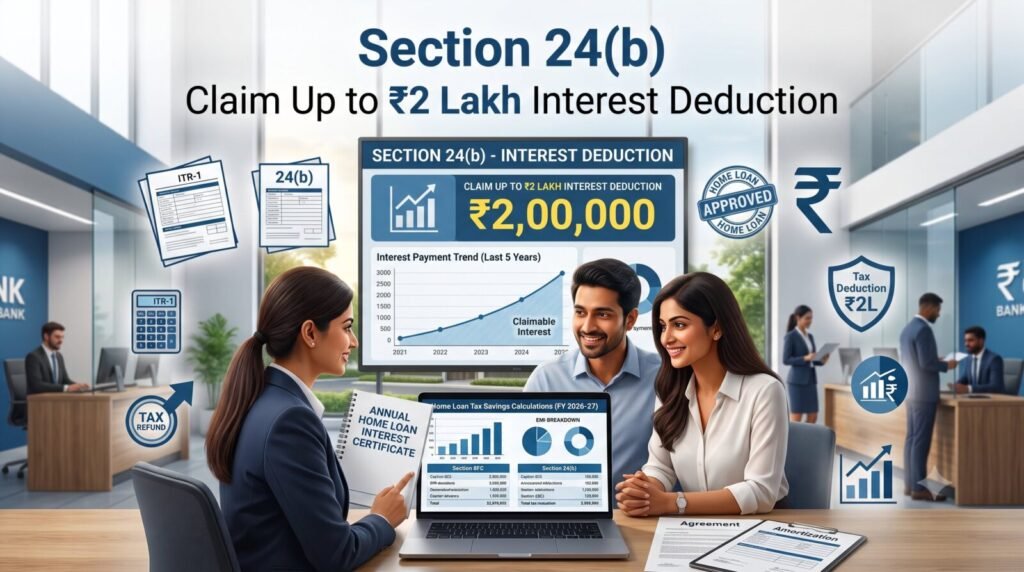
“This is the biggest of all home loan tax benefits — and the one most borrowers rely on.”
This is where the real money is. In the early years of a home loan, 70-80% of your EMI is interest. Section 24(b) lets you deduct that interest from your taxable income.
The Rules
| Property Type | Maximum Interest Deduction | Eligibility & Conditions |
|---|---|---|
| Self-Occupied Property | ₹2,00,000 per financial year | Construction must be completed within 5 years from the end of the financial year in which the home loan was taken. |
| Let-Out (Rented) Property | No upper limit on interest deduction | You can claim the full interest paid against rental income. However, the set-off of house property loss against other income is limited to ₹2,00,000 per financial year. Any unabsorbed loss can be carried forward for up to 8 assessment years, subject to applicable tax rules. |
| Under-Construction Property | No deduction during construction | Interest paid during the construction period is treated as pre-construction interest and can be claimed in five equal annual installments after possession, subject to the applicable deduction limits. |
The 5-year construction rule is critical. If your builder delays possession beyond 5 years from the end of the financial year you took the loan, your Section 24(b) limit drops from ₹2 lakh to just ₹30,000. On a ₹50 lakh loan, that’s a difference of ₹1.7 lakh in lost deductions every year.
💡 Pro tip: Use our EMI Calculator to see exactly how much interest you pay in the first 5 years — that’s your Section 24(b) goldmine.
Section 80C: Principal Repayment (The Hidden Gem)
“While Section 24(b) gets attention, Section 80C is a quiet but powerful home loan tax benefit.”
| Feature | Details |
|---|---|
| Maximum Deduction | ₹1,50,000 per financial year under Section 80C. |
| Shared Deduction Limit | The ₹1.5 lakh limit is shared with other eligible investments such as PPF, ELSS, EPF, LIC premiums, NSC, Sukanya Samriddhi Yojana (SSY), 5-year tax-saving fixed deposits, and children’s tuition fees. |
| Stamp Duty & Registration Charges | These expenses are also eligible for deduction under Section 80C, but only in the financial year in which the property is purchased. They are included within the overall ₹1.5 lakh limit. |
| Important Condition | The property must not be sold within 5 years from the date of possession. If sold earlier, the Section 80C deductions claimed on the principal repayment may be reversed and added back to your taxable income in the year of sale. |
Important: The ₹1.5 lakh limit is a combined bucket. If you already invest ₹1 lakh in PPF and ₹50,000 in ELSS, your home loan principal gets ZERO deduction under 80C. Plan your 80C investments strategically.
Section 80EE: First-Time Buyer Deduction (₹50,000 Extra)
Before Section 80EEA existed, there was Section 80EE. If your home loan was sanctioned between 1 April 2016 and 31 March 2017, you may still be eligible for an additional ₹50,000 deduction on interest — over and above Section 24(b).
| Eligibility Criteria | Requirement |
|---|---|
| Loan Sanction Date | Home loan must have been sanctioned between 1 April 2016 and 31 March 2017. |
| Maximum Loan Amount | The home loan amount must not exceed ₹35 lakh. |
| Maximum Property Value | The value of the residential property must not exceed ₹50 lakh. |
| First-Time Home Buyer | You must not own any other residential property on the date the loan is sanctioned. |
Maximum Tax Benefit
If you meet all the eligibility conditions, you can claim:
| Deduction | Maximum Amount |
|---|---|
| Section 24(b) – Home Loan Interest | ₹2,00,000 |
| Section 80EE – Additional Interest Deduction | ₹50,000 |
| Total Maximum Interest Deduction | ₹2,50,000 per financial year |
Note: Section 80EE applies only to eligible loans sanctioned between 1 April 2016 and 31 March 2017. It cannot be claimed if you are eligible for Section 80EEA, as both sections are mutually exclusive. This additional deduction is available over and above the ₹2 lakh deduction under Section 24(b).
Section 80EEA: First-Time Home Buyer Bonus (Additional ₹1.5 Lakh Interest Deduction)

Section 80EEA provides an additional deduction of up to ₹1.5 lakh on the interest paid for eligible affordable housing loans. This deduction is over and above the ₹2 lakh interest deduction available under Section 24(b), making it one of the most valuable home loan tax benefits for eligible first-time homebuyers.
Eligibility Criteria
| Eligibility Criteria | Requirement |
|---|---|
| Loan Sanction Date | Home loan must have been sanctioned between 1 April 2019 and 31 March 2022. |
| Maximum Stamp Duty Value | The property’s stamp duty value must not exceed ₹45 lakh. |
| Carpet Area | Up to 60 sq. metres in metropolitan cities or 90 sq. metres in non-metropolitan cities. |
| First-Time Home Buyer | You must not own any other residential property on the date the loan is sanctioned. |
| Eligible Lender | The loan must be taken from a scheduled bank or a registered housing finance company. |
Maximum Interest Deduction
| Deduction | Maximum Amount |
|---|---|
| Section 24(b) – Home Loan Interest | ₹2,00,000 |
| Section 80EEA – Additional Interest Deduction | ₹1,50,000 |
| Total Maximum Interest Deduction | ₹3,50,000 per financial year |
Important: Section 80EEA is available only for eligible affordable housing loans sanctioned between 1 April 2019 and 31 March 2022. If you claim a deduction under Section 80EEA, you cannot claim an additional deduction under Section 80EE for the same financial year.
Old Tax Regime vs New Tax Regime: Which Saves More?
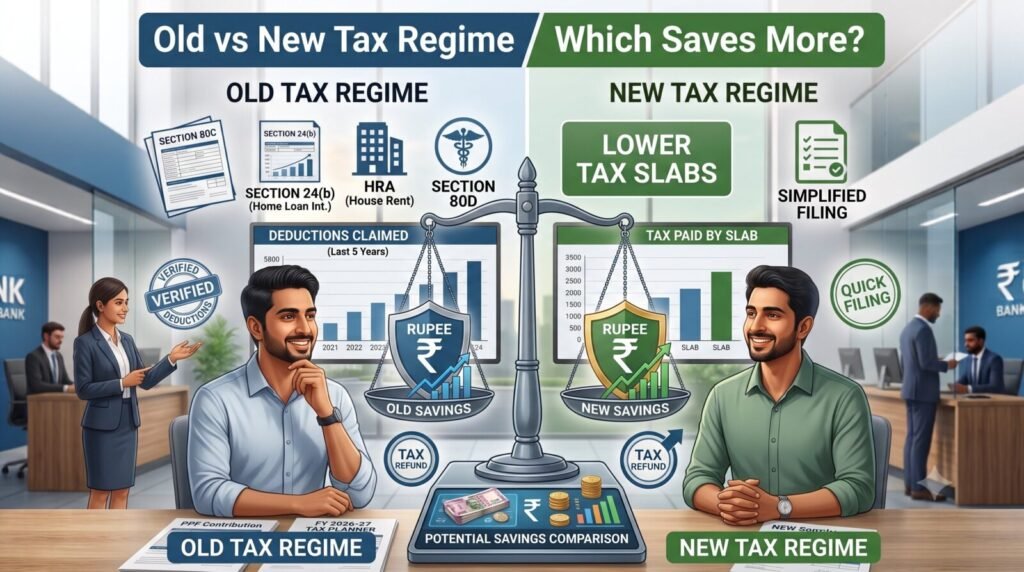
Comparison of old vs new tax regime for home loan tax benefits in India showing Section 80C, Section 24(b), and Section 80EEA deductions.
“This is the question I got every year from borrowers — and the answer changed dramatically after Budget 2025.”
Let’s be clear: The new tax regime is now the default. It has lower slab rates, a higher standard deduction (₹75,000 vs ₹50,000), and a rebate that makes income up to ₹12 lakh effectively tax-free. For many home loan borrowers, the new regime wins.
New Tax Regime Income Tax Slabs (FY 2026-27)
| Annual Taxable Income | Tax Rate |
|---|---|
| Up to ₹4,00,000 | Nil |
| ₹4,00,001 – ₹8,00,000 | 5% |
| ₹8,00,001 – ₹12,00,000 | 10% |
| ₹12,00,001 – ₹16,00,000 | 15% |
| ₹16,00,001 – ₹20,00,000 | 20% |
| ₹20,00,001 – ₹24,00,000 | 25% |
| Above ₹24,00,000 | 30% |
Old Tax Regime Income Tax Slabs (FY 2026-27)
| Annual Taxable Income | Tax Rate |
|---|---|
| Up to ₹2,50,000 | Nil |
| ₹2,50,001 – ₹5,00,000 | 5% |
| ₹5,00,001 – ₹10,00,000 | 20% |
| Above ₹10,00,000 | 30% |
Old Tax Regime vs New Tax Regime (FY 2026-27)
| Feature | Old Tax Regime | New Tax Regime |
|---|---|---|
| Standard Deduction | ₹50,000 | ₹75,000 |
| Section 80C (Principal Repayment) | ✅ Up to ₹1.5 lakh | ❌ Not available |
| Section 24(b) – Interest (Self-Occupied Home) | ✅ Up to ₹2 lakh | ❌ Not available |
| Section 24(b) – Interest (Let-Out Property) | ✅ Full interest deduction (loss set-off capped at ₹2 lakh against other income) | ⚠️ Deductible only against rental income. Loss cannot be set off against salary or other income. |
| Section 80EE | ✅ Available (if eligible) | ❌ Not available |
| Section 80EEA | ✅ Available (if eligible) | ❌ Not available |
| House Rent Allowance (HRA) | ✅ Available | ❌ Not available |
| Tax-Free Income (Salaried Individuals) | Up to about ₹10 lakh (with eligible deductions) | Up to ₹12.75 lakh (including standard deduction and rebate) |
| Tax Slabs | 5%, 20%, 30% | 0%, 5%, 10%, 15%, 20%, 25%, 30% |
Budget 2026 Update
The Union Budget 2026 did not change the income tax slab rates. The tax structure introduced in Budget 2025 continues to apply for FY 2026-27 (AY 2027-28).
Break-Even Point: When Does the Old Tax Regime Win?
One of the biggest myths among home loan borrowers is that having a home loan automatically makes the old tax regime better.
In reality, you need substantial deductions before the old regime starts outperforming the new regime.
| Annual Income | Approximate Deductions Needed for the Old Regime to Win | Practical? |
|---|---|---|
| ₹12 lakh | ₹6.5 lakh+ | Rare |
| ₹15 lakh | ₹5.44 lakh+ | Possible with high HRA, full home loan benefits, 80D, and NPS |
| ₹20 lakh | ₹7.08 lakh+ | Difficult for most taxpayers |
| ₹25 lakh | ₹8 lakh+ | Very difficult |
| ₹30 lakh | ₹8 lakh+ | Very difficult |
Bottom Line: If your total deductions are below approximately ₹5.5 lakh, the new tax regime generally results in a lower tax liability. Always compare both regimes before filing your income tax return.
Real Tax Comparison: ₹15 Lakh Annual Income
Total deductions: ₹3.5 lakh
| Tax Regime | Taxable Income | Tax Before Cess | Health & Education Cess (4%) | Total Tax Payable |
|---|---|---|---|---|
| New Regime | ₹14,25,000 | ₹93,750 | ₹3,750 | ₹97,500 |
| Old Regime | ₹11,00,000 | ₹1,07,500 | ₹4,300 | ₹1,11,800 |
Winner: ✅ New Tax Regime (Saves approximately ₹14,300)
Higher Deductions Scenario
Higher Deductions Scenario
Assume:
Section 24(b): ₹2 lakh
Section 80C: ₹1.5 lakh
HRA: ₹1.5 lakh
Section 80D: ₹50,000
Total deductions: ₹5.5 lakh
Tax RegimeTaxable IncomeTax Before CessHealth & Education Cess (4%)Total Tax PayableNew Regime₹14,25,000₹93,750₹3,750₹97,500Old Regime₹9,00,000₹92,500₹3,700₹96,200
Winner: ✅ Old Tax Regime (Saves approximately ₹1,300)
Real Tax Comparison: ₹25 Lakh Annual Income
Assumptions
Section 24(b): ₹2 lakh
Section 80C: ₹1.5 lakh
HRA: ₹1.5 lakh
Section 80D: ₹50,000
Total deductions: ₹5.5 lakh
Tax RegimeTaxable IncomeTax Before CessHealth & Education Cess (4%)Total Tax PayableNew Regime₹24,25,000₹3,07,500₹12,300₹3,19,800Old Regime₹19,00,000₹3,82,500₹15,300₹3,97,800
Winner: ✅ New Tax Regime (Saves approximately ₹78,000)
Key Takeaway
The new tax regime offers lower tax rates, making it the better choice for many salaried individuals with limited deductions.
“The old tax regime becomes more beneficial only if you can claim substantial deductions. At ₹15 lakh income, you need approximately ₹5.5 lakh in deductions just to save ₹1,300 — barely worth the effort. At ₹25 lakh income, even ₹5.5 lakh in deductions is not enough; the new regime still wins by ₹78,000. You typically need ₹8 lakh+ in total deductions before the old regime starts winning at higher incomes.”
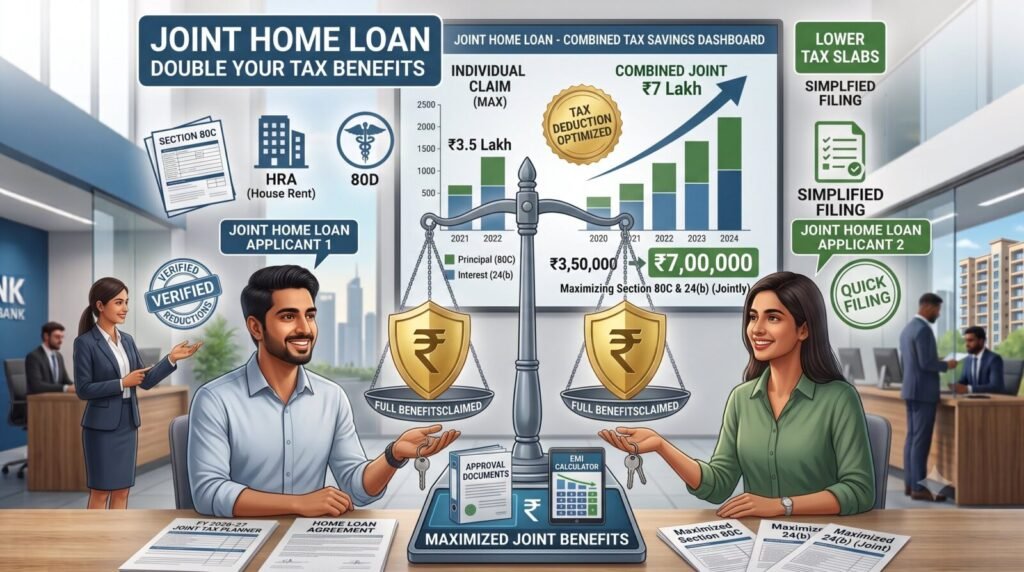
Joint Home Loan: The Ultimate Tax Hack Joint home loan tax benefits for husband and wife in India “The joint loan strategy is the ultimate hack for doubling your home loan tax benefits.”
This is the strategy I recommended to every married couple who walked into my cabin.
Joint Home Loan Tax Benefits: Solo vs Joint Applicants
| Benefit | Solo Applicant | Joint Applicants (Both Eligible & Working) |
|---|---|---|
| Section 24(b) – Interest Deduction | ₹2,00,000 | ₹4,00,000 (₹2,00,000 each) |
| Section 80C – Principal Repayment | ₹1,50,000 | ₹3,00,000 (₹1,50,000 each) |
| Maximum Total Tax Deduction | ₹3,50,000 | ₹7,00,000 |
| Estimated Tax Saving (30% Tax Slab) | ₹1,05,000 | ₹2,10,000 |
Key Conditions for Joint Tax Benefits
Both borrowers can claim tax deductions only if:
- ✅ Both are co-owners of the property.
- ✅ Both are co-borrowers on the home loan.
- ✅ Both contribute towards the repayment of the loan.
- ✅ Each claims deductions only in proportion to their share of loan repayment.
Example: If both spouses are co-owners, co-borrowers, and each pays 50% of the EMI, both can separately claim up to ₹2 lakh under Section 24(b) and ₹1.5 lakh under Section 80C, allowing the family to claim a combined deduction of up to ₹7 lakh per financial year, subject to individual eligibility and the applicable provisions of the Income Tax Act.
📋 Planning a joint loan? Use our Home Loan Planner to check if both of you qualify and which bank offers the best joint loan terms.
Pre-Construction Interest: Claim Before You Move In
You pay EMIs during construction. But you can’t claim Section 24(b) until you get possession. So what happens to that interest?
It’s not lost. It’s called pre-construction interest, and you can claim it in 5 equal installments starting from the year you get possession.
Pre-Construction Interest: Example
| Example | Details |
|---|---|
| Home Loan Taken | April 2021 |
| Interest Paid During Construction | ₹8,00,000 |
| Possession Received | March 2026 |
| Annual Pre-Construction Interest Claim | ₹1,60,000 per year (₹8,00,000 ÷ 5) |
| Claim Period | FY 2026-27 to FY 2030-31 (5 consecutive financial years) |
Important Points to Remember
- Pre-construction interest can only be claimed after you receive possession of the property.
- The total deduction under Section 24(b) for a self-occupied property is capped at ₹2,00,000 per financial year.
- Your annual claim includes both:
- Current year’s home loan interest, plus
- One-fifth of the accumulated pre-construction interest.
Example 1: Full Benefit Available
| Particulars | Amount |
|---|---|
| Current Year’s Interest | ₹40,000 |
| 1/5th Pre-Construction Interest | ₹1,60,000 |
| Total Deduction Claimed | ₹2,00,000 |
Since the total equals the ₹2 lakh limit, you can claim the entire amount.
Example 2: Deduction Capped at ₹2 Lakh
| Particulars | Amount |
|---|---|
| Current Year’s Interest | ₹1,20,000 |
| 1/5th Pre-Construction Interest | ₹1,60,000 |
| Total Eligible Interest | ₹2,80,000 |
| Maximum Deduction Allowed | ₹2,00,000 |
| Unclaimed Amount Lost | ₹80,000 |
Important: If the combined amount of your current year’s interest and 1/5th pre-construction interest exceeds ₹2 lakh for a self-occupied property, the excess cannot be carried forward or claimed in a later year. It is permanently lost. Planning your home loan and understanding this limit can help you avoid missing out on valuable tax benefits.
The 5-Year Trap: When Tax Benefits Get Reversed
“One mistake can reverse years of home loan tax benefits — here’s how to avoid it.”
This is the mistake that cost my client Priya ₹3.2 lakh.
Priya bought a house in Pune in 2021. Claimed ₹1.5 lakh under 80C every year for 3 years. Total deduction: ₹4.5 lakh. Then she got a job transfer to Bangalore in 2024 and sold the Pune house.
The taxman came knocking. Because she sold within 5 years of possession, ALL her Section 80C deductions were reversed and added back to her income in the year of sale.
What Priya Claimed What Happened on Sale
₹1.5L × 3 years = ₹4.5L deducted ₹4.5L added back to FY 2024-25 income
Tax saved earlier Tax now payable + interest penalty
Section 24(b) interest deductions are NOT reversed. Only Section 80C (principal) gets clawed back.
Bottom line: Don’t sell within 5 years unless you absolutely have to. The tax reversal wipes out years of savings.
HRA and Home Loan: Can You Claim Both?
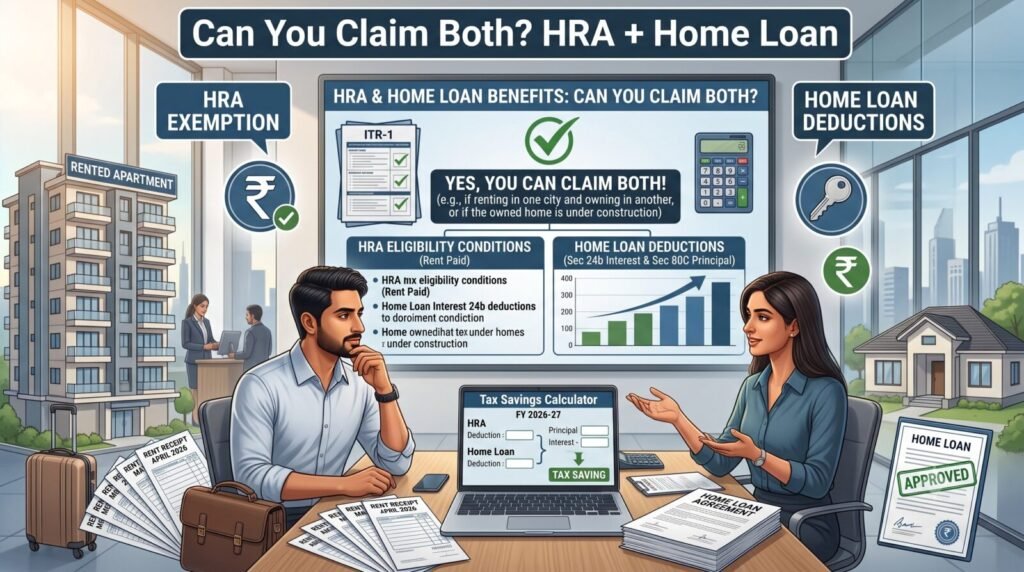
Yes. You can claim both House Rent Allowance (HRA) and home loan tax benefits under certain circumstances. Your eligibility depends on where you live and where your owned property is located.
HRA + Home Loan Eligibility
| Situation | Can You Claim Both? |
|---|---|
| You live in a rented house in City A and own a house in City B | ✅ Yes. You can claim both HRA exemption and eligible home loan tax benefits. |
| You live in a rented house but own a house in the same city | ⚠️ Yes, but only if you have a genuine reason for not staying in your own house. |
| You live in your own house | ❌ No. You cannot claim HRA. However, you can still claim eligible home loan tax benefits. |
Valid Reasons for Claiming HRA in the Same City
If your rented accommodation and owned house are in the same city, you may still be eligible to claim both HRA and home loan benefits if you can justify why you are living in rented accommodation.
Some commonly accepted reasons include:
| Valid Reason | Explanation |
|---|---|
| Property Under Construction | Your own house is not yet ready for possession, so you continue living in rented accommodation. |
| Long Distance from Workplace | Your owned house is located far from your office, making daily commuting impractical (generally around 35–50 km or more, depending on the facts of the case). |
| Parents or Family Occupying the Property | Your parents or dependent family members live in the owned house while you stay in rented accommodation for work. If claiming HRA, rent payments should be genuine and supported with proper documentation. |
Important: There is no specific distance prescribed in the Income Tax Act for claiming HRA when your owned house is in the same city. The reason for staying in rented accommodation should be genuine, reasonable, and supported by evidence if requested by the Income Tax Department.
- 💡 Pro tip: If your parents live in your owned house, pay them rent via bank transfer. They can claim ₹1.5L standard deduction on rental income. You get HRA exemption. It’s a family tax-saving circle.
Documents Required to Claim Home Loan Tax Benefits
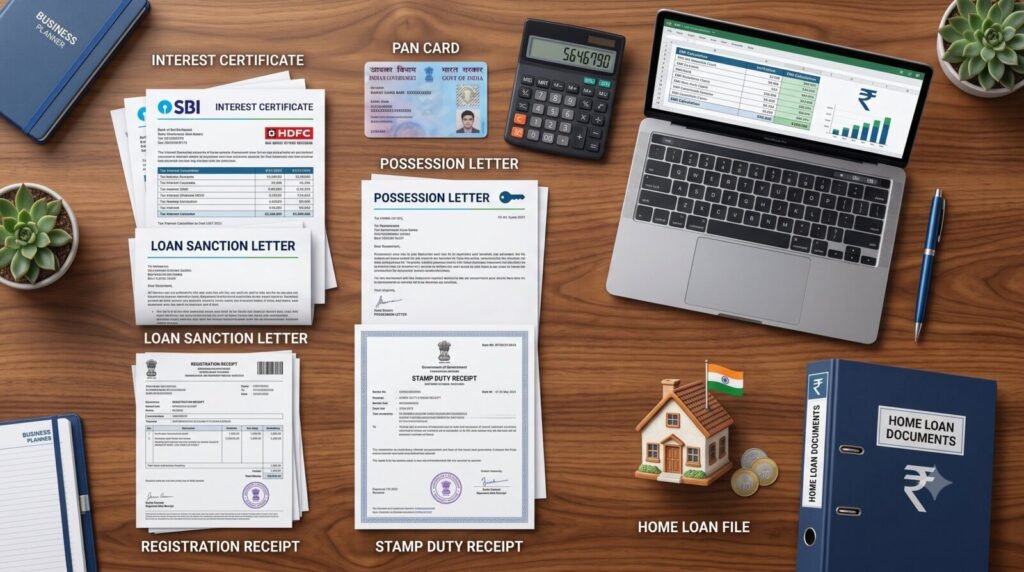
| Document | Purpose | Where to Get It |
|---|---|---|
| Interest Certificate | Proof of the interest paid during the financial year for claiming deduction under Section 24(b). | Download from your bank’s internet banking portal or collect it from the bank branch. |
| Principal Repayment Certificate | Proof of the principal amount repaid for claiming deduction under Section 80C. | Available through your bank’s online portal or branch. |
| Home Loan Sanction Letter | Confirms the loan sanction date for eligibility under Section 80EE or Section 80EEA. | Your original home loan documents or the lending bank. |
| Completion Certificate | Confirms that the construction of the property has been completed, which is required before claiming certain interest deductions. | Issued by the builder or the local municipal authority. |
| Stamp Duty Receipt | Proof of stamp duty payment for claiming a one-time deduction under Section 80C. | Issued by the Sub-Registrar’s Office or available with your property documents. |
| Registration Receipt | Proof of property registration charges eligible for a one-time deduction under Section 80C. | Issued by the Sub-Registrar’s Office during property registration. |
| Possession Letter | Confirms the date on which possession of the property was received, which determines when certain tax benefits can be claimed. | Issued by the builder or developer. |
Pro tip: Most banks issue a combined “Provisional Interest Certificate” in March for the upcoming financial year. Download it and give it to your employer for TDS adjustment. Don’t wait for the final certificate in May.
Frequently Asked Questions
FAQ 1: Can I claim home loan tax benefits in the new tax regime?
No — for self-occupied properties. Section 24(b), Section 80C, Section 80EE, and Section 80EEA are not available under the new tax regime for self-occupied homes. For let-out properties, you can deduct interest only against the rental income earned — you cannot set off any loss against your salary or other income. However, because the new regime has lower slab rates and a higher standard deduction, many borrowers still pay less tax overall in the new regime. Always calculate both before filing.
FAQ 2: How much tax will I actually save with a home loan?
It depends on your income slab, chosen regime, and total deductions. In the old regime at the 30% slab: Section 24(b) saves ₹60,000/year. Section 80C saves up to ₹45,000/year. Combined: up to ₹1,05,000/year. Over 20 years, that can be ₹15–20 lakh in tax savings — but only if you stay in the old regime and your deductions are high enough to make it worthwhile.
FAQ 3: Can both husband and wife claim tax benefits on the same home loan?
Yes, if both are co-owners AND co-borrowers. Each can claim ₹2 lakh interest (24b) + ₹1.5 lakh principal (80C) = ₹3.5 lakh each. Total household benefit: ₹7 lakh deduction, ₹2.1 lakh tax saved (at 30% slab).
FAQ 4: What happens if I miss an EMI? Can I still claim tax benefits?
Section 24(b) interest is based on accrual (what’s payable), so you can claim it even if you missed the EMI. Section 80C principal is based on actual payment — if you didn’t pay, you can’t claim. Pay your EMIs on time.
FAQ 5: Can I claim tax benefits on a second home loan?
Yes, but differently. The first self-occupied home gets ₹2 lakh interest deduction. The second home is deemed “let-out” even if vacant — interest is fully deductible (no ₹2L cap), but you must show notional rent as income. Principal repayment on the second loan is also eligible under 80C.
FAQ 6: Is stamp duty deductible every year?
No. Stamp duty and registration charges are deductible only in the year of purchase under Section 80C. And they share the ₹1.5 lakh limit with your principal repayment, PPF, ELSS, etc.
FAQ 7: Can I claim HRA and home loan benefits together?
Yes, if you live in a rented house and your owned house is in another city or under construction. If both are in the same city, you need a valid reason (distance, parents living there) with documentation.
FAQ 8: What if my builder delays possession beyond 5 years?
Your Section 24(b) limit drops from ₹2 lakh to ₹30,000. That’s a ₹1.7 lakh annual loss. Before buying under-construction, check the builder’s track record. Or buy a ready-to-move property to avoid this risk entirely.
FAQ 9: Has Section 80C been renamed in the new Income Tax Act, 2025?
The Income Tax Act, 2025 replaced the 1961 Act effective FY 2026–27. Some provisions have been restructured, but the deduction limits and rules remain the same. Most CAs and tax filing portals still refer to “Section 80C” and “Section 24(b)” for clarity. When filing your ITR for AY 2027–28, follow the section references used by your tax portal or CA.
Final Thoughts
“Use this guide as your reference for home loan tax benefits every financial year.”
A home loan is not just debt. It’s a tax-saving weapon — but only if you choose the right regime and claim the right sections.
The government WANTS you to buy a house. That’s why they give you up to ₹5 lakh in annual deductions (₹3.5L interest + ₹1.5L principal). But they also want you to stay in that house for at least 5 years. That’s why they claw back Section 80C if you sell early.
My advice? Don’t blindly choose the old regime just because you have a home loan. The new regime’s lower slab rates and higher standard deduction make it the better choice for most borrowers. Do the math. If your total deductions (80C + 80D + HRA + home loan interest + others) exceed approximately ₹5.5 lakh, only then does the old regime start to win. For everyone else, the new regime is simpler and cheaper.
Get your interest certificate from the bank in March. Claim your pre-construction interest if you recently got possession. If you’re married and both work, take a joint loan and double your benefits.
And remember: the ₹1 lakh you save in tax this year is not just a deduction. It’s your child’s school fees. It’s your parent’s health insurance. It’s your SIP that compounds into a retirement corpus.
Related Reading:
- Complete Home Loan Guide for Indian Borrowers
- SBI vs HDFC vs ICICI Home Loan Interest Rate (July 2026)
- Home Loan Eligibility for Salaried Employees
- Fixed vs Floating Home Loan Interest Rates
Disclaimer: Tax laws are subject to change. The deductions mentioned are based on the Income Tax Act as of FY 2026–27 (AY 2027–28). Please consult a chartered accountant before making tax-related decisions. This article is for informational purposes only and does not constitute tax or financial advice.
Get in touch: pennypowerplayofficial@gmail.com
Visit: PennyPowerPlay.com
Connect on LinkedIn