Last Updated: July 2026
Introduction
Buying a home is one of the biggest financial decisions most people make. For many families, a home loan becomes a commitment that lasts 15 to 30 years.
If you’re still planning to purchase your first property, I recommend reading my guide on common home loan mistakes first-time buyers make before taking your first loan.
But what happens when your financial situation improves?
Maybe you receive a salary hike, an annual bonus, inheritance, maturity proceeds from an investment, or profits from your business. Naturally, one question comes to mind:
“Should I use this money to repay my home loan early?”
“At first, it may seem like an easy decision.”
“Most borrowers naturally want to become debt-free as early as possible.”
However, after working in housing finance for more than eight years, I’ve learned that repaying your home loan early isn’t always the smartest financial decision. In some situations, it can save you lakhs of rupees in interest. In others, using all your savings to close the loan could leave you financially vulnerable or cause you to miss better investment opportunities.
The right decision depends on several factors, including your loan balance, interest rate, financial goals, emergency savings, tax benefits, and future cash flow needs.
Before deciding whether to make a home loan prepayment, it’s helpful to understand how different repayment choices affect your finances. You can use my Home Loan Planner to explore home loan affordability, EMI planning, eligibility, and other practical tools that can help you make a more informed borrowing decision.
That’s why understanding home loan prepayment and foreclosure is important before making any extra payment toward your loan.
In this comprehensive guide, you’ll learn:
- What home loan prepayment and foreclosure mean
- The difference between partial prepayment and full foreclosure
- How prepayment affects your interest, EMI, and loan tenure
- When prepaying your loan makes financial sense
- Situations where you should avoid prepayment
- RBI rules and foreclosure charges in India
- Common mistakes borrowers make
- Practical examples from my experience in housing finance
By the end of this guide, you’ll have the knowledge to decide whether repaying your home loan early is the right move for your financial future.
A Real-Life Story from My Housing Finance Experience
During my time in housing finance, I met a salaried professional who had been paying his home loan regularly for almost six years.
One afternoon, he walked into the branch with a smile on his face.
His company had announced a generous performance bonus, and after taxes, he had nearly ₹8 lakh available.
He confidently said,
“I want to close my home loan as quickly as possible. Please tell me how much I need to pay.”
At first, it sounded like an excellent financial decision.
But before preparing the prepayment request, I asked him a few simple questions.
- Do you have an emergency fund?
- What happens if someone in your family faces a medical emergency?
- Are your children’s education expenses coming up?
- Do you have any other loans?
- Have you reviewed your insurance coverage?
- Will this bonus be your only savings after prepayment?
His smile slowly faded.
He admitted that almost his entire savings would be used if he prepaid the loan.
He also had a daughter who would begin college in three years and had very little money set aside for emergencies.
Instead of immediately recommending a large prepayment, we discussed different options.
After reviewing his finances, he decided to:
- Keep six months’ worth of emergency expenses aside.
- Invest a portion toward his daughter’s education.
- Use only part of the bonus for a partial home loan prepayment.
As a result, he still reduced his future interest burden while protecting his family’s financial security.
This experience taught me something important.
A home loan should never be viewed in isolation.
Every repayment decision should fit into your overall financial plan, not just your desire to become debt-free quickly.
Throughout my years in housing finance, I’ve seen borrowers make both excellent and costly repayment decisions. The goal of this guide is to help you make an informed decision based on your own circumstances.
What Is Home Loan Prepayment?
Home loan prepayment means paying an additional amount toward your outstanding home loan before it is due, over and above your regular monthly EMI.
Before deciding to prepay your loan, it’s equally important to understand how much home loan EMI you can really afford based on your monthly income and financial goals.
When you make a prepayment, the bank adjusts the extra amount against your principal outstanding.
Since home loan interest is calculated on the remaining principal balance, reducing the principal earlier can lower the total interest you pay over the life of the loan.
Simple Example
Suppose:
- Home Loan Amount: ₹50 lakh
- Interest Rate: 8.5% per year
- Loan Tenure: 20 years
After a few years, you receive an annual bonus of ₹5 lakh.
Instead of spending the entire amount, you decide to make a partial prepayment toward your home loan.
The bank deducts this amount from your outstanding principal.
As a result:
- Future interest is calculated on a lower outstanding balance.
- You may reduce your loan tenure while keeping the same EMI.
- Or, if your lender allows, you may choose to reduce your EMI while keeping the same tenure.
The exact savings depend on when you make the prepayment, how much you pay, and which repayment option you choose.
What Is Home Loan Foreclosure?

While prepayment refers to paying part of your outstanding loan before schedule, foreclosure means paying the entire remaining loan amount in one payment and closing the loan permanently before the original loan tenure ends.
Once your lender receives the full outstanding amount and completes the required formalities, your loan account is closed.
The bank will then issue documents such as:
- No Objection Certificate (NOC)
- Loan Closure Letter
- Statement showing zero outstanding balance
- Original property documents (if held by the lender)
After foreclosure, you no longer have to pay monthly EMIs because your home loan has been fully repaid.
Home Loan Prepayment vs Home Loan Foreclosure
Although these terms are often used interchangeably, they have different meanings.
| Feature | Home Loan Prepayment | Home Loan Foreclosure |
|---|---|---|
| Amount Paid | Partial amount | Entire outstanding balance |
| Loan Continues? | Yes | No |
| Future EMIs | Continue | Stop completely |
| Interest Savings | Yes | Maximum possible savings on future interest |
| Purpose | Reduce principal and interest burden | Close the loan permanently |
Understanding this difference helps you choose the option that best fits your financial goals.
Home loan prepayment becomes relevant only after your loan is approved. If you’re still applying, my guide on the home loan approval process explains every stage from application to loan disbursement.
Why Do People Choose to Prepay Their Home Loan?
Every borrower has different financial priorities.
Some want to become debt-free as early as possible, while others prefer to reduce their monthly EMI and improve their monthly cash flow.
Here are some of the most common reasons people make a home loan prepayment:
1. Salary Increase
Many salaried professionals receive annual increments or promotions.
Instead of increasing their lifestyle expenses, some choose to use a portion of the additional income to reduce their home loan.
2. Annual Bonus
Performance bonuses are one of the most common sources of home loan prepayment.
A lump sum payment once a year can significantly reduce future interest costs, especially during the early years of the loan.
3. Business Profits
Self-employed borrowers often experience seasonal or annual profits.
When cash flow improves, they may use surplus funds to reduce their loan balance.
4. Inheritance or Family Support
Some borrowers receive financial assistance from parents or inherit family assets, allowing them to reduce or close their home loan.
5. Sale of Another Property or Investment
Selling another property or redeeming long-term investments may provide enough funds for a substantial prepayment or complete foreclosure.
While these situations create opportunities for early repayment, it is important to evaluate your overall financial health before committing a large amount toward your loan.
Expert Insight
During my years in housing finance, I noticed that borrowers who planned their prepayments around their long-term financial goals generally made better decisions than those who rushed to close their loans without considering emergency savings, insurance, or future family expenses.
Becoming debt-free is an important milestone, but maintaining financial flexibility is equally important.
How Does Home Loan Prepayment Save Interest?
One of the biggest misconceptions among borrowers is that every extra payment reduces interest by the same amount.
In reality, the timing of your prepayment matters just as much as the amount you repay.
To understand why, it’s important to know how banks calculate home loan interest.
Most home loans in India follow a reducing balance method. This means interest is charged only on your outstanding principal balance, not on the original loan amount.
Every EMI you pay consists of two parts:
- Interest
- Principal repayment
During the initial years of your loan, a larger portion of your EMI goes toward paying interest, while only a small portion reduces the principal.
As the outstanding principal gradually decreases, the interest component becomes smaller and a larger share of each EMI goes toward principal repayment.
This is why making extra payments during the early years of your loan can save significantly more interest than making the same payment later.
Understanding the Reducing Balance Method
If you’re still evaluating whether you qualify for a home loan, understanding home loan eligibility criteria can help you prepare before applying.
Let’s take a simple example.
Suppose you borrow ₹50 lakh for 20 years at an interest rate of 8.50% per annum.
During the first few EMIs:
- A large portion of your payment covers interest.
- Only a small amount reduces your principal.
Since interest is calculated on the remaining loan balance, reducing the principal earlier means future interest is calculated on a lower amount.
As a result:
- Total interest payable decreases.
- Your loan tenure may reduce.
- Or your EMI may reduce, depending on the repayment option you choose.
This is why financial planners often recommend making prepayments during the first half of your loan tenure whenever possible.
Why Early Prepayments Save More Money
Many borrowers assume they can wait until the last few years of the loan to make a large payment.
While that still reduces some interest, the savings are usually much smaller.
Example
Imagine two borrowers each make a ₹5 lakh prepayment.
Borrower A makes the payment after 3 years.
Borrower B makes the payment after 15 years.
Even though both pay the same amount, Borrower A usually saves much more interest because the outstanding principal is still relatively high.
Borrower B has already paid most of the interest through previous EMIs, leaving less opportunity for additional savings.
Expert Tip
If you know you’ll receive bonuses or variable income regularly, consider making smaller prepayments every year instead of waiting until the end of the loan.
Consistent early prepayments often generate greater long-term interest savings.
Practical Example: How Much Can You Save?

Let’s consider a realistic example.
| Particular | Value |
|---|---|
| Loan Amount | ₹50,00,000 |
| Interest Rate | 8.50% |
| Loan Tenure | 20 Years |
| EMI | Approximately ₹43,391 |
Assume you receive an annual bonus after three years and decide to make a ₹5 lakh partial prepayment.
Depending on your lender’s repayment options, you may choose either:
Option 1: Keep the Same EMI
If your EMI remains unchanged, your loan tenure reduces.
Benefits:
- Faster loan closure
- Significant interest savings
- Become debt-free earlier
This option is generally suitable for borrowers whose monthly income comfortably supports the existing EMI.
Option 2: Reduce Your EMI
Instead of shortening the loan tenure, your lender may reduce your monthly EMI while keeping the remaining tenure unchanged.
Benefits:
- Better monthly cash flow
- Reduced financial pressure
- Helpful during changing family responsibilities
This option is useful if you expect higher future expenses such as children’s education or retirement planning.
Illustration
| Without Prepayment | With ₹5 Lakh Prepayment |
|---|---|
| Higher total interest | Lower total interest |
| Full 20-year tenure | Loan may finish earlier |
| Same outstanding principal | Principal reduces immediately |
| Higher lifetime borrowing cost | Lower lifetime borrowing cost |
Note: Actual savings depend on your lender’s amortization schedule, interest rate, outstanding balance, and the timing of your prepayment.
Should You Reduce Your EMI or Loan Tenure?
This is one of the most common questions borrowers ask.
There is no single answer because both options serve different financial goals.
Let’s compare them.

| Reduce EMI | Reduce Loan Tenure |
|---|---|
| Lower monthly payment | Faster loan closure |
| Improves monthly cash flow | Greater interest savings |
| Useful during rising household expenses | Ideal if income is stable |
| More financial flexibility | Become debt-free sooner |
| Lower immediate financial pressure | Better long-term savings |
Salaried borrowers should also understand how lenders evaluate income while deciding repayment capacity. Read my guide on home loan eligibility for salaried employees for a detailed explanation.
When Reducing EMI May Be Better
Reducing your EMI may be a better choice if:
- You’re planning for your children’s education.
- You’re expecting additional household expenses.
- Your spouse may take a career break.
- You want more monthly savings.
- You’re approaching retirement and prefer lower fixed obligations.
Lower EMIs can improve financial flexibility without completely sacrificing the benefits of prepayment.
When Reducing Loan Tenure May Be Better
Reducing the loan tenure often makes sense if:
- Your income is stable.
- You have sufficient emergency savings.
- You don’t expect major financial commitments in the near future.
- Your primary goal is to minimize total interest paid.
- You want to become debt-free as early as possible.
Keeping the same EMI while reducing the loan tenure usually results in higher overall interest savings.
Decision Guide: Which Option Is Right for You?
Use this simple framework before making a prepayment decision.
| Your Situation | Recommended Approach |
|---|---|
| Stable income with no major upcoming expenses | Reduce loan tenure |
| Growing family responsibilities | Reduce EMI |
| Planning retirement within a few years | Consider reducing the loan burden before retirement |
| Irregular business income | Maintain adequate liquidity before making large prepayments |
| Recently received a bonus | Evaluate partial prepayment after securing emergency savings |
Every borrower’s financial situation is different. Before choosing between reducing your EMI, shortening your loan tenure, or making a partial prepayment, try using my Home Loan Planner to estimate your repayment capacity and explore different home loan scenarios.
Remember, the best option depends on your overall financial plan, not just your home loan.
When Does Home Loan Prepayment Make Financial Sense?
Before your loan is approved, make sure you’ve completed every required document using this home loan application checklist.
Home loan prepayment can be a smart financial move in several situations.
1. You Have a Strong Emergency Fund
Before using surplus money to repay your home loan, ensure you have enough savings to cover at least six months of essential household expenses.
Unexpected events such as job loss, medical emergencies, or major repairs can occur without warning.
2. You’ve Cleared High-Interest Debt
If you still have:
- Credit card debt
- Personal loans
- Consumer durable loans
these usually carry much higher interest rates than home loans.
Repaying expensive debt first often provides greater financial benefit.
3. You Receive a Large Lump Sum
Examples include:
- Annual bonus
- Business profits
- Inheritance
- Sale of another property
- Investment maturity
Using a portion of these funds for partial prepayment can reduce your future interest burden.
4. You’re in the Early Years of Your Loan
Since interest payments are highest during the initial years, prepayments made early generally produce greater savings than those made toward the end of the loan tenure.
5. You Want Greater Financial Security Before Retirement
Many borrowers prefer entering retirement with little or no outstanding debt.
Reducing or closing your home loan before retirement can lower monthly obligations and provide peace of mind.
Expert Insight
Throughout my years in housing finance, I found that the borrowers who benefited most from prepayment were those who treated it as part of a broader financial plan rather than an emotional decision. They maintained emergency savings, reviewed their insurance needs, cleared expensive debt first, and then used surplus funds strategically to reduce their home loan. That balanced approach often led to better long-term financial outcomes.
When Should You Avoid Home Loan Prepayment?
Although prepayment can reduce your interest burden, there are situations where it may not be the best financial decision.
1. You Don’t Have an Emergency Fund
Imagine using all your savings to repay your home loan, only to face an unexpected medical emergency or job loss a few months later.
Without an emergency fund, you may have to borrow again, possibly at a much higher interest rate through a personal loan or credit card.
Recommendation: Build an emergency fund covering at least six months of essential expenses before making large prepayments.
2. You Have High-Interest Debt
If you have:
- Credit card dues
- Personal loans
- Consumer durable loans
these often carry interest rates between 12% and 40%, much higher than most home loans.
In such cases, clearing expensive debt first is usually a better financial decision than prepaying your home loan.
3. You Need Money for Important Financial Goals
Think carefully before using all your savings if you’re planning for:
- Children’s higher education
- Marriage expenses
- Starting a business
- Home renovation
- Retirement planning
Maintaining sufficient liquidity for planned goals is just as important as reducing debt.
4. Better Investment Opportunities May Exist
If your home loan interest rate is relatively low and you’re a disciplined long-term investor, certain investments may generate returns that exceed your borrowing cost.
However, investment returns are never guaranteed and involve risk.
The decision should always align with your financial goals, risk tolerance, and time horizon.
RBI Rules on Home Loan Prepayment and Foreclosure
The rules regarding prepayment and foreclosure can vary depending on the type of loan and borrower.
In general:
- Individual borrowers with floating-rate home loans are typically not charged prepayment or foreclosure penalties by lenders, in line with RBI guidelines.
- Different terms may apply to certain fixed-rate loans, loans to non-individual entities, or specific loan agreements.
Since lender policies and regulations can change over time, always review your loan agreement and confirm the latest terms with your bank or housing finance company before making a prepayment.
If interest rates have fallen since you took your loan, compare whether a home loan balance transfer could save more money than making a large prepayment.
Are There Any Foreclosure Charges?
Many borrowers worry that closing a home loan early will result in heavy penalties.
In many cases, individual borrowers with floating-rate home loans are not charged foreclosure fees. However, charges may apply in certain situations, such as:
- Fixed-rate home loans, depending on the lender’s policy and loan agreement.
- Loans taken by companies, partnerships, or other non-individual entities.
- Specific contractual conditions agreed upon at the time of sanction.
Always request a written foreclosure statement from your lender before making the final payment so you understand any applicable charges and the exact amount required to close the loan.
Documents You Should Collect After Foreclosure
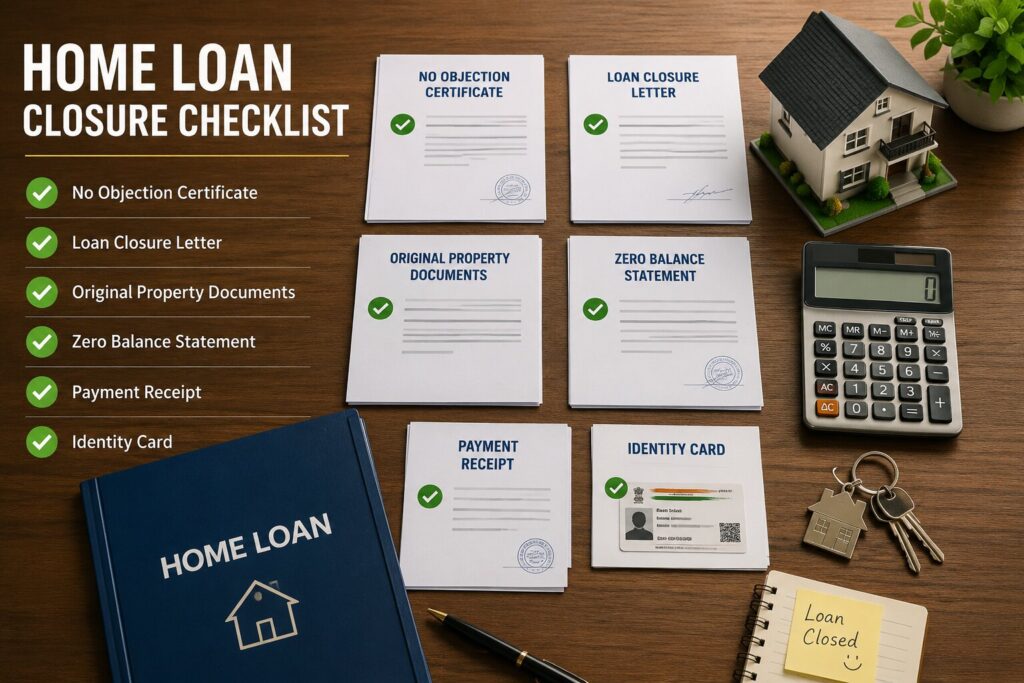
Closing your home loan isn’t complete until you’ve received all the necessary documents.
Before leaving the branch, ensure you receive:
- Loan Closure Letter
- No Objection Certificate (NOC)
- Original property documents deposited with the lender
- Statement showing zero outstanding balance
- Payment acknowledgement or receipt
- Any post-dated cheques or ECS instructions, if applicable
Keep these documents safely, as you may need them when selling the property or applying for another loan.
Step-by-Step Home Loan Foreclosure Process
The foreclosure process is usually straightforward when you follow the correct steps.
Step 1
Contact your lender and request the latest outstanding loan balance.
Step 2
Ask for a foreclosure statement showing:
- Outstanding principal
- Interest payable
- Applicable charges (if any)
- Total amount required for closure
Step 3
Arrange the required funds and make the payment through the mode accepted by your lender.
Step 4
Complete any required forms or declarations.
Step 5
Collect your:
- NOC
- Loan closure certificate
- Original property documents
- Zero balance statement
Step 6
If your property has a registered mortgage, ensure the mortgage release process is completed according to local registration requirements.
Does Home Loan Prepayment Affect Tax Benefits?
Many borrowers ask whether making a prepayment means losing tax benefits.
The answer depends on your outstanding loan and the amount of interest you continue to pay.
If your outstanding loan reduces, the interest payable in future years may also reduce. As a result, the amount eligible for interest-related tax deductions may decrease.
However, reducing interest also means you’re paying less to the lender overall, which can improve your long-term financial position.
Since tax rules can vary based on your individual circumstances and the tax regime you choose, consult a qualified tax professional if you’re unsure about the impact.
Common Mistakes Borrowers Make
Throughout my years in housing finance, I noticed several mistakes that borrowers repeatedly made when planning a prepayment.
Mistake 1: Using Every Rupee of Savings
Leaving no emergency fund can create financial stress if unexpected expenses arise.
Mistake 2: Ignoring High-Interest Debt
Repaying a home loan while carrying expensive credit card debt often isn’t the most efficient strategy.
Mistake 3: Not Comparing Repayment Options
Many borrowers automatically reduce their EMI without understanding that reducing the loan tenure may lead to greater interest savings.
Mistake 4: Forgetting to Collect Original Documents
Some borrowers assume the loan is closed and leave without verifying that all original property documents have been returned.
Always check every document carefully before leaving the branch.
Mistake 5: Not Verifying Loan Closure
After foreclosure, confirm that your loan account shows a zero outstanding balance and retain the closure documents for future reference.
Common Myths About Home Loan Prepayment
Myth: Every borrower should prepay their home loan.
Reality: The right decision depends on your financial goals, emergency savings, interest rate, and other obligations.
Myth: Closing your loan early is always better than investing.
Reality: Depending on expected investment returns, risk, and personal goals, investing part of your surplus may sometimes be more suitable.
Myth: Banks always charge foreclosure penalties.
Reality: Many individual floating-rate home loans do not attract foreclosure charges, though exceptions can apply.
Myth: A small prepayment doesn’t make a difference.
Reality: Even modest prepayments made during the early years of the loan can reduce future interest.
Expert Insight
During my years in housing finance, I met borrowers who focused only on becoming debt-free as quickly as possible. Others carefully balanced loan repayment with emergency savings, insurance, investments, and future family goals. In many cases, the second group was financially better prepared for life’s unexpected events. A home loan is just one part of your financial journey. Your repayment strategy should support your overall financial well-being, not compromise it.
Disclaimer: Home loan policies, lender terms, RBI regulations, and tax provisions may change over time. Always verify the latest information with your lender and consult a qualified financial or tax professional before making important financial decisions.
Frequently Asked Questions (FAQs)
Can I prepay my home loan every year?
Yes. Many lenders allow partial prepayments, though the frequency and minimum amount may vary according to your loan agreement.
Is there a minimum amount for partial prepayment?
Some lenders specify a minimum prepayment amount. Check your loan terms or confirm with your lender.
Should I reduce my EMI or loan tenure?
If your income is stable and your goal is maximum interest savings, reducing the tenure often provides greater long-term benefits. If monthly cash flow is a concern, reducing the EMI may be more appropriate.
Can I use my annual bonus for prepayment?
Yes. Annual bonuses are one of the most common sources of partial prepayment.
Can I prepay my home loan online?
Many banks and housing finance companies now allow online partial prepayments through internet or mobile banking, though procedures vary by lender.
Will prepayment improve my credit score?
Consistently repaying your loan responsibly contributes to a healthy credit profile. Closing a loan successfully may also reflect positively in your credit history, but your overall credit score depends on multiple factors.
Can I foreclose a floating-rate home loan?
Yes. Many individual borrowers can foreclose floating-rate home loans, subject to the terms of their loan agreement.
Is foreclosure the same as prepayment?
No. Partial prepayment reduces your outstanding principal while the loan continues. Foreclosure means repaying the entire outstanding loan and closing the account.
Can I make multiple partial prepayments?
Many lenders allow multiple partial prepayments, subject to their policies.
What should I do after closing my loan?
Collect all original documents, obtain a No Objection Certificate, verify that the loan account is closed, and complete any required mortgage release formalities.
Key Takeaways
- Home loan prepayment reduces your outstanding principal and can lower future interest.
- Early prepayments generally save more interest than late prepayments.
- Reducing the loan tenure usually saves more interest than reducing the EMI.
- Never compromise your emergency fund solely to repay your home loan early.
- Review your financial goals before making a large prepayment.
- Collect all original documents and loan closure certificates after foreclosure.
- Always confirm your lender’s latest policies regarding prepayment and foreclosure.
Your repayment strategy also depends on whether you’ve chosen a fixed vs floating home loan interest rate, as each option can affect long-term interest costs differently.
Final Thoughts

A home loan is often the largest financial commitment most families make, and deciding whether to repay it early deserves careful thought rather than an emotional decision.
For some borrowers, prepayment can significantly reduce interest costs and help them become debt-free sooner. For others, maintaining an emergency fund, investing for long-term goals, or managing other financial responsibilities may be a better use of surplus money.
There is no universal answer that fits everyone.
The best repayment strategy is one that supports your overall financial well-being while balancing debt reduction, financial security, and future goals.
Remember that your home loan is only one part of the total cost of home ownership. Before buying a property, understand the hidden costs of buying a home in India so you can plan your finances more effectively.
If you’d like to plan your home loan more confidently, explore my Home Loan Planner, where you’ll find practical tools and resources covering EMI affordability, eligibility, documentation, repayment planning, and other important aspects of the home loan journey.
If you’re unsure about the right approach, discuss your options with your lender or a qualified financial advisor before making a large prepayment.
By taking a thoughtful, informed approach, you can ensure that every extra rupee you pay moves you closer to both financial freedom and long-term financial stability.