
Learn the 15 most common home loan rejection reasons in India. Discover why banks reject applications and practical steps to improve your approval chances in 2026.
Buying your dream home is an exciting milestone. But imagine finding the perfect property, paying the booking amount, submitting all your documents, and then receiving a call from the bank saying your home loan application has been rejected.
For many home buyers, this is frustrating and confusing.
One of the biggest misconceptions is that a high salary automatically guarantees a home loan approval. In reality, banks and housing finance companies evaluate several factors before approving a loan. Your income is only one part of the overall assessment.
Before applying, it’s also important to understand whether you actually meet the lender’s eligibility requirements. Read our complete guide on Home Loan Eligibility for Salaried Employees to learn how banks assess income, employment, age, and repayment capacity.
During my 8+ years working with leading housing finance companies and banks, I met many applicants who believed they had done everything right. Some had excellent salaries but poor repayment histories. Others had good credit scores but purchased properties with unresolved legal issues. In most cases, the rejection was caused by a problem that could have been identified and corrected before applying.
The good news is that a home loan rejection doesn’t always mean you can never get approved. Understanding why lenders reject applications can help you improve your financial profile and increase your chances of success the next time you apply.
In this guide, you’ll learn:
- The most common reasons banks reject home loan applications.
- What lenders actually evaluate before approving a loan.
- Practical steps to improve your approval chances.
- What to do if your home loan application has already been rejected.
- Expert insights based on real housing finance experience.
Whether you’re applying through SBI, HDFC Bank, ICICI Bank, PNB Housing Finance, LIC Housing Finance, Bank of Baroda, Union Bank, Axis Bank, or another lender, the evaluation process follows similar credit and risk assessment principles, although individual lending policies may differ.
Let’s first understand how banks evaluate every home loan application before looking at the common rejection reasons.
In this guide, we’ll explain the most common home loan rejection reasons in India and what you can do to improve your chances of approval.
Before applying for a home loan, it is important to understand the complete process, eligibility rules, documentation, costs, and common mistakes. You can explore our detailed Home Loan Guide for India to prepare better and improve your chances of approval.
How Banks Evaluate Home Loan Applications
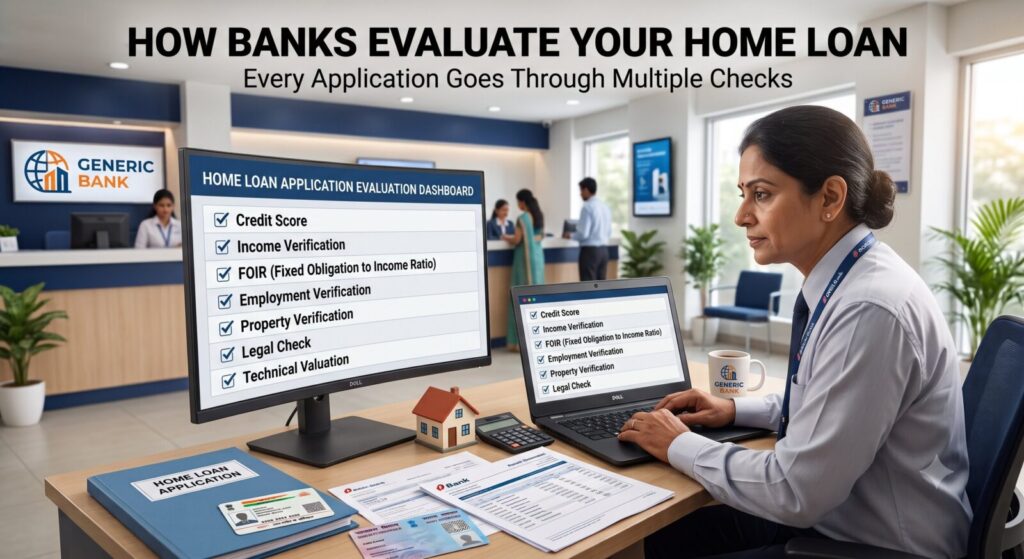
Many borrowers believe banks simply check three things:
- Salary
- Credit score
- Documents
In reality, the evaluation process is much more comprehensive.
A home loan is often one of the largest financial commitments a person makes. Since repayment may continue for 20 to 30 years, lenders carefully assess whether the borrower is likely to repay the loan on time throughout the tenure.
Most banks and housing finance companies follow a structured credit appraisal process that generally includes the following stages:
1. Credit History Assessment
Your credit report provides lenders with a record of how you’ve managed previous loans and credit cards.
Banks commonly review:
- Credit score
- Repayment history
- Existing loans
- Loan defaults
- Settled or written-off accounts
- Recent loan enquiries
A strong repayment history generally builds confidence, while repeated missed payments or defaults may indicate higher lending risk.
2. Income and Repayment Capacity
Banks don’t just ask:
“How much do you earn?”
They also ask:
“Can you comfortably repay this EMI every month without financial stress?”
To answer this, lenders review:
- Monthly salary or business income
- Existing EMIs
- Household expenses
- Other financial commitments
- Stability of income
Someone earning ₹1,20,000 per month with large existing EMIs may be considered riskier than a borrower earning ₹80,000 with minimal debt.
3. Employment Stability
Stable employment generally indicates consistent income.
For salaried applicants, lenders may review:
- Current employer
- Total work experience
- Time with the current employer
- Nature of employment
- Industry stability
Self-employed applicants may need to provide additional financial records to demonstrate consistent business income.
4. Property Verification
Unlike personal loans, home loans are secured against the property being purchased.
Before approving a loan, lenders usually conduct:
- Legal verification of ownership documents
- Technical inspection
- Property valuation
- Approval checks for the project, where applicable
Even if the borrower’s financial profile is strong, unresolved property-related issues can delay or prevent loan approval.
5. Documentation Review
Incomplete or inconsistent documentation can slow down the approval process.
Lenders generally verify:
- Identity proof
- Address proof
- Income documents
- Bank statements
- Property documents
- Tax records, where applicable
Providing accurate and complete documents helps the application move more smoothly through underwriting.
6. Internal Risk Assessment
Every lender has its own credit policy.
Although two banks may review the same applicant, they may not reach the same decision because each institution has its own underwriting standards, risk appetite, and internal lending policies.
This is one reason why an application declined by one lender may still be approved by another after proper assessment.
Want to know what happens after you submit your application? Read our detailed guide on Home Loan Approval Process to understand every stage, from document verification and property verification to final loan disbursement.
What Every Bank Checks Before Approving a Home Loan
| Factor | Why It Matters | Importance |
|---|---|---|
| Credit Score | Indicates repayment behaviour | ⭐⭐⭐⭐⭐ |
| Monthly Income | Shows repayment capacity | ⭐⭐⭐⭐⭐ |
| Existing EMIs | Helps calculate affordability | ⭐⭐⭐⭐⭐ |
| Employment Stability | Demonstrates income continuity | ⭐⭐⭐⭐ |
| Bank Statements | Reflects financial discipline | ⭐⭐⭐⭐ |
| Property Documents | Confirms legal ownership and security | ⭐⭐⭐⭐⭐ |
| Property Valuation | Determines appropriate loan amount | ⭐⭐⭐⭐ |
| Applicant’s Age | Affects eligible loan tenure | ⭐⭐⭐ |
| Down Payment | Shows financial commitment | ⭐⭐⭐⭐ |
| Co-applicant Profile | Can strengthen the application in some cases | ⭐⭐⭐ |
Expert Insight
From My Housing Finance Experience
During my years in housing finance, I noticed that many applicants focused only on their salary. However, loan approvals were often influenced by the overall financial picture. Factors such as repayment behaviour, existing obligations, document quality, and the property’s legal status frequently had just as much impact as monthly income.
15 Common Home Loan Rejection Reasons
Let’s now look at the most common reasons banks reject home loan applications and, more importantly, what you can do to improve your chances of approval.
1. Home Loan Rejection Reason #1: Low Credit Score or Poor Credit History

One of the most common reasons for home loan rejection is a weak credit profile.
Your credit score is more than just a number. It reflects how responsibly you’ve handled previous loans and credit cards.
You can also check your credit report directly through the official TransUnion CIBIL website before applying for a home loan to understand your current credit profile.
One of the top rejection reasons is a low CIBIL score. Learn more about [CIBIL score requirements for home loan] here.
Most lenders prefer applicants with a healthy repayment history because it reduces the risk of future defaults. While there is no universal minimum score, stronger credit profiles generally improve approval chances and may also help borrowers qualify for better loan terms. Lending decisions are based on multiple factors, not the credit score alone.
Why it happens
Banks may become cautious if your credit report shows:
- Missed EMI payments
- Delayed credit card payments
- Loan defaults
- Settled loan accounts
- High credit utilisation
- Frequent borrowing
Example
Rahul earns ₹95,000 per month and has a stable private-sector job.
However, he missed several credit card payments over the past year, reducing his credit score significantly. Even though his salary comfortably supports the proposed EMI, the lender views his repayment history as a warning sign and asks him to improve his credit profile before reapplying.
How to improve your chances
- Pay all EMIs and credit card bills on time.
- Reduce outstanding debt where possible.
- Check your credit report for errors and dispute inaccuracies.
- Avoid taking unnecessary new loans before applying for a home loan.
- Allow time for improved repayment behaviour to reflect in your credit profile before submitting a fresh application.
2. High Existing EMIs and Debt Obligations (FOIR Too High)
One of the most overlooked reasons for home loan rejection is having too much existing debt.
Many applicants focus only on whether they can personally manage another EMI. However, banks evaluate something called Fixed Obligation to Income Ratio (FOIR).
FOIR measures how much of your monthly income is already committed towards fixed financial obligations such as:
- Home Loan EMIs
- Personal Loan EMIs
- Car Loan EMIs
- Education Loan EMIs
- Consumer Durable Loans
- Credit Card Minimum Payments
Although different lenders may use different limits depending on the borrower’s income, loan amount, and internal credit policy, a higher FOIR generally reduces the likelihood of loan approval. Banks want to ensure borrowers have enough disposable income left after paying all EMIs.
Why Banks Reject
Let’s understand with an example.
Monthly Salary: ₹80,000
Current Personal Loan EMI: ₹12,000
Car Loan EMI: ₹15,000
Credit Card EMI: ₹5,000
Existing EMI Total:
₹32,000
Now suppose your new Home Loan EMI is expected to be ₹28,000.
Your total monthly obligations become:
₹60,000
That leaves only ₹20,000 for:
- Household expenses
- Food
- Children’s education
- Medical emergencies
- Savings
- Other living expenses
From the bank’s perspective, this increases the risk of repayment difficulties.
| Monthly Income | Existing EMIs | New EMI | Total EMI | General Assessment |
|---|---|---|---|---|
| ₹60,000 | ₹10,000 | ₹18,000 | ₹28,000 | More comfortable, subject to profile |
| ₹80,000 | ₹32,000 | ₹28,000 | ₹60,000 | Higher repayment burden |
| ₹1,20,000 | ₹20,000 | ₹35,000 | ₹55,000 | Stronger repayment capacity |
If you’re unsure how much EMI fits comfortably within your monthly income, read our guide on How Much Home Loan EMI Can You Really Afford? before deciding your loan amount.
Real-Life Example
During my housing finance career, I met applicants earning over ₹1 lakh per month whose home loans were delayed or declined because they already had several personal loans and credit card EMIs.
Their income was strong.
Their repayment capacity wasn’t.
How to Improve Your Chances
✔ Close small loans before applying.
✔ Reduce credit card outstanding balances.
✔ Avoid taking a personal loan just before applying.
✔ Increase your down payment to reduce the required home loan amount.
✔ If suitable, consider adding a financially strong co-applicant.
If you already have an existing home loan with a higher interest rate, you may also benefit from understanding when a Home Loan Balance Transfer can help reduce your EMI and overall interest cost.
Expert Tip
From My Experience
Many borrowers ask, “My salary is good. Why was my home loan rejected?”
In many cases, the issue isn’t income.
It’s how much of that income is already committed to other loans.
3. Insufficient Income for the Requested Loan Amount
Many applicants assume banks approve loans based on the property’s value.
Actually, lenders first assess whether your income can comfortably support the requested EMI.
Even if you’re buying a property worth ₹80 lakh, the bank will calculate whether your monthly income can sustain the repayment over the loan tenure.
Your monthly EMI also depends on the type of interest rate you choose. Learn the difference in our guide on Fixed vs Floating Home Loan Interest Rates before making your final decision.
Why Banks Reject
Banks typically evaluate:
- Net monthly income
- Existing financial obligations
- Expected EMI
- Family responsibilities
- Loan tenure
- Down payment
For example, if your income supports an EMI of around ₹30,000 but the requested loan requires an EMI closer to ₹50,000, the lender may:
- Reduce the eligible loan amount,
- Suggest a longer tenure (subject to eligibility), or
- Decline the application if the repayment burden is considered too high.
Real-Life Example
Priya earns ₹45,000 per month.
She applies for a home loan requiring an EMI of approximately ₹34,000.
Although she has an excellent credit score, the lender determines that the proposed EMI would consume too much of her monthly income and therefore approves a lower loan amount instead.
How to Improve Your Chances
✔ Increase your down payment.
✔ Add an earning co-applicant.
✔ Choose a longer eligible loan tenure if appropriate.
✔ Consider purchasing a property within your financial capacity.
✔ Reduce other outstanding EMIs before applying.
4. Frequent Job Changes or Unstable Employment
Home loans are long-term financial commitments.
Banks therefore prefer applicants with stable and predictable income.
Changing jobs occasionally is normal.
However, frequent job changes within a short period, long employment gaps, or being in a probation period may lead lenders to assess the application more cautiously.
Why Banks Reject
Banks may become concerned if:
- You’ve recently joined a new employer.
- You’re still on probation.
- There are multiple job changes within a short period.
- Employment gaps cannot be reasonably explained.
- Income appears inconsistent.
Different lenders have different employment eligibility requirements depending on the applicant’s profile and occupation.
Real-Life Example
Amit changed three companies within the last twelve months.
Although each move increased his salary, the lender wanted evidence of stable employment before approving a long-term home loan.
Instead of rejecting him permanently, the bank advised him to complete his probation period and apply again.
How to Improve Your Chances
✔ Stay with your current employer for a reasonable period before applying.
✔ Complete your probation, where applicable.
✔ Keep salary credits regular.
✔ Maintain employment records.
✔ Explain genuine career transitions clearly if requested.
What I Saw While Working in Housing Finance
From My Housing Finance Experience
Salary growth is positive, but consistency also matters.
Banks generally feel more comfortable approving long-term loans for borrowers whose employment history demonstrates stable income over time.
5. Incomplete, Incorrect, or Inconsistent Documents
This is one of the easiest rejection reasons to avoid.
Many applications are delayed or declined simply because important documents are missing, outdated, or contain inconsistent information.
Banks rely on documentation to verify both the borrower and the property. Missing or inaccurate information can prevent the application from moving forward until the issues are resolved.
Preparing every required document before applying can save valuable time. Use our complete Home Loan Application Checklist to ensure you have all the necessary documents ready before submitting your application.
Common Documentation Issues
- Missing salary slips
- Missing bank statements
- PAN and Aadhaar details not matching
- Incorrect address
- Expired identity documents
- Unsigned application forms
- Missing property papers
- Missing income tax documents for self-employed applicants
Real-Life Example
A borrower submitted all income documents but forgot to provide the latest bank statements.
The credit assessment could not be completed until the documents were updated, delaying the approval process.
How to Improve Your Chances
✔ Double-check every required document.
✔ Ensure names and addresses are consistent.
✔ Submit recent salary slips.
✔ Keep updated bank statements ready.
✔ Verify that all property documents are complete.
✔ Review your application before submission.
Quick Checklist Before Submission
Before submitting your application, make sure you have:
☐ PAN Card
☐ Aadhaar Card
☐ Passport-size photographs
☐ Salary slips (last 3-6 months, if applicable)
☐ Bank statements (as requested by the lender)
☐ Form 16 or Income Tax Returns, depending on your employment type
☐ Property agreement and related documents
☐ Identity and address proof
☐ Employment proof or business documents, where applicable
Preparing these in advance can help reduce unnecessary delays during the verification process.
6. Poor Bank Statement and Unhealthy Financial Behaviour
Your bank statement tells a story that goes beyond your salary.
Lenders don’t just look at how much money comes into your account. They also review how you manage it.
Some common red flags include:
- Frequent cheque returns
- Repeated low account balances
- Irregular salary credits
- High cash withdrawals without clear explanation
- Numerous bounced ECS or EMI payments
- Large unexplained transactions
These patterns may prompt lenders to examine the application more closely, especially when viewed alongside other risk factors.
Real-Life Example
Vikas earned ₹92,000 per month and maintained a strong credit score.
However, his bank statements showed multiple cheque returns and frequent account overdrafts.
The lender requested clarification before proceeding with the loan assessment because the transaction history suggested inconsistent financial management.
How to Improve Your Chances
✔ Maintain a healthy average account balance.
✔ Avoid cheque bounces and missed ECS payments.
✔ Ensure salary is credited regularly.
✔ Keep financial transactions transparent and well documented.
✔ Avoid large unexplained cash transactions before applying for a home loan.
7. Home Loan Rejection Reason #7: Property Legal Issues

Many first-time home buyers believe that if they qualify financially, their home loan will automatically be approved.
Unfortunately, that’s not always true.
A home loan is secured against the property you purchase. Before approving the loan, the lender must be satisfied that the property offers clear legal security. Even if your salary, credit score, and repayment capacity are excellent, unresolved legal issues with the property can delay or stop the loan process.
Most banks and housing finance companies conduct a legal verification of the property’s documents before approving or disbursing the loan.
The Reserve Bank of India (RBI) also provides useful information and FAQs related to housing loans and borrower rights that can help applicants better understand the lending process.
Why Banks Reject
Some common legal problems include:
- Unclear ownership history
- Missing chain of title documents
- Pending legal disputes
- Missing approvals from local authorities
- Encroachments
- Agricultural land sold as residential property without proper conversion
- Property already mortgaged without proper disclosure
- Incomplete registration records
These issues increase the lender’s risk because the property serves as collateral for the loan.
Besides legal verification, first-time buyers should also budget for registration charges, stamp duty, and other expenses. Read our guide on Hidden Costs of Buying a Home in India to avoid unexpected surprises.
Real-Life Example
A customer had an excellent credit score of over 780 and sufficient income for the requested loan.
However, during legal verification, it was found that one of the previous ownership transfer documents was missing. The lender could not establish a clear title to the property, and the loan process was put on hold until the legal issue was resolved.
How to Improve Your Chances
✔ Ask for all property documents before paying the booking amount.
✔ Buy from reputed builders or verified sellers.
✔ Ensure the property has all required approvals.
✔ If purchasing a resale property, verify the ownership history.
✔ Consult a qualified property lawyer if you have any doubts.
Practical Advice for Borrowers
From My Housing Finance Experience
I have seen borrowers become emotionally attached to a property before completing legal verification. My advice has always been simple: verify the property first, then make financial commitments. Solving a legal issue after paying a booking amount can be stressful and time-consuming.
8. Builder or Project Approval Issues
This is especially relevant for buyers purchasing under-construction properties.
Many banks maintain approved lists of builders or projects based on their own due diligence. Even when a project is not on such a list, the lender may still assess it independently before making a lending decision.
Why Banks Reject
Possible reasons include:
- Required project approvals are incomplete.
- Construction progress does not match the submitted information.
- Previous legal disputes involving the project.
- Missing occupancy or completion-related documentation where applicable.
- The builder’s financial position raises additional concerns during the lender’s assessment.
Every lender has its own internal policies for evaluating projects, so decisions can vary between institutions.
Real-Life Example
Two friends booked apartments in the same city.
One project had already completed most regulatory requirements and was accepted by several lenders.
The other project was still awaiting key approvals.
The first buyer’s loan moved forward smoothly, while the second buyer experienced delays because the lender required additional verification.
How to Improve Your Chances
✔ Check whether the project has all required approvals.
✔ Ask the builder which banks have financed buyers in the project.
✔ Request copies of approval documents before making a booking.
✔ Research the builder’s track record.
✔ Read customer reviews and previous project history.
Quick Tip
Never assume that because a builder is well-known, every project automatically meets every lender’s requirements.
Always verify the project separately.
9. Existing Loan Defaults or Loan Settlements
One of the strongest warning signs for any lender is a previous loan default.
Banks understand that financial difficulties can happen.
However, previous repayment behaviour often plays an important role in assessing future lending risk.
Why Banks Reject
Lenders carefully review your credit history.
Common concerns include:
- Personal loan defaults
- Vehicle loan defaults
- Education loan defaults
- Credit card write-offs
- Loan settlements instead of full repayment
- Accounts classified as non-performing
Many borrowers think that once a loan is “settled,” the issue disappears.
Unfortunately, settlement and full closure are not the same.
A settled account indicates that the lender accepted less than the full amount owed, which may influence future credit decisions.
Real-Life Example
A borrower had settled a personal loan three years earlier.
Although his current income and credit score had improved, the lender requested additional clarification because the previous settlement appeared in his credit report.
How to Improve Your Chances
✔ Repay loans in full whenever possible.
✔ Avoid settling loans unless absolutely necessary.
✔ Review your credit report before applying.
✔ Clear overdue accounts.
✔ Allow time for improved repayment behaviour to strengthen your credit profile.
Common Mistake I Frequently Saw
From My Experience
Many customers believed that once a loan was settled, future lenders would treat it the same as a fully repaid loan. In practice, lenders usually review the complete repayment history, not just the current balance.
10. Too Many Credit Cards and High Credit Utilisation
Having a credit card is not a problem.
Having several cards with consistently high outstanding balances may raise concerns during the credit assessment.
Banks often review how much of your available revolving credit you are using because it helps them understand your dependence on borrowed money.
Why Banks Reject
Some common warning signs include:
- High outstanding credit card balances
- Paying only the minimum amount due
- Multiple active credit cards with significant balances
- Frequent cash advances
- Heavy dependence on revolving credit
High utilisation may suggest that the borrower has limited financial flexibility.
Real-Life Example
Neha earned ₹1,05,000 per month.
She had four active credit cards with combined outstanding balances of more than ₹4 lakh.
Although she had never missed a payment, the lender advised her to reduce her outstanding balances before proceeding with the home loan assessment.
How to Improve Your Chances
✔ Reduce outstanding credit card balances.
✔ Avoid relying on minimum payments.
✔ Keep credit utilisation moderate whenever possible.
✔ Avoid unnecessary new credit card applications before applying for a home loan.
✔ Demonstrate consistent repayment behaviour over time.
11. Multiple Recent Loan Enquiries
Many home buyers compare offers from different banks, which is a sensible approach.
However, submitting full loan applications to several lenders within a very short period may result in multiple hard enquiries on your credit report.
A few enquiries are generally normal, but a large number in a short time may prompt lenders to review your application more carefully.
Why Banks Become Cautious
Several recent enquiries can sometimes indicate:
- Urgent borrowing needs
- Repeated loan rejections
- Financial stress
- Aggressive credit seeking
The enquiries themselves do not automatically cause rejection, but they are considered alongside your overall financial profile.
Real-Life Example
Rahul submitted complete home loan applications to six different lenders within ten days because he wanted the lowest interest rate.
When another lender reviewed his credit report, the multiple recent enquiries prompted additional questions about his borrowing activity.
How to Improve Your Chances
✔ Compare lenders before submitting formal applications.
✔ Request preliminary eligibility information first.
✔ Avoid applying simultaneously to many banks without a clear strategy.
✔ Choose two or three suitable lenders rather than applying everywhere.
Quick Summary So Far
By now, we’ve covered eleven of the most common reasons home loan applications may be delayed or rejected:
✔ Low Credit Score
✔ High Existing EMIs (FOIR)
✔ Insufficient Income
✔ Frequent Job Changes
✔ Incomplete Documentation
✔ Poor Bank Statements
✔ Property Legal Issues
✔ Builder or Project Approval Problems
✔ Existing Loan Defaults
✔ High Credit Card Utilisation
✔ Multiple Loan Enquiries
12. Age and Loan Tenure Limitations
Age is another important factor that lenders consider before approving a home loan. While there is no single age rule that applies to every lender, banks generally assess whether the borrower can comfortably repay the loan within the eligible tenure.
A younger applicant may qualify for a longer repayment period, while an older applicant may receive a shorter tenure, resulting in a higher EMI.
Why Banks May Reject or Reduce the Loan Amount
Lenders may become cautious if:
- The requested tenure extends well beyond the applicant’s expected retirement age (subject to the lender’s policy).
- The higher EMI resulting from a shorter tenure affects repayment capacity.
- There is no financially strong co-applicant where one could improve the overall application.
Example
Mr. Sharma, aged 56, applied for a 30-year home loan.
Although his salary was sufficient, the lender offered a shorter eligible tenure based on its lending policy. The resulting EMI was significantly higher, reducing the amount he qualified to borrow.
How to Improve Your Chances
✔ Apply earlier in your home-buying journey if possible.
✔ Consider adding an eligible co-applicant.
✔ Increase your down payment to reduce the loan requirement.
✔ Discuss suitable tenure options with the lender before selecting a property.
13. Issues with the Co-applicant
Many borrowers add a spouse or family member as a co-applicant to improve loan eligibility.
While this can strengthen an application, it can also create challenges if the co-applicant has a weak financial profile.
Why Banks May Reject
Common issues include:
- Poor credit history
- Existing loan defaults
- High debt obligations
- Unstable income
- Incorrect or incomplete documentation
The lender evaluates both applicants when assessing the overall risk.
Example
A husband had an excellent credit profile.
His wife, who joined as a co-applicant, had several missed credit card payments in the past.
The lender requested additional clarification before proceeding with the application because the combined financial profile was part of the assessment.
How to Improve Your Chances
✔ Review the co-applicant’s credit report before applying.
✔ Clear overdue debts.
✔ Submit complete income documents for both applicants.
✔ Add a co-applicant only if it strengthens the application.
14. Self-Employed Income Cannot Be Properly Verified
Self-employed applicants can absolutely qualify for home loans.
However, compared with salaried borrowers, lenders often require more documentation to assess business income because earnings may fluctuate over time.
Why Banks May Reject
Common reasons include:
- Inconsistent business income
- Low declared taxable income
- Missing Income Tax Returns
- Poor business banking history
- Inadequate financial records
Example
A business owner generated healthy monthly cash flow but reported relatively low taxable income over the previous years.
The lender based its assessment on the documented financial information available and approved a lower loan amount than requested.
How to Improve Your Chances
✔ File Income Tax Returns regularly.
✔ Maintain proper business accounts.
✔ Use business banking channels consistently.
✔ Keep GST and financial records updated where applicable.
✔ Consult your financial advisor before applying.
15. Applying to the Wrong Lender
This is one of the least discussed reasons for home loan rejection.
Every bank and housing finance company has its own:
- Credit policy
- Risk appetite
- Property evaluation process
- Income assessment methods
- Internal underwriting guidelines
As a result, two lenders may assess the same borrower differently.
Example
One lender may be comfortable financing a self-employed professional with variable income after reviewing supporting documents.
Another lender may require additional evidence before making the same lending decision.
This is why comparing lenders is valuable, but it should be done thoughtfully rather than submitting multiple applications simultaneously.
How to Improve Your Chances
✔ Compare lenders before applying.
✔ Understand eligibility requirements.
✔ Ask questions before submitting a formal application.
✔ Work with a trusted home loan advisor if you need guidance.

Home Loan Approval Checklist
Before applying for your home loan, review this checklist.
Financial Profile
☐ Check your credit score.
☐ Pay EMIs on time.
☐ Reduce existing loans.
☐ Lower your credit card outstanding balances.
☐ Avoid unnecessary new loans.
Employment
☐ Maintain stable employment.
☐ Complete your probation period if applicable.
☐ Keep salary credits regular.
Documents
☐ PAN Card
☐ Aadhaar Card
☐ Salary Slips
☐ Bank Statements
☐ Form 16 or Income Tax Returns
☐ Property Documents
☐ Identity Proof
☐ Address Proof
Property
☐ Verify legal ownership.
☐ Confirm regulatory approvals.
☐ Check project approvals if buying under construction.
☐ Understand the lender’s property requirements.
Quick Reference Table
| Common Reason | Can It Be Fixed? | Suggested Action |
|---|---|---|
| Low Credit Score | ✅ Yes | Improve repayment history and review your credit report. |
| High EMIs | ✅ Yes | Reduce debt before applying. |
| Low Income | ✅ Sometimes | Increase down payment or add an eligible co-applicant. |
| Job Instability | ✅ Yes | Build a stable employment record. |
| Missing Documents | ✅ Yes | Submit complete and accurate paperwork. |
| Property Legal Issues | ✅ Depends | Resolve legal concerns before proceeding. |
| Project Approval Issues | ✅ Depends | Verify approvals with the builder and lender. |
| Loan Defaults | ✅ Over Time | Rebuild your credit profile through consistent repayments. |
| High Credit Card Usage | ✅ Yes | Reduce outstanding balances. |
| Multiple Loan Enquiries | ✅ Yes | Limit formal applications within a short period. |
Frequently Asked Questions (FAQs)
1. Can I apply for a home loan again after rejection?
Yes. In many cases, borrowers can reapply after addressing the issue that led to the earlier decision. Before applying again, ask the lender for the reason and work on improving the relevant part of your financial profile.
2. Does a home loan rejection affect my credit score?
A rejection itself generally does not reduce your credit score. However, the lender’s hard enquiry may appear on your credit report. Repeated applications within a short period may influence how future lenders assess your profile.
3. What credit score is considered good for a home loan?
There is no single minimum score that guarantees approval. Many lenders prefer applicants with a strong repayment history and a healthy credit score, but the final decision depends on your overall financial profile.
4. Can a bank reject my loan because of the property?
Yes.
Even if your income and credit profile are strong, unresolved legal or technical issues with the property may delay or prevent loan approval because the property acts as security for the loan.
5. Can I get a home loan with an existing personal loan?
Yes, provided your overall repayment capacity remains comfortable. The lender will consider your existing EMIs along with the proposed home loan EMI.
6. Does changing jobs affect home loan approval?
Changing jobs does not automatically lead to rejection. However, lenders may review recent employment changes, probation status, and income stability as part of their assessment.
7. Can adding a co-applicant improve my eligibility?
Yes.
An eligible co-applicant with stable income and a healthy financial profile may improve repayment capacity and overall eligibility, depending on the lender’s policy.
8. How long should I wait before applying again?
The appropriate waiting period depends on the reason for the earlier rejection. Rather than reapplying immediately, focus on correcting the underlying issue first, whether it relates to documentation, credit history, debt, or property concerns.
9. Do all banks follow the same home loan approval process?
No.
Most lenders evaluate similar factors such as income, repayment history, employment, and property verification, but each bank or housing finance company has its own internal credit policies and underwriting standards.
10. How can I improve my chances of getting a home loan approved?
Maintain a healthy credit profile, keep your debt under control, prepare complete documentation, choose a legally verified property, and apply only after understanding the lender’s eligibility requirements.
Many home loan rejections can be prevented with proper planning. Before you apply, don’t miss our guide on 10 Home Loan Mistakes First-Time Buyers Make to avoid common errors that could delay or affect your loan approval.
Conclusion
A home loan rejection can feel disappointing, especially after you’ve found the right property and completed the application process. However, in many cases, a rejection is not permanent. It is often an indication that one or more aspects of your financial profile, documentation, or the property itself require attention.
Throughout my 8+ years in housing finance, I have seen many borrowers who initially faced setbacks but later secured home loans after addressing the issues identified during the lender’s assessment. Improving your credit habits, reducing existing debt, organizing your documents, and choosing the right property can make a significant difference.
Remember that every lender has its own credit policy. A rejection from one bank does not necessarily mean every other lender will reach the same conclusion. Instead of rushing into multiple applications, take time to understand the reason, strengthen your profile, and apply strategically.
Buying a home is one of the biggest financial decisions most people make. Preparing well before you apply can save time, reduce stress, and improve your chances of receiving a positive decision.