Buying a home is one of the biggest financial decisions most people make in their lifetime. For many Indian families, owning a house represents years of hard work, financial planning, and long-term commitment.
However, once you’ve selected your dream home and decided to apply for a home loan, another important journey begins.
Many home buyers ask questions such as:
- How does the Home Loan Approval Process work?
- How long does it take for a home loan to be approved?
- Why do banks ask for so many documents?
- What happens after submitting the loan application?
- What is legal verification?
- What is technical verification?
- When will the loan amount finally be disbursed?
These questions are completely normal.
During my 8+ years of working in housing finance, I met hundreds of first-time home buyers who felt nervous after submitting their application because they didn’t understand what the bank was doing behind the scenes.
Some believed approval depended only on their salary.
Others assumed that submitting documents meant the loan was already approved.
In reality, a home loan passes through several important stages before the bank finally releases the money.
Understanding each stage can help you:
- Prepare the right documents.
- Avoid unnecessary delays.
- Improve your chances of approval.
- Reduce stress during the application process.
- Make smarter financial decisions before committing to a long-term loan.
In this complete guide, I’ll explain the Home Loan Approval Process in India step by step in simple language. Whether you’re buying your first home or applying for another property loan, you’ll understand exactly what happens from the day you choose a property until your first EMI begins.
Quick Summary
Before approving a home loan, banks generally complete the following stages:
✔ Property Selection
✔ Home Loan Eligibility Check
✔ EMI Planning
✔ Document Collection
✔ Loan Application
✔ Credit Assessment
✔ Employment Verification
✔ Legal Verification
✔ Technical Property Inspection
✔ Loan Sanction
✔ Loan Agreement
✔ Loan Disbursement
✔ First EMI
Although every bank follows its own internal credit policy, the overall approval process is broadly similar across most banks and housing finance companies in India.
What Is the Home Loan Approval Process?
The Home Loan Approval Process is the series of checks a bank or housing finance company performs before deciding whether to approve your loan application.
The bank isn’t only lending you money.
It is making a financial commitment that may last 20 to 30 years.
Before approving such a large loan, the lender wants confidence that:
- You can comfortably repay the EMI.
- Your income is stable.
- Your credit history is satisfactory.
- The property has clear legal ownership.
- The property’s market value supports the loan amount.
- All required documents are genuine and complete.
Only after these checks are completed does the lender issue a Home Loan Sanction Letter and later disburse the loan amount.
Why Understanding the Home Loan Approval Process Matters
Many borrowers become anxious because they don’t know what happens after submitting their application.
Some start calling the bank every day.
Others assume the bank has rejected their file simply because they haven’t received an update for a few days.
In reality, your application may simply be moving through different verification stages.
Understanding the process helps you:
1. Avoid Delays
Knowing which documents are required beforehand can prevent unnecessary follow-ups.
2. Improve Approval Chances
Maintaining a healthy credit score, reducing existing EMIs, and submitting complete documents strengthens your application.
3. Plan Your Finances Better
You’ll know when to arrange your down payment, registration charges, and other home-buying expenses.
4. Reduce Stress
Instead of worrying about every update, you’ll understand which stage your application has reached and what usually happens next.
Home Loan Approval Process: Step-by-Step
Let’s now understand each stage in detail.
Step 1: Choose the Right Property
Every home loan journey begins with selecting the property you want to purchase.
Many first-time buyers think they should visit a bank first.
In reality, banks usually require details of the property before processing your loan application.
Depending on your purchase, the property could be:
- Under-construction apartment
- Ready-to-move flat
- Independent house
- Villa
- Resale property
- Plot with construction (subject to lender policy)
At this stage, collect important information such as:
- Property price
- Builder details
- Project approvals
- Carpet area
- Agreement value
- Location
- Expected possession date
My Experience
During my years in housing finance, I often saw buyers emotionally commit to a property before checking whether it met the lender’s requirements.
Sometimes the borrower was financially eligible, but the property itself had legal or technical issues that delayed the loan.
Choosing a property with proper approvals can make the approval process much smoother.
Step 2: Check Your Home Loan Eligibility
Before applying, every borrower should understand how much loan they are actually likely to qualify for.
This is where many people make their first mistake.
They assume the bank will finance the entire property cost.
In reality, lenders evaluate several factors before deciding the maximum loan amount.
These generally include:
- Monthly salary
- Employment stability
- Credit score
- Existing EMIs
- Age
- Down payment
- Property value
- Income documents
A higher salary alone doesn’t guarantee a higher loan amount.
For example:
A borrower earning ₹80,000 per month with no existing loans may qualify for a larger loan than someone earning ₹1,20,000 but already paying multiple EMIs.
That’s why understanding your eligibility before applying can save both time and disappointment.
Related Guide:
Home Loan Eligibility for Salaried Employees in India (2026 Guide)
Step 3: Calculate an Affordable EMI
One of the biggest mistakes I noticed during my housing finance career was this:
Many borrowers focused only on how much loan the bank was willing to approve.
Very few asked a much more important question:
“How much EMI can I comfortably pay every month?”
Remember, the maximum loan amount isn’t always the right loan amount.
A slightly lower loan could mean:
- Lower monthly EMI
- Less financial stress
- Lower total interest
- Better savings
- Greater financial flexibility
Before submitting your application, compare different loan amounts, repayment tenures, and interest rates.
This helps you choose an EMI that comfortably fits your monthly budget rather than stretching your finances.
Use the PennyPowerPlay Home Loan Planner
Before applying for a home loan, use the PennyPowerPlay Home Loan Planner to calculate your EMI, total interest payable, total loan cost, and compare different repayment scenarios so you can borrow with confidence.
- Monthly EMI
- Total Interest Payable
- Total Loan Cost
- Different Repayment Scenarios
Planning ahead can help you make a smarter borrowing decision.
Related Guide:
How Much Home Loan EMI Can You Really Afford?
Step 4: Prepare Your Home Loan Documents
Once you’ve selected your property and estimated your loan eligibility, the next step is gathering the required documents.
Many loan applications are delayed simply because borrowers submit incomplete paperwork.
Although documentation varies slightly between lenders, most banks generally require:
Identity Proof
- Aadhaar Card
- PAN Card
- Passport
- Voter ID
- Driving Licence
Address Proof
- Aadhaar Card
- Passport
- Utility Bill
- Rental Agreement (where applicable)
Income Proof
- Last three salary slips
- Latest Form 16
- Income Tax Returns (if required)
- Salary Certificate (if requested)
Bank Statements
Generally, the last six months’ salary account statements.
Employment Proof
- Employee ID Card
- Appointment Letter (if requested)
- Employment Confirmation (where applicable)
Property Documents
- Agreement to Sell
- Builder Documents
- Approved Plans
- Allotment Letter
- Property Title Documents (depending on the transaction)
My Experience
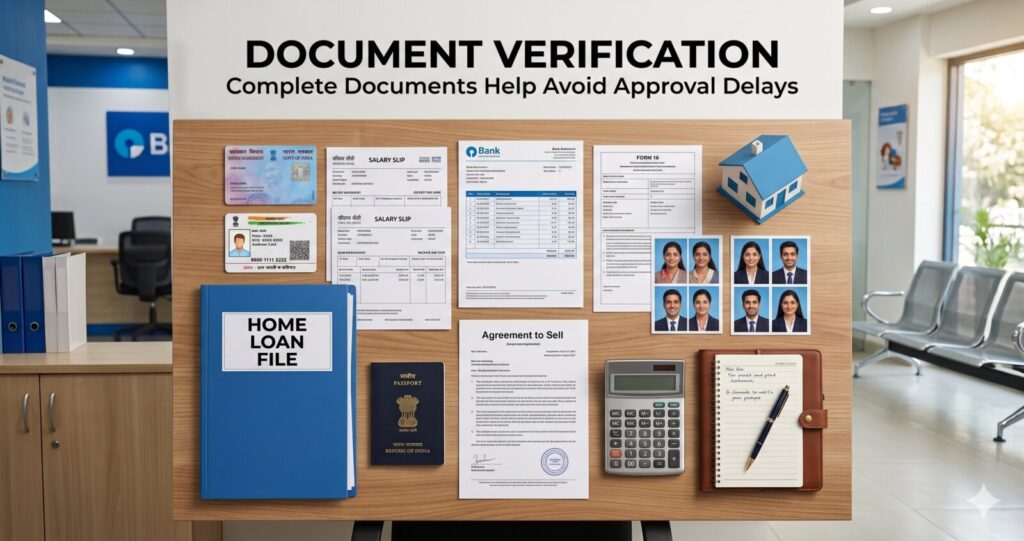
One of the most common reasons for delayed approvals wasn’t poor credit scores.
It was incomplete documentation.
Borrowers often forgot to submit one important document, forcing the bank to pause processing until everything was received.
Preparing all your paperwork before applying can significantly reduce delays.
Related Guide:
Home Loan Application Checklist: Complete Documents Required for Home Loan in India
What’s Next?
Once your documents are submitted and your application is complete, the lender begins evaluating your financial profile.
Step 5: Submit Your Home Loan Application
After selecting your property, checking your eligibility, calculating a comfortable EMI, and preparing all the required documents, the next step is submitting your home loan application.
Today, most banks allow borrowers to apply through:
- Branch Visit
- Official Bank Website
- Mobile Banking App
- Housing Finance Company (HFC)
- Direct Sales Executive (DSE)
- Home Loan Agent or Channel Partner
During this stage, you’ll usually complete an application form that includes details such as:
- Personal Information
- Employment Details
- Monthly Income
- Existing Loans
- Property Information
- Loan Amount Required
- Loan Tenure
Along with the application form, you’ll submit the required KYC documents, income proof, bank statements, and property papers.
Some lenders may also collect a processing fee at this stage.
The processing fee varies from lender to lender and may depend on the loan amount or promotional offers available at the time of application.
Quick Tip
Before signing the application form, carefully review every detail.
Incorrect information about your salary, employer, existing EMIs, or property value may delay your application later.
What Happens After You Submit the Application?
Many borrowers think the bank immediately decides whether to approve the loan.
That’s not how the process works.
Once the application reaches the lender, multiple departments begin reviewing different parts of your file.
Think of it like this:
Application Submitted
↓
Documents Verified
↓
Financial Assessment
↓
Property Verification
↓
Legal Verification
↓
Technical Inspection
↓
Approval Decision
↓
Sanction Letter
Every stage has its own purpose.
Step 6: Credit Score & Financial Assessment
This is one of the most important stages of the entire Home Loan Approval Process.
Here, the lender evaluates whether you have the financial ability to repay the loan over the next 20 to 30 years.
Banks generally review:
- Monthly Salary
- Net Take-home Income
- Existing EMIs
- Credit Score
- Loan Repayment History
- Credit Card Usage
- Savings Pattern
- Fixed Obligations
- Income Stability
One of the key concepts used during this stage is FOIR (Fixed Obligation to Income Ratio).
Although each lender follows its own internal policy, FOIR helps the bank understand how much of your monthly income is already committed towards existing financial obligations.
For example:
Monthly Salary: ₹1,00,000
Current Car Loan EMI: ₹12,000
Personal Loan EMI: ₹8,000
Existing EMI = ₹20,000
The lender then evaluates whether adding another home loan EMI would still keep your finances manageable.
Why Is Your Credit Score So Important?
Your credit score tells the lender how responsibly you’ve managed previous borrowing.
A healthy repayment history increases confidence.
Frequent defaults reduce it.
Banks commonly review:
- Home Loans
- Personal Loans
- Car Loans
- Credit Cards
- Consumer Loans
Late payments or loan defaults don’t automatically result in rejection, but they may require additional review.
My Experience

During my years in housing finance, I noticed something interesting.
Many customers believed that earning a high salary guaranteed loan approval.
In reality, I often saw borrowers with moderate salaries receive faster approvals because they had:
- Excellent repayment history
- Low existing EMIs
- Good banking habits
- Complete documentation
Meanwhile, applicants earning much higher salaries sometimes faced delays because of multiple personal loans or poor credit discipline.
Financial behavior matters just as much as income.
Step 7: Employment & Income Verification
Once your financial profile looks satisfactory, the lender verifies your employment and income.
The purpose is simple.
The bank wants to confirm that the income mentioned in your application is genuine and stable.
Depending on the lender’s policy, they may verify:
- Current Employer
- Designation
- Length of Employment
- Salary Credits
- Employment Stability
- Work Experience
Some lenders may also contact your employer for confirmation.
Others rely mainly on salary slips and salary account statements.
This process usually takes only a few days if all documents are complete.
Why Stable Employment Matters
Banks are providing a long-term loan.
Naturally, they prefer borrowers who have a stable source of income.
This doesn’t mean changing jobs automatically affects your application.
However, multiple job changes within a short period may require additional clarification.
Applicants with regular salary credits into their bank account generally present a stronger financial profile.
Common Employment Verification Documents
- Salary Slips
- Salary Account Statements
- Employee ID
- Appointment Letter (where required)
- Form 16
- Income Tax Returns (if applicable)
Quick Tip
Avoid changing jobs immediately before applying for a home loan unless necessary.
If you’re already planning to switch employers, discuss your situation with the lender before submitting your application.
Step 8: Legal Verification of the Property
This is one of the most critical stages of the Home Loan Approval Process.
Many borrowers assume that if they are financially eligible, the bank will automatically approve the loan.
That’s not true.
The property itself must also satisfy the lender’s legal requirements.
Banks appoint legal experts to verify whether the property has a clear legal title.
They generally review:
- Ownership History
- Chain of Title
- Sale Agreement
- Previous Sale Deeds
- Encumbrance Status
- Approved Building Plans
- Local Authority Approvals
- RERA Registration (where applicable)
- Land Records
- Property Tax Records
The objective is to ensure that:
- The seller legally owns the property.
- There are no ownership disputes.
- No legal restrictions exist.
- The bank can safely create a mortgage.
Can a Loan Be Delayed During Legal Verification?
Yes.
Legal verification is one of the most common reasons for delays.
Issues may include:
- Missing documents
- Incomplete title chain
- Unapproved construction
- Property disputes
- Incorrect survey details
- Builder approval issues
If any legal concern arises, the lender may request additional documents before moving to the next stage.
My Experience
I remember several borrowers who had excellent salaries and strong credit scores.
Unfortunately, their loans couldn’t move forward because the property documentation was incomplete.
In almost every case, the delay wasn’t caused by the borrower.
It was caused by the property.
This is why selecting a legally clear property can save significant time during the approval process.
Step 9: Technical Property Inspection
After legal verification, the lender usually conducts a technical inspection of the property.
A qualified engineer or technical officer visits the property to verify whether its physical condition matches the information provided in the application.
The inspection generally includes:
- Property Location
- Construction Quality
- Stage of Construction
- Built-up Area
- Carpet Area
- Structural Condition
- Occupancy Status
- Market Value
- Photographs
- Property Measurements
For under-construction projects, the engineer also verifies the progress of construction.
Why Technical Verification Is Necessary
The bank is lending against the property.
Before approving the loan, it wants to ensure:
- The property actually exists.
- Construction quality is satisfactory.
- Market value is reasonable.
- Loan amount is appropriate for the property’s value.
This protects both the borrower and the lender.
Can Technical Verification Affect Loan Approval?

Yes.
If the property’s market value is significantly lower than expected, the lender may:
- Reduce the eligible loan amount.
- Request additional down payment.
- Seek further clarification.
- Delay approval until the issue is resolved.
What’s Next?
By this stage, the lender has completed most of the important checks.
If your financial profile, legal documents, and property inspection are satisfactory, the application moves to the final stages.
Step 10: Home Loan Sanction Letter
After successfully completing the financial assessment, employment verification, legal verification, and technical inspection, the lender makes its credit decision.
If everything meets the lender’s requirements, you’ll receive a Home Loan Sanction Letter.
Many first-time home buyers think that a sanction letter means the loan amount has already been transferred.
That’s not correct.
A sanction letter simply means that the lender has agreed, in principle, to finance your home purchase subject to the conditions mentioned in the letter.
A typical sanction letter generally includes:
- Approved Loan Amount
- Interest Rate
- Loan Tenure
- EMI Details
- Type of Interest Rate (Fixed/Floating)
- Special Conditions (if any)
- Validity Period of the Sanction
Read the sanction letter carefully before accepting it.
If anything is unclear, ask your relationship manager to explain the terms before signing.

Can a Home Loan Be Rejected Before the Sanction Letter?
Yes.
If issues arise during verification, such as:
- Poor credit history
- Incomplete documents
- Property-related legal concerns
- Income mismatch
- Incorrect information in the application
the lender may reject or delay the application until the issue is resolved.
Step 11: Loan Agreement and Mortgage Creation
Once you accept the sanction letter, the lender prepares the final loan documents.
This stage includes signing the loan agreement and completing the mortgage formalities.
Depending on the property type and lender, the process may involve:
- Loan Agreement
- ECS/NACH Mandate
- Post-dated Cheques (where applicable)
- Mortgage Documentation
- Stamp Duty on Loan Documents (if applicable)
- MOD (Memorandum of Deposit of Title Deeds), depending on state regulations
- Home Loan Insurance (optional or lender-specific)
Read every document before signing.
Many borrowers focus only on the interest rate and ignore the other conditions mentioned in the agreement.
Take your time.
A home loan is a long-term financial commitment.
Step 12: Loan Disbursement
This is the stage every borrower eagerly waits for.
After all formalities are completed, the lender releases the approved loan amount.
This process is called Loan Disbursement.
The way the loan is disbursed depends on the type of property.
Ready-to-Move Property
The lender usually pays the approved loan amount directly to the seller after completing the required documentation.
Under-Construction Property
In under-construction projects, the loan is often disbursed in stages based on the progress of construction.
This is commonly known as partial disbursement.
Resale Property
For resale transactions, payment is generally released after legal documentation and property transfer formalities are completed.
When Does EMI Start?
This depends on the type of disbursement.
For fully disbursed loans, your regular EMI generally begins according to the repayment schedule mentioned in your loan agreement.
For under-construction properties with partial disbursement, lenders may initially charge Pre-EMI Interest, depending on the loan terms.
Always confirm the repayment schedule with your lender before signing the agreement.

Typical Home Loan Approval Timeline
Although timelines vary depending on the lender and the complexity of the case, the process generally looks like this:
| Stage | Typical Time |
|---|---|
| Loan Application | 1 Day |
| Document Verification | 1–3 Days |
| Credit Assessment | 2–4 Days |
| Employment Verification | 1–3 Days |
| Legal Verification | 3–7 Days |
| Technical Inspection | 2–5 Days |
| Sanction Letter | 1–3 Days |
| Loan Agreement | 1–2 Days |
| Loan Disbursement | 2–7 Days |
A straightforward application with complete documents may be processed more quickly, while complex cases may take longer.
Common Reasons Why Home Loans Get Delayed
Many borrowers assume delays always mean rejection.
Fortunately, that’s often not the case.
Applications are frequently delayed because of avoidable issues.
Some of the most common reasons include:
1. Incomplete Documents
Missing salary slips, bank statements, or property papers.
2. Low Credit Score
Poor repayment history may require additional review.
3. High Existing EMIs
A high debt burden may affect repayment capacity.
4. Property-Related Issues
Unclear ownership, missing approvals, or legal disputes.
5. Employment Verification Delays
Difficulty confirming employment or income details.
6. Incorrect Information
Differences between the application form and supporting documents.
7. Additional Bank Requirements
Sometimes lenders request extra clarification or updated documents before final approval.
How to Make Your Home Loan Approval Process Faster
Although you cannot control every stage, you can improve your chances of a smooth approval.
Here are some practical tips:
✔ Check your credit score before applying.
✔ Reduce existing EMIs if possible.
✔ Save a higher down payment.
✔ Keep your salary banking regular.
✔ Collect every required document before submitting your application.
✔ Avoid applying to multiple lenders at the same time.
✔ Choose a property with clear legal documentation.
✔ Calculate an affordable EMI instead of borrowing the maximum amount.
Good preparation often results in a faster and less stressful approval process.
My Experience After Working in Housing Finance for 8+ Years
During my career in housing finance, I worked with borrowers applying for home loans ranging from ₹20 lakh to more than ₹1.5 crore.
One lesson became very clear.
The fastest approvals rarely went to the people earning the highest salaries.
Instead, they usually went to borrowers who had:
- Stable employment
- Healthy credit scores
- Low existing financial obligations
- Complete documentation
- Well-selected properties with proper approvals
I also met borrowers who delayed their own applications because they focused only on getting the lowest interest rate while ignoring their financial preparation.
In my experience, preparing yourself before applying is often more valuable than spending weeks comparing lenders.
A well-prepared borrower usually enjoys a smoother experience from application to disbursement.
Before Applying, Compare Different Loan Scenarios
One mistake many borrowers make is accepting the maximum loan amount offered by the bank without checking how comfortable the EMI will be over the next 20 or 30 years.
Instead, compare:
- Different Loan Amounts
- Interest Rates
- Loan Tenures
- Monthly EMI
- Total Interest Payable
The PennyPowerPlay Home Loan Planner allows you to compare multiple repayment scenarios before applying.
Spending a few minutes planning today can help you avoid financial stress for many years.
Related Home Loan Guides on PennyPowerPlay
If you’re planning to buy a home, these detailed guides can help you make better financial decisions throughout your home-buying journey:
- Home Loan Eligibility for Salaried Employees
- Home Loan Application Checklist
- How Much Home Loan EMI Can You Really Afford?
- Hidden Costs of Buying a Home in India
- Fixed vs Floating Home Loan Interest Rates
- Home Loan Balance Transfer: Does It Really Save Money?
- 10 Home Loan Mistakes First-Time Buyers Make
Together, these articles provide a complete understanding of the home loan journey from planning your budget to successfully managing your loan.
Frequently Asked Questions (FAQs)
1. How long does the Home Loan Approval Process usually take?
Most straightforward applications are completed within a few days to a few weeks, depending on the lender, documentation, property verification, and individual circumstances.
2. What happens after submitting my home loan application?
The lender generally reviews your financial profile, verifies your documents, checks your credit history, evaluates the property, and then decides whether to issue a sanction letter.
3. Can a home loan be rejected after document verification?
Yes. Approval depends on several factors, including your financial profile, credit history, legal verification of the property, and the lender’s internal credit policy.
4. What is legal verification in a home loan?
Legal verification ensures that the property’s ownership, approvals, and legal documents are clear before the lender approves the loan.
5. What is technical verification?
A technical officer or engineer inspects the property to verify its physical condition, construction quality, and market value.
6. What happens after receiving the sanction letter?
You’ll generally complete the loan agreement, mortgage documentation, and other formalities before the lender disburses the approved loan amount.
7. When does my EMI start?
For fully disbursed loans, EMIs generally begin according to the repayment schedule in your loan agreement. Under-construction properties may initially have Pre-EMI interest depending on the lender’s terms.
8. Can changing jobs affect my home loan approval?
Changing jobs doesn’t automatically result in rejection, but lenders generally prefer applicants with stable employment and consistent income.
9. How can I improve my chances of faster approval?
Maintaining a healthy credit score, reducing existing EMIs, preparing complete documents, and selecting a legally clear property can help make the approval process smoother.
10. Should I calculate my EMI before applying?
Yes.
Understanding your monthly repayment before applying helps you borrow responsibly and choose a loan amount that comfortably fits your financial goals.
Looking to learn more beyond the approval process? Explore our Home Loan Guide India, where you’ll find practical guidance on eligibility, EMI affordability, interest rates, required documents, common mistakes, hidden costs, balance transfers, and other essential topics to help you make informed home-buying decisions.
Final Takeaway
Understanding the Home Loan Approval Process can make your home-buying journey far less stressful.
While every lender follows its own internal credit policy, most banks generally complete similar stages, from eligibility assessment and document verification to legal checks, technical inspection, sanction, and loan disbursement.
From my 8+ years of experience in housing finance, I’ve learned that borrowers who prepare their finances, maintain proper documentation, and understand the approval process usually enjoy a smoother experience than those who apply without planning.
Before submitting your application:
- Review your documents.
- Check your repayment capacity.
- Understand the total borrowing cost.
- Compare different loan scenarios.
- Borrow only what comfortably fits your monthly budget.
A home loan is a long-term financial commitment.
Making informed decisions today can help you enjoy greater financial stability for many years to come.
If you’re planning to apply for a home loan, don’t forget to use the PennyPowerPlay Home Loan Planner to compare loan scenarios, calculate your EMI, and make a more confident borrowing decision before submitting your application.