Updated on 14th November 2026 | PennyPowerPlay
Home loan disbursement for under construction property purchases in India works differently from disbursement for ready-to-move-in homes. Banks generally release the sanctioned loan amount in stages, depending on construction progress, the builder’s payment schedule and the lender’s conditions.
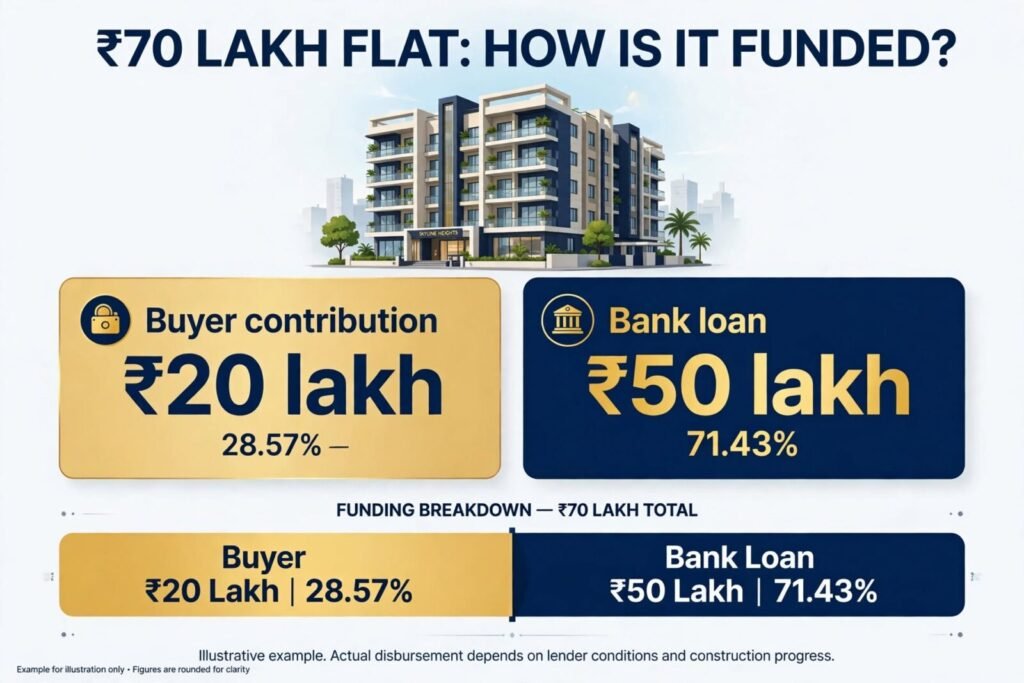
Imagine you have purchased an under-construction flat worth ₹70 lakh. Your bank has sanctioned a home loan of ₹50 lakh, and you have arranged ₹20 lakh from your own savings.
One day, your builder sends you a demand letter requesting ₹10 lakh. You submit it to the bank, expecting the money to be released immediately.
However, the bank says, “We need to verify the construction progress first.”
Why does this happen when your home loan is already sanctioned?
The answer is simple. Home loan sanction and home loan disbursement are two different processes.
This guide explains how banks release home loan funds, what documents you need, how builder demand letters are verified and what to check before every disbursement. We will also use an example of a ₹70 lakh flat to explain the process.
1. Home Loan Disbursement for Under Construction Property: How Does It Work?
When a bank sanctions your home loan, it means the lender has approved a certain loan amount, subject to the conditions mentioned in your sanction letter.
The bank considers your income, repayment capacity, credit history and other eligibility factors before approving the loan.
However, loan sanction does not mean the bank will immediately transfer the entire amount.
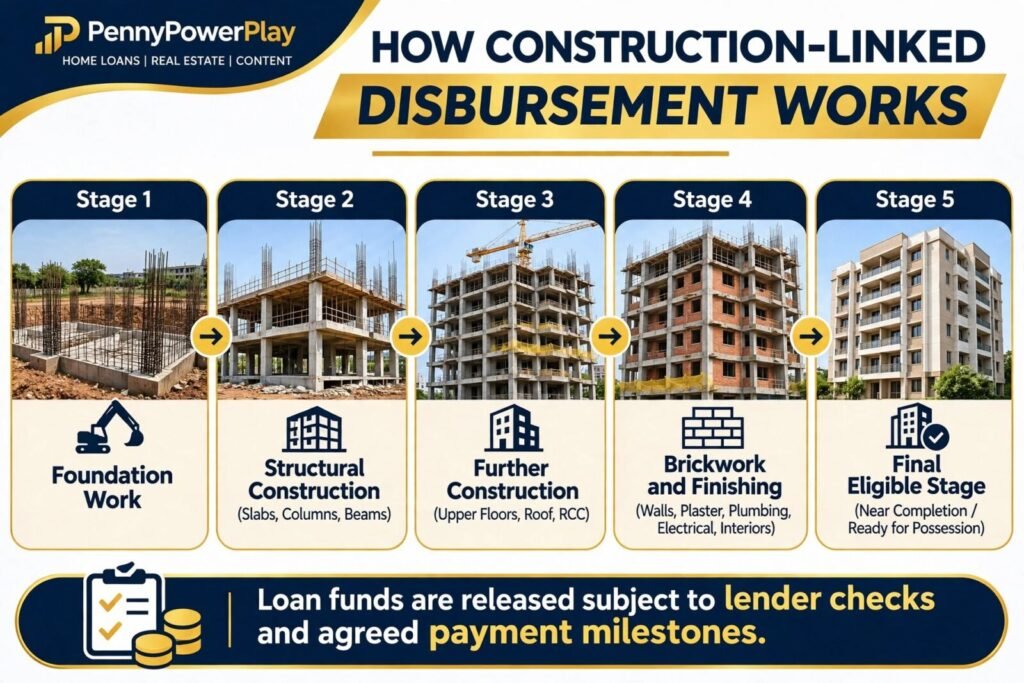
For an under-construction property, banks generally release the loan in stages as construction progresses. This process is known as construction-linked disbursement.
Let’s understand this with an example.
Suppose you are purchasing an under-construction flat worth ₹70 lakh.
You arrange ₹20 lakh from your own savings, and the bank sanctions a home loan of ₹50 lakh.
However, the building is still under construction, and only part of the work has been completed.
In this situation, the bank will generally not release the entire ₹50 lakh immediately.
Instead, it may release ₹10 lakh or ₹15 lakh at a particular stage, depending on the verified construction progress, the builder’s payment schedule and the bank’s disbursement conditions.
The remaining sanctioned amount may be released in subsequent stages after the required conditions are met.
This helps reduce the risk of releasing a large loan amount before the construction work is completed.
Why is the banking system set up like this?
This is mainly because under-construction projects carry certain risks. Construction may be delayed, the developer may face financial difficulties, or the project may not progress according to the original schedule.
Imagine if the bank released the entire loan amount at the beginning, but the project was later delayed or left incomplete. You could end up repaying a large loan for a property that is still unfinished.
- Construction-linked disbursement helps reduce this risk by linking further loan payments to verified construction progress. However, it does not guarantee that the project will be completed on time.
2. Sanctioned Loan Amount, Disbursed Loan Amount, and Outstanding Loan Amount
Before going further, it is important to understand these three terms. Many borrowers confuse them when checking their home loan statements.
The sanctioned loan amount is the total amount approved by the bank, subject to the conditions mentioned in your sanction letter. If the sanctioned amount by the bank is Rs. 50,00,000 then this is your sanctioned loan amount. Keep in mind that it will always be conditional to the terms stated in the sanction letter.
The disbursed loan amount is the amount which has been disbursed by the bank. If your sanctioned loan amount is Rs. 50,00,000 but the disbursed loan amount is Rs. 20,00,000 then it is your disbursed loan amount.
The outstanding principal amount is the principal amount which you owe to the bank. If you haven’t paid back the principal amount till now then it may be equal to the disbursed loan amount.
| Particulars | Amount |
|---|---|
| Total sanctioned loan | Rs 50,00,000 |
| Amount already disbursed | Rs 20,00,000 |
| Amount not yet disbursed | Rs 30,00,000 |
| Outstanding principal | Depends on principal already repaid |
These three amounts may be different. Understanding the difference will help you review your loan statement and communicate more clearly with your bank.
To learn more about the first part of the process, refer to our guide on Home Loan Approval Process in India.
3. How Does the Construction Linked Payment Scheme Operate?
The concept is simple. The bank releases funds as the construction proceeds. Once you purchase an apartment from the developer, you and the developer settle on the payment schedule. You will have a payment coming up once the foundation is laid, a specific slab is completed, the brickwork is done and more.
Here is how a builder’s payment request moves through the bank’s disbursement process.
Step 1: The developer achieves a specific milestone in construction. For instance, once the foundation is complete and a new payment stage comes about, the developer sends a demand letter requesting you to make the payment.
Step 2: You receive the demand letter. This is normally accompanied by a description of the project, your apartment number, the payment amount and the payment details.
Step 3: You submit a disbursement request to the bank along with the builder’s demand letter and any additional documents required by the lender. Some banks allow this process to be done online, while others require you to make your demand at the branch, at the loan servicing center or even through your relationship manager.
Step 4: The bank reviews your request, supporting documents, loan conditions, previous disbursements and construction progress. At times, the bank will also ask for technical inspection or construction progress report.
Step 5: The bank calculates the amount eligible for disbursement at that construction stage. It also checks whether you have paid the required share of your own funds, known as margin money.
Step 6: The bank processes the disbursement. Upon completion of all verification and approval processes, the bank processes and disburses the calculated amount. In case of builder purchases, the money is disbursed directly to the designated account of the builder.
Step 7: You receive your disbursement confirmation. You need to get your confirmation or loan statement showing the total disbursement so far and the remaining balance.
The same cycle continues for each milestone in the construction process.
4 Example: Rs 70 Lakh Flat with Rs 50 Lakh Housing Loan
Let us understand how this happens through numbers. Assume that you want to buy an under-construction apartment in Navi Mumbai.
| Particulars | Amount |
|---|---|
| Property agreement value | Rs 70,00,000 |
| Your contribution | Rs 20,00,000 |
| Sanctioned home loan | Rs 50,00,000 |
| Loan share of property value | About 71.43% |
| Your share | About 28.57% |
For the sake of simplicity, let us assume that you pay the whole Rs 20 lakhs out of your own money before the bank starts disbursing Rs 50 lakhs to you. For this example, we assume that the bank releases the loan in five instalments.
An example of the payments
| Construction stage | Bank payment | Total bank disbursed |
|---|---|---|
| Foundation and initial structure | Rs 10,00,000 | Rs 10,00,000 |
| Structural construction milestone | Rs 15,00,000 | Rs 25,00,000 |
| Further structural work | Rs 10,00,000 | Rs 35,00,000 |
| Brickwork and finishing milestone | Rs 10,00,000 | Rs 45,00,000 |
| Final eligible construction stage | Rs 5,00,000 | Rs 50,00,000 |
| Total | Rs 50,00,000 | Rs 50,00,000 |
Please note that this is just for illustration purposes. The actual stages and figures will depend on the agreement registered by you, the payment schedule of the builder, bank’s approval and the construction status confirmed by the bank.
Some banks may require you to contribute your share at each construction stage instead of paying the entire margin amount upfront. The exact requirement depends on the lender’s policy and your loan agreement.
What should you check after every disbursement?
You must always demand a new statement from the bank showing:
• Amount disbursed up till now.
• Date of disbursement.
• Name of the person who receives the payment.
• Amount of disbursal so far.
• Amount yet to be disbursed.
You must keep this statement along with your property documents. Whenever there is a mismatch between the accounts of the builder and the bank, then you can find it through this statement.
5. What Is a Builder Demand Letter?
For home loan disbursement for under construction property purchases, the builder’s demand letter is an important document. However, receiving a demand letter does not mean the bank will release the money immediately.
The bank may first verify the construction progress, previous payments, your contribution and other loan conditions before approving the disbursement.
What must be present in a well-drafted demand letter?
The right demand letter should leave no doubt about what payment you want and why. These elements must be included:
1. Name of the builder or developer.
2. Name and location of the project.
3. Your name as the purchaser.
4. Unit number.
5. Stage of construction requiring payment.
6. Amount to be paid.
7. Amounts that have been received.
8. Taxes and additional charges, if any.
9. Date when payment is due.
10. Official bank account information for payment.
You must also ensure that the demand matches the payment schedule agreed upon by both parties.
A simple example
The agreement indicates that there would be a payment once a specific slab is finished. You receive a demand from the builder for Rs 8,00,000. Before submitting the letter to the bank, check two things: Has the slab actually been completed? Is ₹8 lakh the correct amount according to your agreement?
If you find anything doubtful, insist on getting an explanation in writing from the builder. Do not rely solely on phone conversations.
6. How Do Banks Verify Construction Progress Before Disbursement?
It is one of the most crucial aspects of the entire procedure. Banks and housing finance companies may use site inspections, construction progress reports and supporting documents to verify whether the builder’s payment demand matches the completed construction work. The approach varies depending on each lending company.
Technical inspection. In some cases, the bank can ask an engineer, architect, valuer, or technical firm to conduct an inspection at the site of construction. This helps the lender compare the actual construction progress with the stage claimed by the developer. For instance, if the contractor claims that the building has come to a certain floor, then this will be stated in the report.
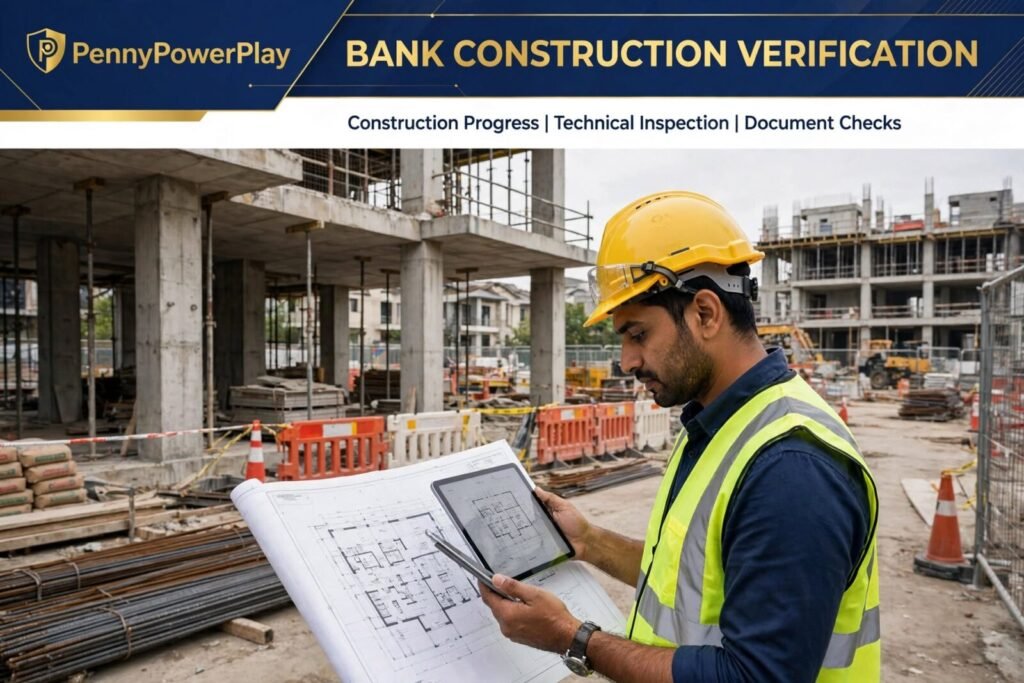
Construction progress report. In order to make sure that the amount asked is adequate, the bank can request a certificate of completion or technical report.
Sanctioned building plan. The bank may consider the sanctioned building plan and other sanctions. If there have been considerable alterations in the plans, it may ask for new documentation.
Past payment history. The bank considers the payments made by you and the amount it has disbursed in the past. This ensures that it does not pay beyond the eligible amount.
Building project documentation. Depending on the lender and the agreement, the bank may also verify the legality of the project and its documents.
One thing to keep in mind, the bank’s verification does not necessarily mean that your property will be free of any issues. It is always better to do your own homework as well.
7. The Documents Needed for Home Loan Disbursement
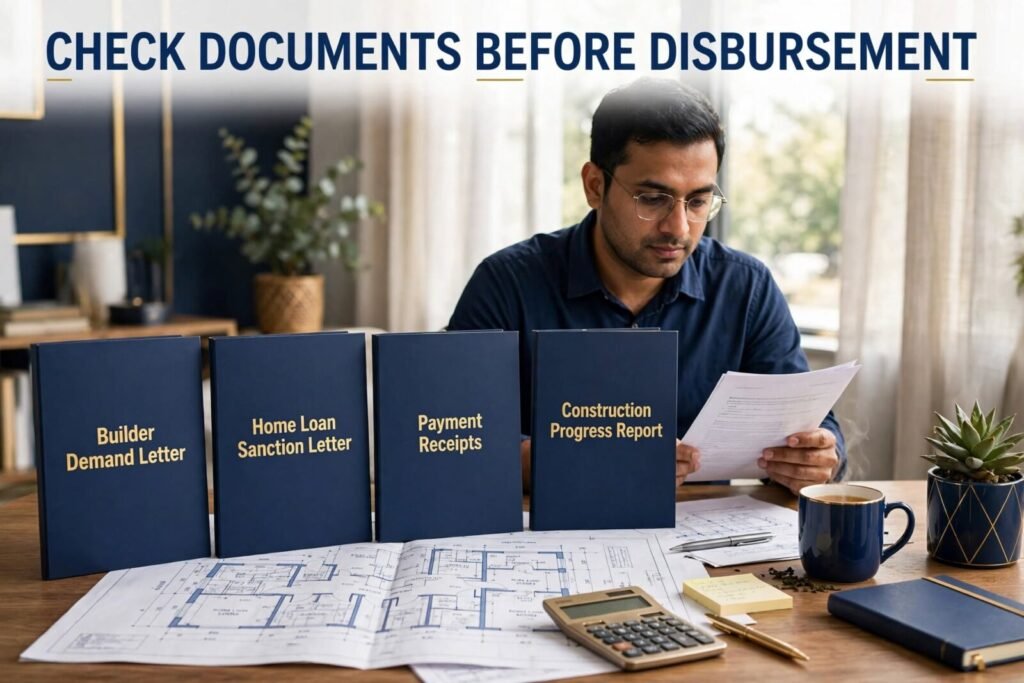
The documents required for home loan disbursement may vary depending on the lender, builder and property. The requirements may also differ between the first disbursement and subsequent disbursements. Below are some of the documents needed for home loan disbursement.
For the First Disbursement
• Home loan sanction letter: This mentions the sanctioned amount and important conditions.
• Signed loan documents: It is possible that the bank will require loan agreement and other security documents signed.
• Registered agreement for sale: This mentions the name of the buyer, seller, property, its value and other terms of payments.
• Receipts of payments made: It is possible that the bank will require proof of the amount that you have paid from your end.
• Builder demand letter: It mentions the payment demand.
• Property & Project documents: These can be title documents, approvals and RERA documents, and others.
• NOC or other builder documents: As per the deal, the bank may require a no-objection certificate or due certification.
• Disbursement form: You may be required to fill it.
For subsequent disbursements
In the next rounds, you might be asked to provide:
• New builder demand letter.
• Revised construction progress certificate.
• Payment receipts of previous disbursements.
• Evidence of additional margin payments made by you.
• Revised disbursement application.
• And other documentation required due to changes in the construction project and loan agreement.
However, not all banks will need all documents for all the disbursement stages. So, the safest procedure would be asking your bank for its latest disbursement checklist.
A handy tip
Keep one physical folder and one digital folder for all your home loan documents. Keep all your demand letters, receipts, construction details, and bank confirmations there. Name them properly along with dates. You will be thankful that you did so when checking out something in your account after several months.
Also, you can refer to our Home Loan Application Checklist for any paperwork.
8. What Is the Effect of Down Payment and Margin on Disbursement?
Margin money is the portion of the property’s cost that you pay from your own funds. Banks rarely advance the entire cost of the property. The loan will depend upon the discretion of the bank and other conditions imposed by the bank.
Let’s say your flat costs Rs 70,00,000, and the bank sanctions Rs 50,00,000. So your margin amount will be Rs 20,00,000.
Do I need to pay my entire margin money before the first disbursement?
Not necessarily. It depends on your lender’s policy and the payment schedule agreed upon with the builder.
Some lenders may require you to contribute your entire margin amount before releasing the loan. Others may allow you to contribute your share at different construction stages.
Before the first disbursement, ask your bank how and when you need to pay your contribution.
Example of Proportionate Payments
Let’s say that a particular construction stage requires a total of Rs. 14,00,000 to be paid. Using the assumed loan share of approximately 71.43% from our earlier example, the payment could be divided as follows:
| Payment source | Amount |
|---|---|
| Your contribution | Rs 4,00,000 |
| Bank disbursement | Rs 10,00,000 |
| Total payment | Rs 14,00,000 |
It is simply a means of making sense of the mathematics involved. It does not represent an obligation for all banks. Your ratio will vary based on your lending institution’s approval.
Other expenses to consider
Your down payment might not be the only payment you have to make. You could also have to budget for stamp duty, registration fees, taxes and other charges. Find out from your bank which payments it will cover and which you will have to make yourself.
To understand this better, read our detailed guide on Home Loan Down Payment in India.
9. What Is a Tripartite Agreement in a Home Loan?
A tripartite agreement is an agreement involving three parties. In case of an under-construction home loan, the three parties are as follows:
1. You (the buyer).
2. The bank.
3. The builder.
The agreement describes the roles of each party with respect to the flat and the loan.
Why does the bank need it?
Where required, a tripartite agreement helps clarify the responsibilities of the buyer, developer and lender, including their rights and obligations relating to the property and loan. According to the type of contract, it can include information related to the payments schedule, mortgages, notice, refund in case certain circumstances take place.
Nevertheless, there is no universal template. It differs from deal to deal.
Is it mandatory?
No, it is not obligatory for all mortgages. Some lenders or projects require a tripartite agreement, while others use different documents. Please ask your bank whether it requires such contract or not.
What should you review carefully?
Prior to signing, check the following aspects about:
• Who is going to pay what amount.
• Security interest of the bank in the property.
• Obligations and commitments of the developer, where specified in the agreement.
• Cancellation and refund process.
• Communication policy of the three parties.
• Condition which might influence future payments.
If you do not understand any point, make sure you clarify it before signing. Remember that signing a tripartite agreement does not eliminate every risk associated with the property.
10. What if the builder requests more money than the construction justifies?
Suppose your builder demands an amount of Rs 12,00,000. However, the technical assessment by the bank justifies only an amount of Rs 7,00,000 at the existing stage of construction. What will happen next?
In this case, the bank can refuse to disburse the total amount until the above conditions are fulfilled. The bank can disburse the lower amount, ask for clarification, or wait until further construction takes place. This will depend upon the terms of your loan agreement and bank policy.
What action should you take?
First, ask the bank for the reasons why the entire amount cannot be released.
Second, compare the demand made by the builder against the payment plan provided in the agreement for sale. If there is any mismatch, ask the builder for explanation. You may also request for an update on the progress of the construction.
Do not accept a payment demand simply because it appears on the builder’s official letterhead. At the same time, do not ignore the demand, as delayed payments may have consequences under your agreement for sale. If the amount appears incorrect, raise the issue promptly and request written clarification from both the builder and the bank.
If the issue remains unresolved, consider seeking advice from a qualified legal or financial professional.
What if you have been requested by the builder to pay out of your personal funds?
It is important to be cautious in such cases. You need to understand the reasons for the bank’s withholding of the money before paying it out of your own pocket because the request may not coincide with the construction stage.
11. What Could Prevent a Bank from Releasing Funds?
Just because the loan was sanctioned does not mean that all future demands would be easily approved. A delay in home loan disbursement for under construction property purchases can happen when construction milestones are incomplete, required documents are missing or the buyer’s contribution has not been paid.
Here are some common reasons.
1. Construction phase is not completed yet. The builder might make a request even before the completion of the specified milestone.
2. Documents are lacking. The demand letter, construction certificate, margin certificate or any other document could be lacking.
3. Your contribution is still unpaid. The bank could want to know whether you have made your own contribution.
4. Some concern is raised regarding the property/project. The bank finds a problem related to approvals, documentation or completion of the project.
5. Any change has occurred in your loan account. If you have not made timely payments, then the bank would conduct a review of the account.
6. Sanction conditions have not been fulfilled. Your sanction letter may state conditions that should first be met, like registration or the generation of security or additional documents.
7. Payment terms should be clarified. The bank might need to verify the bank account of the builder or correlate the demand to previous payments.
What are you supposed to do in case of disbursement delay?
Contact your bank and get the specific reason behind the delay. Check if it is because of your documents, the builder, construction or your own loan account. Get the list of pending documents and try to resolve them through the appropriate person.
Remember that disbursement delays can happen for several reasons. Identifying the actual cause will help you take the right steps to resolve the issue.
12. Directions by RBI Related to Construction Linked Disbursement
The Reserve Bank of India (RBI) has issued guidelines on housing finance concerning loans for under-construction projects. Such directions have been made since the risk to the borrower increases if huge amounts are disbursed even before the completion of construction.
What are the guidelines?
RBI has issued directions concerning housing loan disbursements for under-construction properties. The applicable requirements depend on the type of lender, loan arrangement and relevant regulatory provisions.They don’t usually release the total amount in one go for an incomplete project.
The RBI has also issued warnings regarding schemes where the developer makes a commitment to pay the buyer’s loan instalments until the time when the house is completed. Such practices can be risky. In case the developer does not make the payments or complete the project, it will be the responsibility of the buyer to sort out the matter.
With respect to housing finance companies, some additional instructions that need to be adhered to relate to construction monitoring and obtaining the borrower’s consent before releasing payments to the developers. Some government/statutory authority schemes have certain unique terms and conditions; hence it is advisable not to take all schemes as being the same.
Why is this relevant to you?
The point here is that had the bank disbursed the total amount of Rs 50 lakh when only a fraction of the structure was completed and then construction got halted, you would have ended up with a huge loan on an incomplete flat. This reduces the risk involved in buying such property.
It does not reduce all the risks associated with purchasing an under-construction property, though.
Where to read more
You can read the official directions on the Reserve Bank of India website. And if someone offers you an unusual payment arrangement, ask your lender how it fits with the RBI rules.
13. Seven Questions before You Agree to Pay All Builder Payments
Before you agree to the release of the next payment, go through the following seven questions. The process will only take a few minutes, but it may save you a lot of trouble.
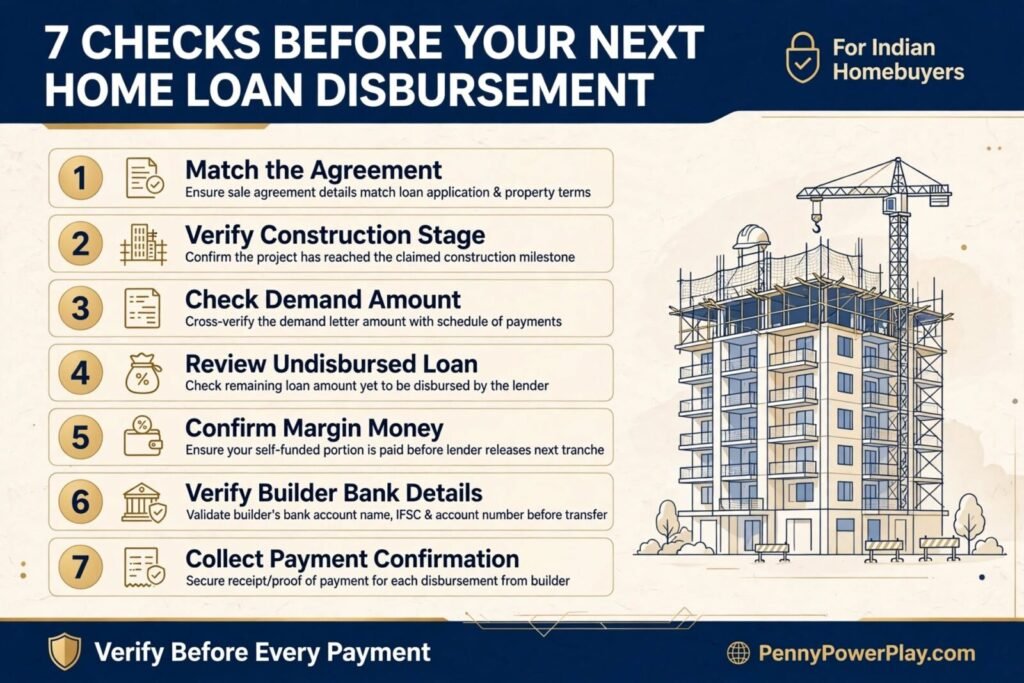
Check 1: Does the demand match the agreement? Examine the payment schedule of the agreement for sale to determine if the demand matches the milestone.
Check 2: Does the construction meet the milestones? Is that milestone really achieved? Examine the progress report of the construction. It is recommended that if possible, you inspect the construction site yourself.
Check 3: Are the amounts correct? Examine the demand amount and make sure there are no discrepancies in previous payments, tax, and adjustments.
Check 4: How much of your sanctioned loan has already been disbursed? Review the total amount released by the bank and check how much remains available for future disbursements. Do not assume that every future builder demand will automatically be approved. Don’t assume that your bank will sanction all demands in the future.
Check 5: Ensure that your contribution to the margin is correct. Find out whether you will have to contribute additional amounts before the next payment is made by the bank.
Check 6: Check the payment account. Ensure that the account details provided by the builder are authentic and confirm to those approved by the bank. In case they have changed, ensure that you validate the details yourself before making the payment.
Check 7: Seek confirmation after payment. Request a loan statement indicating the amount paid out after your payment has been made.
A simple Excel spreadsheet can help you track construction milestones, builder demands, your contributions, bank disbursements and the remaining loan amount.. List out the various milestones of construction, the demand from the builder, your own payments, bank’s payments, and the balance.
14. Frequently Asked Questions
Q1. How is home loan disbursed when it is under-construction property?
Banks generally release the sanctioned loan amount in instalments, depending on construction progress and the conditions of the loan agreement.
Q2. Is the entire loan disbursed by the bank immediately after sanction?
Not always; when it is an under-construction property, the loan is usually released in installments.
Q3. What is construction-based disbursement?
Construction-based disbursement means releasing home loan funds in stages based on verified construction progress and the lender’s conditions.
Q4. Will the bank pay the loan on the basis of demand letter alone from the builder?
No, the bank may require construction milestone verification, proof of margin, legal verification, etc.
Q5. How is the construction process verified?
The bank may verify construction progress through its technical team or an appointed engineer, architect or valuer.
Q6. Does the bank have the right to refuse the builder’s disbursement request?
Yes. The bank has the right to refuse or delay the payment when the request doesn’t comply with its conditions.
Q7. Is the first disbursement different from the subsequent ones?
Usually, yes. The first one might require more documentation of loans and securities. Subsequent ones will mainly cover new requests and progress of the project.
Q8. Can I request a statement of disbursements from the bank?
Yes. You can request a loan statement showing the amount disbursed, payment dates, outstanding principal and remaining undisbursed loan amount.
Q9. Will the builder complete a project approved by the bank?
No. The bank’s approval of the project doesn’t guarantee timely completion or any elimination of financial risks.
Q10. My margin money isn’t sufficient, what should I do?
The bank may delay the next disbursement until you arrange the required contribution, depending on its policy and your loan terms
Q11. Do I have to sign a tripartite agreement for my housing loan?
Not necessarily. The requirement depends on the lender, project and applicable documentation.
Q12. Can I choose the construction stage at which my bank will make disbursements?
Not entirely. For an under-construction property, the bank generally releases the loan amount according to construction progress, the builder’s payment schedule and the conditions of your loan agreement.
You can discuss the payment schedule with your bank and raise concerns if construction is delayed. However, the bank must verify that the required conditions are met before releasing the money.
Q13. Can I stop the next disbursement if the construction appears to be doubtful?
Immediately bring it to the notice of the bank and request an evaluation before making a disbursement. Whether any payment can be held back depends on your agreement, bank’s assessment and guidelines.
Q14. When does interest begin on the disbursed amount?
Generally, interest begins from the date of disbursement, as per your loan agreement. You may have pre-EMI or fully EMI repayments. For details of repayment issues due to delay, see our article on Home Loan If Builder Delays Possession.
Q15. What happens if there is a difference of opinion between the builder and the bank regarding construction progress?
Request an explanation in writing from both parties. Examine the demand letter along with the agreement and technical assessment made. Consider seeking professional advice if necessary.
15. Final Thoughts
Getting your home loan sanctioned is an important step towards buying your own home. However, for an under-construction property, the process does not end with loan approval.
Banks generally release the sanctioned amount in stages, depending on construction progress, the builder’s payment schedule and the lender’s conditions.
As a homebuyer, you should understand the difference between the sanctioned amount, disbursed amount and outstanding loan balance.
Always review the builder’s demand letter, verify the construction stage and keep records of your payments and the amounts released by the bank.
Understanding home loan disbursement for under construction property purchases can help you plan your finances and avoid confusion when the builder raises a payment demand.
Before requesting the next disbursement, confirm that the necessary documents and lender requirements are in place. A little preparation can help you avoid unexpected delays and financial pressure.
Need help understanding your home loan?
At PennyPowerPlay, we explain home loans, eligibility, EMI calculations and housing finance in simple English.
If you are planning to buy an under-construction flat, start with our Complete Home Loan Guide for Indian Buyers. You can also learn about our Home Loan Review Services if you need help understanding your loan documents or repayment arrangements.
Disclaimer: This article is for general educational purposes only. Disbursement procedures, documents and conditions differ between lenders and property deals. Please check which RBI directions and other legal requirements apply to your lender and project. Speak to your lender or a qualified professional before making any important financial or legal decision.