By Ashok / August 9, 2026
“Sir, down payment ke liye paise kahan se laun? Bank toh sirf 80% de raha hai, baki 20% kaun dega?”
The home loan down payment in India is where most home loan dreams stall.
“If you are struggling with your home loan down payment India, this guide will show you exactly what works at the credit desk.”
I have heard this question more times than I can count at ICICI Bank, HDFC, Axis Bank, and PNB Housing Finance.
And here is the truth most loan officers will not say out loud:
The home loan down payment is where most home loan dreams stall.
Not the CIBIL score.
Not the interest rate.
The down payment.
Because while banks advertise “up to 90% funding,” the reality on the ground can be very different. By the time you add stamp duty, registration, brokerage, GST on eligible under-construction properties, and other buying costs, your actual upfront cash requirement can be significantly higher than the down payment percentage alone.
In this guide, I will show you exactly how much cash you really need before buying a house in India in 2026, practical ways to arrange it, and the mistakes I have seen borrowers make during the home-loan process.
This down payment guide explains how Indian home buyers can legally and smartly arrange the upfront cash needed for their dream home, based on real lending experience rather than generic savings tips.
Rate Alert: RBI Repo Rate at 5.25%
The RBI Monetary Policy Committee kept the policy repo rate unchanged at 5.25% on August 5, 2026, while retaining a neutral policy stance.
For home buyers, a stable policy rate does not guarantee that every lender’s home-loan rate will remain unchanged. Your actual rate can depend on the lender, borrower profile, credit score, loan amount, LTV, employment profile and other factors.
Still, a relatively stable rate environment gives borrowers a good opportunity to review affordability, down payment requirements and lender offers before applying.
Before we look at the strategies, here is what the RBI actually says about down payments.
| Factor | What Most People Think | What Actually Happens at the Credit Desk |
| Down payment is just 10–20% | “I only need 20% of property value.” | You need the lender’s required margin PLUS stamp duty, registration, GST where applicable, brokerage and other buying costs. |
| EPF cannot be used | “PF is only for retirement.” | EPF withdrawal for eligible housing purposes may be available under specific EPFO provisions and conditions. |
| Personal loan can fill the gap | “I’ll take a personal loan for the down payment.” | A fresh personal loan increases your debt burden and can affect FOIR and home-loan eligibility. |
| Family gift is simple | “Papa se paise le lunga, bas ho gaya.” | Banks may ask for a gift declaration/deed, donor’s bank statements, PAN/KYC and relationship proof. |
| Higher down payment hurts | “Why pay more when the bank is giving 80%?” | A higher own contribution reduces LTV, lowers your loan requirement and EMI, and can strengthen your overall application. |
Critical Rule
Your lender will generally require the required margin contribution to come from an acceptable, traceable and documented source.
A personal loan or other fresh borrowing can increase your FOIR, affect eligibility, and may lead the lender to reduce the eligible loan amount or decline the application.
Disclaimer: The information in this article is for educational purposes only. RBI regulations, EPFO rules, PMAY guidelines, tax rules and lender policies can change. Always verify current terms directly with your chosen lender, EPFO, the Income Tax Department or the relevant state authority before making financial decisions.
What Is a Down Payment and Why Does RBI Regulate It?
Down Payment for Home Loan in India: The Complete Breakdown
A down payment is the portion of the property cost that you, the buyer, need to arrange yourself before the lender disburses the home loan.
The Reserve Bank of India regulates housing finance through Loan-to-Value, or LTV, norms.
The basic idea is simple.
If a lender financed the entire cost of a property, the borrower would have very little of their own money invested in the transaction. LTV limits ensure that lenders maintain a certain margin and borrowers have their own contribution in the purchase.
But there is an important distinction:
RBI LTV limits are maximum regulatory ceilings. They are not a promise that your bank will finance that percentage.
Your lender can sanction a lower amount depending on your income, credit profile, property valuation, property type, location, repayment capacity and internal credit policy.
RBI LTV Rules: Why the Down Payment Depends on Loan Amount
Your home loan down payment depends not only on the property price, but also on the applicable LTV, your sanctioned loan amount and the lender’s assessment.
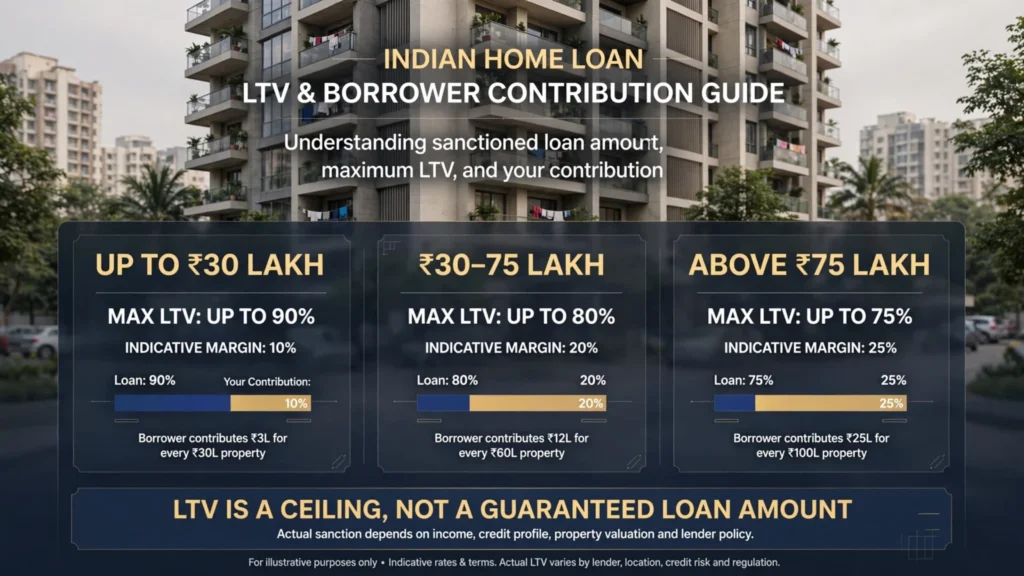
RBI Down Payment Rules and LTV Ratio 2026
The RBI’s housing-finance framework caps the maximum LTV ratio based on the sanctioned loan amount, not simply the property’s purchase price.
| Sanctioned Loan Amount | Maximum LTV | Indicative Minimum Margin |
| Up to ₹30 lakh | Up to 90% | At least 10% of eligible property value |
| Above ₹30 lakh and up to ₹75 lakh | Up to 80% | At least 20% |
| Above ₹75 lakh | Up to 75% | At least 25% |
Important: These are regulatory ceilings, not entitlements.
For example, if the applicable maximum LTV is 80%, that does not mean your lender must finance exactly 80%.
The lender may sanction less because of:
- Your credit profile
- Income and FOIR
- Property valuation
- Property type
- Location
- Existing liabilities
- Employment profile
- Internal risk policy
Also remember that the RBI LTV framework generally excludes stamp duty, registration and certain documentation charges from the property cost used for LTV calculation.
That means these expenses usually have to be arranged separately.
A practical example
Suppose you are buying a ₹50 lakh property.
If your lender sanctions a ₹40 lakh home loan, your own contribution toward the property cost would be ₹10 lakh.
But your cash requirement does not stop at ₹10 lakh.
You may also need money for:
- Stamp duty
- Registration
- Brokerage
- GST, where applicable
- Legal and documentation expenses
- Basic interiors or modifications
- Other transaction-related costs
That is why down payment and total upfront cash requirement are not the same thing.
Home Loan Down Payment India: The Real Math on Cash You Need
Here is an illustrative example showing how the upfront requirement can change depending on the property price and assumed additional costs.
| Property Price | Assumed Own Contribution | Stamp Duty + Registration (6%) | GST/Brokerage/Other (Illustrative) | Total Upfront Cash Needed |
| ₹25 lakh | ₹2.5 lakh | ₹1.5 lakh | ₹50,000 | ₹4.5 lakh |
| ₹50 lakh | ₹10 lakh | ₹3.0 lakh | ₹1.5 lakh | ₹14.5 lakh |
| ₹80 lakh | ₹20 lakh | ₹4.8 lakh | ₹2.5 lakh | ₹27.3 lakh |
| ₹1 crore | ₹25 lakh | ₹6.0 lakh | ₹3.5 lakh | ₹34.5 lakh |
Important: These are illustrations, not universal costs. The applicable LTV, stamp duty, registration, GST, brokerage and other expenses can vary by property, state, transaction type and lender.
For the ₹25 lakh example, the assumed own contribution is based on a 90% LTV scenario.
For the ₹50 lakh and ₹80 lakh examples, the assumed own contribution uses a 20% margin.
For the ₹1 crore example, the assumed own contribution uses a 25% margin.
Pro Tip from My Credit Desk
I have seen borrowers walk into the branch with exactly 20% saved, only to discover that they also need money for stamp duty, registration, brokerage and other costs.
For many buyers, the total upfront requirement can be materially higher than the down payment alone.
Depending on the property, state and transaction type, a buyer may need to budget 20–35% or more of the property value in total cash requirements.
Always calculate the complete upfront requirement before you start house hunting.
The Hidden Truth: Stamp Duty, Registration & Other Costs Banks Won’t Fund

This is where many online “down payment calculators” fall short.
They show you 20%.
And stop.
But your actual home-buying budget may include several other expenses.
| Cost | Typical Range | On ₹50 Lakh Property |
| Stamp Duty | 5–8% depending on state | ₹2.5–4.0 lakh |
| Registration Charges | State-dependent | ₹50,000–1.0 lakh |
| GST | Applicable to eligible under-construction property | Depends on transaction |
| Brokerage | Often 1–2% where applicable | ₹50,000–1.0 lakh |
| Legal Charges | Variable | ₹10,000–50,000 |
| Interior/Modification | Variable | ₹1–3 lakh |
“Brokerage is not compulsory and applies only when you purchase through a property broker or agent. Direct purchases from a builder or owner may not involve brokerage.”
Important: GST generally applies to eligible under-construction residential properties and generally does not apply to completed properties where the applicable completion/occupation conditions are satisfied.
For resale properties, GST generally does not apply in the same way as it does to an eligible under-construction purchase.
Always verify GST applicability for your specific transaction.
Also remember that state-level stamp duty and registration rules vary.
The practical lesson
Don’t ask: “How much down payment do I need?”
Ask: “How much total cash do I need to complete this property purchase comfortably?”
That second question will give you a much more realistic number.
If you are struggling to arrange your home loan down payment, the key is to start planning the funding sources well before you apply.
How to Arrange Down Payment for Home Loan in India: 7 Proven Strategies
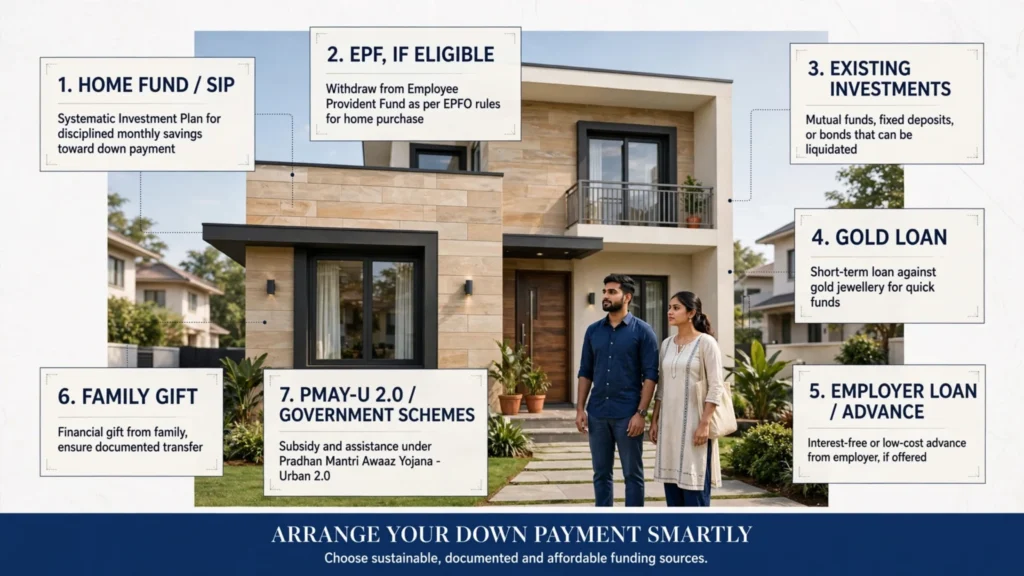
Now that you know the real number you need to arrange, let’s look at seven practical strategies.
These are ranked broadly by safety, documentation quality and how easily the source can be explained to a lender.
Strategy 1: Build a Dedicated Home Fund via SIPs and Recurring Deposits
Best for: Salaried professionals with 2–5 years before purchase.
This is one of the safest and most disciplined approaches.
Instead of waiting until you find a property and then worrying about the down payment, create a separate Home Fund well in advance.
You can use different instruments depending on your time horizon and risk tolerance.
Option A: Mutual Fund SIPs
For a goal several years away, some investors may consider diversified equity-oriented or hybrid mutual funds.
But remember:
Mutual fund returns are not guaranteed.
If your home purchase is many years away, market-linked investments may provide growth potential, but you need to reduce risk as the purchase date gets closer.
Illustrative SIP calculation
| Target Amount | Monthly SIP @ 12% p.a. | Time to Reach |
| ₹10 lakh | ₹4,300 | 10 years |
| ₹15 lakh | ₹6,450 | 10 years |
| ₹20 lakh | ₹8,600 | 10 years |
| ₹10 lakh | ₹12,100 | 5 years |
| ₹15 lakh | ₹18,200 | 5 years |
Note: The 12% figure is purely illustrative and is not an assured return.
For a more conservative illustration, at approximately 10% p.a., the monthly SIP required for ₹10 lakh in 10 years would be around ₹4,850.
Actual market returns can be higher or lower.
Option B: Recurring Deposits for Short-Term Goals
If you expect to buy within the next one or two years, you may not want to take unnecessary equity-market risk with money you will soon need for a property purchase.
A bank RD or other suitable low-risk instrument can provide more predictable accumulation, although returns are generally lower than long-term market-linked investments.
Pro Tip from My Credit Desk
I have seen borrowers liquidate equity investments during a market correction because they suddenly needed the money for a property booking.
That is a painful situation.
If your home purchase is approaching, gradually reduce the risk in the money earmarked for your down payment.
Your home fund should not depend on what the stock market happens to do in the month you find your dream house.
Strategy 2: Withdraw from Your EPF Corpus
Best for: Employees who satisfy the applicable EPFO housing-withdrawal conditions.
This is one of the strategies many salaried employees overlook.
Under the EPF Scheme, withdrawals or advances may be available for eligible housing purposes, subject to the applicable provision, service requirement, amount limits and other conditions.
The exact amount depends on the particular EPFO provision being used.
EPF Withdrawal for Housing: Key Points
| Aspect | What to Know |
| Eligibility | Depends on the applicable paragraph of the EPF Scheme, service requirement and other conditions |
| Maximum Amount | Depends on the purpose and applicable EPFO provision |
| Property Ownership | Conditions can apply regarding ownership by the member/spouse/joint ownership |
| Tax Status | Tax treatment depends on the circumstances and applicable rules |
| Application | Through the EPFO claim process, subject to the applicable requirements |
For example, EPFO’s current Form 31 guidance lists housing-related withdrawals under Para 68B and specifies different limits depending on the housing purpose.
How to Apply
The exact online process can change, so use the current EPFO member portal and instructions applicable to your claim.
Generally, you should:
- Log in using your UAN and credentials.
- Go to the applicable online claim section.
- Select the eligible housing-related purpose.
- Provide the required declarations and details.
- Ensure your bank and KYC information is correctly updated.
- Track the claim through the EPFO system.
Critical Warning
Do not assume that you can withdraw a fixed percentage of your PF balance for every type of housing transaction.
EPF housing withdrawals have specific provisions and conditions.
Check the current EPFO rules before including EPF money in your home-purchase budget.
Strategy 3: Liquidate Existing Investments

Best for: Buyers who already have a savings corpus spread across different investments.
Many families have money sitting in:
- Fixed deposits
- Mutual funds
- Stocks
- Gold
- Other investments
The question is not simply:
“Can I sell it?”
The better question is:
“Which investment should I liquidate, when should I liquidate it, and what tax or exit cost will I face?”
| Investment Type | When to Consider Liquidating | Tax Considerations |
| Fixed Deposits | Depending on purchase timeline | Interest generally taxable according to applicable tax rules |
| Debt Mutual Funds | Depending on goal timeline | Tax treatment depends on fund classification, acquisition date and applicable rules |
| Equity Mutual Funds | Subject to goal and tax implications | LTCG/STCG rules depend on holding period and fund type |
| Stocks/Equity | Subject to goal and tax implications | Listed equity generally has specific STCG/LTCG rules |
| Physical Gold | Depending on holding period and tax implications | Other capital assets generally use a 24-month long-term threshold under current rules |
| Sovereign Gold Bonds | Depending on maturity/redemption rules | Tax treatment depends on the applicable rules and holding period |
For listed equity and equity-oriented mutual funds, current rules provide a ₹1.25 lakh annual threshold for LTCG under Section 112A, with gains above that threshold generally taxed at 12.5%, subject to the applicable conditions.
For other assets, the tax treatment can differ.
Pro Tip from My Credit Desk
If you liquidate investments to fund your down payment, keep the paper trail.
For example:
Mutual funds: Keep redemption statements and bank credit proof.
Stocks: Keep the contract note or transaction statement and bank credit proof.
FD: Keep the FD closure advice and bank credit proof.
The lender wants to understand where the money came from.
A clean paper trail makes that explanation much easier.
Strategy 4: Consider a Gold Loan With Full Disclosure
Best for: Families that own gold and need a temporary source of funds.
A gold loan may be considered as a funding source in some cases.
It is a secured loan against an asset you already own.
But there is one important point:
A gold loan is still a loan.
It creates an additional repayment obligation.
| Parameter | Gold Loan | Personal Loan |
| Security | Gold pledged | Usually unsecured |
| Processing | Can be relatively quick | Varies by lender |
| Documentation | Generally simpler | Usually more extensive |
| Impact on Home Loan | Must be disclosed and assessed | Can significantly affect eligibility |
| Tenure | Often shorter | Often longer |
How to Use a Gold Loan Responsibly
- Borrow only what you genuinely need.
- Understand the interest rate and repayment structure.
- Disclose the loan to your home-loan lender.
- Ensure the additional EMI does not make your overall debt burden uncomfortable.
- Have a clear repayment plan.
Critical Warning
Never hide a gold loan from your home-loan lender.
Your credit report and financial documents may reveal existing liabilities. An undisclosed liability can create problems during underwriting.
Strategy 5: Employer Salary Advance or Housing Loan
Best for: Employees of large corporates, PSUs or government departments where such facilities are available.
Some employers provide:
- Salary advances
- Employee loans
- Housing loans
- House Building Advance
- Other employee welfare loans
The terms can be significantly different from commercial borrowing.
| Type | Possible Features | Tax Considerations |
| Salary Advance | May be recovered from future salary | Depends on structure and applicable tax rules |
| Employer Housing Loan | May carry a concessional interest rate | Perquisite taxation can apply in certain cases |
| House Building Advance | Available to eligible government employees under applicable rules | Depends on the scheme and applicable tax rules |
Government employees and eligible PSU employees may have access to House Building Advance schemes.
If your employer offers such a facility, check the terms before taking a separate unsecured loan.
Pro Tip from My Credit Desk
Don’t assume an employer loan is automatically tax-free.
The tax treatment of a concessional employer loan can depend on the applicable perquisite valuation rules and benchmark rate.
Check with your HR department or Chartered Accountant before making the decision.
Strategy 6: Family Support and Gift Documentation
Best for: Buyers whose parents or other eligible relatives can contribute.
This is one of the most common sources of home-purchase funds in India.
But it is also one of the most poorly documented.
Banks generally don’t have a problem with a genuine family gift.
The problem is when the money appears suddenly without a clear source.
What Banks May Ask for
Gift Declaration or Gift Deed
The donor may need to provide documentation stating that the money is being given as a genuine gift and is not a repayable loan.
Whether registration is required depends on the nature of the gift and applicable law.
Source of Funds
The donor may need to show:
- Bank statements
- Salary/income proof
- Investment redemption proof
- FD closure documents
- Other legitimate source evidence
PAN and KYC
The lender may request the donor’s PAN and KYC documents.
Relationship Proof
Depending on the lender, documents may be requested to establish the relationship.
Tax Implications
Under Section 56(2)(x), gifts from specified relatives are generally not taxable in the recipient’s hands, subject to the applicable provisions.
Gifts from non-relatives above ₹50,000 can be taxable as income from other sources, subject to the law and applicable exceptions.
There is no general monetary ceiling for gifts from specified relatives merely because the amount is large, although the source and documentation should be genuine and properly recorded.
Pro Tip from My Credit Desk
If your parents are helping with your down payment, don’t wait until the last week before registration.
Move the money through the banking system, maintain proper documentation and keep the donor’s source-of-funds evidence.Large or unusual cash deposits without a clear documented source can create questions.
Strategy 7: PMAY-U 2.0 Subsidy and State Government Schemes
Best for: Eligible first-time urban home buyers who meet the applicable PMAY-U 2.0 criteria.
PMAY-U 2.0 includes an Interest Subsidy Scheme for eligible beneficiaries.
The scheme does not simply hand you your down payment.
Instead, an eligible interest subsidy can reduce the effective outstanding home-loan burden.
PMAY-U 2.0 Interest Subsidy Scheme: Key Details
| Eligibility/Feature | Details |
| EWS | Annual household income up to ₹3 lakh |
| LIG | Above ₹3 lakh and up to ₹6 lakh |
| MIG | Above ₹6 lakh and up to ₹9 lakh |
| Maximum Loan | ₹25 lakh |
| Maximum Property Value | ₹35 lakh |
| Maximum Carpet Area | 120 sqm |
| Interest Subsidy | 4% on the first ₹8 lakh, subject to scheme conditions |
| Maximum Subsidy | Up to ₹1.80 lakh on NPV basis |
| Subsidy Period | Applicable scheme structure, subject to conditions |
| First-Time Buyer | Applicant/family must satisfy the applicable first-home conditions |
PMAY-U 2.0’s official material provides the current framework for the Interest Subsidy Scheme, including the ₹25 lakh loan and ₹35 lakh property-value limits.
How It Helps Your Affordability
Suppose you are eligible for PMAY-U 2.0 and purchase a property within the applicable ₹35 lakh property-value limit with a qualifying home loan.
The subsidy can reduce the effective outstanding principal and therefore reduce the overall interest burden.
But remember:
The subsidy does not replace your required upfront contribution.
You still need to arrange the margin contribution and transaction costs required for the purchase.
State Government Schemes to Explore
Depending on your location, you can also check:
- Maharashtra: MHADA housing schemes
- Delhi: DDA housing schemes
- Tamil Nadu: TNHB schemes
- Karnataka: KHB schemes
- West Bengal: WBHIDCO schemes
Eligibility, application windows and benefits vary by scheme.
The Big Mistake: Why a Personal Loan or Credit Card for Down Payment Is Risky
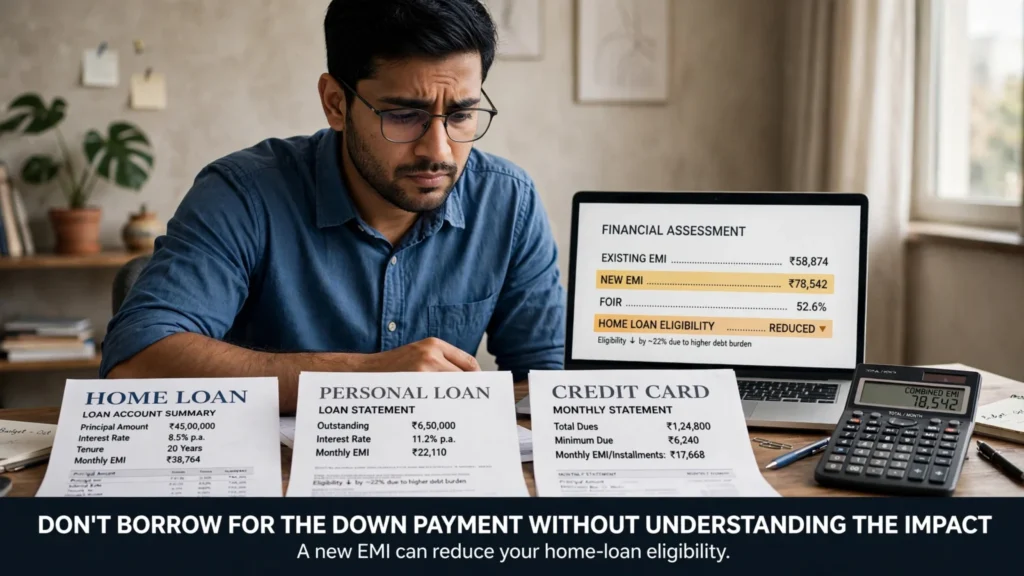
This is one of the most common mistakes I have seen during the home-loan process.
A borrower takes a personal loan shortly before applying for a home loan and thinks:
“Problem solved. Down payment arrange ho gaya.”
But the lender may see a completely different picture.
1. It Can Reduce Your Home-Loan Eligibility
A fresh personal loan creates an additional EMI.
That EMI is considered when the lender assesses your repayment capacity.
Your eligible home-loan amount can therefore fall.
2. It Can Increase Your FOIR
Suppose your home-loan EMI would be ₹45,000.
You already have a personal-loan EMI of ₹15,000.
Now the lender has to consider both obligations.
Depending on the lender’s FOIR policy and your income, this can materially affect eligibility.
3. It Can Signal Higher Financial Dependence on Borrowing
A personal loan taken immediately before a home-loan application can make the lender ask:
“If the borrower needed to borrow for the margin contribution, how strong is the available savings buffer?”
It doesn’t automatically mean rejection.
But it can lead to additional scrutiny.
4. It Can Affect Your Credit Profile
A new loan can affect your credit profile through:
- A new credit enquiry
- Higher outstanding debt
- A new repayment obligation
- Changes in your credit mix
The exact impact on your CIBIL score varies by borrower.
5. Credit Cards Are an Even More Expensive Way to Bridge the Gap
Using a credit card cash advance or other expensive credit facility to fund a property purchase can create substantial repayment pressure.
Instead of quoting one universal interest rate, remember this:
Credit-card cash advances and similar borrowing can carry very high costs compared with normal secured home-loan borrowing.
That is usually a poor way to fund a property purchase.
Illustrative Example: Personal Loan Before Home Loan
The following example is illustrative.
Rahul is a 34-year-old IT professional earning ₹1.20 lakh per month.
His CIBIL score is 760.
He wants to buy a property and needs additional money for his contribution.
Instead of waiting, he takes a ₹5 lakh personal loan two weeks before applying for the home loan.
The new EMI pushes his overall obligations higher.
If the resulting FOIR crosses the lender’s acceptable range, the lender may reduce his eligible home-loan amount or decline the application.
The lesson?
The problem isn’t simply the ₹5 lakh loan.
The problem is what that additional liability does to the entire home-loan application.
“Personal loan se down payment banana home loan ke liye risky move ho sakta hai.” Using a personal loan for a home-loan margin contribution can be a risky move.
How Banks Verify Your Down Payment Source

At the credit desk, the lender may examine your financial trail to understand where the money for your contribution came from.
Here is what can be checked.
| Verification Step | What We Check | What Can Create Problems |
| Bank Statements | Large deposits, transfers and unusual credits | Unexplained deposits |
| Source of Funds | Explanation and supporting documents | Vague answers without proof |
| Gift Documentation | Gift declaration/deed, donor statements and relationship | Informal or unexplained transfers |
| Investment Liquidation | Redemption statement and bank credit | No evidence of sale/redemption |
| EPF Withdrawal | Claim/credit documentation where applicable | Funds not yet received |
| Gold Loan | Loan sanction and disclosure | Undisclosed liability |
Red Flags That Can Trigger Additional Questions
- Large or unusual cash deposits close to the application date
- Recent personal loan
- Credit-card cash withdrawal
- Funds transferred from an undisclosed borrowing source
- Family gift without documentation
- Investment sale without supporting records
- Undisclosed existing liabilities
- Transactions that cannot be satisfactorily explained
The important point is not:
“Never have a large transaction.”
The point is: “Be able to explain and document your large transactions.”
Down Payment Planning Timeline: When to Start
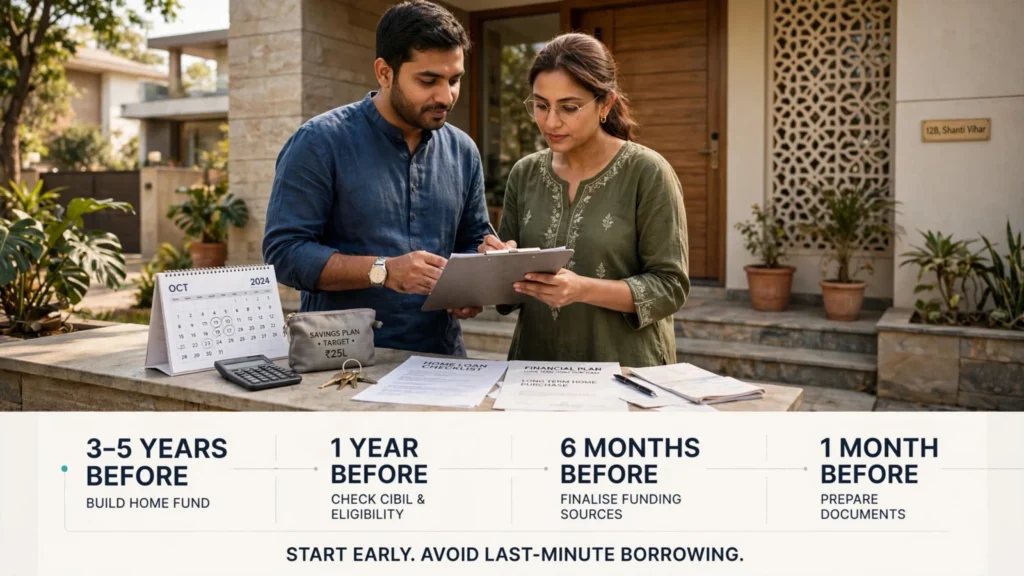
The earlier you start, the easier the process becomes.
| Timeline | Action Items |
| 3–5 years before purchase | Estimate property budget and start a dedicated Home Fund |
| 2–3 years before | Review investment risk and gradually increase the stability of your down-payment corpus |
| 1 year before | Check CIBIL, estimate eligibility and review existing liabilities |
| 6 months before | Finalise likely funding sources and prepare documentation |
| 3 months before | Avoid unnecessary new credit applications and keep bank statements clean |
| 1 month before | Finalise down-payment documentation and confirm the lender’s requirements |
Pro Tip from My Credit Desk: The borrowers who get smoother approvals are not always the ones with the highest CIBIL scores.
They are often the ones with:
- Clean bank statements
- Stable income
- Manageable liabilities
- Clear documentation
- Properly sourced funds
Start preparing well before the application.
No sudden unexplained deposits.
No unnecessary new loans.No last-minute financial surprises.
Illustrative Example: How a Borrower Could Arrange a ₹20–24 Lakh Upfront Corpus
The following example is illustrative.
Actual eligibility, EPF withdrawal limits, lender policies, property costs and funding sources vary.
Rahul, a 31-year-old marketing manager in Pune, wants to buy a ₹75 lakh apartment.
Suppose his overall upfront requirement is approximately ₹24 lakh after considering his assumed property contribution and transaction-related costs.
He could potentially arrange the corpus from several documented sources.
| Source | Amount | Timeline |
| EPF Withdrawal, if eligible | ₹8 lakh | Planned several months before purchase |
| Liquidated Debt Mutual Funds | ₹5 lakh | Redeemed before purchase |
| Family Gift from Father | ₹6 lakh | Bank transfer with documentation |
| Monthly Salary Savings | ₹3 lakh | Built through disciplined saving |
| Gold Loan, if lender accepts and affordability permits | ₹2 lakh | Temporary bridge with repayment plan |
| Total | ₹24 lakh | — |
This is not a recommendation to use all five sources.
In fact, a borrower should generally prefer the simplest and most sustainable funding structure available. The example simply demonstrates that a down-payment corpus can sometimes be built from multiple legitimate and documented sources.
Frequently Asked Questions
FAQ 1: What is the minimum down payment for a home loan in India in 2026?
The RBI framework provides maximum LTV ceilings of up to 90%, 80% and 75% for the applicable sanctioned-loan slabs.
That means the borrower’s minimum contribution can be approximately 10%, 20% or 25% depending on the applicable loan amount and lender assessment.
However, you must also arrange stamp duty, registration, GST where applicable and other transaction costs separately. Your total upfront cash requirement can therefore be significantly higher than the down payment alone.
FAQ 2: Can I use my EPF for home-loan down payment?
EPF withdrawal may be available for eligible housing purposes under specific provisions of the EPF Scheme 1952.
The applicable service requirement, amount and conditions depend on the particular housing provision.
Check the latest EPFO guidance before including EPF funds in your purchase budget.
FAQ 3: Can I take a personal loan for a home-loan down payment?
It is generally not advisable to take a personal loan specifically to fund your home loan down payment or margin contribution. The additional EMI can increase your FOIR, reduce your eligible home-loan amount and create additional underwriting concerns.
FAQ 4: How much stamp duty and registration do I need to pay?
There is no single India-wide rate.
Stamp duty and registration charges vary by state and sometimes by property type, location, buyer category and other factors.
For planning purposes, many buyers use a broad estimate, but you should verify the exact amount applicable to your property and state.
FAQ 5: Can my parents gift me money for a down payment?
Yes.
Genuine gifts from specified relatives are generally not taxable in the recipient’s hands under the applicable provisions of Section 56(2)(x).
However, the lender may ask for:
- Gift declaration/deed
- Donor’s bank statements
- PAN/KYC
- Relationship proof
- Source-of-funds evidence
Use banking channels and maintain a proper documentation trail.
FAQ 6: Is a gold loan acceptable for a down payment?
A gold loan may be considered in some cases, but it must be fully disclosed to the home-loan lender.
It is secured against gold, but it remains a financial liability.
The lender will consider the resulting repayment obligation when assessing your overall affordability.
FAQ 7: What is PMAY-U 2.0 subsidy and how does it help?
PMAY-U 2.0’s Interest Subsidy Scheme can provide an interest subsidy of up to ₹1.80 lakh for eligible beneficiaries, subject to the scheme’s conditions.
The subsidy can reduce the effective outstanding principal and interest burden.
It does not replace your required upfront contribution.
FAQ 8: How do banks verify the down-payment source?
Banks may review:
- Bank statements
- Source-of-funds declarations
- Investment redemption statements
- Gift documents
- EPF claim/credit evidence
- Existing loan information
- CIBIL and other credit records
Large or unusual transactions without a clear explanation can result in additional questions.
FAQ 9: Can I use my credit card for a down payment?
Using credit-card cash advances or other expensive credit to fund a property purchase is generally a poor idea.
It can create high-cost debt, increase repayment pressure and potentially affect your home-loan eligibility.
FAQ 10: How early should I start saving for a down payment?
Ideally, start as early as possible.
Three to five years gives you significantly more flexibility than trying to build the entire corpus in six months.
The longer your time horizon, the smaller your required monthly saving can be.
FAQ 11: Does a higher down payment get me a better home-loan interest rate?
Not automatically.
However, a higher own contribution reduces the LTV ratio and can strengthen the lender’s risk assessment.
It also reduces your loan amount, EMI and total interest burden.
The actual interest rate still depends on the lender and your overall borrower profile.
FAQ 12: What documents do I need to prove my down-payment source?
Depending on the source, you may need:
- Bank statements
- Source-of-funds declaration
- Gift deed/declaration
- Donor’s bank statements
- EPF withdrawal/credit proof
- Investment redemption statements
- FD closure documents
- Gold-loan documents
- Salary savings evidence
- Other supporting documents requested by the lender
The exact list varies by lender and transaction.
Final Thoughts
A well-planned home loan down payment can make the entire home-buying process much smoother.
“Now you know exactly how much home loan down payment india requires and how to arrange it smartly.”
The down payment is not just a financial hurdle.
It is also a test of how prepared you are for a 20–30 year financial commitment.
Before you start house hunting:
- Calculate your real upfront cash requirement, not just the down payment
- Add stamp duty, registration, GST where applicable and other transaction costs
- Choose funding sources that are sustainable and properly documented
- Avoid taking a fresh personal loan or using expensive credit to bridge the gap
- Maintain a clean banking trail
- Check your CIBIL score and existing liabilities before applying
- Start preparing your finances several months before the application
My advice from the credit desk:
The borrowers who get smoother approvals are not always the richest.
They are often the most prepared.
A borrower with a well-documented ₹15 lakh contribution can be in a stronger position than someone with ₹25 lakh sitting in unexplained cash deposits.
“Down payment arrange karna mushkil hai, lekin impossible nahi. Planning, patience, aur paperwork, teeno chahiye.”
Arranging a down payment is difficult, but not impossible. You need planning, patience and paperwork.
Ready to Plan Your Home Loan?
“Now that you know how to arrange down payment for home loan in India, use our calculator to check your eligibility before approaching any lender.”
Before you approach a lender, calculate:
- Your maximum affordable EMI
- Existing EMI obligations
- Expected home-loan eligibility
- Required down payment
- Stamp duty and registration
- Other purchase costs
- Available own contribution
Use our Home Loan Eligibility Calculator to estimate how much you may be able to borrow based on your income, existing EMIs and down-payment capacity.
Check Your Home Loan Eligibility Now
Official References
This article is based on official regulatory and government information, together with the author’s practical experience in India’s banking and housing-finance industry.
- Reserve Bank of India: Housing finance and LTV framework
- Reserve Bank of India: Monetary Policy Committee and policy-rate decisions
- Employees’ Provident Fund Organisation : EPF Scheme 1952 and housing-related withdrawal provisions
- Ministry of Housing and Urban Affairs : PMAY-U 2.0 guidelines and Interest Subsidy Scheme
- Income Tax Department : Capital gains and gift-tax provisions
- State-level authorities : Stamp duty, registration and applicable housing schemes
For current official information, readers should verify the applicable rules directly with the relevant authority before making a financial decision.
About the Author
Ashok K. Satpute is the founder of PennyPowerPlay.com and a Home Loan Specialist with over 8 years of experience in India’s banking and housing finance industry.
During his career, he has worked with leading financial institutions, including ICICI Bank, HDFC, Axis Bank and PNB Housing Finance, assisting borrowers with home-loan eligibility, loan processing, documentation, CIBIL analysis, balance transfers and other aspects of housing finance.
Through PennyPowerPlay.com, he shares practical, experience-based home-loan guides designed to help Indian home buyers understand the lending process and make better-informed financial decisions.
Related Posts
- Home Loan Guide India
- How Much Home Loan EMI Can You Really Afford?
- Home Loan Eligibility for Salaried Employees in India (2026 Guide)
- Home Loan Eligibility for Self-Employed
- CIBIL Score for Home Loan: What Score Do You Need in India?
- Home Loan Rejection Reasons
- Hidden Costs of Buying a Home in India
- Home Loan Application Checklist
Educational Disclaimer This article is for educational and informational purposes only. It does not constitute financial, legal or tax advice.
RBI regulations, EPFO rules, PMAY guidelines, tax rules and lender policies are subject to change. They can also vary by lender, state, property type and borrower circumstances.
Verify current terms directly with your lender, EPFO, the Income Tax Department or the relevant state authority before applying for a home loan or making a property purchase.
All calculations and figures in this article are illustrative unless specifically stated otherwise.
Please consult a qualified financial advisor or Chartered Accountant before making major financial decisions.