By Ashok K. Satpute / August 5, 2026
“Sir, PMAY ka subsidy kaise milta hai?” (Sir, how do we get the PMAY subsidy?)
This is the second most common question I heard at the credit desk — right after “kitna loan milega?” During my 8+ years across ICICI Bank, HDFC, Axis Bank, and PNB Housing Finance, I processed hundreds of PMAY-linked home loan files. Some borrowers saved ₹2.67 lakh under the old CLSS scheme. Others walked away with nothing because they missed a small document or bought a property 2 square meters too large.
The scheme has changed. The old Credit Linked Subsidy Scheme (CLSS) ended in March 2022. What is active now is PMAY-Urban 2.0 — and the rules are different. If you are house-hunting in 2026, this guide will save you both money and repeated trips to the bank.
“This PMAY Subsidy 2026 guide explains everything you need to know about saving ₹1.8 lakh on your home loan under the new PMAY-Urban 2.0 rules.”
The Short Answer
| Your Annual Household Income | Category | Interest Subsidy | Max Subsidy Benefit | Max Loan for Subsidy | Max House Value | Carpet Area |
|---|---|---|---|---|---|---|
| Up to ₹3 lakh | EWS | 4% on first ₹8 lakh | ₹1.80 lakh* | ₹25 lakh | ₹35 lakh | 120 sq. m. |
| ₹3 lakh – ₹6 lakh | LIG | 4% on first ₹8 lakh | ₹1.80 lakh* | ₹25 lakh | ₹35 lakh | 120 sq. m. |
| ₹6 lakh – ₹9 lakh | MIG | 4% on first ₹8 lakh | ₹1.80 lakh* | ₹25 lakh | ₹35 lakh | 120 sq. m. |
*₹1.80 lakh is released in 5 equal annual instalments of ₹36,000 each. NPV at 8.5% discount rate = ₹1.50 lakh. Minimum loan tenure: 5 years. Maximum subsidy tenure: 12 years.
Important: If someone tells you that you can still get 6.5% subsidy under EWS or 3% under MIG-II, they are referring to the old CLSS scheme that closed in 2022. The current active scheme is PMAY-U 2.0 with unified terms.
Not sure how much home loan you qualify for? Start with my guide on Home Loan Eligibility For Salaried in India — it will give you your baseline before you factor in the subsidy.
Rate Alert: The RBI MPC on August 5, 2026 unanimously decided to keep the repo rate unchanged at 5.25%, maintaining a neutral stance. Home loan rates remain stable, making 2026 a favourable window for first-time buyers.
Disclaimer: Scheme rules, income limits, and subsidy amounts are based on official MoHUA guidelines as of August 2026. Always verify on pmaymis.gov.in or pmay-urban.gov.in before applying.
PMAY Subsidy 2026: What Is PMAY-Urban 2.0?
Pradhan Mantri Awas Yojana (PMAY) is the Government of India’s “Housing for All” mission. The urban component PMAY-Urban provides affordable housing through four verticals:
- In-Situ Slum Redevelopment (ISSR)
- Affordable Housing in Partnership (AHP)
- Beneficiary-Led Construction (BLC) direct assistance of ₹1.5 lakh for EWS families building on their own land
- Interest Subsidy Scheme (ISS) interest subsidy on home loans
For home loan borrowers, the relevant vertical is the subsidy on your loan. But here is what changed:
The original CLSS (with 6.5% for EWS/LIG, 4% for MIG-I, and 3% for MIG-II) closed on 31 March 2022. After a gap, the government launched PMAY-Urban 2.0 in September 2024 with a simplified Interest Subsidy Scheme (ISS).
Under PMAY-U 2.0:
- A single subsidy rate of 4% applies across EWS, LIG, and MIG
- It applies to the first ₹8 lakh of your loan
- Maximum loan eligible for subsidy: ₹25 lakh (but subsidy only on first ₹8 lakh)
- Maximum property value: ₹35 lakh
- Maximum carpet area: 120 sq. m. (about 1,292 sq. ft.)
- Scheme validity: 1 September 2024 to 31 August 2029
- Subsidy is paid in 5 equal annual instalments of ₹36,000 each — not as a one-time upfront credit
PMAY-Urban 2.0 vs. Old CLSS: Know the Difference
Many bank DSA agents and even some branch officers still confuse the old and new schemes. Here is a side-by-side comparison so you know exactly what applies today.
| Parameter | Old CLSS (Closed March 2022) | PMAY-U 2.0 ISS (Active 2024–2029) |
|---|---|---|
| Subsidy structure | Upfront lump sum to loan account | 5 annual instalments of ₹36,000 |
| EWS/LIG Subsidy | 6.5% on ₹6 lakh loan | 4% on first ₹8 lakh |
| MIG-I Subsidy | 4% on ₹9 lakh loan | 4% on first ₹8 lakh |
| MIG-II Subsidy | 3% on ₹12 lakh loan | Not applicable (MIG cap is ₹9L) |
| Max Subsidy (actual release) | Up to ₹2.67 lakh (EWS/LIG) | ₹1.80 lakh (all categories) |
| Max Subsidy (NPV) | — | ₹1.50 lakh at 8.5% discount |
| Income Cap | Up to ₹18 lakh (MIG-II) | Up to ₹9 lakh (MIG) |
| Max Loan | ₹12 lakh (MIG-II) | ₹25 lakh |
| Max House Value | Varies by category | ₹35 lakh |
| Carpet Area | 30–200 sq. m. depending on category | 120 sq. m. (all categories) |
| Female Ownership | Mandatory for EWS/LIG | Generally mandatory for all; exemptions apply per official guidelines |
| Subsidy Tenure | Up to 20 years | Up to 12 years |
| Min Loan Tenure | — | 5 years |
| Processing Fee to Borrower | Varies by lender | Governed by PMAY-U 2.0 operational guidelines; confirm with your lender |
Observation from my banking experience: Borrowers who qualified under the old MIG-II category (income ₹12–18 lakh) are the most disappointed today. Their income bracket is no longer covered under PMAY-U 2.0. If your household income is above ₹9 lakh, you are not eligible for the interest subsidy scheme in 2026.
Who Is Eligible for PMAY Subsidy in 2026?
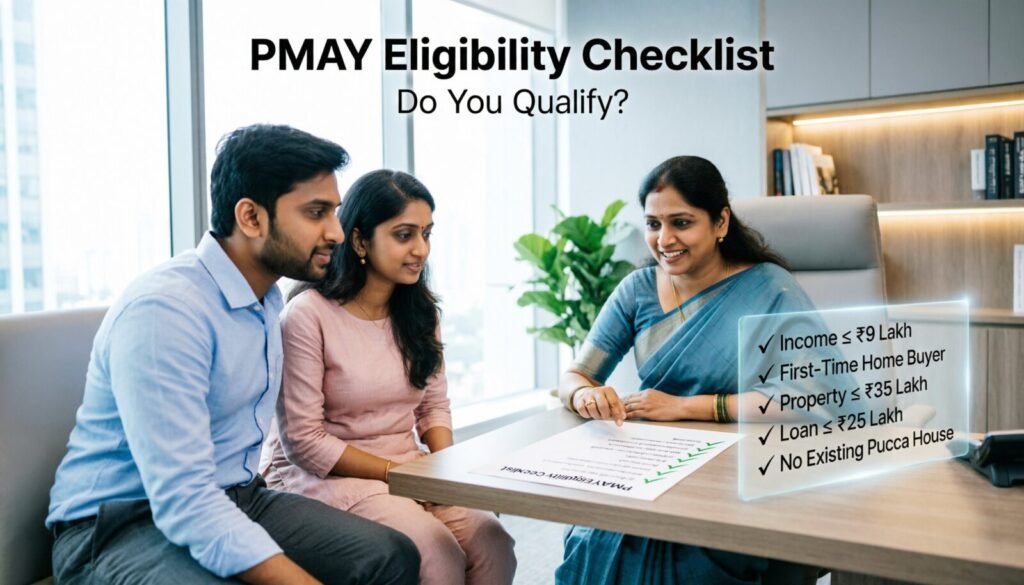
Eligibility has two parts: financial and property-related. Both must be satisfied. Banks do not negotiate on these.
Income-Based Eligibility
| Category | Annual Household Income | Who Counts as “Family” |
|---|---|---|
| EWS | Up to ₹3 lakh | Husband, wife, unmarried sons/daughters |
| LIG | ₹3 lakh to ₹6 lakh | Same as above |
| MIG | ₹6 lakh to ₹9 lakh | Same as above |
Critical point: “Household income” means the combined income of all earning members in the family. If you earn ₹7 lakh and your spouse earns ₹4 lakh, your total is ₹11 lakh — you are not eligible for PMAY-U 2.0.
Property Ownership Rules
- No pucca house anywhere in India — not in your name, not in your spouse’s name, not in the name of any family member.
- No prior housing scheme benefit in last 20 years — if anyone in your family has availed benefit from any Central, State, or Local Self Government housing scheme in the past 20 years, you are ineligible.
- First-time homebuyer only — the loan must be for purchase, construction, or extension of a residential house. Not for buying land alone.
Property Specifications
| Parameter | Requirement |
|---|---|
| Location | Statutory towns as per Census 2011 or subsequently notified towns |
| Max carpet area | 120 sq. m. (1,292 sq. ft.) |
| Max property value | ₹35 lakh |
| Female ownership | Generally mandatory — house must be in the name of the female head of the household or in joint ownership with a male member. Exemptions apply under official PMAY-U 2.0 guidelines for households without an adult female member. |
| Loan tenure | Minimum 5 years; subsidy calculated for up to 12 years |
Eligible vs. Not Eligible — Quick Check
| You ARE Eligible If… | You Are NOT Eligible If… |
|---|---|
| First-time homebuyer in India | You or any family member owns a pucca house anywhere in India |
| Household income ≤ ₹9 lakh per annum | Household income > ₹9 lakh per annum |
| Property carpet area ≤ 120 sq. m. | Carpet area > 120 sq. m. |
| Property value ≤ ₹35 lakh | Property value > ₹35 lakh |
| Property in a statutory town (Census 2011+) | Property in an unnotified rural area (apply under PMAY-Gramin instead) |
| Home loan amount ≤ ₹25 lakh | Loan amount > ₹25 lakh (only first ₹25L considered for scheme) |
| No prior PMAY/CLSS/housing scheme benefit in last 20 years | Any family member availed housing scheme benefit in last 20 years |
| Applying for purchase, construction, or extension | Applying for land purchase only, commercial property, or balance transfer |
| Aadhaar-linked bank account available | No Aadhaar or Aadhaar not linked to bank account |
| Loan tenure ≥ 5 years | Loan tenure < 5 years |
| Female ownership or joint ownership with female | Property solely in male name without a qualifying exemption under PMAY-U 2.0 guidelines |
How Much Subsidy Will You Actually Receive?

The subsidy is calculated as the Net Present Value (NPV) of the interest saved on the eligible loan amount. The government uses a discount rate of 8.5% for this calculation.
Under PMAY-U 2.0:
- Subsidy rate: 4% per annum
- Eligible loan amount: First ₹8 lakh of your home loan
- Subsidy tenure: Up to 12 years (or full loan tenure, whichever is lesser)
- Minimum loan tenure: 5 years
- Maximum actual subsidy released: ₹1.80 lakh
- Maximum NPV of subsidy: ₹1.50 lakh
- Payment structure: 5 equal annual instalments of ₹36,000 each
What If Your Loan Is More Than ₹8 Lakh?
The subsidy applies only to the first ₹8 lakh. The remaining amount is at the normal interest rate charged by your lender.
Example: You take a ₹20 lakh home loan at 8.00% p.a. for 20 years.
Table
| Component | Amount | Interest Rate |
|---|---|---|
| Subsidized portion | ₹8 lakh | 4.00% |
| Non-subsidized portion | ₹12 lakh | 8.00% |
Your lender will calculate a blended EMI, but the key benefit is this: ₹36,000 is credited to your principal each year for 5 years, reducing your outstanding balance instalment by instalment.
How the Subsidy Reduces Your EMI (With Real Numbers)
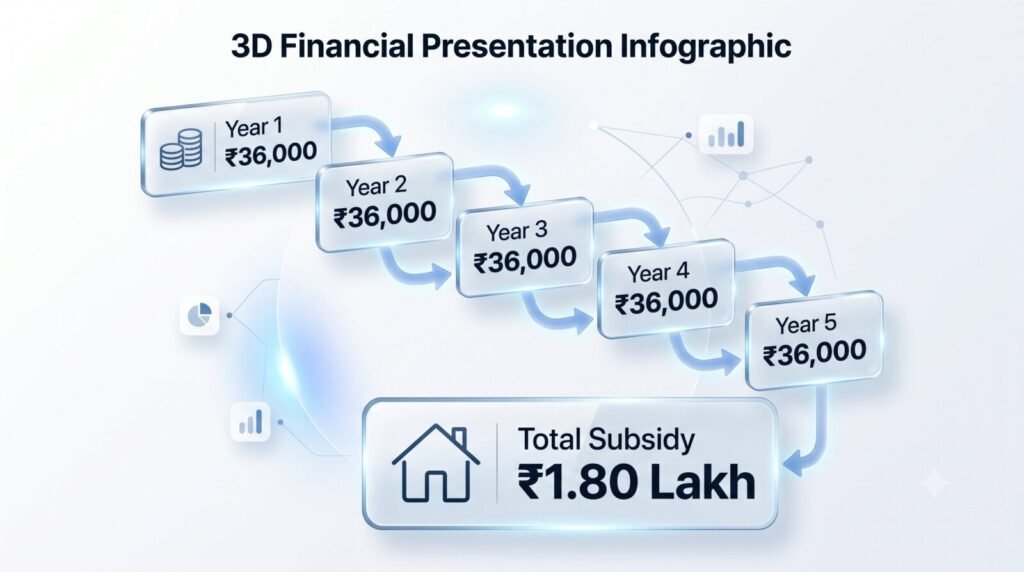
This is where most borrowers get confused. The subsidy does not reduce your interest rate permanently. Instead, the subsidy amount is credited to your loan account in annual tranches. Your lender then either:
- Reduces your EMI (keeping tenure same), or
- Reduces your tenure (keeping EMI same)
Most banks prefer to reduce the tenure because it saves you more interest over time. But you can request EMI reduction if cash flow is tight.
Illustration: ₹20 Lakh Loan at 8.00% for 20 Years
| Scenario | Without PMAY | With PMAY-U 2.0 Subsidy |
|---|---|---|
| Loan amount | ₹20,00,000 | ₹20,00,000 |
| Subsidy credited (Year 1) | — | ₹36,000 |
| Subsidy credited (Years 2–5) | — | ₹36,000 × 4 = ₹1,44,000 |
| Total subsidy over 5 years | — | ₹1,80,000 |
| Effective principal reduction | — | ₹1,80,000 over 5 years |
| EMI (before subsidy impact) | ₹16,729 | ₹16,729 |
| EMI after Year 1 principal reduction | — | ₹16,385 (approx.) |
| Total interest saved over loan life | — | ~₹2,10,000+ |
Real-world scenario from my experience: A school teacher in Pune with ₹5.5 lakh annual income took a ₹15 lakh loan at 7.75% through SBI. Her first PMAY instalment of ₹36,000 was credited within 5 months of disbursement. Her EMI dropped marginally each year as subsequent instalments hit her principal. Over 5 years, the total ₹1.80 lakh reduction saved her approximately ₹2.3 lakh in interest over the remaining loan tenure.
Want to calculate your exact EMI before and after subsidy? Use our Home Loan EMI Calculator or read How Much Home Loan EMI Can You Really Afford?
Step-by-Step: How to Apply for PMAY-U 2.0
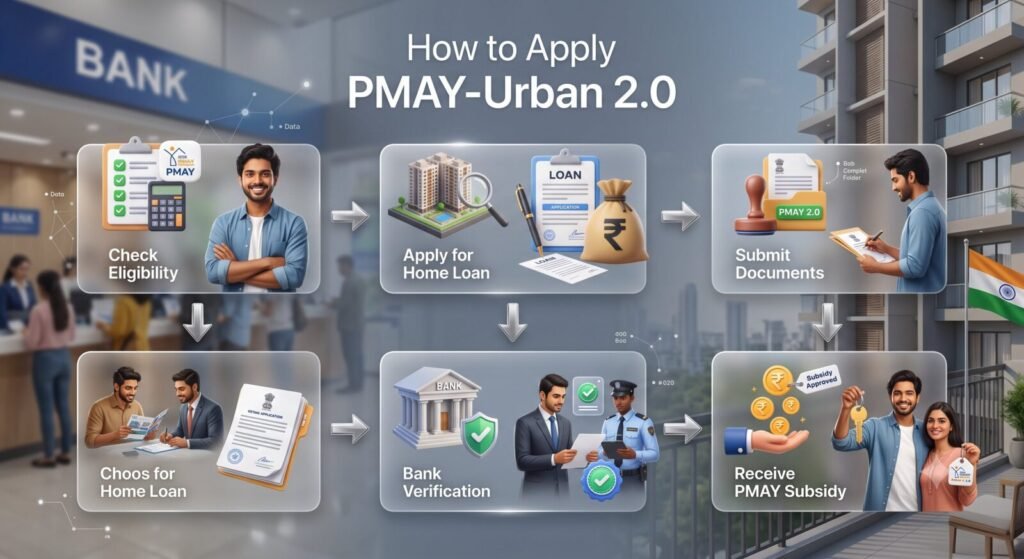
You do not need a broker. You do not need to pay anyone. Here is the exact process.
Method 1: Online (Recommended)
Step 1: Visit the official portal at pmaymis.gov.in or pmay-urban.gov.in
Step 2: Click on “Citizen Assessment” → Select the ISS vertical for home loan subsidy
Step 3: Enter your Aadhaar number for verification. Virtual ID (VID) is also accepted in some cases.
Step 4: Fill the application form with:
- Personal details (name, address, contact)
- Family details (number of members, income)
- Bank account details (Aadhaar-linked)
- Income details (salary slips, ITR, or income certificate)
- Property details (if already identified)
Step 5: Upload required documents and submit. Save the Assessment ID.
Step 6: Approach a PMAY-empanelled lender (SBI, HDFC, ICICI, Axis, PNB Housing, etc.) for your home loan. Inform them you have a PMAY Assessment ID.
Step 7: The bank disburses the loan and forwards your subsidy claim to the Central Nodal Agency (NHB or HUDCO). Participating lenders are expected to submit claims promptly as per MoHUA operational guidelines — delays at the lender’s end can postpone your subsidy processing.
Step 8: Subsidy is credited to your loan account in 5 yearly instalments, typically starting within 3 to 6 months of the first disbursement. You receive an SMS each time an instalment is credited.
Method 2: Offline
Visit a Common Service Centre (CSC) authorized by your state government. Fill the form, pay ₹25 + GST, and submit documents. The CSC will upload your application. No private agent is authorized to collect fees for this.
Method 3: Through Your Bank
Many borrowers apply directly through their home loan lender. The bank officer registers you on the PMAY portal internally. This is the method I recommend — it reduces errors because the bank has a vested interest in getting your subsidy approved (it reduces their risk too).
Important: If your lender is slow to submit the claim, follow up proactively. The sooner the claim reaches the nodal agency, the sooner your instalments begin.
Documents Required (The Checklist Banks Actually Use)
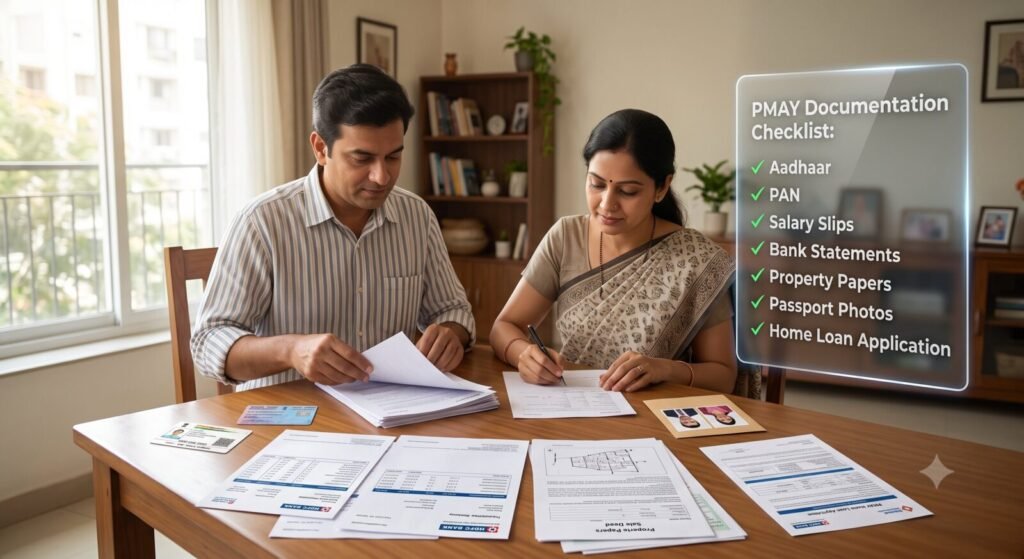
Here is the exact document set I used to verify at the credit desk. Missing even one delays subsidy credit by weeks.
Identity & Address
- Aadhaar Card (mandatory — no exceptions)
- PAN Card
- Voter ID / Passport / Driving Licence (any one)
- Recent passport-size photographs
Income Proof
- Salaried: Last 3 months’ salary slips, Form 16, last 6 months’ bank statements
- Self-employed: Last 2 years’ ITR with computation, GST returns (if applicable), bank statements
- Informal sector: Income certificate from competent authority (Tehsildar/District Magistrate)
Property Proof
- Sale agreement / allotment letter
- NOC from builder (if under construction)
- Property valuation report
- Chain of title documents
- Approved layout plan (as per state/UT guidelines)
PMAY-Specific
- Affidavit declaring no family member owns a pucca house in India
- Income category certificate (EWS/LIG/MIG) — some states require this from designated authorities
- Aadhaar-linked bank account proof (for DBT)
- Self-certificate/affidavit as proof of income (accepted under PMAY-U 2.0 guidelines)
Pro tip from my banking days: The most common delay was name mismatch between Aadhaar, PAN, and property documents. Ensure all spellings match exactly. If your Aadhaar says “Mohd. Ashif” and your PAN says “Mohammad Ashif,” get it corrected before applying.
Which Banks and HFCs Offer PMAY-Linked Loans?
Almost all major lenders are empanelled under PMAY-U. Here is a quick reference:
Table
| Lender Type | Examples |
|---|---|
| Public Sector Banks | SBI, Bank of Baroda, PNB, Canara Bank, Union Bank |
| Private Banks | HDFC Bank, ICICI Bank, Axis Bank, Kotak Mahindra |
| Housing Finance Companies | HDFC Ltd., LIC Housing Finance, PNB Housing Finance, Grihum Housing, Tata Capital Housing |
| Regional Rural Banks | As per state-specific empanelment |
Practical tip: Eligible processing fee support is governed by PMAY-U 2.0 operational guidelines. Borrowers should confirm applicable charges with their participating lender before signing the loan agreement. For loan amounts above the eligible subsidised limit, standard lender processing fees typically apply.
6 Common Reasons PMAY Applications Get Rejected
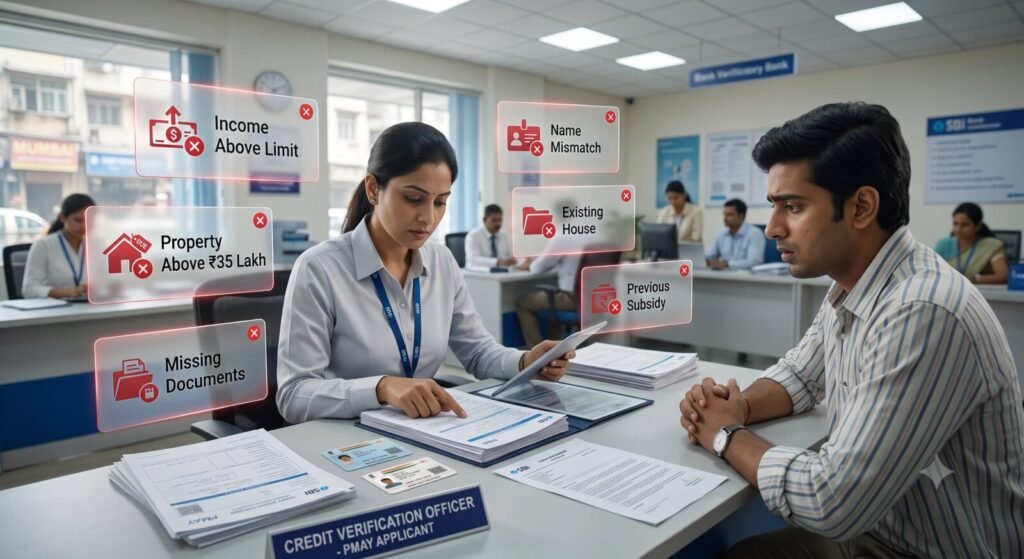
From hundreds of files I processed, these are the rejection patterns I saw repeatedly:
1. Income Bracket Violation
Your household income exceeds ₹9 lakh, or you failed to include your spouse’s income in the calculation. Banks cross-check Form 26AS and bank statements.
2. Prior Property Ownership
The system now auto-verifies against state land records (Bhulekh portals). If your father owns a pucca house in your hometown, and you are an unmarried son living in the same household, you may be flagged.
3. Carpet Area Exceeds 120 sq. m.
Builders sometimes quote “super built-up area.” The scheme looks at carpet area only. A 1,400 sq. ft. super built-up apartment may have 1,100 sq. ft. carpet area — but verify before buying.
4. Property Value Above ₹35 Lakh
If the sale agreement shows ₹36 lakh, you are disqualified. Some buyers try to split payments — this is risky and can lead to legal issues.
5. Name Mismatch Across Documents
Aadhaar, PAN, property documents, and loan application must have identical names. Even minor variations cause portal rejection.
6. Duplicate Subsidy Claim
If your spouse or parent availed PMAY/CLSS earlier, the system flags it through Aadhaar linkage.
PMAY-Urban vs. PMAY-Gramin: Which One Applies to You?
Table
| Feature | PMAY-Urban 2.0 | PMAY-Gramin |
|---|---|---|
| Target | Urban/town residents | Rural residents |
| Benefit type | Interest subsidy on home loan (4% on first ₹8L) | Direct financial assistance |
| Assistance amount | Up to ₹1.80 lakh (5 yearly instalments) | ₹1.20 lakh (plains), ₹1.30 lakh (hilly) |
| Application | Online at pmaymis.gov.in or through bank | Via Gram Panchayat / SECC list |
| Aadhaar linking | Mandatory for DBT | Mandatory for instalment release |
| Female ownership | Generally mandatory; exemptions apply per guidelines | Encouraged |
If you live in a village, you cannot apply for the urban interest subsidy. Your route is through the Gram Panchayat and SECC data.
Frequently Asked Questions
FAQ 1: Is the old CLSS scheme with 6.5% subsidy still available?
No. The old CLSS for EWS/LIG (6.5%) and MIG-I/II (4% and 3%) closed on 31 March 2022. The current active scheme is PMAY-Urban 2.0 with 4% subsidy on the first ₹8 lakh, valid until 31 August 2029.
FAQ 2: I earn ₹10 lakh per year. Can I get any PMAY subsidy?
No. Under PMAY-U 2.0, the MIG income cap is ₹9 lakh per annum. If your household income exceeds this, you are not eligible for the interest subsidy scheme.
FAQ 3: Can I apply for PMAY if I already own a plot of land?
Yes, if you do not own a pucca house (all-weather dwelling). A vacant plot does not disqualify you. However, if you are building under the BLC vertical, the rules differ — consult your local ULB.
FAQ 4: How long does it take to receive the subsidy?
The first instalment is typically credited within 3 to 6 months of loan disbursement. Subsequent instalments are released annually, provided your loan remains active (not NPA) and more than 50% principal is outstanding at the time of each release.
FAQ 5: Does PMAY subsidy apply to under-construction properties?
Yes, provided the builder/project is approved by your lender and the property meets carpet area and value norms. Ensure the builder has RERA registration.
FAQ 6: Can I claim PMAY subsidy on a top-up loan or balance transfer?
No. PMAY subsidy is only for fresh home loans for purchase or construction. Balance transfers and top-up loans are not eligible.
FAQ 7: Is female co-ownership mandatory?
Generally yes. Under PMAY-U 2.0 ISS, the house should be in the name of the female head of the household or in joint ownership with a male member. However, the official guidelines provide exemptions for households where no adult female member is available. Confirm your specific situation with your lender.
FAQ 8: What happens if my income increases after taking the loan?
The subsidy is determined at the time of application and disbursement. A subsequent income increase does not claw back the subsidy already credited.
FAQ 9: Can an unmarried individual apply?
Yes, provided you meet the income criteria and do not own a pucca house. For EWS/LIG, if there is no adult female in the family, male-only ownership is permitted.
FAQ 10: Where can I check my PMAY application status?
Visit pmaymis.gov.in → Citizen Assessment → Track Your Assessment Status. Enter your Assessment ID or your name, father’s name, and mobile number.
Final Thoughts
PMAY-Urban 2.0 is not the generous scheme the old CLSS was — the maximum subsidy has dropped from ₹2.67 lakh to ₹1.80 lakh, and the income cap for MIG is now ₹9 lakh instead of ₹18 lakh. But for eligible first-time buyers, ₹1.80 lakh credited to your principal over 5 years is still meaningful money. It can reduce your EMI gradually or shave years off your loan tenure.
My advice from the credit desk:
- Verify your eligibility before shortlisting properties. A ₹36 lakh house disqualifies you. A 1,300 sq. ft. carpet area disqualifies you.
- Apply through your home loan lender, not independently. The bank has dedicated PMAY cells that understand the documentation better than most CSC operators.
- Match your names across every document. This single step prevents 40% of delays.
- Ensure female ownership is on paper before loan disbursement, or confirm your exemption. Banks will reject your subsidy claim if the property is solely in the male applicant’s name without a qualifying exemption.
- Do not borrow the maximum just because the subsidy is available. Follow the 40% EMI rule I outlined in my Home Loan Affordability Guide.
“Ghar khareedna sapna hai, lekin soch-samajh ke khareedna akal mandi hai.” (Buying a home is a dream, but buying it wisely is smart.)
Official References
This article is based on the following official government sources:
- Ministry of Housing and Urban Affairs (MoHUA): pmay-urban.gov.in — Official PMAY-Urban 2.0 portal and Operational Guidelines (September 2024).
- PMAY MIS Portal:pmaymis.gov.in — Official portal for scheme registration, application tracking, and beneficiary verification.
- National Housing Bank (NHB): Central Nodal Agency for processing and disbursing PMAY interest subsidies to Primary Lending Institutions. NHB PLI User Manual for PMAY-U 2.0 ISS.
- Housing and Urban Development Corporation (HUDCO): Co-nodal agency for subsidy disbursement and monitoring.
- Reserve Bank of India (RBI): Monetary Policy Committee decision, August 5, 2026 — repo rate held at 5.25%.
- IDBI Bank: FAQ on PMAY (Urban) 2.0 ISS — official PLI guidance document.
- Census of India 2011: Statutory town definitions for PMAY-Urban eligibility.
About the Author
Ashok K. Satpute is the founder of PennyPowerPlay.com and a Home Loan Specialist with 8+ years of real-world banking and housing finance experience across leading Indian financial institutions including ICICI Bank, HDFC, Axis Bank, and PNB Housing Finance. He has processed thousands of home loan applications, reviewed hundreds of PMAY subsidy files, and advised borrowers on eligibility, documentation, and lender selection. All content on this site is written from direct professional experience and verified against official government sources.
Related Posts
- Home Loan Eligibility on ₹30,000, ₹50,000, ₹75,000 & ₹1 Lakh Salary
- How Much Home Loan EMI Can You Really Afford?
- Home Loan Application Documents Checklist for India
Educational Disclaimer: This article is for educational and informational purposes only. It does not constitute financial, legal, or professional advice. PMAY eligibility, subsidy amounts, income limits, and scheme rules are subject to change by the Ministry of Housing and Urban Affairs (MoHUA). Please verify all details on the official portal pmaymis.gov.in or pmay-urban.gov.in or consult your bank/housing finance company before applying. All calculations are illustrative and based on scheme parameters as of August 2026.