
By Ashok K. Satpute / August 2, 2026
“Home loan eligibility on a ₹50,000 salary — how much can you actually get? This is the most common question I encountered during my 8+ years in the Indian banking and housing finance sector across ICICI Bank, HDFC, Axis Bank, and PNB Housing Finance.”
This is the most common question I encountered during my 8+ years in the Indian banking and housing finance sector across ICICI Bank, HDFC, Axis Bank, and PNB Housing Finance. Not “What documents do I need?” Not “Which bank is best?”
Just: “Sir, kitna loan milega?” (Sir, how much loan will I get?)
“Home Loan Eligibility: The Short Answer”
| Monthly Gross Salary | Est. Net Salary | Home Loan You Can Get* | Monthly EMI |
|---|---|---|---|
| ₹30,000 | ₹25,500 | ₹13 – ₹15 lakh | ₹10,900 – ₹12,500 |
| ₹50,000 | ₹42,500 | ₹25 – ₹28 lakh | ₹20,900 – ₹23,400 |
| ₹75,000 | ₹63,750 | ₹38 – ₹42 lakh | ₹31,800 – ₹35,100 |
| ₹1,00,000 | ₹85,000 | ₹50 – ₹55 lakh | ₹41,800 – ₹46,000 |
*Illustrative calculations at 8.00% p.a. interest, 20-year tenure, 50% FOIR, CIBIL 750+, zero existing EMIs. Actual eligibility varies by bank and profile.
The long answer: Those numbers move up or down by ₹3–5 lakh depending on which bank you approach, your CIBIL score, existing EMIs, and whether you apply alone or with a co-applicant.
In this guide, I’ll explain the calculation methodology that banks use — drawn from my experience working on thousands of home loan applications across leading Indian lenders. No generic advice. Just the actual framework, with numbers you can verify.
New to home loans? Start with my complete Home Loan Guide for India — it covers the full process before you worry about exact amounts.
Rate Alert: “The Reserve Bank of India Monetary Policy Committee (MPC) is scheduled to meet from August 3–5, 2026. The repo rate is currently held at 5.25% since December 2025.”. Borrowers should watch for any policy announcement that may affect home loan rates.
Disclaimer: Interest rates, processing fees, and eligibility policies may change at any time. Please check with the respective lender or visit their official website before applying. The information in this article is based on publicly available data and professional experience as of August 2026.
How Banks Actually Calculate Eligibility
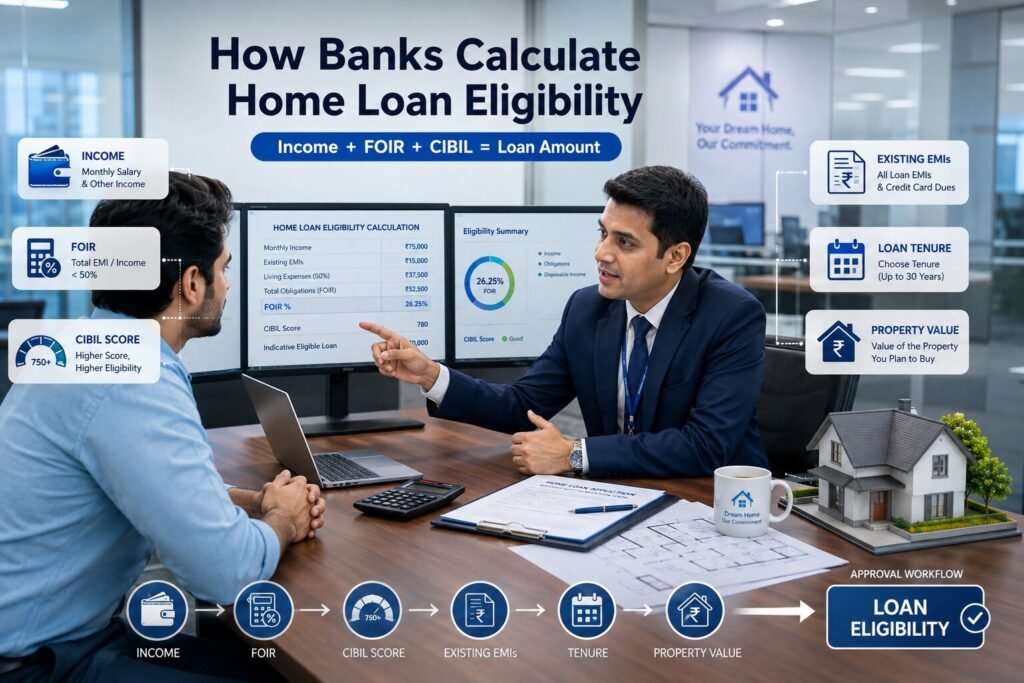
Most articles tell you: “Banks check your income, age, and CIBIL.” That is technically true but practically useless if you want a number.
Here is what actually happens when your application reaches the credit desk.
Every bank uses two methods and approves the lower of the two results.
Method 1: The Income Multiplier (Quick Estimate)
Net Monthly Income × Multiplier = Estimated Loan Eligibility
Many Indian lenders typically use income multipliers in the following ranges, although every bank maintains its own internal credit policy:
| Net Income Bracket | Typical Multiplier Range | Why This Range? |
|---|---|---|
| ₹20,000 – ₹40,000 | 50 – 55x | Conservative approach for lower income brackets |
| ₹40,000 – ₹70,000 | 55 – 60x | Standard middle-income segment |
| ₹70,000 – ₹1,00,000 | 60 – 65x | Lower perceived risk, better repayment capacity |
| Above ₹1,00,000 | 65 – 70x | Preferred customer segment |
Example: At ₹42,500 net salary, a bank using a 60x multiplier would estimate:
₹42,500 × 60 = ₹25.5 lakh
Method 2: FOIR — The Real Gatekeeper
FOIR stands for Fixed Obligation to Income Ratio. This is the metric that most commonly reduces approved loan amounts.
Formula:
(Existing EMIs + Proposed Home Loan EMI) ÷ Net Monthly Income × 100
Typical FOIR ranges used by many Indian lenders:
Table
| Net Monthly Income | Typical Max FOIR |
|---|---|
| Up to ₹30,000 | 40% – 45% |
| ₹30,000 – ₹50,000 | 45% – 50% |
| ₹50,000 – ₹75,000 | 50% – 55% |
| Above ₹75,000 | 50% – 55% |
Important: Banks calculate FOIR on your net salary (after PF, professional tax, and other deductions), not your gross CTC. If your salary slip shows ₹50,000 gross but ₹43,000 net, the bank uses ₹43,000.
Current Interest Rate Landscape (August 2026)
Home loan rates in India are linked to the RBI repo rate, which has been held at 5.25% since December 2025 after a series of cuts through 2025. The next MPC review is scheduled for August 3–5, 2026.
Below are indicative rates compiled from aggregator data and bank disclosures as of July–August 2026. Rates change frequently based on campaigns, CIBIL score, employer profile, and loan amount. Always verify on the official bank website before applying.
| Bank / NBFC | Indicative Interest Rate | Processing Fee (Indicative) |
|---|---|---|
| SBI | Starting 7.25% p.a. onwards | Up to 0.35% (Min ₹2,000, Max ₹10,000) + GST |
| HDFC | 7.20% – 13.20% p.a. | Up to 0.50% (Min ₹4,000) + applicable taxes |
| ICICI | 7.50% – 9.80% p.a. | Up to 0.50% (Min ₹3,000) + GST |
| Axis | 8.00% – 11.90% p.a. | Up to 1% (Min ₹10,000) + GST |
Sources: Official SBI, HDFC Bank, ICICI Bank, Axis Bank websites and publicly available product disclosures (accessed August 2026).
Observation from my banking experience: SBI often offers the lowest processing fee and competitive starting rates. However, SBI is also generally more conservative on eligibility calculations. Private lenders like HDFC and ICICI may approve slightly higher eligibility amounts for the same salary profile, though sometimes at a marginally higher rate. It is worth comparing 2–3 lenders.
Exact Home Loan Eligibility by Salary
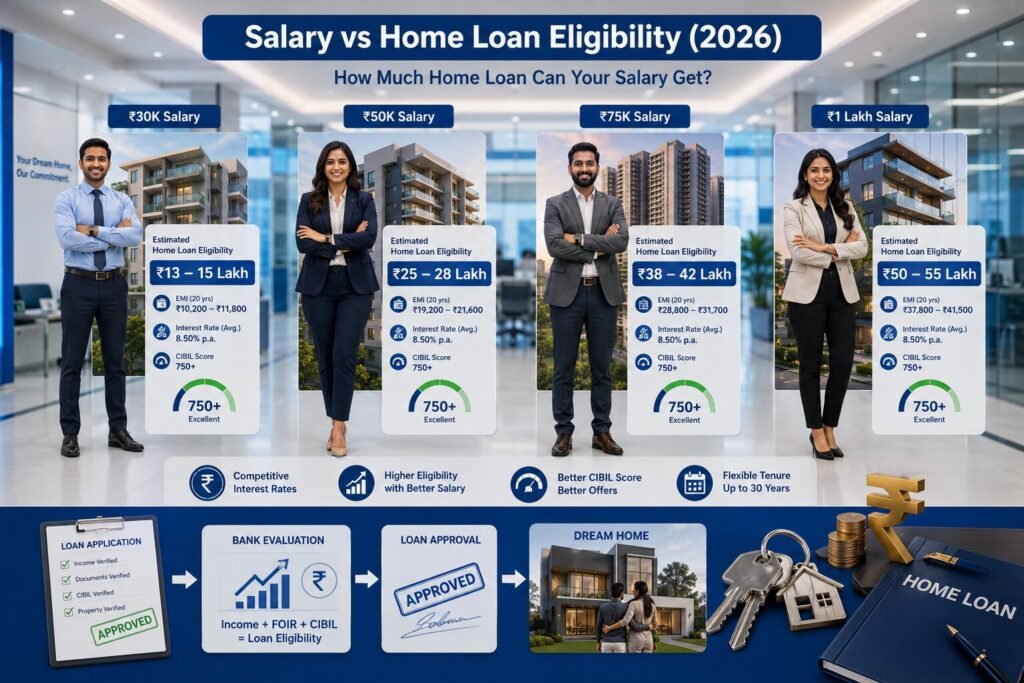
The tables below use 8.00% p.a. as an illustrative interest rate (close to the current market average for strong profiles) and assume:
- Tenure: 20 years
- CIBIL score: 750+
- No existing EMIs
- Net salary: For illustration, this guide assumes net salary is approximately 85% of gross salary. Your actual take-home salary may vary depending on PF, taxes, professional tax, and other deductions.
₹30,000 Salary
| Parameter | Value |
|---|---|
| Gross Salary | ₹30,000 |
| Est. Net Salary | ₹25,500 |
| Max EMI (45% FOIR) | ₹11,475 |
| Est. Eligibility (Multiplier ~55x) | ₹14.0 lakh |
| Final Eligibility Range | ₹13 – ₹15 lakh |
| Monthly EMI | ₹10,900 – ₹12,500 |
At this income level, home loan eligibility for most borrowers is capped at around ₹14–15 lakh unless a co-applicant is added or an existing banking relationship exists.
Planning to apply? Use our Home Loan Application Documents Checklist to avoid multiple trips to the branch.
₹50,000 Salary
| Parameter | Value |
|---|---|
| Gross Salary | ₹50,000 |
| Est. Net Salary | ₹42,500 |
| Max EMI (50% FOIR) | ₹21,250 |
| Est. Eligibility (Multiplier ~60x) | ₹25.5 lakh |
| Final Eligibility Range | ₹25 – ₹28 lakh |
| Monthly EMI | ₹20,900 – ₹23,400 |
This salary range generally falls within a common lending segment that banks actively serve. With a clean CIBIL and stable employment, approval is typically straightforward.
Illustrative scenario based on typical lending patterns:
A software engineer with ₹52,000 net salary, CIBIL 780, and no existing loans approached HDFC and was offered ₹26 lakh at approximately 7.85%. His salary account bank, ICICI, offered ₹28 lakh at approximately 7.75% due to the existing relationship. Name and details changed for privacy. Based on typical lending scenarios.
₹75,000 Salary
| Parameter | Value |
|---|---|
| Gross Salary | ₹75,000 |
| Est. Net Salary | ₹63,750 |
| Max EMI (55% FOIR) | ₹35,060 |
| Est. Eligibility (Multiplier ~65x) | ₹41.4 lakh |
| Final Eligibility Range | ₹38 – ₹42 lakh |
| Monthly EMI | ₹31,800 – ₹35,100 |
At this salary level, home loan eligibility improves significantly. Borrowers often qualify for pre-approved home loan offers. Banks may also reduce processing fees or offer marginal rate discounts for strong profiles.
₹1,00,000 Salary
| Parameter | Value |
|---|---|
| Gross Salary | ₹1,00,000 |
| Est. Net Salary | ₹85,000 |
| Max EMI (55% FOIR) | ₹46,750 |
| Est. Eligibility (Multiplier ~70x) | ₹59.5 lakh |
| Final Eligibility Range | ₹50 – ₹55 lakh |
| Monthly EMI | ₹41,800 – ₹46,000 |
For ₹1 lakh earners, home loan eligibility reaches the premium tier. Borrowers in this bracket are typically classified as preferred customers. Lenders may offer reduced processing charges and relatively faster turnaround times for complete applications.
Bank-Wise Comparison: SBI vs HDFC vs ICICI vs Axis
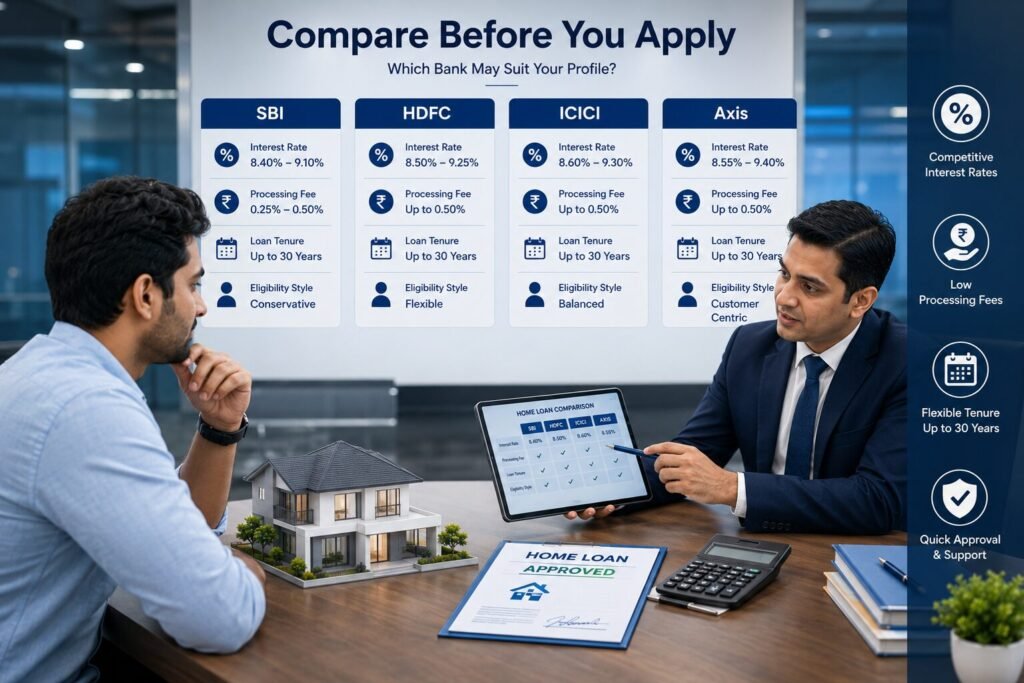
| Parameter | SBI | HDFC | ICICI | Axis |
|---|---|---|---|---|
| Indicative Rate | Starting 7.25% p.a. | 7.20% – 13.20% p.a. | 7.50% – 9.80% p.a. | 8.00% – 11.90% p.a. |
| Processing Fee | ~0.35% (₹2K–₹10K) | ~0.50% (Min ₹4K) | ~0.50% (Min ₹3K) | ~1% (Min ₹10K) |
| Max Tenure | Up to 30 years | Up to 30 years | Up to 30 years | Up to 30 years |
| Eligibility Style | Conservative; strict net salary check | Flexible for existing customers | Aggressive for IT professionals | Flexible for co-applicant loans |
Practical tip: A 0.10% rate difference on a ₹25 lakh loan changes your EMI by roughly ₹250/month. But a ₹3 lakh difference in eligibility can determine whether you can afford your chosen property. Compare both rate and eligibility across lenders.
5 Factors That Change Your Eligibility

1. Existing Loans (The Biggest Reducer)
If you already pay:
- Car loan EMI: ₹8,000
- Personal loan EMI: ₹5,000
Your existing obligation of ₹13,000 is deducted from your FOIR capacity. At ₹50,000 net salary with a 50% FOIR cap (₹21,250), your remaining home loan EMI room is only ₹8,250 — dropping eligibility from ~₹25 lakh to roughly ₹10–11 lakh.
Solution: Close unsecured loans first. Car loans with fewer than 12 EMIs remaining are sometimes excluded from FOIR calculations by certain lenders.
2. CIBIL Score
Table
| CIBIL Score | Typical Impact |
|---|---|
| 800+ | Best rates, full eligibility |
| 750 – 799 | Standard eligibility |
| 700 – 749 | Possible 5–10% reduction; higher rate |
| 650 – 699 | Significant reduction; may need guarantor |
| Below 650 | Approval becomes difficult with most banks; NBFCs may consider at higher rates |
If your CIBIL is below 700, read our guide on Home Loan Rejection Reasons before applying.
3. Co-Applicant (The Eligibility Multiplier)
| Primary Salary | Co-Applicant Salary | Combined Est. Eligibility |
|---|---|---|
| ₹50,000 | ₹30,000 | ₹40 – ₹45 lakh |
| ₹50,000 | ₹50,000 | ₹50 – ₹56 lakh |
| ₹75,000 | ₹50,000 | ₹65 – ₹72 lakh |
Banks assess combined FOIR. Two incomes = higher obligation capacity = larger loan amount.
4. Interest Rate Fluctuations
A higher rate reduces eligibility because the EMI for the same loan amount increases.
| Interest Rate | ₹25 Lakh EMI (20 years) | Est. Eligibility at ₹50K Net Salary |
|---|---|---|
| 7.50% | ₹20,140 | ₹27 lakh |
| 8.00% | ₹20,911 | ₹25 lakh |
| 8.50% | ₹21,696 | ₹24 lakh |
| 9.00% | ₹22,493 | ₹23 lakh |
Note: With the RBI holding the repo rate at 5.25% and inflation projected at 5.1% for FY27, some economists have indicated that a rate adjustment may be possible in future MPC meetings. If you are rate-sensitive, consider locking in your rate or choosing a fixed-rate product.
5. Age and Tenure
Banks prefer loans to close by retirement age (typically 60). A 45-year-old applicant may receive a maximum 15-year tenure instead of 30 years. Shorter tenure = higher EMI = lower eligibility.
Should You Borrow the Maximum Amount?
My professional recommendation: Keep your home loan EMI within 40% of your net monthly income, even if the bank permits 50–55%.
| Net Salary | Bank May Allow | Safer EMI Limit |
|---|---|---|
| ₹50,000 | Up to ₹21,250 | Maximum ₹17,000 |
| ₹75,000 | Up to ₹35,000 | Maximum ₹28,000 |
| ₹1,00,000 | Up to ₹46,750 | Maximum ₹34,000 |
Life brings unexpected expenses — medical emergencies, education costs, job transitions. A 55% FOIR leaves almost no financial buffer.
Not sure what EMI is safe for you? Read: How Much Home Loan EMI Can You Really Afford?
Frequently Asked Questions
FAQ 1: Can I get a home loan on ₹25,000 salary?
Yes, but with limitations. You may qualify for approximately ₹10 – ₹12 lakh. A co-applicant or longer tenure (25–30 years) can improve the amount. Consider properties in your budget range or explore government housing schemes if available.
FAQ 2: Does my bonus or incentive count?
Partially. Most banks count:
- Fixed salary components: 100%
- Average variable pay: 50–70%
- One-time bonuses: Generally not counted
FAQ 3: I am 45 years old. Will my eligibility be lower?
Yes. Lenders usually want the loan repaid by age 60–65. At 45, your maximum tenure may be capped at 15–20 years instead of 30. Shorter tenure means higher EMI, which reduces the eligible loan amount.
FAQ 4: How can I increase eligibility without a salary hike?
Four practical ways:
- Add a co-applicant (spouse or parent with income)
- Close existing loans to improve FOIR
- Opt for a longer tenure (if age permits)
- Increase your down payment to reduce the required loan amount
FAQ 5: Which bank offers the highest eligibility for ₹50,000 salary?
From industry patterns: ICICI Bank and Axis Bank tend to be relatively aggressive on eligibility for salaried professionals, particularly in the IT sector. SBI is typically more conservative but offers competitive starting rates and lower processing fees. HDFC generally sits in the middle. It is advisable to get pre-approved offers from 2–3 lenders.
FAQ 6: What is the minimum CIBIL score for a home loan?
Most banks prefer 700+. SBI and HDFC may consider applications in the 650–699 range at higher rates. ICICI Bank typically reserves its best rates for 750+. Below 650, approval becomes difficult with most banks, though some NBFCs may consider the application at significantly higher rates.
FAQ 7: Are processing fees negotiable?
Sometimes. Premium profiles (strong CIBIL, stable employment, high income) may receive processing fee waivers or reductions during festive campaigns or special promotions. SBI generally charges the lowest processing fee. It is always worth asking: “Is there any current waiver or discount on processing charges?”
Final Thoughts
The tables in this article give you a realistic starting point. Your exact eligibility depends on your salary structure, CIBIL report, existing obligations, age, and the specific lender’s internal credit policy.
My advice: Before house hunting, obtain pre-approved home loan offers from 2–3 banks. It costs nothing, takes a few days, and gives you a concrete budget — so you don’t fall in love with a property outside your reach.
“Want the complete picture?” Read our detailed guide on Home Loan Eligibility for Salaried Employees covering documents, CIBIL requirements, and the full approval process.
Have a specific salary or situation not covered here? Drop your question in the comments and I will help you estimate your eligibility.
Educational Disclaimer: This article is for educational and informational purposes only. It does not constitute financial, legal, or professional advice. Home loan eligibility, interest rates, processing fees, and terms vary by lender and individual credit profile. Please consult your bank, housing finance company, or a SEBI-registered financial advisor before making any borrowing decisions. All calculations in this article are illustrative and may differ from actual bank offers.