By Ashok / August 8, 2026
“CIBIL score for home loan approval in India is 750 really mandatory? ‘Sir, mera CIBIL 720 hai, kya home loan mil jayega?’ I have heard this question at least a thousand times…”
I have heard this question at least a thousand times across ICICI Bank, HDFC, Axis Bank, and PNB Housing Finance. And every time, my answer starts the same way: “It depends. CIBIL is important, but it is not the only thing.”
Here is the truth most DSA agents and online articles won’t tell you: there is no single CIBIL score that guarantees home loan approval in India. Not 750. Not 800. Not even 900. I have sanctioned loans to borrowers with 680 CIBIL, and I have rejected borrowers with 820 CIBIL. The difference was never just the three-digit number.
“Let us start with the most common question about CIBIL score for home loan applicants.”
In this guide, I will show you exactly how lenders actually use your CIBIL score, what happens at different score ranges, why a high score can still get rejected, and what you should do 3–6 months before applying for your home loan.
“This CIBIL score guide explains what Indian home buyers actually need to know before applying for a home loan — based on real lending decisions, not generic definitions.”
Rate Alert: The RBI MPC on August 5, 2026 unanimously decided to keep the repo rate unchanged at 5.25%, maintaining a neutral stance. Home loan rates remain stable, With the repo rate currently at 5.25%, borrowers can use this period to review their CIBIL profile and prepare their home-loan application.
“Before we look at the ranges, here is what a CIBIL score for home loan actually means.”
| Factor | What Most People Think | What Actually Happens at the Credit Desk |
|---|---|---|
| Minimum CIBIL needed | “750 is mandatory” | No universal minimum. Each lender sets its own policy. |
| 800+ CIBIL | “Automatic approval” | Still rejected if income, property, or FOIR is weak. |
| 650–699 CIBIL | “Impossible to get loan” | Possible with stronger income, co-applicant, or higher down payment. |
| Below 650 CIBIL | “No chance” | Difficult but not impossible with compensating factors. |
| No CIBIL (NH/NA) | “Bad credit” | Not automatically negative. Lender may assess differently. |
Critical Rule: CIBIL scores range from 300 to 900. A score above 700 is generally considered good. A score above 750 is often viewed favorably. But CIBIL does not approve loans — lenders do. And they look at your complete financial profile, not just three digits.
Disclaimer: The information in this article is for educational purposes only. CIBIL scores, lender policies, and RBI regulations are subject to change. Always verify current terms directly with your chosen lender before making financial decisions. PennyPowerPlay does not provide financial advice.
What Is a CIBIL Score for Home Loan Approval?
CIBIL Score for Home Loan: The Complete Breakdown
A CIBIL Score is a three-digit summary of your credit history that helps lenders assess your creditworthiness. It is generated by TransUnion CIBIL, one of India’s four credit bureaus.
- 300 = Lower end of the range (higher credit risk)
- 900 = Highest possible score (lower credit risk)
According to CIBIL’s own guidance, the score is derived primarily from information in the Accounts and Enquiries sections of your credit report:
- Accounts: Your loans, credit cards, repayment history, outstanding balances, and credit limits.
- Enquiries: Records of lenders who have accessed your credit report when you applied for credit.
Here is what CIBIL itself says:“The lender, not CIBIL, makes the final lending decision.”
This is the first thing borrowers misunderstand. They think CIBIL is a gatekeeper. It is not. It is a reference tool. The bank’s credit officer makes the call.
CIBIL Score Table: Where Do You Stand?
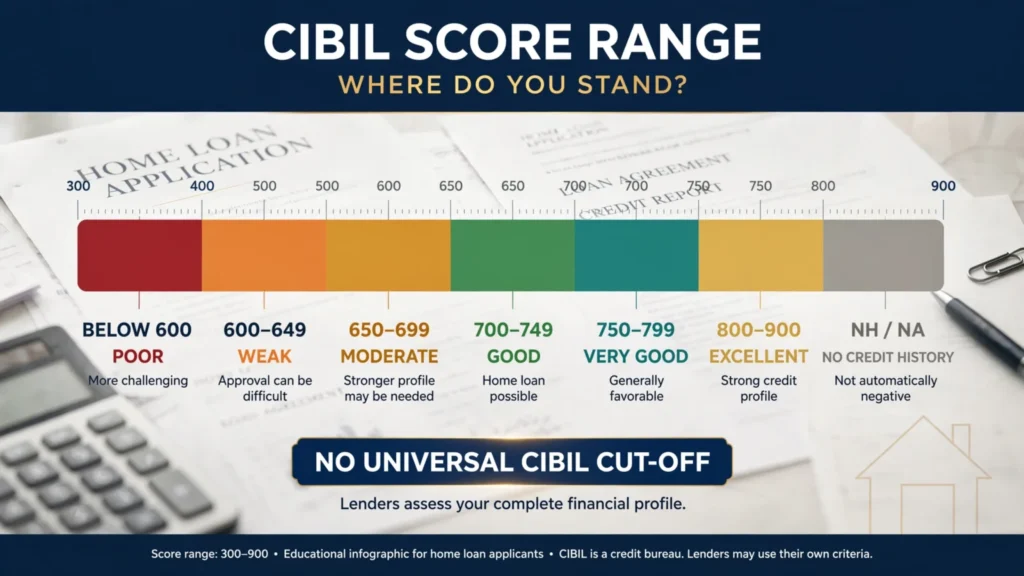
| CIBIL Score | General Interpretation | Home Loan Position |
|---|---|---|
| 800 – 900 | Excellent | Strong credit profile; generally favorable underwriting |
| 750 – 799 | Very Good | Generally favorable across most lenders |
| 700 – 749 | Good | Possible, subject to lender criteria and overall profile |
| 650 – 699 | Moderate | May require stronger income, lower FOIR, or larger down payment |
| 600 – 649 | Weak | Approval can be difficult; limited lender options |
| Below 600 | Poor | Home loan may be difficult without significant compensating factors |
| NH / NA | No/Limited Credit History | Lender may assess differently; not automatically negative |
Important: These are educational ranges, not official universal bank cut-offs. Lenders use their own credit policies and consider your complete borrower profile.
Why CIBIL Matters for Home Loan Approval

Your CIBIL score matters because it gives the lender a quick, data-driven snapshot of how you have managed credit in the past. At the credit desk, I used it to evaluate:
- Repayment History — Have you paid your EMIs and credit card bills on time?
- Credit Risk — How likely are you to default on a large home loan?
- Existing Obligations — How much debt do you already carry?
- Credit Card Behavior — Do you max out your cards or pay in full?
- Recent Credit Enquiries — Have you applied for multiple loans recently?
- Past Defaults — Have you ever settled a loan or missed payments?
- Outstanding Amounts — How much do you currently owe relative to your limits?
However, CIBIL is only one part of the home loan decision. Let me show you a real example from my files:
| Factor | Applicant A | Applicant B |
|---|---|---|
| CIBIL Score | 800 | 730 |
| Monthly Salary | ₹60,000 | ₹1,00,000 |
| Existing EMI | ₹25,000 | ₹5,000 |
| FOIR | ~42% | ~5% |
| Property | Under-construction, approved builder | Resale, 20 years old |
Who got the loan?
Applicant B, despite the lower CIBIL score. Why? Because Applicant A’s existing obligations left almost no room for a home loan EMI, and the under-construction property required additional developer verification that delayed approval.
This is why articles that simply say “You need 750 CIBIL to get a home loan” are misleading. At the credit desk, we look at the full picture.
Is 750 CIBIL Mandatory for a Home Loan?
No. 750 is not a universal mandatory cut-off.
I cannot stress this enough. During my 8+ years in banking, I have seen loans sanctioned at 680 CIBIL and rejected at 820 CIBIL. The difference was never just the score.
What you should know:
- There is no RBI-mandated minimum CIBIL score for home loans.
- Public sector banks (SBI, PNB, Bank of Baroda) may be more flexible with moderate scores if other factors are strong.
- Private banks and HFCs often have stricter internal benchmarks, but even they evaluate the full profile.
- Some lenders use their own internal credit scores in addition to CIBIL.
- ICICI Bank’s educational material discusses 700 as a commonly considered minimum, while describing 725–749 as a good range.
The safe way to think about it:“A higher CIBIL score generally strengthens your home loan application, but lenders use their own credit policies and consider your complete financial profile.”
Pro Tip from My Credit Desk: If your CIBIL is between 700–749, do not assume you will get rejected. Instead, strengthen your application in other areas: reduce existing credit card balances, ensure your ITR is clean, and consider a higher down payment to improve your LTV ratio. These compensating factors often matter more than 20–30 CIBIL points.
CIBIL Score 800+: What It Really Means
A score in this range generally indicates:
- A strong credit profile with consistent repayment behavior
- Potentially easier underwriting and faster processing
- Better negotiating position for interest rates (depending on lender policy)
- Higher likelihood of approval for the requested loan amount
RBI’s financial awareness material also notes that, all else being equal, borrowers with higher credit scores will usually be able to borrow at a lower rate because lenders price risk based on creditworthiness.
But here is the catch: Even with 800+ CIBIL, you can still face rejection if:
- Your income is insufficient for the requested loan amount
- Your existing obligations push FOIR beyond the lender’s limit (typically 50–60%)
- The property has legal or technical issues
- Your employment is unstable or your business is too new
- You have too many recent credit enquiries (yes, even with 800 CIBIL)
I once handled a case involving a borrower with an 810 CIBIL score who had changed jobs four times in two years. The credit score was strong, but employment stability became a concern during assessment.
CIBIL Score 750–799
This is the comfort zone for most lenders. If you are in this range, your CIBIL score is unlikely to be the reason for rejection — provided everything else is in order.
What lenders typically see:
- Consistent repayment history
- Reasonable credit utilisation
- No recent defaults or settlements
- Stable credit behavior
What you should do: Focus on the other parts of your application. Make sure your income documents are complete, your property is legally clear, and your FOIR is within limits. Do not get complacent just because your CIBIL is strong.
CIBIL Score 700–749
Yes, approval is very much possible in this range. Many Indian borrowers fall into this bracket, and lenders regularly approve home loans for scores between 700 and 749.
“A CIBIL score for home loan in the 700–749 range is still very workable.”
What matters alongside your score:
- Stable income (salaried for 2+ years, self-employed for 3+ years)
- Reasonable FOIR (generally below 50–55% for salaried, 40–50% for self-employed)
- Clean repayment history in the last 12–24 months
- Acceptable property with clear title and legal verification
- Sufficient down payment (lower LTV reduces lender risk)
Pro Tip from My Credit Desk: If your score is in this range, avoid applying to multiple lenders simultaneously. A lender’s credit enquiry is recorded as a hard enquiry and multiple enquiries over a short period can negatively affect your credit profile. Research 2–3 lenders, check their indicative criteria, and apply to the one where your profile fits best.
CIBIL Score 650–699
This is where it gets more nuanced. Approval is possible, but your application may require a stronger overall profile to compensate.
Lenders may:
- Ask for a higher down payment (lower LTV)
- Charge a slightly higher interest rate to offset risk
- Require a co-applicant with a stronger credit profile
- Reduce the loan amount relative to your income
- Scrutinize your income documents more closely
If you are in this range, I strongly recommend reading our guide on Home Loan Rejection Reasons to understand what banks look for and how to strengthen your application before applying.
CIBIL Score Below 650
This is challenging, but not impossible in every case. Options may include:
- Adding a strong co-applicant (spouse or parent with good CIBIL)
- Opting for a lower loan amount with a higher down payment
- Approaching your existing bank where you have a long relationship
- Waiting 6–12 months to improve your score before applying
- Considering NBFCs that may have more flexible policies (though at higher rates)
Critical Warning: “Multiple loan applications can affect your CIBIL score because each lender’s credit enquiry is recorded on your credit report. If your score is below 650, don’t apply randomly to 5–6 lenders. First understand why your score is low and work on strengthening your profile.”
Can You Get a Home Loan Without a CIBIL Score?
Yes, in some cases. Your CIBIL report may show NH (No History) or NA (Not Available) if:
- You have never taken a loan or credit card
- You are a first-time borrower
- You are young and recently started earning
- Your credit history is too short to generate a score
CIBIL explicitly states that NA/NH is not necessarily a bad thing. However, some lenders may have policies that make lending more difficult for applicants without a conventional credit history.
What you can do:
- Apply with a co-applicant who has an established credit history
- Build credit first with a secured credit card or small consumer loan
- Approach a bank where you already hold a salary account or fixed deposits
- Provide additional income documentation to demonstrate repayment capacity
Pro Tip from My Credit Desk: If you are a first-time borrower with no CIBIL history, start with your salary account bank. They already know your cash flow. A 2-year salary credit history can sometimes compensate for the absence of a CIBIL score, especially if your income is stable and your account has no bounces.
Why a Good CIBIL Score Does NOT Guarantee Home Loan Approval

This is one of the most misunderstood aspects of home lending in India. Let me be absolutely clear:
A borrower can have an 800 CIBIL score and still face problems if:
- Their income is insufficient for the requested loan amount
- Their existing obligations push FOIR beyond the lender’s cap
- The property does not satisfy the lender’s legal or technical requirements
- Their business income is erratic or poorly documented
- They have too many recent credit enquiries
- Their age plus loan tenure exceeds the lender’s retirement policy
Other factors lenders consider:
| Factor | Why It Matters | Typical Lender Expectation |
|---|---|---|
| Monthly Income | Determines EMI affordability | Minimum income varies by lender, location, occupation, loan amount and borrower profile. |
| Existing EMIs | Affects FOIR and remaining capacity | Total FOIR generally under 50–60% |
| FOIR | Fixed Obligations to Income Ratio | Salaried: up to 50–55%; Self-employed: up to 40–50% |
| Age | Affects maximum loan tenure | Loan should close before retirement (60–65 years) |
| Employment Stability | Frequent job changes raise red flags | 2+ years at current job for salaried |
| Business Vintage | Self-employed need established business | 3+ years in current business |
| Property Value | Determines LTV and loan amount | As per bank’s approved valuer |
| LTV Ratio | RBI caps LTV at 75–90% | RBI regulatory LTV ceiling: up to 90% for loans up to ₹30 lakh, up to 80% for loans above ₹30 lakh and up to ₹75 lakh, and up to 75% for loans above ₹75 lakh, subject to applicable regulations and lender policy. |
| Down Payment | Higher down payment = lower lender risk | Minimum 10–20% of property value |
| Bank Statements | Reveals spending patterns and cash flow | 6–12 months, no bounces |
| ITR / Income Tax Returns | Validates declared income | Last 2–3 years for salaried; 3 years for self-employed |
| Property Legal Verification | Ensures clear title and no disputes | Advocate’s legal opinion |
| Technical Valuation | Confirms property value matches market rates | Bank’s empanelled valuer |
This is why we always recommend borrowers use our Home Loan Eligibility Calculator and read our Home Loan Guide India before applying.
How CIBIL Score Is Calculated
CIBIL identifies four major factors that influence your score:
1. Payment History
This is generally considered the most influential factor. Late EMI or credit card payments can significantly hurt your score. Even a single missed or delayed payment can remain on your report for years and affect future lending decisions.
2. Credit Utilisation
Using a very high proportion of your available revolving credit (credit cards) can negatively affect your profile. Try to keep utilisation below 30% of your total limit.
3. Age of Credit
A longer, well-managed credit history is viewed favorably. This is why financial advisors often recommend not closing your oldest credit card without understanding the impact.
4. Credit Enquiries
Multiple loan or credit card applications over a short period create multiple “hard enquiries” and can lower your score temporarily.
5. Credit Mix
A healthy mix of secured loans (home loan, car loan) and unsecured credit (credit cards, personal loan) can positively influence your profile.
How to Improve Your CIBIL Score Before Applying for a Home Loan

If your score needs work, start preparing at least 3–6 months before you apply for a home loan. Here is the action plan I give to borrowers at the credit desk:
Step 1: Pay Every EMI and Credit Card Bill on Time Set up auto-debits or calendar reminders. Payment history is the single biggest factor. A missed or late payment can negatively affect your CIBIL score, and the impact varies depending on your individual credit profile and overall repayment history.
Step 2: Reduce Outstanding Credit Card Balances Pay down cards to below 30% utilisation. If you have ₹1 lakh total limit, keep outstanding below ₹30,000. I have seen borrowers improve their score by 40–60 points just by clearing credit card dues.
Step 3: Avoid Unnecessary New Loans Do not take a personal loan or new credit card just before applying for a home loan. It increases your enquiries and your FOIR.
Step 4: Don’t Make Multiple Loan Applications Each application creates a hard enquiry. Research lenders first, then apply to 1–2 where you have the best chance. I have seen borrowers apply to 6 banks in one month and watch their CIBIL drop from 720 to 690.
Step 5: Check Your Credit Report for Errors Download your free CIBIL report once per year from the official CIBIL website and verify every account. Errors are more common than you think.
Step 6: Clear Overdue Accounts If you have any “written off” or “settled” accounts, try to clear them and obtain a “closed” status from the lender. A “settled” status is a red flag at most banks.
Step 7: Don’t Close Old Credit Accounts Without Understanding the Impact Closing your oldest credit card can reduce your “age of credit” and hurt your score. If the card has no annual fee, keep it active with a small transaction every few months.
Step 8: Monitor Your Credit Report Before Applying Check your score 2–3 months before applying so you have time to fix issues.
How Long Does It Take to Improve CIBIL Score?
There is no fixed timeline. Improvement depends on:
- What caused the low score — A single missed payment recovers faster than a default.
- Repayment behavior — Consistent on-time payments build trust over 6–12 months.
- Credit utilisation — Reducing card balances can show impact within 1–2 billing cycles.
- Lender reporting — CIBIL updates when lenders report (usually monthly).
- Correction of errors — Disputing and correcting errors can show results in 30–45 days.
- Overall credit history — Older negative marks have less impact over time.
Realistic expectation: If you have a moderate score (650–699) and follow the steps above, you may see meaningful improvement within 3–6 months. For scores below 600, plan for 6–12 months of disciplined credit behavior.
Pro Tip from My Credit Desk: Do not fall for “CIBIL repair” agencies that promise to fix your score in 30 days for a fee. Most of what they do — disputing errors, paying down balances, stopping new applications — you can do yourself for free. The only thing that genuinely improves CIBIL is consistent, responsible credit behavior over time.
How to Check Your CIBIL Report
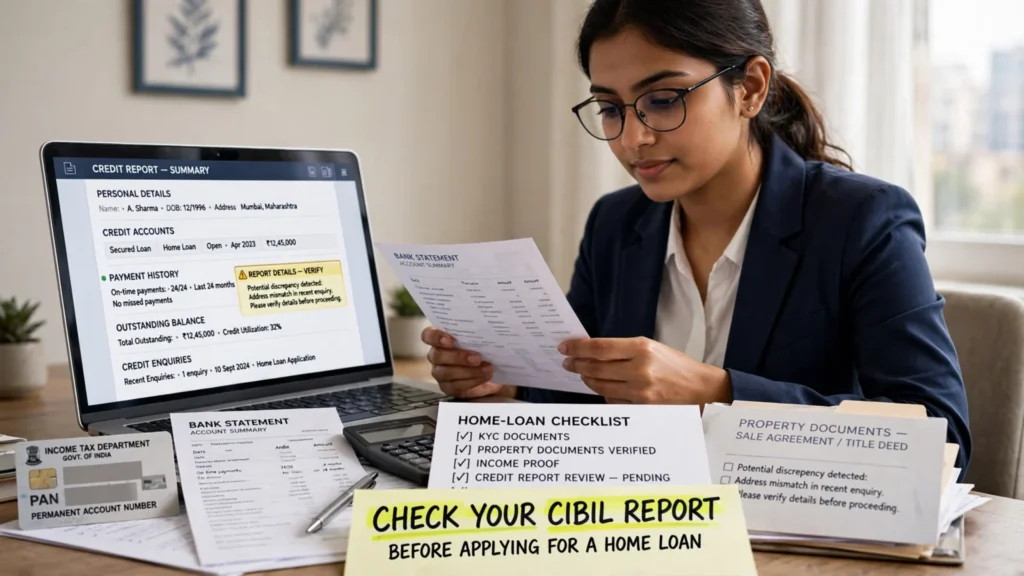
CIBIL currently provides a free CIBIL Score and Report once per calendar year through its official website: www.cibil.com
What to check in your report:
- Is your personal information (name, PAN, address) correct?
- Are all listed accounts actually yours?
- Is any closed loan still showing as active?
- Are there any incorrect overdue amounts?
- Are there enquiries you did not authorize?
Tip: I recommend checking your CIBIL report at least 2–3 months before applying for a home loan. This gives you time to dispute errors and improve your profile. Do not wait until the week before your property booking.
What If Your CIBIL Report Contains a Mistake?
Errors in credit reports are more common than you think. At the credit desk, I have seen:
- Loan shown as active after full closure
- Wrong overdue amount reported
- Payment incorrectly marked as late
- Account that does not belong to you
- Incorrect personal information
- Duplicate account entries
- Unauthorized enquiry records
How to correct errors:
- Identify the error — Note the account number, lender name, and exact discrepancy.
- Raise a dispute — Use CIBIL’s online dispute resolution portal or contact the lender directly.
- Follow up — The lender must investigate and respond within 30 days.
- Escalate if needed — If unresolved, approach the RBI Ombudsman for credit information disputes.
RBI’s financial awareness material confirms that borrowers have the right to request correction of inaccuracies in their credit information.
Does CIBIL Affect Home Loan Interest Rate?
Yes, it can. A stronger credit profile can help a borrower qualify for more favorable terms in some lending situations. However, the exact rate depends on:
- The lender’s pricing policy
- The applicant’s overall profile (income, employment, property)
- Current RBI repo rate and MCLR/EBLR benchmarks
- Whether the loan is under a special scheme (e.g., women borrower, government employee)
What we know:
- Many lenders offer risk-based pricing where borrowers with scores above 750–800 may get the lowest advertised rates.
- Borrowers with scores below 700 may be offered rates 0.25%–1.00% higher, or may need to provide additional collateral.
- Some lenders do not differentiate rates by CIBIL at all — they simply approve or reject based on a minimum threshold.
Do not assume:“800 CIBIL = lowest interest rate.” Use “may,” “can,” and “depending on lender policy” when discussing this.
Does CIBIL Affect Home Loan Eligibility?
This is where borrowers often get confused. A higher CIBIL score does not directly increase the loan amount you are eligible for.
There is a critical difference:
Table
| Concept | What It Means |
|---|---|
| Creditworthiness | Your likelihood of repaying (measured by CIBIL) |
| Repayment Capacity | Your ability to repay based on income and obligations |
Loan eligibility is primarily determined by:
- Your monthly income
- Your existing EMIs
- The FOIR limit set by the lender
- The loan tenure you choose
- The LTV ratio
Example from my files:
Table
| Borrower | CIBIL | Income | Existing EMI | Proposed Home Loan EMI |
|---|---|---|---|---|
| Salaried | 780 | ₹1,00,000 | ₹30,000 | ₹45,000 |
Even with a 780 CIBIL score, the lender will examine whether a total monthly obligation of ₹75,000 (₹30,000 + ₹45,000) is acceptable under its FOIR policy. If the lender’s FOIR cap is 50%, this borrower’s total obligation is 75% — which may lead to rejection or a reduced loan amount.
This is why we recommend reading our article on How Much Home Loan EMI Can You Really Afford? before deciding your loan amount.
Whose CIBIL Matters in a Joint Home Loan?

In a joint home loan, both the primary applicant and the co-applicant’s credit profiles matter.
The lender typically assesses:
- The primary applicant’s CIBIL score and credit history
- The co-applicant’s CIBIL score and credit history
- Both applicants’ combined income
- Both applicants’ existing obligations
- The income contribution and repayment capacity of each party
Important: Do not assume that “the lower CIBIL score will cause rejection.” The lender assesses the applicants according to its credit policy and the overall application. Some lenders focus more on the primary applicant; others take a blended view.
If you are considering a joint home loan, read our detailed guide: Joint Home Loan India 2026
Real-Life Story: Two Borrowers, Same Bank, Different Outcomes
Let me share a real case from my HDFC days. Two borrowers applied for the same ₹50 lakh home loan on the same day.
Table
| Factor | Borrower A | Borrower B |
|---|---|---|
| CIBIL Score | 810 | 740 |
| Monthly Income | ₹70,000 | ₹1,00,000 |
| Existing EMI | ₹25,000 | ₹5,000 |
| Age | 32 | 35 |
| Employment | 2 years at current job | 5 years at current job |
| Property | New construction, approved builder | Resale property, 15 years old |
Who got approved?
Borrower B — despite the 70-point CIBIL gap. Borrower A was put on hold pending additional income verification because his FOIR was too high, and the under-construction property needed extra developer checks.
The lesson: You cannot decide a home loan outcome from CIBIL alone. The lender needs to assess the entire profile — income stability, FOIR, property type, and repayment capacity.
“CIBIL score dekhne se approval nahi milta. Poora profile dekhna padta hai.” (You don’t get approval by looking at CIBIL score alone. You have to look at the entire profile.)
CIBIL Score and Home Loan: Mistakes to Avoid
- Checking your score through random websites — Use only the official CIBIL portal or your bank’s authorized channel. Fake sites harvest your data.
- Applying to multiple lenders simultaneously — Each hard enquiry lowers your score slightly. Research first, then apply strategically.
- Ignoring errors on your report — Even small errors can cost you approval or better rates. One wrong “settled” status can derail your application.
- Maxing out credit cards before applying — High utilisation signals financial stress. Keep it below 30%.
- Becoming a guarantor for someone else’s loan — If they default, it hurts your CIBIL. I have seen guarantors lose their own home loan eligibility because of this.
- Closing old accounts to “clean up” your report — This can reduce your credit age and hurt your score.
- Assuming a high score means automatic approval — Income, property, and FOIR still matter enormously.
- Paying “CIBIL repair” agencies — There is no shortcut. Responsible credit behavior is the only fix.
“Here are the most common questions about CIBIL score for home loan eligibility.”
Frequently Asked Questions
FAQ 1: What CIBIL score is required for a home loan in India?
There is no universal minimum. Scores above 700 are generally considered good, and 750+ is often viewed favorably. However, each lender sets its own policy and considers your complete financial profile.
FAQ 2: Is 750 CIBIL mandatory for a home loan?
No. 750 is not mandatory. Some lenders may consider scores in the 700–749 range, and others may have different internal benchmarks. CIBIL itself does not set approval thresholds.
FAQ 3: Can I get a home loan with a 650 CIBIL score?
It is possible but more challenging. You may need a stronger income profile, a co-applicant, a higher down payment, or you may face a higher interest rate. Each lender’s policy differs.
FAQ 4: Can I get a home loan with a 700 CIBIL score?
Yes. Many borrowers in the 700–749 range successfully obtain home loans, especially if their income is stable and their FOIR is within the lender’s limits.
FAQ 5: Can I get a home loan with 800 CIBIL?
A score of 800+ generally indicates a strong credit profile and improves your chances. However, approval still depends on income, property, and other eligibility criteria.
FAQ 6: Does CIBIL score affect home loan interest rate?
It can. Some lenders use risk-based pricing where higher scores may qualify for lower rates. However, rates also depend on the lender’s policy, RBI benchmarks, and your overall profile.
FAQ 7: Does checking my CIBIL score reduce my score?
No. When you check your own score, it is a “soft enquiry” and does not affect your CIBIL score. Only “hard enquiries” by lenders when you apply for credit can have a minor impact.
FAQ 8: How can I improve my CIBIL score before applying for a home loan?
Pay all EMIs and credit card bills on time, reduce credit card utilisation below 30%, avoid new credit applications, check your report for errors, and clear any overdue accounts.
FAQ 9: Can I get a home loan without a CIBIL score?
Yes, in some cases. If you have no credit history (NH/NA), lenders may assess you differently. A co-applicant with established credit, a salary account relationship, or a secured credit card can help.
FAQ 10: Does my spouse’s CIBIL score matter in a joint home loan?
Yes. In a joint home loan, both applicants’ credit profiles are typically assessed. The lender evaluates the combined application according to its credit policy.
FAQ 11: How many CIBIL enquiries are too many?
There is no fixed number, but multiple hard enquiries within 3–6 months can signal credit hunger. I recommend researching lenders thoroughly and applying to no more than 1–2 at a time.
FAQ 12: How long does it take for CIBIL to improve?
It depends on the reason for the change and when your lender reports updated information. Credit information is now required to be updated more frequently than the earlier monthly cycle, with fortnightly reporting under RBI’s current framework. However, the time required for your score to improve depends on your individual credit history.
CIBIL is only one part of your home-loan profile
A good credit profile can help, but lenders also consider income, existing obligations, employment or business profile, down payment, property details and documentation.
If you’re preparing to apply and want to look at your overall home-loan readiness, you can explore the ₹499 Home Loan Readiness Review.
📚 Recommended Reading Before You Apply
Planning to buy a home? These expert-recommended books will help you build the financial habits you need before taking a home loan:
- Let’s Talk Mutual Funds by Monika Halan — India’s most trusted personal finance expert shows how to build wealth systematically before your big purchase. (₹263 paperback)
Disclosure: This post contains Amazon affiliate links. If you purchase through these links, we earn a small commission at no extra cost to you. This helps keep PennyPowerPlay free for all readers.
Final Thoughts
Your CIBIL score is a critical piece of your home loan application — but it is not the only piece. A score above 700 puts you in a favorable position with most lenders, while 750+ strengthens your profile further. However, banks and HFCs will always look at your complete financial picture: income, existing obligations, employment stability, property value, and down payment capacity.
Before you apply:
- Check your CIBIL score and report at least 2–3 months in advance
- Fix any errors immediately
- Reduce credit card utilisation
- Avoid new credit applications
- Calculate your realistic eligibility using income and FOIR, not just CIBIL
My advice from the credit desk:
- Do not obsess over 750. A 720 CIBIL with a ₹1 lakh salary and clean FOIR is often stronger than an 800 CIBIL with a ₹50,000 salary and high existing obligations.
- Check both CIBIL scores 3 months before applying — especially in a joint loan, one low score may result in a higher interest rate or rejection.
- Do not pay CIBIL repair agencies. There is no shortcut. Consistent repayment behavior is the only real fix.
- Match your loan amount to your repayment capacity, not your CIBIL score. A high score does not mean you can afford a ₹1 crore EMI.
“CIBIL achcha hona zaroori hai, lekin akela kaafi nahi.” A good CIBIL score is important, but it is not enough by itself
Ready to Check Your Home Loan Eligibility?
Use our Home Loan Eligibility Calculator to see how much you can borrow based on your income, existing EMIs, and CIBIL score. Compare EMIs across banks and plan your application before you approach the lender.
Check Your Home Loan Eligibility Now
(If you haven’t built the calculator page yet, link this to your existing “How Much Home Loan EMI Can You Really Afford?” post instead.)
Official References
This article is based on the following authoritative sources:
- Reserve Bank of India (RBI): Monetary Policy Committee decision, August 5, 2026 — repo rate held at 5.25% with neutral stance.
- TransUnion CIBIL: Official CIBIL Score and Report guidance, consumer education material on score ranges, and dispute resolution process.
- Income Tax Act, 1961: Relevant provisions for home loan tax deductions.
- RBI Financial Awareness Material: Credit score education and borrower rights regarding credit report corrections.
- ICICI Bank: Educational material on CIBIL score thresholds and home loan eligibility criteria.
- State Bank of India (SBI): Home loan policies and risk-based pricing guidelines.
- HDFC / Axis Bank / PNB Housing Finance: Internal credit policies and underwriting guidelines observed during the author’s tenure.
- Author’s practical experience: The article also includes observations from the author’s 8+ years of experience in banking and housing finance.
About the Author
Ashok K. Satpute is the founder of PennyPowerPlay.com and a Home Loan Specialist with over 8 years of experience in India’s banking and housing finance industry.
During his career, he has worked with leading financial institutions, including ICICI Bank, HDFC, Axis Bank, and PNB Housing Finance, assisting borrowers with home loan eligibility, loan processing, documentation, CIBIL analysis, balance transfers, and tax benefits.
Through PennyPowerPlay.com, he shares practical, experience-based home loan guides designed to help Indian home buyers make informed financial decisions. Every article is reviewed against the latest official guidelines and reliable sources before publication.
Related Posts
- Home Loan Eligibility for Salaried Employees in India (2026 Guide)
- Home Loan Eligibility for Self-Employed
- Home Loan Rejection Reasons
- How Much Home Loan EMI Can You Really Afford?
- Joint Home Loan India 2026
- Home Loan Guide India
Educational Disclaimer: This article is for educational and informational purposes only. It does not constitute financial, legal, or tax advice.
CIBIL scores, lender policies, and RBI regulations are subject to change. They vary by lender. Verify current terms directly with your lender before applying.
All calculations and figures are illustrative. They are based on rates and rules as of August 2026.
Please consult a qualified financial advisor or Chartered Accountant before making major financial decisions.