Home loan eligibility for self employed professionals and business owners in India depends on several factors, including business stability, Income Tax Returns (ITRs), CIBIL score, repayment capacity, and property documents. If you’re planning to buy a home in 2026, understanding these eligibility requirements can significantly improve your chances of getting approved.
Unlike salaried applicants, self-employed borrowers don’t receive a fixed monthly salary. Instead, banks assess your business income, financial stability, tax returns, repayment capacity, and overall credit profile before approving a home loan.
The good news is that being self-employed does not reduce your chances of getting a home loan. In fact, many banks and housing finance companies actively offer attractive home loan options to self-employed professionals and business owners. The key is understanding what lenders look for and preparing the right documents before applying.
During my 8+ years of experience in banking and housing finance, working with organizations such as ICICI Bank, HDFC Home Loans, Axis Bank, and PNB Housing Finance, I met many business owners who assumed that banks only preferred salaried customers. In reality, I found that banks are equally willing to finance self-employed applicants when they can clearly demonstrate stable income, sound financial discipline, and the ability to repay the loan.
One common mistake I observed was that many applicants focused only on the maximum loan amount they could obtain. However, the more important question is:
Can you comfortably repay your home loan EMI while continuing to grow your business?
Answering that question honestly can help you avoid financial stress in the future.
In this comprehensive guide, you’ll learn:
- Who qualifies as a self-employed applicant.
- Home loan eligibility criteria followed by major Indian banks.
- Complete documents required for self-employed borrowers.
- Bank-wise documentation requirements.
- Common reasons home loan applications are rejected.
- Practical approval tips based on my experience in the housing finance industry.
- Frequently asked questions to help you apply with confidence.
Whether you’re a doctor, chartered accountant, architect, lawyer, consultant, retailer, trader, manufacturer, shop owner, startup founder, freelancer, or entrepreneur, this guide will help you understand the home loan process and improve your chances of approval.
If you’re new to the home buying journey, don’t forget to read our Complete Home Loan Guide for India, where we explain the entire process from choosing the right loan to closing it successfully. You can also use our Home Loan Planner to estimate your EMI, affordability, eligibility, and prepayment savings before applying.
Who Is Considered Self-Employed?
Many people believe that only shop owners or business owners fall under the self-employed category. However, banks use a much broader definition when evaluating home loan applications.
If you earn income through your own profession, business, or independent work instead of receiving a fixed monthly salary from an employer, you are generally considered a self-employed applicant for home loan purposes.
This category includes everyone from independent professionals to entrepreneurs running established businesses.
Before approving a home loan, banks evaluate the stability and sustainability of your income rather than simply checking whether you receive a monthly salary.
Home Loan Eligibility for Self Employed

Common Categories of Self-Employed Applicants
1. Home Loan Eligibility for Self Employed Professionals
These are individuals who earn income by offering professional services based on their qualifications, skills, or licenses.
Examples include:
- Doctors
- Chartered Accountants (CA)
- Company Secretaries (CS)
- Cost Accountants (CMA)
- Architects
- Lawyers
- Engineers
- Interior Designers
- Consultants
- Financial Advisors
- Insurance Advisors
- Tax Consultants
- Independent IT Professionals
- Freelance Designers
- Digital Marketing Consultants
Most banks generally consider professionals a lower-risk category because their qualifications often support stable earning potential.
2.Home Loan Eligibility for Self Employed Business Owners
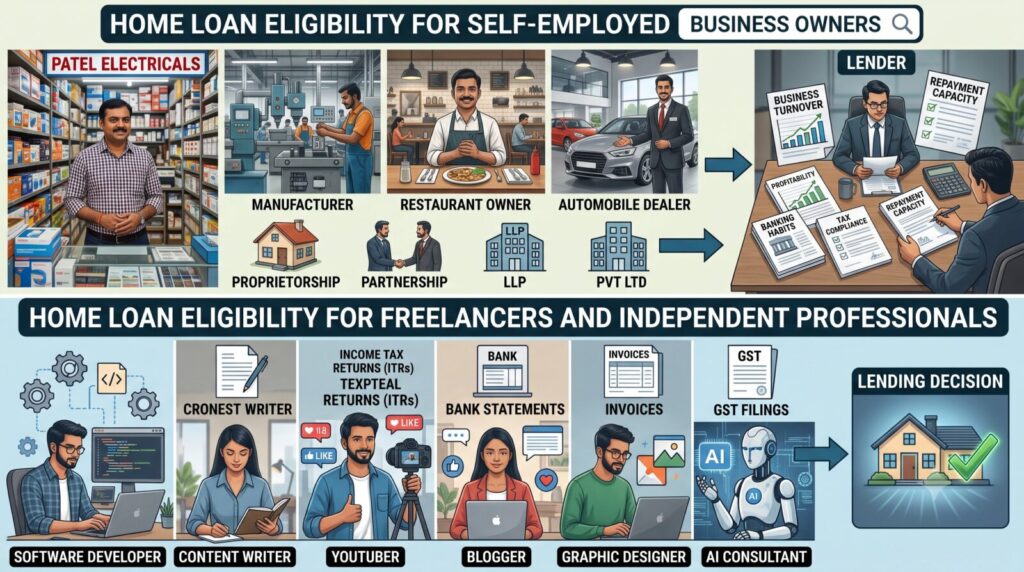
This category includes individuals who own and operate a business.
Examples include:
- Proprietorship firms
- Partnership firms
- LLPs (Limited Liability Partnerships)
- Private Limited Companies
- Retail shop owners
- Wholesale traders
- Manufacturers
- Restaurant owners
- Medical store owners
- Automobile dealers
- Distributors
- Franchise owners
- Exporters
- Importers
- E-commerce sellers
For these applicants, lenders usually examine business turnover, profitability, banking habits, tax compliance, and repayment capacity before making a lending decision.
3. Freelancers and Independent Professionals
With the growth of the digital economy, many professionals now earn income independently.
Examples include:
- Software developers
- Content writers
- YouTubers
- Bloggers
- Graphic designers
- Video editors
- AI consultants
- Online educators
- Social media managers
If your income is properly documented through Income Tax Returns (ITRs), bank statements, invoices, or GST filings where applicable, many lenders are willing to consider your application.
Does Being Self-Employed Reduce Your Chances of Getting a Home Loan?
No.
Being self-employed does not automatically reduce your eligibility. What matters is whether you can demonstrate consistent income and the ability to repay the loan.
Banks focus on questions such as:
- Is your business generating stable income?
- Have you been filing Income Tax Returns regularly?
- Do your bank statements show healthy business transactions?
- Is your credit history satisfactory?
- Are your existing loan repayments manageable?
If these factors are positive, self-employed applicants can receive competitive interest rates and loan amounts, just like salaried borrowers.
My Experience from 8+ Years in Housing Finance
During my time working with ICICI Bank, HDFC Home Loans, Axis Bank, and PNB Housing Finance, I noticed that many self-employed customers believed banks preferred salaried applicants.
In reality, I saw numerous business owners receive substantial home loan approvals because they maintained proper financial records, filed their taxes on time, and managed their businesses responsibly.
On the other hand, some applicants with high business income faced delays or rejection simply because their documentation was incomplete or their financial records did not clearly reflect their repayment capacity.
One lesson stood out repeatedly:
Banks don’t reject applicants because they are self-employed. They reject applications when they cannot confidently assess the applicant’s ability to repay the loan.
Preparing accurate documents and maintaining transparent financial records can significantly improve your chances of approval.
Self-Employed vs Salaried: What’s the Difference?
| Criteria | Salaried Applicant | Self-Employed Applicant |
|---|---|---|
| Primary Income Proof | Salary Slips and Form 16 | Income Tax Returns (ITRs), Profit & Loss Statement, Balance Sheet |
| Income Stability | Fixed monthly salary | Business or professional income |
| Employer Verification | Required | Not Applicable |
| Business Proof | Not Required | Required |
| Financial Statements | Usually Not Required | Often Required |
| Bank Statements | Salary Account | Business and Personal Bank Accounts |
| Additional Assessment | Employment Stability | Business Stability and Profitability |
Related Reading: If you receive a regular salary from an employer, you can also read our Home Loan Eligibility for Salaried Employees in India guide to understand how banks assess salaried borrowers.
Home Loan Eligibility Criteria for Self-Employed Professionals & Business Owners
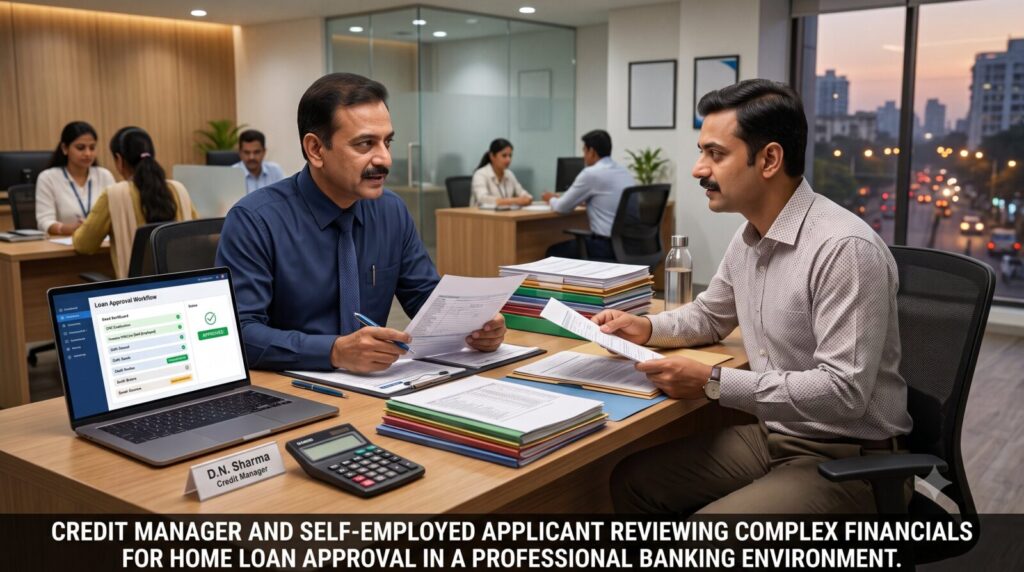
Before approving a home loan, banks and housing finance companies carefully assess whether an applicant has the financial capacity to repay the loan over the chosen tenure. Unlike salaried applicants, where monthly income is relatively fixed and easy to verify, self-employed individuals often have fluctuating income. Therefore, lenders evaluate multiple financial and business-related factors before making a lending decision.
While eligibility criteria may vary slightly from one lender to another, most banks such as SBI, HDFC Bank, ICICI Bank, Axis Bank, PNB Housing Finance, and LIC Housing Finance follow a similar evaluation process.
Let’s understand each eligibility factor in detail.
1. Age Criteria
Age is one of the first eligibility parameters banks consider because it directly affects the loan tenure and repayment capacity.
Most lenders generally require applicants to be:
| Criteria | Typical Requirement |
|---|---|
| Minimum Age | 21 years |
| Maximum Age at Loan Maturity | 65–70 years (varies by lender) |
A younger applicant may be eligible for a longer repayment tenure, which can reduce the monthly EMI. On the other hand, applicants nearing retirement age may receive a shorter tenure based on their expected earning period.
My Experience
During my years in housing finance, many customers believed that turning 50 automatically reduced their chances of getting a home loan. In reality, banks usually looked at their business stability, income, and repayment capacity first. Several experienced business owners with strong financials were approved even after the age of 50.
Practical Tip: If you’re approaching the maximum eligible age, applying with a younger earning co-applicant, such as your spouse or adult child (where permitted), may help improve eligibility and increase the repayment tenure.
2. Citizenship and Residency
Most banks provide home loans to:
- Indian Citizens
- Non-Resident Indians (NRIs) (subject to specific lender policies)
- Persons of Indian Origin (PIOs)
- Overseas Citizens of India (OCIs)
If you’re an NRI or OCI, banks may require additional documents such as a valid passport, visa, overseas employment or business proof, and NRE/NRO account statements.
3. Business Vintage (How Long You’ve Been in Business)
For self-employed applicants, the stability of the business is extremely important.
Most lenders prefer applicants whose business has been operational for at least:
- 2 to 3 years (minimum)
- Longer operating history may strengthen the application.
A business that has demonstrated consistent operations over several years provides greater confidence to lenders than a newly established venture.
Why Do Banks Check Business Vintage?
Banks want to understand whether the business has survived different market conditions and is capable of generating sustainable income over time.
For example:
- A business running successfully for 8 years generally presents lower risk than a business started six months ago.
- Established businesses often have better financial records, customer base, and predictable cash flow.
My Experience
One common misconception I noticed among customers was that high monthly income alone guaranteed loan approval. However, applicants with a newly started business sometimes struggled because there wasn’t enough financial history for the bank to assess.
On the other hand, businesses with moderate but consistent income over several years often received smoother approvals.
4. Income and Repayment Capacity
Unlike salaried employees, there is usually no single minimum income requirement for self-employed applicants across all banks.
Instead, lenders evaluate:
- Average annual income
- Net profit
- Business turnover
- Income consistency
- Existing financial obligations
- Cash flow
- Savings pattern
- Income Tax Returns (ITRs)
Rather than focusing only on turnover, banks are more interested in how much income is available after business expenses and taxes to comfortably repay the loan.
Example
Suppose two businesses each have an annual turnover of ₹1 crore.
Business A
- Healthy profit margin
- Low existing debt
- Consistent tax filings
Business B
- High turnover
- Very low profit
- Multiple outstanding loans
Despite having similar turnover, Business A may have stronger home loan eligibility because it demonstrates better repayment capacity.
Can I Get a Home Loan Without ITR if I Am Self-Employed?
This is one of the most common questions I received from self-employed applicants during my years in housing finance.
Short Answer: Yes, it is possible in some cases, but it is more difficult and depends heavily on the lender.
Most mainstream banks (SBI, HDFC, ICICI, Axis, etc.) strongly prefer at least 2–3 years of Income Tax Returns. However, some Housing Finance Companies (HFCs) and NBFCs are more flexible, especially if you can prove income through alternative documents.
What Lenders May Accept Instead of ITR
- Bank statements (last 12–24 months) showing healthy business transactions
- GST returns (if registered)
- Audited or CA-certified financial statements (Profit & Loss + Balance Sheet)
- Business registration proof + invoices
- Form 26AS or AIS (Annual Information Statement)
- Strong CIBIL score (preferably 750+)
- Higher down payment (20–30% or more)
Important Reality Check
Even if a lender considers your application without ITR:
- The eligible loan amount is usually lower
- Interest rate may be slightly higher
- Processing may take longer due to extra verification
- Some lenders may still ask for at least one year of ITR later
My Experience Tip: If you currently do not have ITRs, start filing them as soon as possible (even if the income is moderate). Having proper tax records dramatically improves your approval chances and interest rate in the future.
Complete Home Loan Documents Checklist for Self-Employed (2026)
A. Identity & Address Proof
- PAN Card
- Aadhaar Card
- Passport / Driving Licence / Voter ID (any one)
- Recent passport-size photographs
B. Business & Income Proof
- Last 2–3 years’ Income Tax Returns (ITR) with computation
- Profit & Loss Account and Balance Sheet (CA certified preferred)
- GST Registration Certificate + GST returns (if applicable)
- Business Registration proof (Shop Act, Partnership Deed, Certificate of Incorporation, etc.)
- Last 12–24 months’ business bank statements
- Personal bank statements (last 6–12 months)
C. Other Important Documents
- Form 26AS / AIS
- Existing loan statements (if any)
- Business profile / brief note about your business (helpful)
D. Property Documents
- Agreement for Sale / Allotment Letter
- Title documents & previous chain of ownership
- Approved building plan
- Occupancy / Completion Certificate (if ready property)
- Property tax receipts & NOCs (if required)
Pro Tip: Keep both digital (PDF) and physical copies ready. Name the files clearly (e.g., “ITR_2024-25.pdf”, “Bank_Statement_Apr23-Mar24.pdf”) so the bank can process them faster.
5. Credit Score (CIBIL Score)
Your credit score is one of the most influential factors in a home loan application.
While every lender follows its own internal credit policy, many banks generally prefer applicants with a CIBIL score of 750 or above for better approval prospects and potentially more competitive interest rates.
A lower score does not always mean automatic rejection, but it may lead to:
- Additional scrutiny
- Lower eligible loan amount
- Higher interest rate
- Requirement for additional documents or a co-applicant
Factors That Affect Your Credit Score
Banks review your repayment history, including:
- Existing home loans
- Personal loans
- Business loans
- Credit card payments
- EMI repayment history
- Loan defaults or settlements
- Number of recent loan enquiries
My Experience
Many applicants focused entirely on increasing their income but overlooked their credit history. I saw cases where financially stable business owners experienced delays because of repeated late credit card payments or unresolved loan issues.
Maintaining a healthy repayment record is often just as important as earning a good income.
Before applying, check your [CIBIL score for home loan] banks scrutinize self-employed credit profiles closely
6. Existing EMI Obligations
Banks assess your current financial commitments before deciding how much additional EMI you can comfortably afford.
These obligations may include:
- Personal loans
- Car loans
- Business loans
- Gold loans
- Education loans
- Credit card EMIs
- Existing home loans
The lower your existing debt burden, the stronger your repayment capacity may appear.
Practical Tip
If possible, consider closing smaller high-interest loans before applying for a home loan. This may improve your eligibility and reduce financial pressure after loan disbursement.
7. Fixed Obligation to Income Ratio (FOIR)
One important parameter that many home buyers are unaware of is the Fixed Obligation to Income Ratio (FOIR).
FOIR helps banks determine how much of your monthly income is already committed toward existing financial obligations.
It considers:
- Existing EMIs
- Other fixed monthly obligations
- Proposed home loan EMI
- Net monthly income
A lower FOIR generally indicates that you have more disposable income available to repay a new home loan.
Why FOIR Matters
Even if your business earns well, a high percentage of existing obligations can reduce your loan eligibility.
My Experience
During loan discussions, many customers asked only one question:
“What is the maximum loan I can get?”
Instead, I encouraged them to ask:
“What EMI can I comfortably repay without affecting my family’s lifestyle or my business cash flow?”
That simple shift in thinking often led to better long-term financial decisions.
8. Loan-to-Value (LTV) Ratio
Banks also evaluate the value of the property you intend to purchase.
The Loan-to-Value (LTV) ratio determines what percentage of the property’s value can be financed through a home loan.
For example, if a property is valued at ₹80 lakh, the bank may finance only a portion of that amount, while the remaining amount must be paid by the borrower as the down payment.
The applicable LTV depends on RBI guidelines and the lender’s internal policy.
9. Property Eligibility
Even if your financial profile is strong, the property itself must also satisfy the lender’s legal and technical requirements.
Banks generally verify:
- Clear ownership title
- Approved building plan
- Legal approvals
- Property valuation
- Encumbrance status
- Builder approvals (for under-construction properties)
A legally compliant property helps ensure smoother loan processing and protects both the borrower and the lender.
My Advice After 8+ Years in Housing Finance
If there’s one lesson I would share with every self-employed home buyer, it’s this:
Banks don’t approve home loans based on a single document or one impressive income figure. They look at your overall financial story.
That story includes your business stability, tax compliance, banking habits, repayment history, credit score, existing obligations, and the property you’re buying.
Preparing these aspects well before applying can significantly improve your chances of a faster and smoother approval.
Understanding home loan eligibility for self employed applicants starts with preparing the right documents.
Complete Home Loan Documents Checklist for Self-Employed Professionals & Business Owners
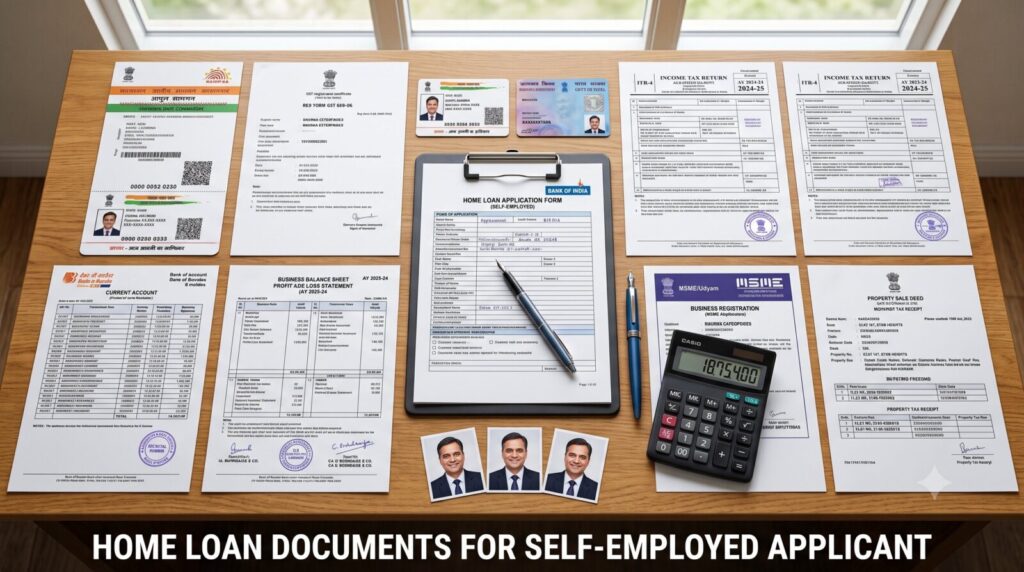
One of the biggest reasons home loan applications get delayed is incomplete documentation. Many applicants assume that submitting their PAN card, Aadhaar card, and a few bank statements is enough. However, banks evaluate much more than identity proof.
Since self-employed individuals do not receive a regular salary, lenders rely heavily on financial documents to understand the stability of the business, repayment capacity, and creditworthiness.
During my 8+ years in banking and housing finance, I noticed that applicants who prepared their documents in advance generally experienced faster loan processing and fewer follow-ups from the bank.
Let’s go through the complete document checklist.
1. Identity Proof Documents
Every applicant and co-applicant must submit valid identity proof as part of the Know Your Customer (KYC) process.
Accepted Identity Proof
| Document | Accepted by Most Banks |
|---|---|
| Aadhaar Card | ✅ Yes |
| PAN Card | ✅ Mandatory for most loans |
| Passport | ✅ Yes |
| Voter ID Card | ✅ Yes |
| Driving Licence | ✅ Yes |
| Government-issued Photo ID | ✅ Accepted in certain cases |
Why Banks Ask for Identity Proof
Identity documents help banks verify:
- Applicant’s identity
- Date of birth
- Photograph
- Signature
- Compliance with KYC norms
- Fraud prevention
Practical Tip: Ensure that the name on all your documents (PAN, Aadhaar, bank account, and property documents) matches exactly. Even small spelling differences can lead to additional verification and delays.
2. Address Proof Documents
Banks also verify your residential address before processing a home loan application.
Commonly Accepted Address Proof
| Document | Accepted by Most Banks |
|---|---|
| Aadhaar Card | ✅ |
| Passport | ✅ |
| Driving Licence | ✅ |
| Voter ID | ✅ |
| Electricity Bill | ✅ |
| Telephone Bill | ✅ |
| Gas Connection Bill | ✅ |
| Registered Rent Agreement (where applicable) | ✅ |
Banks may request both your current residential address and your permanent address, especially if they differ.
My Experience
I often came across applicants who had recently shifted to a new city but had not updated their Aadhaar or bank records. This led to additional document requests and avoidable delays. Updating your KYC records before applying can help streamline the verification process.
3. PAN Card (Mandatory)
Although PAN is an identity document, it deserves special mention because it plays a crucial role in financial verification.
Banks use your PAN to:
- Verify Income Tax Returns
- Check financial history
- Match income records
- Validate business details
- Prevent duplicate borrowing
For most home loans, PAN is mandatory.
4. Business Proof Documents
Unlike salaried applicants who submit an employer’s certificate, self-employed individuals must establish that their business legally exists.
The exact documents depend on your business structure.
Common Business Proof Documents
| Document | Applicable For |
|---|---|
| GST Registration Certificate | GST Registered Businesses |
| Udyam Registration Certificate | MSMEs |
| Shop & Establishment Certificate | Retail Shops |
| Trade Licence | Local Businesses |
| Professional Practice Certificate | Doctors, CAs, Lawyers, Architects |
| Business Registration Certificate | Various Businesses |
| Certificate of Incorporation | Companies |
| Partnership Deed | Partnership Firms |
| LLP Agreement | LLPs |
| Memorandum & Articles of Association (MOA & AOA) | Private Limited Companies |
Why Business Proof Matters
Banks need confirmation that your business is genuine and actively operating.
Business documents help lenders verify:
- Nature of business
- Business ownership
- Years of operation
- Legal registration
- Business continuity
Documents Based on Business Type
Proprietorship Firm
Generally required:
- GST Registration (if applicable)
- Shop & Establishment Certificate
- Udyam Registration (if available)
- Business PAN (if applicable)
- Trade Licence
- Business Address Proof
Partnership Firm
Usually required:
- Partnership Deed
- GST Registration
- PAN of Partnership Firm
- Registration Certificate (if applicable)
- Business Bank Statements
- Income Tax Returns
LLP (Limited Liability Partnership)
Usually required:
- LLP Agreement
- LLP Registration Certificate
- PAN Card
- GST Registration
- Bank Statements
- Income Tax Returns
Private Limited Company
Generally required:
- Certificate of Incorporation
- PAN Card
- GST Registration
- Memorandum of Association (MOA)
- Articles of Association (AOA)
- Board Resolution (if required)
- Company Financial Statements
5. Income Proof Documents
For self-employed applicants, income proof is one of the most important parts of the home loan application.
Banks evaluate your repayment capacity by reviewing your financial records over multiple years rather than relying on a single month’s income.
Common Income Proof Documents
| Document | Purpose |
|---|---|
| Income Tax Returns (ITRs) for the last 2–3 years | Verify declared income |
| Computation of Income | Detailed tax calculation |
| Profit & Loss Statement | Business profitability |
| Balance Sheet | Financial position |
| CA-certified Financial Statements | Independent verification |
| Business Bank Statements (last 6–12 months) | Cash flow assessment |
| Personal Bank Statements | Income pattern |
| GST Returns (where applicable) | Business turnover verification |
| Form 26AS (if requested) | Tax verification |
| Advance Tax Challans (where applicable) | Tax payment history |
Why Banks Ask for Multiple Years of ITRs
Many applicants wonder why banks request 2 to 3 years of Income Tax Returns instead of only the latest return.
The reason is simple.
Banks want to assess whether your income has remained stable over time. A single year of high income does not necessarily indicate long-term repayment capacity.
They generally look for:
- Consistent income
- Stable business performance
- Regular tax compliance
- Sustainable profitability
My Experience
One of the most common mistakes I observed was applicants filing lower income in their ITRs to reduce tax liability while expecting a higher home loan amount.
Remember:
The income you declare to the Income Tax Department is often the same income banks use to assess your loan eligibility.
If your declared income is significantly lower than your actual earnings, it may reduce the loan amount you qualify for.
It’s always advisable to discuss tax planning and long-term borrowing goals with your Chartered Accountant.
6. Bank Statement Requirements
Banks usually ask for:
| Statement | Typical Period |
|---|---|
| Business Bank Account | Last 6–12 Months |
| Personal Savings Account | Last 6 Months |
They review these statements to understand:
- Business turnover
- Monthly cash flow
- Credit and debit patterns
- EMI payments
- Returned cheques
- Average balance maintained
Healthy banking habits can strengthen your application.
7. GST Documents (Where Applicable)
If your business is registered under GST, banks may ask for:
- GST Registration Certificate
- GST Returns
- GST Payment Records
GST records help lenders understand the scale and consistency of business operations.
8. Udyam Registration (MSME)
Although not mandatory for every applicant, Udyam Registration can support your business profile if you’re registered as a Micro, Small, or Medium Enterprise (MSME).
It provides additional evidence of your business’s legal status and may assist during document verification.
9. Property Documents
Your eligibility alone is not enough. Banks also verify the legal and technical aspects of the property being financed.
The required property documents may vary depending on whether you’re buying a new property, a resale property, or an under-construction property.
| Document | Purpose |
|---|---|
| Sale Agreement / Agreement to Sell | Purchase details |
| Sale Deed | Ownership proof |
| Approved Building Plan | Construction approval |
| Occupancy Certificate (Ready Property) | Occupancy verification |
| Completion Certificate | Construction completion |
| Builder-Buyer Agreement | Under-construction projects |
| Property Tax Receipts | Tax compliance |
| Encumbrance Certificate (where applicable) | Clear ownership |
| Society NOC (Resale Properties) | Society approval |
| Previous Chain of Title Documents | Ownership history |
My Advice After 8+ Years in Housing Finance
A strong financial profile alone doesn’t guarantee quick approval. I have seen applications delayed because of simple issues such as an expired address proof, missing GST records, unsigned financial statements, or incomplete property papers.
Before submitting your application, create a personal document checklist and verify that every document is current, complete, and consistent. Spending an extra hour reviewing your paperwork can save weeks of unnecessary delays later.
Every lender follows slightly different rules for home loan eligibility for self employed borrowers.
Bank-wise Home Loan Document Requirements for Self-Employed Applicants
Although the basic home loan documentation remains similar across most banks and housing finance companies, each lender may have slightly different requirements depending on your profession, business structure, loan amount, property type, and internal credit policy.
Preparing the required documents in advance can help reduce processing delays and improve your overall borrowing experience.
Below is an overview of the documents commonly requested by some of India’s leading home loan lenders.
Important: The final document list may vary based on your individual profile, the loan amount, and the lender’s internal credit policy. Always confirm the latest requirements with your chosen bank or housing finance company before submitting your application.
SBI Home Loan Documents for Self-Employed Applicants
The State Bank of India (SBI) is one of India’s largest home loan providers and offers home loans to self-employed professionals, business owners, and entrepreneurs.
SBI commonly asks for:
Identity & Address Proof
- Aadhaar Card
- PAN Card
- Passport / Driving Licence / Voter ID (where applicable)
Income Documents
- Income Tax Returns (generally the last 2–3 years)
- Balance Sheet
- Profit & Loss Account
- Computation of Income
- CA-certified financial statements (where applicable)
Business Proof
- GST Registration (if applicable)
- Business Registration Certificate
- Shop & Establishment Certificate
- Professional Registration Certificate (if applicable)
Banking Documents
- Business Bank Statements
- Personal Savings Bank Statements
Property Documents
- Sale Agreement
- Approved Building Plan
- Property Title Documents
- Property Tax Receipts
- Other legal documents as required
My Practical Observation
Many applicants assume SBI only focuses on income. In reality, the bank also places significant importance on the legal verification of the property. Having complete property documents ready can help avoid unnecessary delays during legal and technical evaluation.
HDFC Bank Home Loan Documents for Self-Employed Applicants
HDFC Bank provides home loans to a wide range of self-employed professionals and business owners across India.
Commonly Required Documents
KYC Documents
- PAN Card
- Aadhaar Card
- Passport-sized Photographs
Income Proof
- Income Tax Returns
- Balance Sheet
- Profit & Loss Statement
- CA-certified Financial Statements
- Bank Statements
Business Proof
- GST Registration
- Business Registration Certificate
- Professional Practice Certificate (if applicable)
- Partnership Deed / LLP Agreement / Company Incorporation Documents (where applicable)
Property Documents
- Agreement to Sell
- Title Documents
- Approved Plans
- Builder Documents
- Occupancy or Completion Certificate (depending on property type)
Practical Tip
Before applying, ensure your Income Tax Returns and financial statements are consistent. Any mismatch between declared income and bank transactions may result in additional queries during credit assessment.
ICICI Bank Home Loan Documents for Self-Employed Applicants
ICICI Bank evaluates both the applicant’s financial profile and business stability before approving a home loan.
Commonly Required Documents
KYC
- Aadhaar Card
- PAN Card
- Passport-sized Photographs
Income Proof
- Last 2–3 years Income Tax Returns
- Profit & Loss Statement
- Balance Sheet
- Business Bank Statements
- Personal Bank Statements
Business Documents
- GST Registration (if applicable)
- Trade Licence
- Shop & Establishment Certificate
- Udyam Registration (where available)
- Company Registration Documents
Property Documents
- Sale Deed
- Agreement to Sell
- Approved Building Plan
- Property Tax Receipts
- Other legal documents based on the property
My Experience
During my time working with ICICI Bank, one of the common reasons for delays was incomplete financial documentation. Applicants who submitted organized and up-to-date records usually experienced a much smoother processing journey.
Axis Bank Home Loan Documents for Self-Employed Applicants
Axis Bank offers home loans to both professionals and non-professionals operating their own businesses.
Commonly Required Documents
Identity Documents
- Aadhaar Card
- PAN Card
- Passport
- Driving Licence
Income Proof
- Income Tax Returns
- Profit & Loss Account
- Balance Sheet
- Business Bank Statements
- Personal Bank Statements
Business Proof
- GST Registration
- Trade Licence
- Business Registration Certificate
- Partnership Deed / LLP Documents / Company Incorporation Documents
Property Documents
- Sale Agreement
- Builder Documents
- Property Title Documents
- Approved Plans
- Occupancy Certificate (where applicable)
Practical Tip
Maintain separate business and personal bank accounts whenever possible. It helps lenders assess your business cash flow more accurately and can simplify the underwriting process.
PNB Housing Finance Documents for Self-Employed Applicants
PNB Housing Finance offers home loans to professionals, entrepreneurs, and business owners across various income segments.
Commonly Required Documents
- PAN Card
- Aadhaar Card
- Income Tax Returns
- Profit & Loss Statement
- Balance Sheet
- Business Proof
- Business Bank Statements
- Property Documents
- Passport-sized Photographs
My Experience
While working with PNB Housing Finance, I noticed that applications with complete financial records often moved through underwriting more efficiently. Keeping all business and property documents organized before applying can make a noticeable difference.
LIC Housing Finance Documents for Self-Employed Applicants
LIC Housing Finance also finances a broad range of self-employed borrowers.
Commonly Required Documents
- PAN Card
- Aadhaar Card
- Income Tax Returns
- Financial Statements
- Business Registration Documents
- Bank Statements
- Property Documents
- Recent Photographs
The lender may request additional documents depending on your profession, business type, and loan amount.
Quick Comparison: Major Banks’ Home Loan Document Requirements
| Documents | SBI | HDFC Bank | ICICI Bank | Axis Bank | PNB Housing | LIC Housing Finance |
|---|---|---|---|---|---|---|
| Aadhaar Card | ✅ | ✅ | ✅ | ✅ | ✅ | ✅ |
| PAN Card | ✅ | ✅ | ✅ | ✅ | ✅ | ✅ |
| Income Tax Returns | ✅ | ✅ | ✅ | ✅ | ✅ | ✅ |
| Profit & Loss Statement | ✅ | ✅ | ✅ | ✅ | ✅ | ✅ |
| Balance Sheet | ✅ | ✅ | ✅ | ✅ | ✅ | ✅ |
| Business Bank Statements | ✅ | ✅ | ✅ | ✅ | ✅ | ✅ |
| GST Registration (if applicable) | ✅ | ✅ | ✅ | ✅ | ✅ | ✅ |
| Business Registration Proof | ✅ | ✅ | ✅ | ✅ | ✅ | ✅ |
| Property Documents | ✅ | ✅ | ✅ | ✅ | ✅ | ✅ |
| Passport-size Photographs | ✅ | ✅ | ✅ | ✅ | ✅ | ✅ |
Note: This comparison is intended as a general guide. Individual documentation requirements may vary depending on the applicant’s financial profile, business structure, property type, and the lender’s prevailing credit policy.
Expert Tip from My 8+ Years in Housing Finance
Many borrowers spend weeks collecting financial documents after they find the right property. I recommend doing the opposite.
Prepare your KYC documents, Income Tax Returns, financial statements, bank statements, and business records before you start property hunting. Once you find the right home, you’ll already be in a strong position to apply, and your loan processing is likely to move faster.
Top Reasons Home Loan Applications for Self-Employed Applicants Get Rejected (and How to Avoid Them)
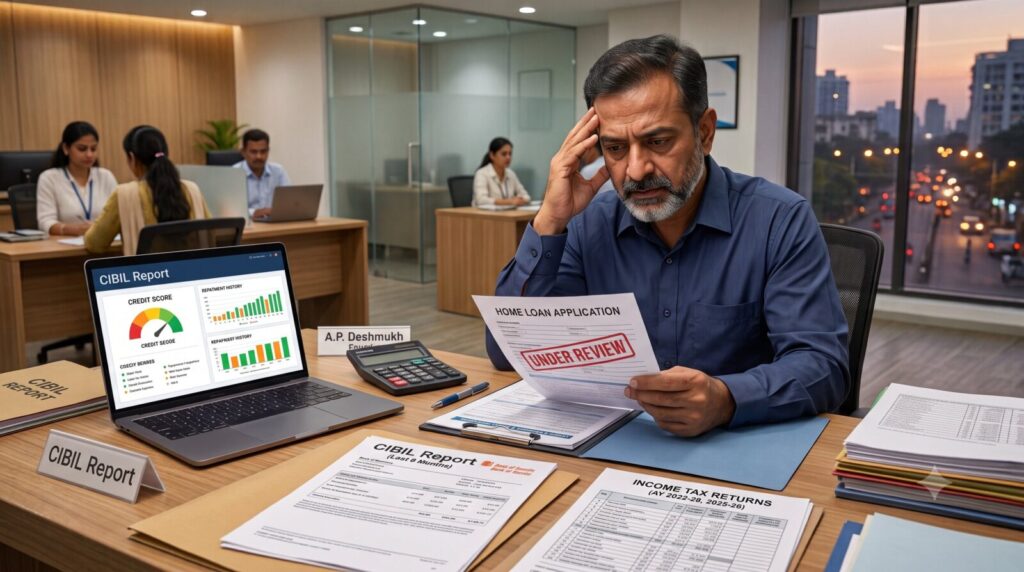
Receiving a home loan rejection can be disappointing, especially after you’ve spent time searching for your dream home and preparing the required documents. Fortunately, many rejections are preventable.
During my 8+ years of experience in banking and housing finance, I noticed that most home loan applications were not rejected because applicants were self-employed. Instead, they were declined because of avoidable financial or documentation issues.
Understanding these common reasons can help you prepare better and improve your chances of approval.
1. Inconsistent Income or Fluctuating Business Performance
One of the first things banks assess is whether your business generates a stable and sustainable income.
Unlike salaried employees who receive a fixed monthly salary, self-employed applicants may experience seasonal income fluctuations. While occasional variations are normal, lenders generally prefer businesses that demonstrate consistent earnings over several years.
Example
Suppose two applicants own retail businesses.
- Applicant A has reported stable profits for the last three years.
- Applicant B reported high profits one year but significant losses in the next.
Even if Applicant B earned more during one year, Applicant A may present a stronger repayment profile because of income consistency.
How to Improve
- File Income Tax Returns regularly.
- Maintain accurate financial records.
- Avoid large unexplained variations in declared income.
- Keep proper accounting records.
2. Low CIBIL Score or Poor Credit History
Your credit history reflects how responsibly you’ve managed previous borrowings.
Banks review:
- Credit cards
- Personal loans
- Business loans
- Vehicle loans
- Existing home loans
- EMI repayment history
Frequent late payments or loan defaults may reduce your chances of approval.
My Experience
I met several applicants whose businesses were performing well, but repeated delays in credit card payments negatively affected their credit scores. These issues often resulted in additional scrutiny or delayed approvals.
How to Improve
- Pay all EMIs on time.
- Clear overdue credit card balances.
- Avoid unnecessary loan applications before applying for a home loan.
- Regularly review your credit report and correct any errors.
3. Insufficient Income Declared in Income Tax Returns
Many business owners legally plan their taxes to reduce taxable income. While tax planning has its place, declaring very low income can also reduce your borrowing capacity.
Banks generally rely on your declared income when determining the maximum loan amount you can comfortably repay.
My Experience
One question I heard frequently was:
“My business earns much more than what’s shown in my Income Tax Return. Why did the bank approve a smaller loan?”
The answer was usually straightforward. The lender assessed the income that could be verified through official financial records.
How to Improve
Work closely with your Chartered Accountant and consider both tax efficiency and future borrowing needs when planning your finances.
4. High Existing Financial Obligations
Banks don’t evaluate only your income. They also review your current financial commitments.
These may include:
- Personal loan EMIs
- Vehicle loans
- Business loans
- Credit card EMIs
- Education loans
- Existing home loans
A high debt burden may reduce the amount you can comfortably repay each month.
Practical Tip
If possible, repay smaller high-interest loans before applying for a home loan. Reducing your existing obligations can improve your overall financial profile.
5. Incomplete or Incorrect Documentation
Documentation issues are among the most common reasons for delays and, in some cases, rejection.
Examples include:
- Missing Income Tax Returns
- Unsigned financial statements
- Expired KYC documents
- Mismatched names across documents
- Missing property papers
- Incomplete bank statements
My Experience
Many applications remained pending not because the customer was ineligible, but because an important document was missing. Preparing a complete document file before applying can save significant time.
6. Short Business Vintage
Banks generally prefer businesses with an established operating history.
If your business has been running for only a few months, lenders may have limited financial data to assess repayment capacity.
How to Improve
If you’re planning to purchase a home in the near future, continue maintaining proper financial records and tax compliance as your business grows. A longer track record often strengthens future loan applications.
7. Property-Related Legal Issues
Even if your financial profile is excellent, the property itself must meet the lender’s legal and technical requirements.
Banks may raise concerns if:
- Ownership is unclear.
- Title documents are incomplete.
- Required approvals are missing.
- Property taxes are unpaid.
- Construction approvals are unavailable.
Practical Tip
Before paying a substantial booking amount, confirm that the property’s legal documentation is complete. This can help avoid complications later in the loan process.
8. Frequent Cheque Returns or Irregular Banking Habits
Your bank statements provide lenders with valuable insight into how you manage your finances.
Frequent cheque returns, irregular account activity, or repeated low balances may create concerns during underwriting.
How to Improve
Maintain healthy banking habits by ensuring sufficient account balances, avoiding cheque returns, and conducting business transactions through your primary business account whenever possible.
9. Applying for an Unrealistically High Loan Amount
Many applicants focus on the maximum loan amount they can obtain rather than the EMI they can comfortably manage.
A loan that appears affordable today may become difficult to repay if business income fluctuates in the future.
My Advice
Choose a loan amount that fits comfortably within your long-term financial plan rather than stretching your budget to purchase a more expensive property.
Remember: Your dream home should bring financial security, not financial stress.
10. Lack of Financial Planning Before Applying
One of the biggest lessons I learned while working with home loan customers was that successful borrowers rarely started preparing after selecting a property.
Instead, they planned months in advance by:
- Improving their credit score.
- Organizing financial documents.
- Reducing unnecessary debt.
- Filing Income Tax Returns on time.
- Saving for the down payment.
- Reviewing their monthly affordability.
This preparation often resulted in faster approvals and a smoother borrowing experience.
My Final Advice After 8+ Years in Banking & Housing Finance
After helping hundreds of customers through different stages of the home loan process, one lesson has stayed with me:
A home loan is not approved because of one impressive document. It is approved because your overall financial story gives the lender confidence.
Strong repayment habits, transparent financial records, timely tax filings, responsible credit management, and complete documentation all work together to build that confidence.
Whether you’re a doctor, consultant, freelancer, retailer, manufacturer, or entrepreneur, taking the time to strengthen these areas before applying can significantly improve your chances of securing the right home loan.
Expert Tips to Improve Your Home Loan Eligibility as a Self-Employed Applicant

Applying for a home loan is not just about meeting the minimum eligibility criteria. It’s about presenting yourself as a financially responsible borrower who can comfortably repay the loan over the long term.
During my 8+ years of experience in banking and housing finance, I noticed that applicants who planned their finances before applying generally experienced faster approvals and fewer complications than those who applied without proper preparation.
Whether you’re a doctor, consultant, freelancer, trader, shop owner, manufacturer, or entrepreneur, the following tips can help strengthen your home loan application.
1. File Your Income Tax Returns (ITRs) Regularly
Income Tax Returns are one of the most important documents banks use to evaluate self-employed applicants.
Many lenders prefer applicants who have filed 2 to 3 years of consistent ITRs, as they provide a clearer picture of income stability and repayment capacity.
Why It Matters
Regular ITR filing demonstrates:
- Financial discipline
- Stable income
- Tax compliance
- Long-term business continuity
Practical Tip
Even if your taxable income is relatively low, avoid skipping ITR filing. Consistent tax records can strengthen future home loan applications.
2. Maintain a Healthy Credit Score
Your CIBIL score is often one of the first indicators lenders review during the loan approval process.
Although each bank has its own lending policy, a CIBIL score of 750 or above is generally considered favorable for home loan applications.
How to Maintain a Good Credit Score
- Pay all EMIs before the due date.
- Clear credit card bills on time.
- Avoid loan defaults.
- Keep your credit utilization under control.
- Check your credit report periodically for inaccuracies.
My Experience
Many customers believed that increasing their income alone would improve their chances of loan approval. However, I often found that a strong repayment history carried just as much weight as income during the credit assessment process.
3. Keep Business and Personal Finances Separate
One of the simplest ways to strengthen your financial profile is by maintaining separate bank accounts for your business and personal expenses.
This helps banks clearly understand:
- Business turnover
- Monthly income
- Business expenses
- Cash flow patterns
It also makes it easier to prepare financial statements and Income Tax Returns.
Practical Tip
Avoid using your business account for personal shopping or household expenses whenever possible. Clear financial records create a more professional impression during underwriting.
4. Reduce Existing Loan Obligations
Before applying for a home loan, review your current financial commitments.
If possible, repay or reduce:
- Personal loans
- Credit card EMIs
- Consumer durable loans
- Vehicle loans
Lower existing obligations can improve your repayment capacity and increase your eligibility for a higher home loan amount.
5. Save for a Higher Down Payment
Many home buyers focus only on arranging the minimum down payment required by the bank.
However, contributing a larger down payment can offer several advantages.
Benefits of a Higher Down Payment
- Lower loan amount
- Reduced monthly EMI
- Lower interest cost over the loan tenure
- Better financial flexibility
- Improved repayment comfort
It also demonstrates financial discipline, which can strengthen your overall borrowing profile
6. Maintain Proper Business Records
Well-organized financial records make it easier for lenders to assess your business.
Keep important documents updated, including:
- Income Tax Returns
- Balance Sheets
- Profit & Loss Statements
- GST Returns (where applicable)
- Business Registration Documents
- Bank Statements
My Experience
Applicants who maintained organized records generally spent less time responding to document requests and often completed the loan process more smoothly.
7. Avoid Frequent Credit Enquiries
Every time you apply for a loan or credit card, the lender may perform a credit enquiry.
Submitting multiple loan applications within a short period may indicate financial stress and can affect your credit profile.
Practical Tip
Instead of applying to several banks simultaneously, compare home loan options carefully and shortlist the lenders that best match your financial profile before submitting your application.
8. Choose the Right Loan Amount
One of the biggest mistakes I observed during my banking career was applicants choosing a loan amount based solely on eligibility rather than affordability.
Just because a bank approves a certain loan amount doesn’t necessarily mean you should borrow the maximum available.
Before finalizing your loan, ask yourself:
- Will I be comfortable paying this EMI if business income slows down temporarily?
- Can I continue investing in my business while managing the home loan?
- Will this EMI allow me to maintain my family’s financial goals?
A realistic borrowing decision today can help prevent financial stress tomorrow.
9. Include a Suitable Co-Applicant (If Required)
Adding a financially stable co-applicant, such as your spouse or an eligible family member, may strengthen your home loan application in certain situations.
Potential benefits include:
- Improved combined repayment capacity
- Higher loan eligibility
- Better income assessment
- Potential tax benefits (subject to applicable laws and individual circumstances)
Before adding a co-applicant, understand the responsibilities involved, as all borrowers remain jointly responsible for repaying the loan.
10. Use a Home Loan Planner Before Applying
Many borrowers start comparing interest rates without first understanding how much they can comfortably afford.
Before approaching a lender, calculate:
- Affordable EMI
- Loan eligibility
- Down payment
- Total interest payable
- Loan tenure
- Impact of future prepayments
Doing this exercise in advance helps you make informed decisions rather than relying solely on the maximum loan amount offered by the bank.
Helpful Resource: Use our Home Loan Planner to estimate your EMI, affordability, eligibility, and prepayment savings before submitting your home loan application.
I hope this complete guide on home loan eligibility for self employed helps you prepare better before applying for a home loan.
My Biggest Lesson After 8+ Years in Housing Finance
Looking back at my experience across ICICI Bank, HDFC Home Loans, Axis Bank, and PNB Housing Finance, one lesson stands out clearly.
The customers who experienced the smoothest home loan journey were not necessarily those with the highest income.
They were the ones who planned ahead.
They maintained good credit habits.
They filed their taxes regularly.
They kept their financial records organized.
And most importantly, they borrowed within their repayment capacity.
Buying a home is an emotional milestone, but financing it should always be a well-planned financial decision.
A little preparation before applying can save weeks of delays, reduce stress during the approval process, and help you move into your dream home with greater financial confidence.
Here are the most common questions about home loan eligibility for self employed in India.

Ready to Check Your Home Loan Eligibility?
Understanding your eligibility is only the first step. Before you apply for a home loan, it’s important to know how much you can comfortably borrow, what your monthly EMI could be, and whether the loan fits your long-term financial goals.
Instead of relying on estimates, calculate your numbers in advance.
Use our FREE Home Loan Planner to:
- Calculate your Home Loan EMI
- Check your loan eligibility
- Estimate your monthly affordability
- Compare different loan tenures
- Understand the impact of prepayments
- Download your personalized loan report
Try the PennyPowerPlay Home Loan Planner
Planning before you apply can help you make informed decisions and avoid financial stress later.
Frequently Asked Questions (FAQs)
1. Can a self-employed person get a home loan in India?
Yes. Self-employed professionals, business owners, entrepreneurs, consultants, freelancers, and other eligible applicants can apply for a home loan in India. Banks evaluate factors such as business stability, repayment capacity, Income Tax Returns (ITRs), credit score, financial statements, and property documents before approving the loan.
Being self-employed does not reduce your chances of getting a home loan, provided you meet the lender’s eligibility criteria and maintain a healthy financial profile.
2. What documents are required for a home loan for self-employed applicants?
Although document requirements may vary between lenders, most banks commonly ask for:
- Aadhaar Card
- PAN Card
- Passport-size photographs
- Income Tax Returns (usually the last 2–3 years)
- Profit & Loss Statement
- Balance Sheet
- Business Bank Statements
- Personal Bank Statements
- GST Registration (where applicable)
- Business Registration Documents
- Property Documents
Submitting complete and accurate documents can help speed up the loan approval process.
3. How many years of Income Tax Returns (ITRs) are required for a home loan?
Most banks generally prefer 2 to 3 years of Income Tax Returns for self-employed applicants.
Multiple years of ITRs allow lenders to evaluate:
- Income consistency
- Business growth
- Tax compliance
- Repayment capacity
If you’ve recently started your business, the lender may request additional financial documents or apply different eligibility criteria.
4. What is the minimum CIBIL score required for a self-employed home loan?
There is no single minimum credit score applicable to all lenders. However, a CIBIL score of 750 or above is generally considered favorable for home loan applications.
A higher credit score may improve your chances of:
- Faster approval
- Better loan eligibility
- More competitive interest rates
Even if your score is lower, some lenders may still consider your application depending on your overall financial profile.
5. Can freelancers apply for a home loan?
Yes.
Many banks now consider freelancers and independent professionals for home loans, provided they can demonstrate stable income through documents such as:
- Income Tax Returns
- Bank Statements
- Professional invoices
- GST Returns (where applicable)
- Financial Statements
The key factor is the ability to verify regular income and repayment capacity.
6. Can I get a home loan without filing Income Tax Returns?
Obtaining a home loan without Income Tax Returns can be challenging for most self-employed applicants because ITRs are one of the primary documents lenders use to verify income.
Depending on the lender and your individual profile, alternative documentation may sometimes be considered. However, filing regular ITRs generally strengthens your eligibility and simplifies the approval process.
7. Which bank is best for self-employed home loans in India?
Several banks and housing finance companies offer home loans to self-employed applicants, including:
- State Bank of India (SBI)
- HDFC Bank
- ICICI Bank
- Axis Bank
- PNB Housing Finance
- LIC Housing Finance
Rather than focusing only on interest rates, compare factors such as:
- Eligibility criteria
- Processing fees
- Documentation requirements
- Customer service
- Loan flexibility
- Prepayment policies
Choosing the right lender depends on your individual financial profile and borrowing needs.
8. Does GST registration improve home loan eligibility?
GST registration itself does not guarantee loan approval. However, for businesses where GST registration is applicable, it helps lenders understand:
- Business operations
- Turnover
- Tax compliance
- Financial transparency
Combined with other financial documents, GST records may support a stronger loan application.
9. Can I include my spouse as a co-applicant?
Yes.
Many banks allow eligible family members, including spouses, to become co-applicants.
Adding a co-applicant may help improve:
- Combined repayment capacity
- Overall loan eligibility
- Income assessment
In some cases, borrowers may also be eligible for tax benefits, subject to applicable tax laws and individual circumstances.
10. Can I get a home loan if my business is less than two years old?
Some lenders may consider newer businesses, but many banks generally prefer applicants whose businesses have been operational for at least 2 to 3 years.
If your business is relatively new, maintaining proper financial records and consistent banking transactions can strengthen future loan applications.
11. What factors do banks consider before approving a self-employed home loan?
Banks typically evaluate several factors, including:
- Age
- Business stability
- Business vintage
- Income consistency
- Income Tax Returns
- Credit score
- Existing EMIs
- Bank Statements
- Financial Statements
- Property documents
- Repayment capacity
A combination of these factors helps lenders assess the overall creditworthiness of the applicant.
12. How can I improve my chances of getting a home loan?
Some practical steps include:
- File Income Tax Returns regularly.
- Maintain a healthy CIBIL score.
- Keep business and personal finances separate.
- Reduce existing loan obligations.
- Maintain organized financial records.
- Save for a higher down payment.
- Apply for a loan amount that comfortably fits your repayment capacity.
Proper financial planning before applying can significantly improve your chances of approval.
13. Can self-employed applicants get the same interest rates as salaried employees?
Yes, in many cases.
Interest rates are generally determined by multiple factors, including:
- Credit profile
- Repayment capacity
- Loan amount
- Loan tenure
- Lender’s internal credit policy
A financially strong self-employed applicant may receive interest rates comparable to those offered to salaried borrowers.
14. What is the maximum home loan amount a self-employed person can get?
There is no fixed maximum loan amount for all applicants.
The approved amount depends on factors such as:
- Income
- Business profitability
- Existing financial obligations
- Credit score
- Property value
- Loan-to-Value (LTV) ratio
- Bank’s lending policy
Using a home loan eligibility calculator before applying can help estimate the amount you may qualify for.
15. Should I compare multiple lenders before applying?
Absolutely.
Before making a final decision, compare:
- Interest rates
- Processing charges
- Prepayment and foreclosure rules
- Documentation requirements
- Customer support
- Loan flexibility
Choosing the right lender is about finding the loan that best fits your long-term financial goals, not simply the one advertising the lowest interest rate.
Final Thoughts
Buying a home is one of the biggest financial milestones in life, and applying for a home loan as a self-employed professional or business owner may seem more complex than it does for salaried borrowers. However, with proper planning, organized financial records, and a clear understanding of the eligibility requirements, the process can become much smoother.
Throughout my 8+ years of experience in banking and housing finance, I learned that successful home loan applications are rarely about a single document or one impressive income figure. Banks look at the complete financial picture, including your business stability, repayment capacity, tax compliance, credit history, and the property you intend to purchase.
If you take the time to prepare these aspects before applying, you’ll not only improve your chances of approval but also make better borrowing decisions that support your long-term financial well-being.
Whether you’re a doctor, chartered accountant, architect, lawyer, consultant, freelancer, trader, retailer, manufacturer, startup founder, or entrepreneur, understanding the home loan process can help you move one step closer to owning your dream home with confidence.
Ready to Take the Next Step?
Before applying for a home loan, make sure you also explore these helpful resources on PennyPowerPlay:
- Complete Home Loan Guide for India
- Home Loan Planner to calculate your EMI, affordability, eligibility, and prepayment savings
- Home Loan Eligibility for Salaried Employees
- Home Loan Documents Checklist
- Home Loan Approval Process in India
- Top Reasons Home Loan Applications Get Rejected
Making informed decisions today can help you build a financially secure tomorrow.