By Ashok Satpute | Published: October 2, 2026
You have a good salary, a strong CIBIL score, complete income documents and manageable EMIs. You expect your home loan to be approved. Then the lender examines the property, and suddenly there is a problem.
So, can a home loan be rejected because of the property?
Many buyers are surprised by a home loan rejected because of property issues, even with a good salary, a strong CIBIL score, complete income documents and manageable EMIs. You expect your home loan to be approved. Then the lender examines the property, and suddenly there is a problem.
This is one of the most important things a homebuyer should understand before paying a large token amount or committing most of their savings. In this guide, I explain why lenders check the property, how valuation and LTV can reduce your eligible loan with a worked ₹1 crore example, which property problems matter most, and what to check before you pay a token.
Important: Home-loan approval is always subject to the lender’s credit, legal, technical, valuation and property policies. The examples in this article are for education and illustration.
A home loan has two separate approval questions
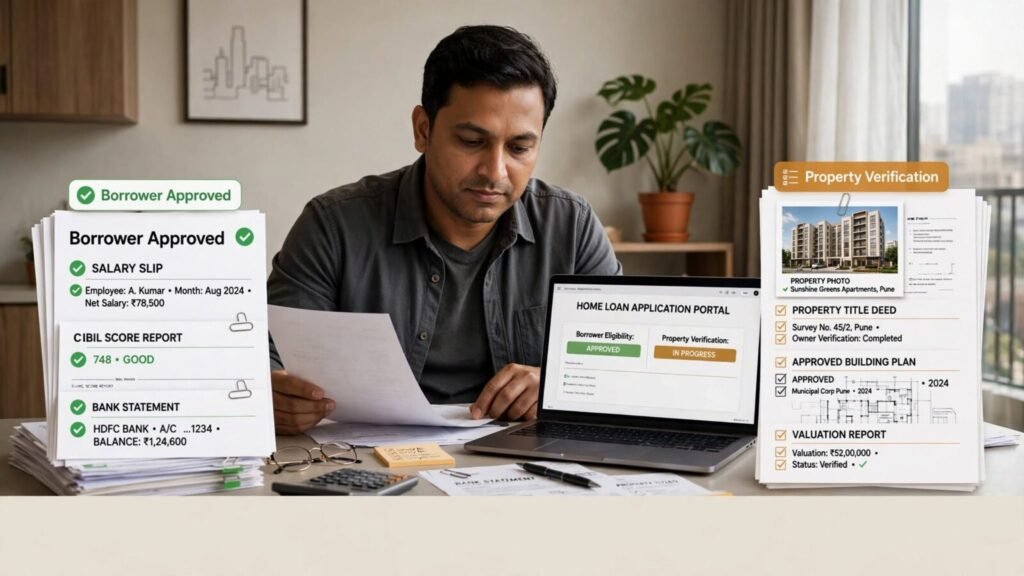
A useful way to understand the process is to split it into two parts.
1. Borrower assessment. The lender looks at your income, employment or business stability, existing EMIs, credit history and CIBIL score, age, bank statements, tax documents and the loan amount you want. This tells the lender whether you can reasonably repay the loan.
2. Property assessment. The lender separately looks at ownership, title, legal documents, approved plans and permissions, existing mortgages or charges, physical condition, measurements, valuation, RERA registration where applicable, and whether the property fits the lender’s own policy. This tells the lender whether the property is acceptable security.
These two assessments can lead to different outcomes. You can be:
- Borrower approved, property rejected
- Borrower approved, property valuation reduced
- Borrower approved, property needs additional documents
- Borrower approved, property accepted with a lower loan amount
A good borrower profile does not automatically make every property financeable. A sanction letter or eligibility indication is usually based on your profile; the property-specific checks still have to be completed before disbursement. So “I am eligible for ₹75 lakh” does not mean “I can use ₹75 lakh to buy any ₹1 crore property.”
Why lenders check the property
A home loan is generally secured by a mortgage over the residential property. RBI’s consumer guidance explains that housing loans are typically secured by the property, and that buyers and lenders should make sure the title is clear of encumbrances such as an existing mortgage, loan or litigation that could affect it.
If a borrower stops paying, the lender needs security it can enforce and sell under applicable law. That is why lenders want reasonable confidence that:
- The seller has the right to sell
- The title is acceptable and the property can legally be mortgaged
- The property complies with applicable approvals
- The property gives adequate security for the proposed loan amount and tenure
The exact process varies by lender, property type, location, state and transaction. There is no single checklist that works identically for every home loan.
Legal, technical and valuation checks are different things. Many buyers treat them as one step, but they are not:

- Legal verification looks at ownership, title chain, encumbrances and whether the property can be mortgaged.
- Technical verification looks at the physical property: construction, layout, measurements, condition and whether it matches the approved plan.
- Valuation assesses the property’s value for lending purposes, considering location, size, construction, age, condition and comparable market information.
A property can pass one check and fail another. It may be legally clear but technically deviate from the approved plan, or have a clean title but a valuation below your negotiated price.
Home Loan Rejected Because of Property: 10 Common Reasons
There is no universal list that guarantees rejection. The same issue might lead to a clarification, an extra document, a lower loan amount, a delay or a refusal, depending on the circumstances and the lender. These are the areas that most often cause trouble.
1. Lower-than-expected valuation. You agree to pay ₹1 crore, but the lender’s valuer assesses the property at ₹88 lakh. That does not mean the property is bad; it means the lender’s acceptable value is lower than your price, which can reduce the amount it will finance. I calculate this in detail in the next section.
2. Title or ownership problems. The seller must have a legally acceptable right to sell. Typical concerns include gaps in the title chain, missing previous sale deeds, disputed ownership, unresolved inheritance or succession, name mismatches, unregistered transfers where registration is required, and litigation. The lender may ask for additional documents or a legal clarification, and if a material issue cannot be resolved, it may not accept the property.
3. Existing mortgage or charge. A seller having a loan on the property is not unusual, and it does not automatically stop the sale. But the existing charge must be properly handled: the outstanding amount, closure, release of original documents, and transfer of ownership usually need to be coordinated between the seller, the existing lender, your lender and you. Do not treat it as a minor formality.
4. Approved plan does not match the actual construction. Suppose the approved plan shows 900 sq. ft. but the technical inspection finds 1,050 sq. ft., or the property has an enclosed balcony, an extra room or a changed layout. There may be a legitimate explanation, such as an approved modification or outdated documents, or it may be an unauthorized alteration. The lender decides whether the deviation is acceptable under its policy and local rules. Do not assume “everyone in this building has made the same change, so the bank will accept mine.”
5. Missing or unclear approvals. Depending on the property, lenders may want evidence of building plan approval, commencement certificate, completion or occupancy certificate, land-use or conversion permissions and other local authority approvals. Terminology and requirements differ by state and local authority, so a checklist from another city may not fit your property.
6. RERA-related problems. For applicable under-construction and builder projects, RERA registration is part of the due-diligence picture. See the RERA section below.
7. Property age and physical condition. An old property is not automatically unacceptable, but lenders may consider building age, structural condition, remaining useful life, maintenance, redevelopment status and your loan tenure. A 25-year loan on a very old building raises the question of whether the property will remain acceptable security for that period.
8. Property type does not fit the lender’s policy. Lenders may have extra requirements or restrictions for certain property types, locations, mixed-use buildings, very old buildings, unusual construction or unusual documentation. So “my friend got a loan for the same building” is not proof that your lender will finance your transaction.
9. Documents do not match each other. The sale agreement says 1,000 sq. ft., the approved plan says 900 sq. ft., and the property tax record shows another figure. Names, flat numbers, survey or CTS numbers, addresses, floors and areas should be consistent across documents. One small error may be easy to correct; unexplained inconsistencies can delay or stop a transaction.
10. The property does not meet the lender’s internal requirements. A property can be legally valid and still not fit a particular lender’s underwriting policy. Regulatory compliance is not the same as lender approval. This is the most misunderstood point: a lender saying “we do not finance this property type” is very different from a lender saying “there is a serious title issue.” Changing lenders may solve the first. It does not automatically solve the second.
Property valuation can reduce your home loan

This is the issue that surprises buyers most. The price you negotiate with the seller and the value the lender assigns are two different numbers.
A valuer considers factors such as location, comparable transactions, size, construction, floor, age, condition, amenities and local market conditions. The lender then uses that valuation in its decision. Your funding plan should therefore never be built only from the seller’s asking price.
A ₹1 crore example
Suppose you are buying a property for ₹1 crore. You have ₹25 lakh in savings and want a ₹75 lakh loan. On paper that is 75% of the price. Your profile is strong, so you feel comfortable.
Then the lender’s valuation comes in at ₹88 lakh. RBI’s LTV ceiling for a loan in the ₹30 lakh to ₹75 lakh slab is 80%, so the calculation becomes:
₹88 lakh × 80% = ₹70.40 lakh
| Item | Amount |
|---|---|
| Agreed purchase price | ₹1 crore |
| Lender-assessed value | ₹88 lakh |
| Loan you requested | ₹75 lakh |
| Illustrative loan at 80% of ₹88 lakh | ₹70.40 lakh |
| Gap versus your requested loan | ₹4.60 lakh |
| Your own funds needed for the ₹1 crore price | ₹29.60 lakh |
You still owe the seller ₹1 crore under your agreement, so the ₹4.60 lakh gap has to come from your own pocket, taking your required contribution from ₹25 lakh to ₹29.60 lakh. And that is before other costs.
How RBI’s LTV ceilings work
RBI’s LTV ceiling depends on the loan amount:
| Individual housing loan amount | Maximum LTV |
|---|---|
| Up to ₹30 lakh | 90% |
| Above ₹30 lakh, up to ₹75 lakh | 80% |
| Above ₹75 lakh | 75% |
Note: In this example the loan works out to ₹70.40 lakh, so the 80% slab applies. For a loan above ₹75 lakh, the lower 75% ceiling would apply instead.
These are regulatory ceilings, not promises. A lender can offer a lower LTV based on your credit profile, the property and its own policy. Lenders also typically apply LTV to the lower of the agreement value and its own valuation, which is why valuation matters so much.
Stamp duty and other costs come on top
RBI’s housing-finance guidance generally excludes stamp duty, registration and other documentation charges from the property cost used for LTV, with a limited exception for very low-cost properties up to ₹10 lakh. In practice, stamp duty and registration are not financed by the home loan, and they vary by state. So your cash requirement is not simply “property price minus loan.” Budget separately for:
- Stamp duty and registration
- Legal and processing charges, and any valuation or technical fees
- Brokerage, if any
- Interiors, moving and repairs
- An emergency reserve you will not touch
The question to ask before you sign: “What happens to my purchase if the lender finances less than I expected?”
RERA: what homebuyers should check

For applicable under-construction or builder projects, RERA registration is an important check. Under Section 3 of the Real Estate (Regulation and Development) Act, promoters generally cannot advertise, market, book, sell or offer for sale a real estate project in a planning area without registering it with the relevant Real Estate Regulatory Authority, subject to statutory exemptions. Each phase of a project can be treated as a separate project for registration purposes.
Before paying a substantial amount to a builder, check the relevant state RERA portal (for example, MahaRERA for projects in Maharashtra) and verify:
- Project name and registration number
- Promoter details
- Approved project information and phase details
- Construction status and declared completion date
- Whether your unit and project details are consistent with the registration
RERA registration is not the same as home-loan approval. The lender still carries out its own legal, technical, valuation, project and credit assessment. A registered project can still be declined by a particular lender.
Can one lender reject a property while another accepts it?
Yes, it is possible. Lenders have different risk policies, legal processes, technical standards, location preferences and valuation approaches. One lender’s rejection does not prove the property is unacceptable to every lender.
But do not treat switching lenders as a shortcut around a genuine property problem. If the first lender found a serious title issue, another lender will likely find it too. Always ask: “Why was the property not accepted?” The answer usually falls into one of these buckets:
- Valuation: another lender may assess the value differently.
- Lender policy: another lender may have a different property policy.
- Missing document: may be fixable if the document can be obtained.
- Legal title problem: serious; understand it fully, and get legal advice, before proceeding.
- Unauthorized construction: may need clarification, rectification or legal advice.
That answer is far more useful than simply hearing “the loan was rejected.”
What to check before paying a large token

Suppose the seller says, “Pay ₹5 lakh today, I have other buyers,” and a bank has told you that you are eligible for ₹75 lakh. You still need to answer two separate questions: Am I eligible for the loan? and Will this particular property support the financing I need?
This does not mean you must complete every lender check before paying any token. The practical point is to understand the token terms and what happens if the loan cannot proceed because of the property. Read the agreement carefully, and get legal advice on the wording where appropriate.
Ask the seller:
- Who is the legal owner, and can I see the ownership documents?
- Is there an existing home loan or mortgage on the property, and how will it be cleared?
- Are the relevant approvals available in writing, not just verbally?
- Does the current construction match the approved plan?
- Can you provide the documents my lender will ask for, without long delays?
- Has another lender previously rejected this property, and if so, why?
- What happens to my token if the loan is not approved?
Check on your side:
- Do I know my own contribution, including stamp duty, registration and other costs?
- Have I considered that the lender’s valuation could be lower than my negotiated price?
- Have I asked my intended lender whether this property or project fits its policy?
- Will I still have an emergency reserve after the down payment and purchase expenses?
- Have I checked RERA registration for an under-construction project?
A practical tip from my years in home-loan sales: borrowers almost always ask me, “How much home loan can I get?” That is an important question, but “Will this particular property support the loan I need?” deserves equal attention. Find out before you pay a large token, not after.
Property document checklist
The exact documents depend on the property, location and lender, and the lender may ask for more. Use this as a starting point, not a universal legal checklist.
For a resale property:
- Current sale deed and previous sale deeds or title chain
- Property card or equivalent records, and mutation records where applicable
- Encumbrance-related records
- Approved building plan, plus completion or occupancy documents where applicable
- Property tax receipts
- Society share certificate, NOC and other society documents where required
- Existing loan closure documents, if the seller has a loan
- Possession documents and seller identity documents
- Inheritance or succession documents where applicable
For an under-construction property:
- RERA registration details
- Builder or promoter documents and approved project plans
- Agreement for sale and payment schedule
- Project approvals and construction-related permissions
- Unit details, demand letters and construction-stage documents
- Any project-specific documents your lender requires
For significant purchases, an independent property lawyer is worth considering. The lender’s legal review protects the lender’s position; your own lawyer protects your purchase. The two are related but not the same.
What to Do If Your Home Loan Is Rejected Because of Property Issues

First, do not panic. Ask the lender for the broad reason, then decide the next step based on that reason.
- Document issue: find out exactly which document is missing and whether the seller can provide it.
- Valuation issue: understand how the lender valued the property, then reconsider the price, loan amount, down payment or property choice. Another lender may assess it differently.
- Technical or construction issue: find out whether the deviation can legally be regularized or explained.
- Legal or title issue: do not simply apply elsewhere. Get independent legal advice before going further.
- Lender policy: another lender may have different criteria, but still understand exactly why the first one declined.
The rule is simple: find the reason first, then look for the solution.
Frequently asked questions
Can a home loan be rejected because of the property?
Yes. A lender can decline to finance a property because of legal, technical, valuation, documentation, approval or internal policy concerns, even when the borrower’s profile is strong.
Can a good CIBIL score guarantee home-loan approval?
No. CIBIL and credit history matter for borrower assessment, but the lender also evaluates the property.
If a property costs ₹1 crore, can I automatically get a ₹75 lakh loan?
No. The lender considers RBI’s LTV framework, its own valuation of the property, your eligibility and its lending policy.
What happens if a ₹1 crore property is valued at ₹88 lakh?
The lender may finance less than you expected. In the example above, 80% of ₹88 lakh is ₹70.40 lakh, so you would need to fund the difference from your own money. The exact result depends on the applicable LTV rules and lender policy.
Can another bank approve a property rejected by one bank?
Possibly. Lenders have different property policies and valuation approaches. But first understand why the original lender rejected it.
Does RERA registration guarantee a home loan?
No. RERA registration is an important project-level check, but lenders conduct their own credit, legal, technical and valuation assessments.
Can an old property get a home loan?
Often, yes. The lender may consider the building’s age, condition, remaining useful life, documentation and its own policy.
Can unauthorized construction cause a home-loan problem?
Yes. A difference between approved plans and actual construction can raise technical or legal concerns.
Does an existing loan on the seller’s property stop me from buying it?
Not necessarily. Such sales can be structured around repayment of the seller’s loan and release of the original documents. Confirm the process with the lenders and a legal professional.
Does a sanction letter mean the property is approved?
Not necessarily. The lender may still need property-specific legal, technical and valuation checks, and may attach conditions before disbursement.
Final takeaway
A home loan is not only about your salary and CIBIL score. The property itself matters: its title, documents, approvals, construction, valuation, existing charges, RERA status and fit with the lender’s policy.
The biggest mistake a buyer can make is assuming, “If I am eligible for a ₹75 lakh loan, I can use it to buy any ₹1 crore property.” Your eligibility and the property’s eligibility are separate questions, and a successful purchase needs both to work.
A home loan rejected because of property issues is often preventable, because many property risks can be spotted before you commit a large amount. So alongside “How much home loan can I get?”, also ask: “Will the lender accept the property I want to buy, and how much will it actually finance against it?”
Use the PennyPowerPlay Home Loan Planner to test different loan amounts, EMIs and affordability scenarios before you decide.
Related PennyPowerPlay guides
- How Much Home Loan Can I Afford on My Salary?
- Home Loan Eligibility: What Banks Check Before Approval
- Home Loan Processing Fees and Other Charges
- How CIBIL Score Affects Home Loan Approval
- Home Loan EMI Calculator and Affordability Planner
- Home Loan Balance Transfer: When Does It Make Sense?
- Prepayment of Home Loan: What Should You Check First?
Important disclaimer
This article is for general educational and informational purposes only. Home-loan approval, property valuation, LTV, legal verification, technical assessment, documentation requirements and lending conditions vary by lender, property, location, borrower profile and applicable regulations. RBI rules and lender policies can change. The LTV examples in this article are illustrative and are not a promise of loan eligibility or approval.
The RBI policy repo rate was 5.25% as of October 2, 2026. The RBI’s next Monetary Policy Committee meeting is scheduled for October 5-7, 2026, so please check the latest announcement before making a major borrowing decision.
A lender’s property assessment is not a substitute for independent legal due diligence. For property transactions, especially where there are title, inheritance, construction, approval or agreement issues, consult a qualified property lawyer and other relevant professionals. Nothing in this article guarantees loan approval.
About the author
Ashok Satpute is the founder of PennyPowerPlay.com, a home-loan education platform for Indian homebuyers. He has 8+ years of experience in home-loan sales across banking and housing finance, including ICICI Bank, HDFC, Axis Bank and PNB Housing Finance. At PennyPowerPlay, he explains eligibility, documentation, EMIs, lender requirements and property-related risks in simple language so buyers can make better-informed decisions. PennyPowerPlay provides educational decision support and does not guarantee loan approval.