By Ashok Satpute / October 1, 2026
Last updated: October 1, 2026 (RBI’s next policy review is scheduled for October 5-7, 2026. The repo rate section may change after that.)
Should you buy a home in 2026 or continue renting? The rent vs buy home India debate usually starts with one familiar thought:
“Why should I keep paying rent when I can pay EMI and own a house?”
It sounds logical. But before taking a home loan, ask another question:
“How much higher will my EMI be compared with the rent for a similar property?”
Suppose you pay ₹40,000 rent for a home similar to the one you want to buy. If buying it requires an EMI of about ₹93,700, you would be committing to roughly ₹53,700 more every month, before maintenance, property tax, insurance and other ownership costs.
That is why the rent vs buy home India decision needs more than the old idea that “rent is wasted money.” Property prices, interest rates, rents, transaction costs and your career plans all matter.
A useful starting point is the 5-year rule. Treat it as a decision framework, not a guarantee.
What Is the 5-Year Rule?
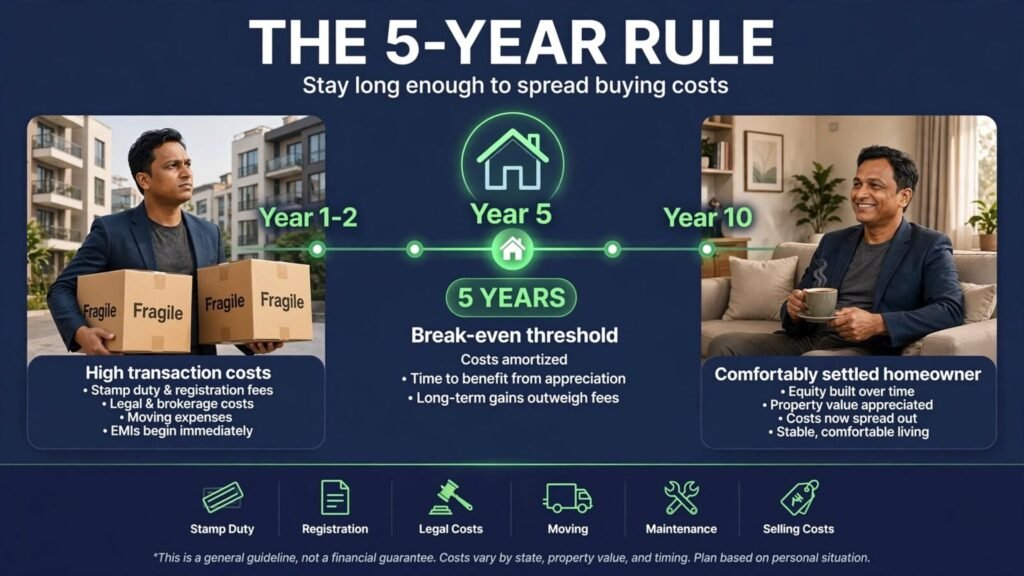
The 5-year rule is a commonly used rule of thumb for the rent vs buy home India question:
If you are unlikely to stay in a property for at least five years, renting deserves serious consideration before you buy.
Why? Because buying and selling a home involves costs:
- Stamp duty and registration charges
- Loan processing and other lender charges
- Legal and documentation expenses
- GST on applicable under-construction purchases
- Brokerage and other selling expenses
- Moving and furnishing costs
- Maintenance and repairs
These costs take time to recover through appreciation and the equity you build by repaying the loan. If you buy and sell within two or three years, they can wipe out much of the benefit.
But five years is not a magic number. A property can work financially in less time, and another may not work even after five years. The actual calculation matters.
Why Staying Period Matters
Imagine two buyers purchase similar ₹1 crore homes.
Buyer A plans to stay for 2 years. Buyer B plans to stay for 10 years.
Both may pay similar purchase costs, but Buyer B has far longer to spread them. Over a longer period there is also more time for the loan principal to reduce, the property to potentially appreciate, your income to grow, and rents to rise with inflation.
So before asking “Can I get this home loan?”, ask:
“How long am I realistically going to live here?”
The Real Cost of Buying a Home
The purchase price is only one part of the calculation. A ₹1 crore property does not mean ₹1 crore total cost.
You may also need money for stamp duty, registration, legal expenses and other purchase-related costs. The amount varies by state, property type and buyer. GST can apply to certain under-construction properties, while a completed resale property is treated differently.
Then there is the cost of selling: brokerage, legal and documentation expenses, moving costs and any applicable taxes.
My guide on the hidden costs of buying a home in India can help you build a fuller budget.
Remember too that a higher market value after two years does not automatically mean a strong return. You still have to account for:
- Initial purchase costs
- Interest paid on the loan
- Maintenance
- Selling expenses and taxes where applicable
- The opportunity cost of your down payment
The EMI-to-Rent Ratio
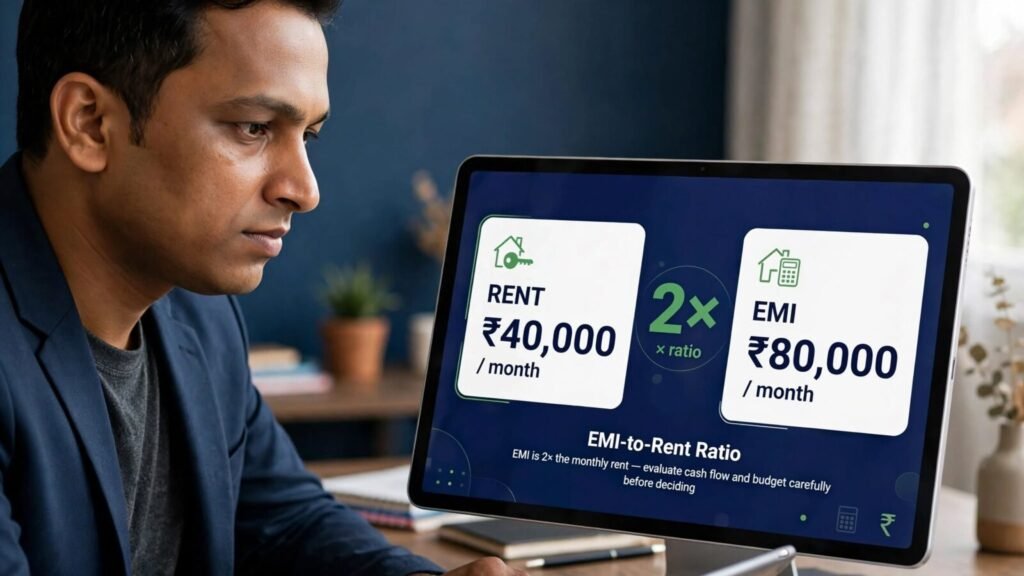
This is one of the simplest ways to start a rent-vs-buy comparison:
EMI-to-Rent Ratio = Monthly EMI ÷ Monthly Rent
If your EMI is ₹80,000 and comparable rent is ₹40,000, the ratio is 2. The EMI is 2x the rent.
A ratio of 2 or higher is a warning sign to investigate further. It does not mean “never buy.” Ownership gives you equity and eventually a home you own outright. Renting gives you flexibility and keeps more cash available for other goals.
Use the ratio as a screening tool in any rent vs buy home India comparison, not as a final verdict.
Rent vs Buy Home India Example: ₹1.5 Crore Home vs ₹40,000 Rent

Suppose you are looking at a property priced at ₹1.5 crore and take a ₹1.12 crore home loan at an illustrative 8% for 20 years.
The approximate EMI is ₹93,700 per month.
Your actual rate depends on the lender, product, credit profile and loan amount. Use the PennyPowerPlay Home Loan Planner to test your own numbers.
A similar property can be rented for about ₹40,000 per month.
| Particular | Amount |
|---|---|
| Property price | ₹1.50 crore |
| Home loan | ₹1.12 crore |
| Illustrative rate | 8% |
| Loan tenure | 20 years |
| Approx. EMI | ₹93,700 |
| Comparable rent | ₹40,000 |
| EMI minus rent | ₹53,700 |
| EMI-to-rent ratio | ~2.3x |
The buyer commits about ₹53,700 more every month, or roughly ₹6.44 lakh per year, before differences in maintenance, taxes, insurance and other ownership costs.
The buyer builds equity by repaying the loan. The renter keeps the extra cash. Neither side should be judged by one number alone.
What About Investing the Difference?
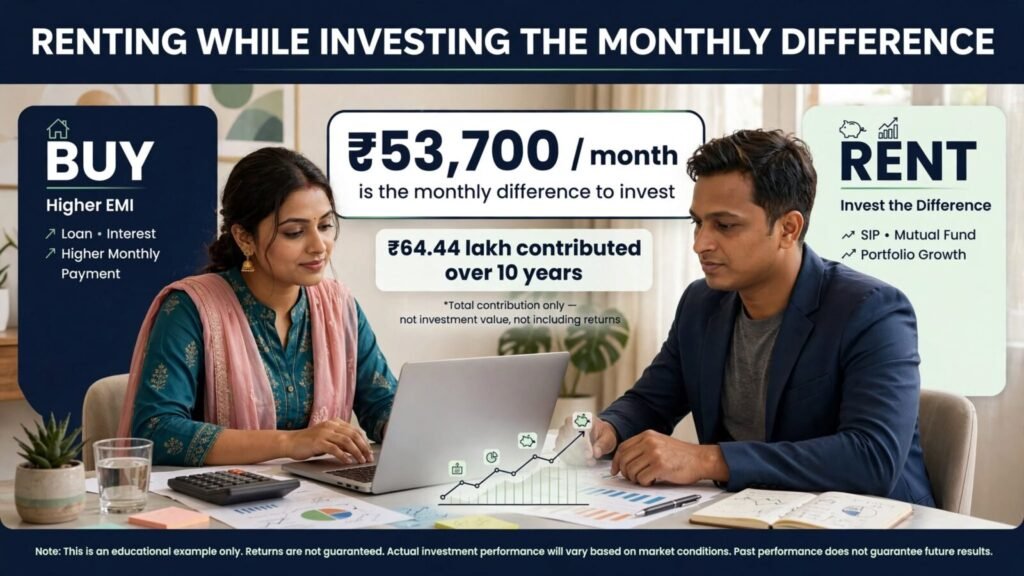
A renter could potentially invest some or all of the roughly ₹53,700 monthly difference. Over 10 years, that is:
₹53,700 × 12 × 10 = ₹64.44 lakh
That is only the total amount contributed, not the investment’s final value.
But investment returns are not guaranteed, and neither is property appreciation. Don’t compare guaranteed appreciation with guaranteed market returns, because neither assumption is correct.
Compare scenarios instead:
- Property appreciates slowly, moderately or strongly
- Investments return less, about as expected, or more
Mixing these gives a more realistic rent-vs-buy analysis than any single assumption.
Renting May Make Sense When…
1. You may relocate within a few years. If your job, business or family situation could require a move within two or three years, buying reduces your flexibility.
2. Your EMI is much higher than rent. An EMI of ₹90,000 against ₹40,000 rent leaves a ₹50,000 monthly gap. Work out what that money could do for you.
3. Your income is uncertain. A home should not be affordable only in your best income months.
4. Buying would use your entire savings. Keep money for registration, interiors, moving, repairs, insurance and emergencies.
5. You are unsure about the location. If you aren’t confident about staying in the neighbourhood for several years, renting is more flexible.
Buying May Make Sense When…
1. You plan to stay for a long period. A 10-year horizon is very different from a 2-year one.
2. EMI is reasonably close to comparable rent. An EMI of ₹50,000 against ₹40,000 rent is far easier to justify than ₹90,000 against ₹40,000.
3. You have a strong emergency fund left after the purchase.
4. Your income is stable. A loan can run 15, 20 or more years, so affordability should not depend only on today’s salary.
5. You can cover the upfront costs. The loan does not necessarily cover every cost of buying. See my guide on home loan down payment requirements.
Interest Rates in 2026
The RBI’s policy repo rate is 5.25%, unchanged at the August 2026 review. The next review is scheduled for October 5-7, 2026, so check the latest rate before deciding.
Home-loan rates are linked to the repo rate, but what you pay depends on the lender, the product, your credit profile, income and loan amount. Advertised starting rates vary widely across lenders, and a headline rate may not be the rate you are offered.
So ask: “What rate am I actually being offered?” And test your EMI at a slightly higher rate too, in case rates rise during a long loan.
RBI LTV Rules and Your Down Payment
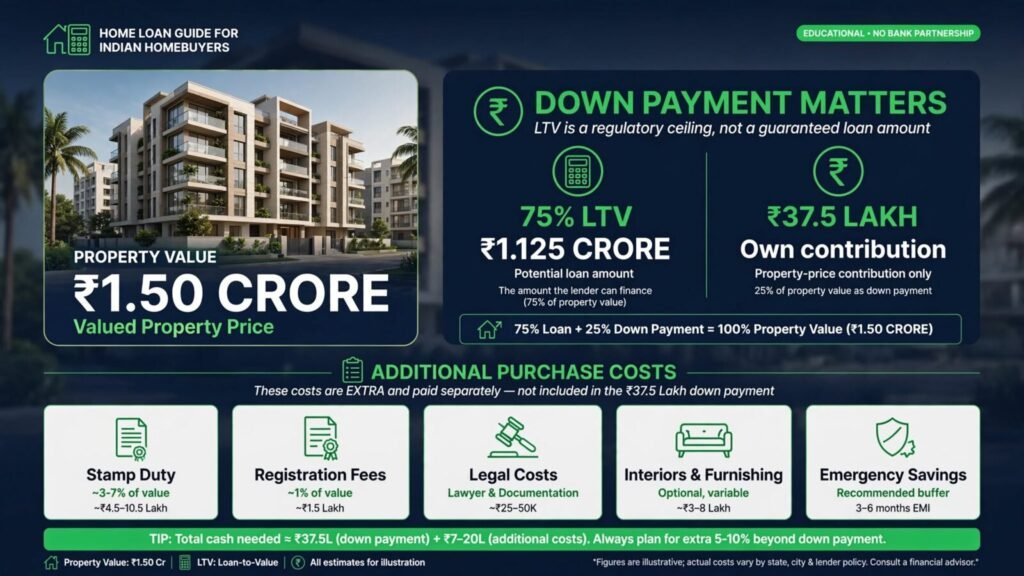
The Loan-to-Value (LTV) framework sets the maximum share of the property value a lender can finance:
| Loan category | Maximum LTV |
|---|---|
| Up to ₹30 lakh | Up to 90% |
| Above ₹30 lakh and up to ₹75 lakh | Up to 80% |
| Above ₹75 lakh | Up to 75% |
These are regulatory ceilings, not a promise that every borrower will receive that percentage. Lenders assess each borrower’s profile. As per an RBI circular on housing loans, banks should not include stamp duty, registration and other documentation charges in the cost of the property they finance, so these charges are not counted when calculating LTV.
For a ₹1.5 crore property at a 75% cap, the loan could theoretically reach about ₹1.125 crore, leaving roughly ₹37.5 lakh as your own contribution to the property price. That is before stamp duty, registration, legal costs, interiors and your emergency fund.
This is why your down payment can change the rent-vs-buy answer.
The rent vs buy home India question in 2026 is not “Is rent a waste of money?” That is too simple. The better question is:
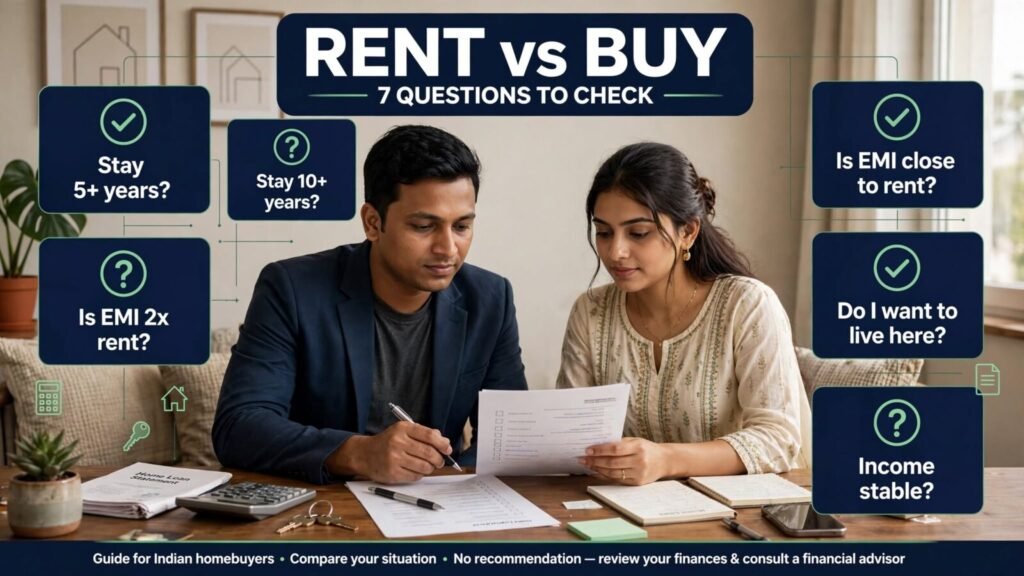
Instead of asking “Is buying better than renting?”, ask these seven questions:
| Question | If YES |
|---|---|
| Will I stay 5+ years? | Buying becomes more worth analysing |
| Will I stay 10+ years? | Long-term ownership deserves serious consideration |
| Is EMI close to comparable rent? | Buying is easier to justify |
| Is EMI 2x or more than rent? | Investigate the numbers carefully |
| Do I have emergency savings after down payment? | Your financial cushion is stronger |
| Is my income reasonably stable? | Long-term EMI risk is easier to manage |
| Do I actually want to live in this location? | Ownership may fit your life better |
This is not a scoring system. No single “yes” or “no” decides the answer. The point is to look at the complete picture.
5 Questions to Ask Before Buying
Before settling your rent vs buy home India decision, ask yourself:
1. How long will I realistically stay? Not “I think I’ll stay,” but: what is the chance my job, family or location changes within five years?
2. What is my EMI-to-rent ratio? If it is 2 or higher, find out why buying costs so much more each month.
3. How much cash remains after the purchase? Add up the down payment, stamp duty, registration, legal costs, interiors, moving expenses and emergency fund, then see what’s left.
4. What happens if my income falls? Could you still manage the EMI through a temporary drop? If you are salaried, my guide on home loan eligibility for salaried employees explains how lenders generally assess income.
5. Have I compared the complete cost? Don’t compare rent with EMI alone. Compare rent + what you could do with the savings against EMI + interest + ownership costs + property equity. Also check how the tax treatment of home-loan interest applies to you under the income-tax regime you file in, or ask a tax professional, before counting any deduction.
Frequently Asked Questions
Is the 5-year rule always correct?
No. It is a rule of thumb. The right answer depends on price, rent, interest rate, transaction costs, holding period, appreciation, maintenance and your finances.
Is renting better if my EMI is twice my rent?
Not automatically. It is a warning sign. Investigate the difference and compare what the renter could do with the extra cash.
Is rent really wasted money?
No. Rent pays for housing and flexibility. A renter doesn’t build property equity but keeps more liquidity and mobility. A homeowner builds equity but takes on a large, long commitment.
Should I buy if I plan to stay for 10 years?
A 10-year horizon gives more time to spread purchase costs and build equity, but you should still run the numbers. A long holding period doesn’t make an expensive property automatically attractive.
How much down payment should I keep aside?
There is no single figure. Consider the lender’s LTV limit, the property price, purchase expenses and your emergency fund. Don’t spend every available rupee on the down payment.
Should I wait for interest rates to fall?
Don’t base the whole decision on a possible future rate change. The repo rate is currently 5.25%, the next RBI review is due October 7, 2026, and your own rate depends on the lender and your profile. Check whether the property and EMI are affordable at the rate you can actually get today.
Can renting and investing the difference beat buying?
It can, but nothing is guaranteed. The result depends on investment returns, appreciation, rent increases, taxes, transaction costs, maintenance and the time period. Run several scenarios rather than assuming one return.
Is it better to rent or buy a home in India in 2026?
There is no universal answer to the rent vs buy home India question. It depends on how long you will stay, your EMI-to-rent ratio, your down payment and your emergency savings. Use the 5-year rule and the EMI-to-rent ratio as a starting point, then run the numbers for your own situation.
My Practical Tip From 8+ Years in Banking and Housing Finance
In my years across banks and housing finance companies, I saw many borrowers focus on one question:
“How much home loan can I get?”
An equally important question is:
“How much home loan should I actually take?”
A lender may approve a certain amount, but that doesn’t mean it is comfortable for your family budget. Before buying, compare your rent, proposed EMI, down payment, emergency savings, expected stay and other financial commitments.
Most importantly, ask whether you could handle the EMI if your circumstances change.
You can use the PennyPowerPlay Home Loan Planner to explore EMI and affordability scenarios.
Final Takeaway
The rent vs buy home India question in 2026 is not ‘Is rent a waste of money?
“Does buying this particular property make financial sense for my situation?”
Start with the 5-year rule. If you may move within a few years, renting deserves serious consideration, because buying and selling can be costly.
Then calculate your EMI-to-rent ratio. If your EMI is about twice the comparable rent, don’t conclude buying is wrong. Investigate the monthly difference and ask what happens if you rent and invest it.
Then total up the ownership side: down payment, interest, principal repaid, maintenance, taxes, purchase and selling costs, possible appreciation and your expected holding period.
Finally, think about your life. A home is not only an investment. It is where you may live, raise a family and build your routine.
If you expect to stay 10 years or more, buying may suit you better. If you expect to relocate in two or three years, renting may give you more flexibility. There is no single rent vs buy home India answer that fits every Indian home buyer. Decide based on numbers, time horizon and affordability, not pressure or the belief that “rent is always wasted money.”
Related PennyPowerPlay Guides
- How Much Home Loan EMI Can You Really Afford?
- Home Loan Down Payment India
- Home Loan Fees and Charges in India
- Hidden Costs of Buying a Home in India
- Home Loan Eligibility for Salaried Employees
- PennyPowerPlay Home Loan Planner
Important Disclaimer
This article is for general educational purposes only. The rent-vs-buy calculation varies with property price, location, rent, loan amount, interest rate, tenure, taxes, transaction costs, maintenance, investment returns and expected appreciation. The 5-year rule and EMI-to-rent ratio are decision-making frameworks, not guarantees of financial performance.
RBI rules, lender policies, interest rates, taxes and property-market conditions can change. Before a major property or borrowing decision, verify the current rules and consider professional financial, tax or legal advice.
About the Author
Ashok K. Satpute is the founder of PennyPowerPlay.com, a home-loan education platform helping Indian home buyers understand home loans, eligibility, documentation, EMIs, interest costs and housing-finance decisions.
With 8+ years of experience in banking and housing finance, Ashok has worked with ICICI Bank, HDFC Home Loans, Axis Bank and PNB Housing/DHFL, gaining practical experience in the home-loan process and the challenges borrowers commonly face.
At PennyPowerPlay, he turns complex home-loan topics into practical guidance so buyers can make better-informed decisions before applying.
Note: Home-loan rates, RBI rules, tax rules and property-market conditions can change. Readers should verify current information before making financial decisions.