“Sir, the bank is charging ₹25,000 as a processing fee. Are there any other charges? How much money should I keep ready?”
This is one of the most important questions to ask before you pay the processing fee.
Because the processing fee is only one part of the picture.
When you buy a ₹70 lakh property with a ₹50 lakh home loan, your cash requirement may include the ₹20 lakh down payment plus stamp duty, registration, processing, legal, technical, mortgage-related and other applicable costs.
Some of these are home-loan charges. Others are property-purchase costs. Knowing the difference can prevent a last-minute cash shortage.
In this guide, I will break down the home loan fees and charges you should expect in India in 2026. I will separate property purchase costs from loan-related costs, explain what is mandatory and what is optional, and show you how to calculate your true cash requirement before you sign anything.
Understanding these home loan fees and charges can help you compare lenders before paying the processing fee.
If you are planning to apply soon, start with my guide on home loan eligibility for salaried individuals to check whether you qualify before you pay any fees.
How Much Extra Money Should You Keep for a Home Loan?

As a general planning rule, don’t budget only for your down payment. Keep a separate cash reserve for government charges, lender fees, legal and technical costs, and other transaction expenses. The exact amount varies substantially by state and property, so calculate these costs before committing to the purchase.
Home Loan Fees and Charges at a Glance
Not every borrower pays every charge, and the amount varies by lender, state, property, and loan structure. But here is the complete landscape:
Table
| Cost | Paid To | Usually Based On |
|---|---|---|
| Down payment | Seller / builder | Property price minus loan amount |
| Stamp duty | State government | State rules / transaction value |
| Registration | Government | State rules |
| Processing fee | Lender | Loan amount / product |
| Legal verification | Lender / third party | Property / lender policy |
| Technical / valuation | Lender / valuer | Property / lender policy |
| Mortgage / MODT charges | Government / lender | State / product |
| CERSAI | Registry / lender process | Applicable security registration |
| Insurance | Insurer | Policy / property / loan |
| Other charges | Lender / third party | Product / service |
This table is the foundation. Everything below explains each row in detail.
Home Loan Fees and Charges vs Property Purchase Costs
The first thing to understand about home loan fees and charges is that property purchase costs and loan-related charges are two different buckets.
- Property purchase costs (down payment, stamp duty, registration) are transaction costs you pay because you are buying a property. They exist even if you pay entirely in cash.
- Loan-related charges (processing fee, legal verification, valuation) are costs you pay because you are borrowing from a lender.
Many first-time buyers mix these together and then blame the bank for “charging too much.” This guide separates them so you know exactly what you are paying for.
Category A: Property Purchase Costs
These are not technically “home loan fees,” but they determine how much cash you need before disbursement.
Down Payment
The maximum loan-to-value (LTV) ratio depends on the property’s value and the applicable regulatory and lender framework. Therefore, your down payment is only one part of the cash you need to arrange. Do not assume that the lender will finance the full amount you need to purchase the property.
Stamp Duty and Registration Charges
These are state-government levies, not bank charges, but they are often the largest out-of-pocket expense after the down payment.
These depend entirely on your state. The applicable amount varies by property type, location, transaction value, buyer category, and current state rules.
For illustration, a ₹70 lakh property in Maharashtra can involve several lakh rupees of stamp duty and registration charges. The exact amount depends on the applicable ready-reckoner/transaction value, property location, buyer category, and prevailing state rules. Verify the applicable amount with your state’s registration authority or a qualified property lawyer.
Some states also levy stamp duty on the loan agreement itself. This is separate from property stamp duty and varies by state.
Home Loan Fees and Charges: Actual Loan-Related Costs
These are the actual home loan fees and charges in India that your lender collects or arranges on your behalf.
Home Loan Processing Fee
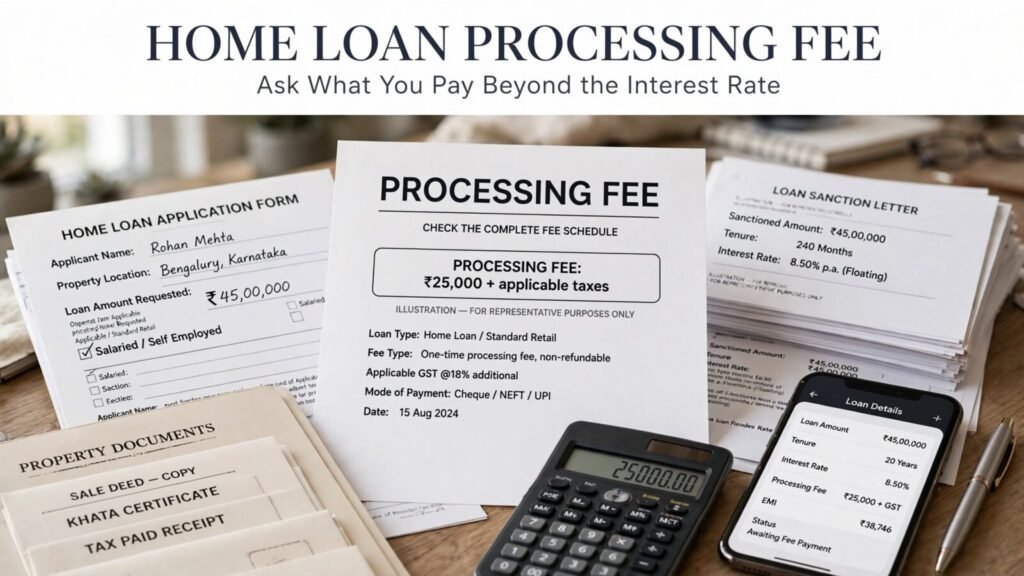
This is the most visible home loan processing charge, and also the most negotiable.
Many lenders price the processing fee as a percentage of the loan amount, while others use a flat fee, a minimum/maximum amount, or a combination. For illustration, a ₹50 lakh loan could have a processing fee in the ₹12,500–₹25,000 range at a 0.25%–0.50% rate. GST of 18% is extra.
- Some PSU banks cap processing fees at a flat ₹5,000–₹10,000 for smaller loans.
- Some lenders advertise zero processing fee during promotional periods. If a lender advertises this, check the complete schedule of charges and compare the interest rate and other costs with competing lenders.
A strong credit profile, stable income, and a competitive loan application may give you some negotiating leverage, although fee waivers depend entirely on the lender and offer.
Legal Verification Charges
Before disbursing the loan, the lender generally carries out legal and technical due diligence on the property to assess title, encumbrances, approvals, valuation and other relevant risks.
This covers the cost of an empanelled lawyer or legal firm conducting this verification.
- For ready properties with clean documentation: ₹5,000 – ₹8,000
- For under-construction or resale properties with complex titles: ₹8,000 – ₹15,000+
If the bank asks you to pay legal fees directly to a lawyer in cash, insist on a proper receipt and bank acknowledgment. All fees should be traceable.
Technical / Valuation Charges
The bank appoints an independent valuer to inspect the property and confirm it is worth what you are paying.
Home loan valuation charges typically range from ₹3,000 to ₹8,000, depending on the city and property size. For premium properties or large land parcels, this can go higher.
Documentation Charges
These cover preparing your loan agreement, mortgage deed, and other documents. Expect ₹2,000 to ₹5,000.
Mortgage, MODT, and CERSAI Charges

- MODT (Memorandum of Deposit of Title Deed): Applicable in some states. Cost: ₹5,000 – ₹15,000.
- CERSAI: Central Registry of Securitisation Asset Reconstruction and Security Interest registration. A nominal charge, typically ₹500 – ₹1,000.
GST on Home Loan Fees
GST at 18% applies to processing fees, legal fees, technical fees, and administrative charges. It does not apply to stamp duty or registration fees.
GST Clarification: GST is generally applicable to taxable services and lender/third-party service charges, but stamp duty and registration fees are government levies and are treated differently. Always check the lender’s invoice and applicable tax treatment rather than assuming 18% applies to every amount you pay.
Category C: Optional or Conditional Costs
These may or may not apply to you, depending on your lender and choices.
Property Insurance
Whether property insurance is required depends on the lender, property, and loan terms. Some lenders require it; others make it optional but strongly recommended.
Premium depends on property value and coverage, typically ₹5,000 – ₹15,000 annually. This is a product-dependent requirement, not a universal home-loan rule.
Loan Protection / Credit-Life Insurance
This is optional in most cases, though some lenders bundle it with the loan. It covers the outstanding loan in case of the borrower’s death.
- Single premium or annual: ₹15,000 – ₹50,000+
- If the premium is added to your loan amount, you will also pay interest on that additional amount over the loan tenure. Ask the lender to show you the total additional repayment before agreeing.
Important: Loan protection insurance is not automatically a mandatory home-loan charge. It is a separate insurance product and should not automatically be treated as a condition of getting the loan. Do not assume that purchasing a particular insurance product from the lender is automatically a condition of getting the home loan. Ask the lender to clearly explain whether any insurance is required under the loan terms and whether you may choose the insurer.
Charges During the Loan Tenure
Your costs do not end at disbursement. Be aware of charges that may apply during repayment:
| Charge | What It Means |
|---|---|
| Penal charges | Charges applicable when specified loan terms are not complied with. The exact quantum and reason must be disclosed upfront by the lender. |
| Bounce / NACH charges | May apply when an EMI payment fails due to insufficient funds. |
| Statement / document charges | May apply for duplicate statements or certain document requests. |
| Conversion charges | May apply when changing certain loan-rate options (e.g., switching from fixed to floating). |
| Prepayment / foreclosure | RBI’s applicable prepayment-charge framework depends on the type of loan, borrower, lender and date of sanction. For many floating-rate loans to individual borrowers, prepayment charges are prohibited, but borrowers should check the current RBI rules and the specific terms disclosed in the KFS and loan agreement. |
The exact amounts should be checked in your lender’s current schedule of charges and Key Facts Statement.
Pre-EMI Interest: The Cost Nobody Talks About
If your loan is disbursed in stages (common for under-construction properties), the bank may charge interest on the disbursed amount from the date of each disbursement until your full EMI begins.
There is no standard pre-EMI amount. It depends on the amount disbursed, interest rate and period for which interest is charged before regular EMI servicing begins. Ask the lender to show you the calculation in rupees.
What Is the “All-In Cost” of a Home Loan?
Interest rate ≠ total borrowing cost.
RBI has repeatedly emphasised that lenders should disclose the all-in cost and relevant fees to borrowers.
Total Cash Requirement
When planning your purchase, budget for:
Down payment + property stamp duty + registration + lender fees + mortgage-related charges + applicable insurance + other transaction costs
Borrowing Cost / APR
When comparing lenders, compare:
Interest and applicable charges included under the RBI KFS/APR framework
RBI’s KFS framework defines APR as the annual cost of credit and requires specified charges to be incorporated, including applicable third-party charges recovered by the regulated entity.
Two lenders offering the same 8.50% interest rate can still leave you with very different out-of-pocket expenses.
Do not ask the bank only, “What is your interest rate?” Ask, “What is my total cost of borrowing?”
That single question separates informed borrowers from those who get surprised later.
Check the Key Facts Statement Before Signing
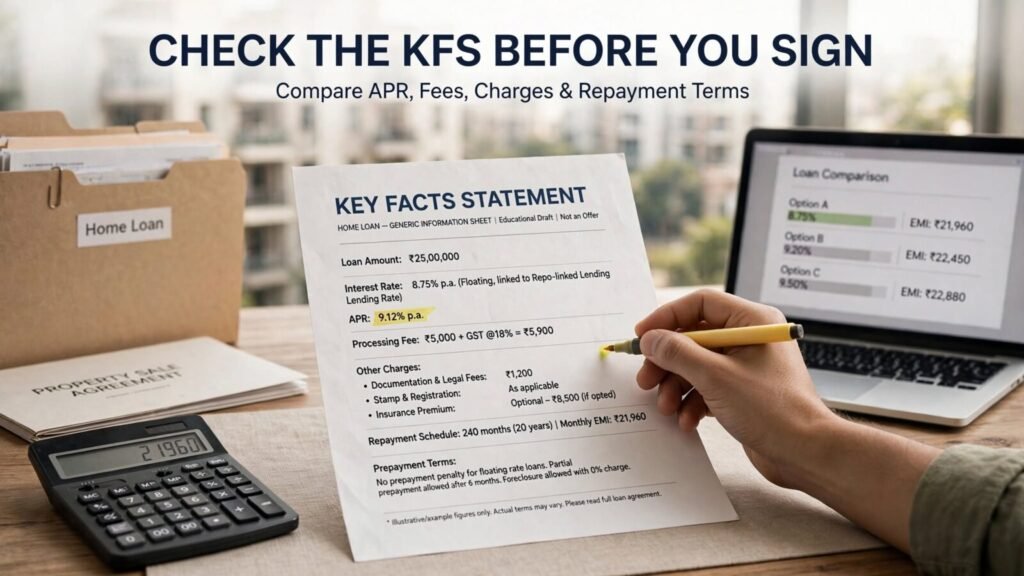
This is probably the most important step you can take when comparing home loan fees and charges before signing.
RBI’s Key Facts Statement (KFS) framework requires all regulated entities to provide prospective borrowers with a standardised document containing critical cost information for applicable retail term loans. The KFS framework applies to retail and MSME term loans of regulated entities, with the framework applicable to new loans sanctioned from October 1, 2024, subject to the scope specified by RBI, as per circular RBI/2024-25/18, DOR.STR.REC.13/13.03.00/2024-25 dated April 15, 2024.
Before you sign your loan agreement, ask for the KFS and verify:
- Loan amount and term
- Interest rate and type (fixed / floating / hybrid) and the reference benchmark
- Annual Percentage Rate (APR) the all-in cost including fees
- All fees and charges (processing, legal, technical, administrative, and third-party charges)
- Repayment schedule with amortisation
- Penal charges, foreclosure, and prepayment terms
- Insurance or third-party charges (where applicable)
- Grievance redressal mechanism
Key protections you should know:
- The KFS must be provided before the loan agreement is signed, and the lender must obtain your acknowledgment that you have understood it.
- The KFS shall have a validity period of at least three working days for loans having a tenor of seven days or more, giving you time to compare offers.
- Any fees, charges, etc. which are not mentioned in the KFS, cannot be charged by the REs to the borrower at any stage during the term of the loan, without explicit consent of the borrower.
- The KFS must be in a language you understand not just English.
Do not ask the bank only, “What is your interest rate?” Ask, “What is my total cost of borrowing?”
Which Charges Are Negotiable?
| Charge | Usually Negotiable? |
|---|---|
| Processing fee | Sometimes |
| Administrative fee | Sometimes |
| Legal fee | Usually limited |
| Technical / valuation fee | Usually limited |
| Government stamp duty | No |
| Registration fee | No, except applicable statutory concessions |
| CERSAI / statutory charges | Generally no |
| Insurance premium | Product-dependent |
| Interest rate | Potentially negotiable, depending on lender/profile |
| Prepayment charges | Governed by applicable RBI/lender rules |
Knowing which home loan fees and charges are negotiable can help you reduce your upfront borrowing cost.
Focus your negotiating effort where it matters. Do not waste time on government charges. Focus on processing fees, interest rate, administrative charges and optional products.
Illustrative Maharashtra Example: ₹50 Lakh Loan on a ₹70 Lakh Property
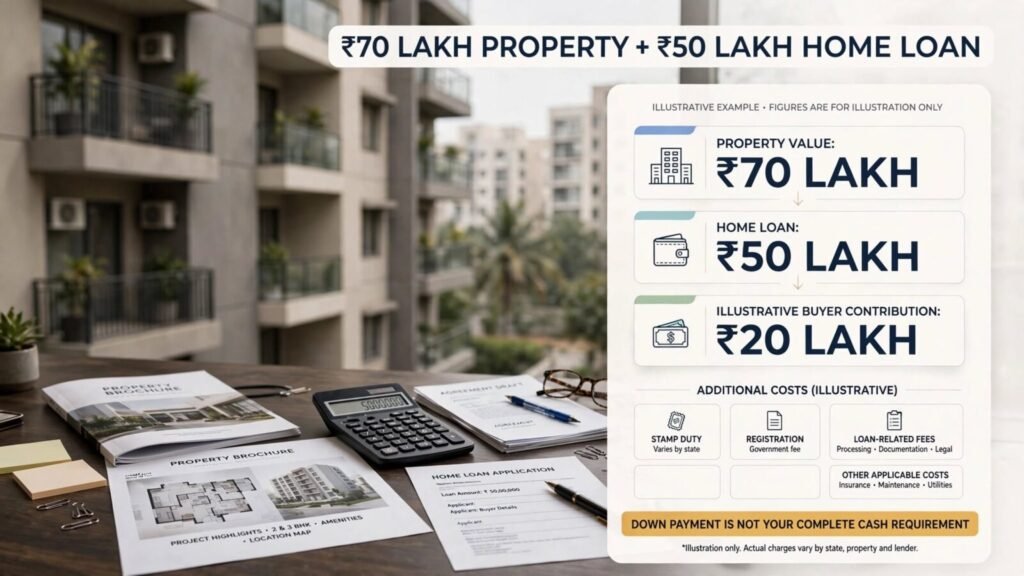
This is an illustration, not a universal closing-cost estimate. Actual government and lender charges vary by state, lender, property, and transaction structure.
Suppose you are buying a property worth ₹70 lakh and taking a ₹50 lakh home loan.
Table
| Category | Component | Estimated Cost |
|---|---|---|
| Property purchase | Down payment (assuming ~80% LTV) | ₹20,00,000 |
| Property purchase | Stamp duty (illustrative Maharashtra range) | ₹3,50,000 – ₹4,20,000 |
| Property purchase | Registration (illustrative) | ₹70,000 |
| Loan-related | Processing fee + GST | ₹12,000 – ₹30,000 |
| Loan-related | Legal + technical + documentation | ₹10,000 – ₹25,000 |
| Loan-related | MODT + CERSAI (where applicable) | ₹5,000 – ₹15,000 |
| Optional/conditional | Property insurance (1st year, if required) | ₹5,000 – ₹15,000 |
| Optional/conditional | Loan protection insurance (if chosen) | ₹15,000 – ₹50,000 |
Estimated cash requirement excluding optional loan-protection insurance: approximately ₹24.4 lakh–₹25.6 lakh
This illustration uses assumed Maharashtra transaction costs and selected lender charges. Your actual amount can be materially different. Government charges are shown only for illustration. The actual amount may depend on the property’s location, applicable transaction/ready-reckoner value, buyer category and prevailing Maharashtra rules.
If you choose the illustrative ₹15,000–₹50,000 loan-protection policy, add that amount separately.
Most buyers budget only for the down payment. But the additional property-purchase and loan-related costs can add several lakh rupees to the cash you need at closing.
Calculate Your Total Home-Buying Cash Requirement
Use this simple formula:
Cash required = Down payment + stamp duty + registration + lender charges + mortgage charges + applicable insurance + other transaction costs
Want to calculate your own cash requirement? Use the PennyPowerPlay Home Loan Planner to estimate your EMI, eligibility, affordability, and other home-buying costs based on your numbers.
How to Compare Home Loans Beyond the Interest Rate
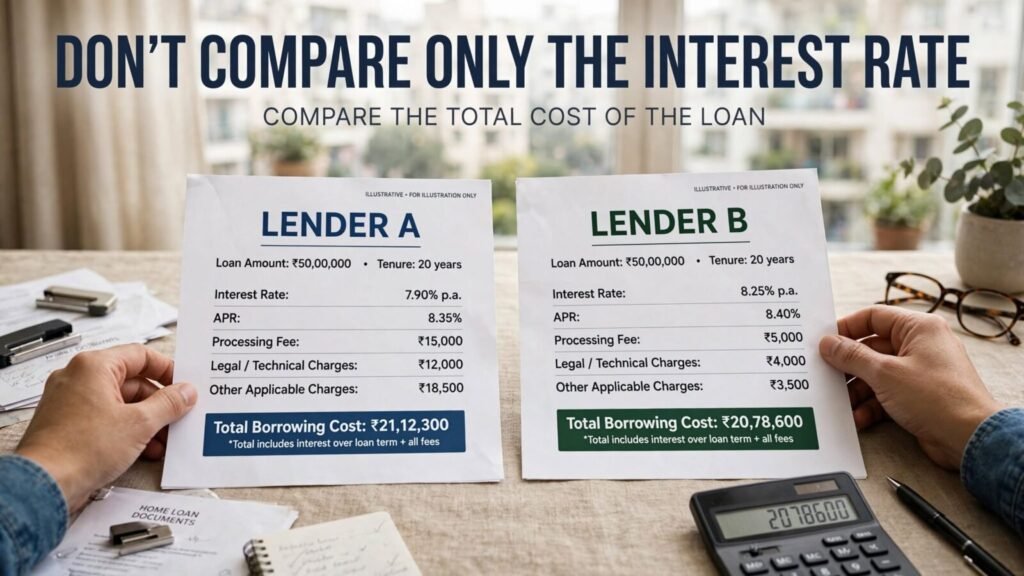
When comparing two lenders:
- Add up all Category B costs (loan-related fees)
- Add GST
- Check if either lender is bundling insurance
- Compare the APR, not just the advertised interest rate
- Check reset frequency and spread terms (read my guide on [RBI home loan rules 2026] for the latest on this)
A lender at 8.60% with lower upfront fees and a transparent KFS may be cheaper over five years than a lender at 8.50% with hidden charges.
10 Questions to Ask Your Bank Before Paying the Processing Fee
- What is the processing fee, and is GST extra?
- Is the processing fee refundable if the loan is not sanctioned?
- What are the legal verification charges?
- What are the technical / valuation charges?
- Are there any mortgage / MODT charges?
- What CERSAI charge applies?
- Are there any insurance products included in the proposal?
- What are the charges for delayed EMI payments?
- What are the prepayment / foreclosure charges applicable to my specific loan?
- Can you provide all of the above in writing before I pay the processing fee?
RBI’s framework puts significant emphasis on transparent disclosure of fees and charges. If the lender cannot clearly explain the charges, ask for a written clarification before proceeding.
Frequently Asked Questions
Q1: Are home loan processing fees refundable if my loan is rejected? Processing fees are often non-refundable, but the exact refund policy depends on the lender and the terms disclosed before payment. Check the lender’s written fee schedule and KFS before paying.
Q2: Can I negotiate home loan charges with the bank? Processing fees and administrative charges are the most negotiable. Legal and valuation charges are harder to negotiate since they are paid to third-party vendors. Government charges (stamp duty, registration) are non-negotiable.
Q3: Do all banks charge the same home loan fees and charges? Fee structures and processing times vary by lender. Compare the complete fee schedule, KFS, service process and turnaround time rather than assuming one lender category is always cheaper or faster.
Q4: Is GST applicable on home loan processing fees? Yes. GST at 18% applies to processing fees, legal fees, technical fees, and administrative charges. It does not apply to stamp duty or registration fees.
Q5: What are the biggest hidden charges in a home loan? Pre-EMI interest, insurance bundling, penal charges, and balance transfer charges are the most common costs borrowers overlook. Always read the loan agreement’s “Schedule of Charges” annexure and demand the KFS.
Q6: Do I need to pay fees again if I transfer my loan to another bank? Yes. A home loan balance transfer involves fresh processing, legal, and valuation charges at the new bank — typically ₹10,000–₹25,000. However, if the interest rate saving is significant, it is often still worth it. Read my guide on [home loan balance transfer] to calculate your break-even.
Q7: Are there charges after the loan is disbursed? Yes. Annual property insurance premiums (if applicable), penal charges for non-compliance, and bounce charges may apply during the loan tenure. For floating-rate term loans to individual borrowers, RBI’s Reserve Bank of India (Pre-payment Charges on Loans) Directions, 2025 (effective January 1, 2026) prohibit prepayment/foreclosure penalties for loans sanctioned or renewed on or after that date. Always check the terms applicable to your particular loan and lender.
Final Thoughts
In my experience, one of the most common problems is not the EMI itself, but borrowers underestimating the upfront costs that come before disbursement.
A ₹50 lakh loan is not just about the interest rate. It is about knowing what is negotiable, what is mandatory, and what is a red flag.
Before you sign your loan agreement, ask your bank one simple question:
“Can I have a written breakdown of every fee, charge, and government cost I will pay before disbursement?”
If the lender cannot clearly explain the charges, ask for a written clarification before proceeding.
“Ghar khareedna sapna hai. Lekin uss sapne ki asli keemat sirf property price nahi, uske saare charges mila kar banti hai.”
Buying a home is a dream. But the real cost of that dream is not just the property price — it is the property price plus every charge that comes with it.
Related Posts
Hidden Costs of Buying a Home in India
Home Loan Eligibility for Salaried Individuals: Complete Guide
Home Loan Documents Checklist: What You Actually Need in 2026
CIBIL Score for Home Loan: What Banks Really Look For
Fixed vs Floating Home Loan Interest Rates: Which Is Better?
Home Loan Balance Transfer: Does It Really Save Money?
Home Loan Prepayment & Foreclosure Guide
Disclaimer: The fee ranges mentioned in this article are indicative and based on prevailing market practices among Indian banks and HFCs as of 2026. Actual charges vary by lender, loan amount, property type, and state. Always verify the latest fee schedule directly with your lender before applying. For stamp duty and registration, consult your state’s official registration website or a qualified property lawyer. This article is for informational purposes only and does not constitute financial advice.
About the Author
A.K. Satpute is a Finance & AI Blogger and the founder of PennyPowerPlay.com, focused on helping Indian home buyers understand home loans, eligibility, interest rates, fees, and borrowing decisions.
With 8+ years of experience in housing finance, he has worked with home-loan applications across leading banks and housing finance companies.
His goal is to simplify complex home-loan information so borrowers can make better-informed decisions before applying for a loan.