“Sir, I have never taken a loan or credit card. My salary is ₹75,000 per month, but I don’t have a CIBIL score. Will the bank reject my home loan?”
I have heard questions like this many times during my years working in the housing finance industry.
And there is one important misunderstanding I want to clear up immediately:
Having no CIBIL score does not automatically mean you are a bad borrower.
If you have never taken a loan, never used a credit card, and have never had a credit facility reported to a credit bureau, the lender simply has less information about your past repayment behaviour.
This is commonly referred to as being new to credit, and understanding new to credit home loan approval is important if you are applying for your first home loan in India.
And there is a big difference between:
No credit history
and
Bad credit history.
The Reserve Bank of India has advised credit institutions that first-time borrowers should not have their loan applications rejected solely because they have no credit history. RBI has also clarified that it has not prescribed a universal minimum credit score for sanctioning loans.
But this does not mean that every person without a CIBIL score is automatically eligible for a home loan.
The lender will still assess your income, employment stability, existing obligations, repayment capacity, banking behaviour, down payment, property and other credit factors.
In this guide, I will explain exactly how new-to-credit home loan approval in India works, what banks look at when you have no established credit history, how FOIR and LTV affect your application, whether you should take a credit card before applying, and what you can do to improve your chances of getting your first home loan.
If you are planning your first home purchase, you can also start with my detailed Home Loan Guide for India to understand the complete process from eligibility to disbursement.
What Does “New to Credit” Mean?
Being new to credit generally means that you have little or no reported borrowing history.
For example, you may have:
- Never taken a personal loan
- Never taken a car or two-wheeler loan
- Never used a credit card
- Never had a home loan
- Never used another traditional credit facility reported to a credit bureau
As a result, your credit report may not contain enough information to generate a conventional credit score.
You may see terms such as:
- NA
- NH
- No Hit
- No Credit History
depending on the credit-reporting system and report you are viewing.
This does not automatically mean that you have a poor credit profile.
Quick Note: What Does a CIBIL Score of -1 Mean?
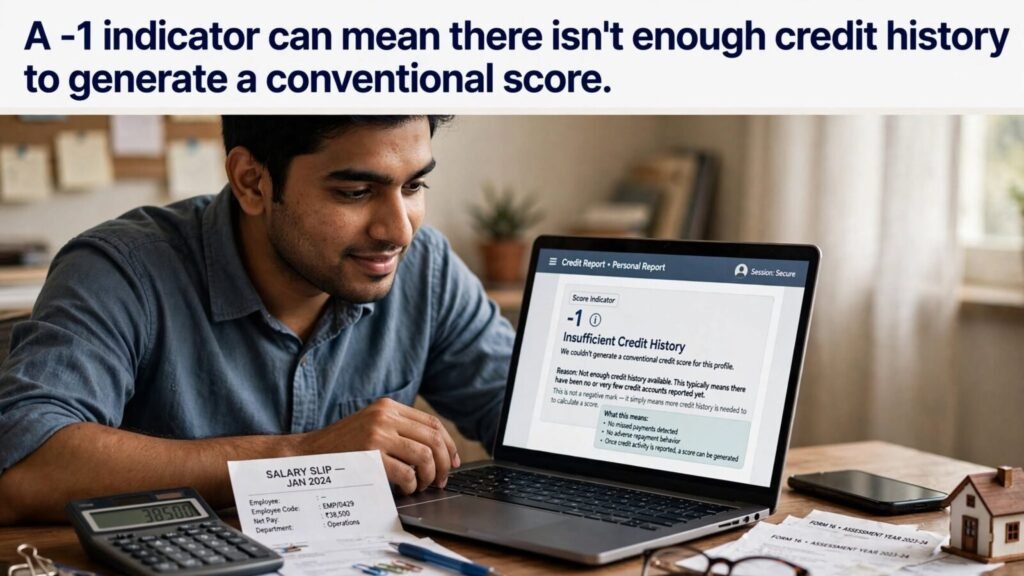
If you check a digital credit report and see a score of -1, don’t immediately assume that it means you have a bad credit score.
Some credit-reporting systems may display -1 or a similar code when there is insufficient credit history to generate a conventional score.
In simple terms, it can mean:
“There isn’t enough reported credit history to calculate your normal credit score.”
The exact terminology can vary depending on the credit-reporting service, so always read the explanation provided with your report.
This distinction is extremely important.
No credit history ≠ bad credit history.
A borrower with a high credit score has demonstrated repayment behavior.
A borrower with a low credit score has also demonstrated repayment behavior, but the credit history may contain negative indicators.
A new-to-credit borrower simply has limited or no credit history to evaluate.
Can You Get a Home Loan Without a CIBIL Score?
Yes, it is possible.
But there is an important qualification.
There is no universal RBI rule saying that every bank or housing finance company must approve a home loan for a person who has no credit score.
RBI’s position is that a first-time borrower should not be rejected solely because there is no credit history.
The lender can still evaluate the application using other information and its own board-approved credit policy.
This is where many first-time buyers get confused.
They hear: “RBI says you cannot be rejected because you have no CIBIL score.”
That is not correct.
The lender can still reject an application because of:
- Insufficient income
- High existing EMI obligations
- Weak repayment capacity
- Unstable employment
- Poor banking behaviour
- Inadequate down payment
- Property-related problems
- Incomplete documentation
- Age or tenure restrictions
- Income verification issues
- Internal credit policy
The absence of a credit score is only one part of the overall assessment.
If you want to understand how lenders calculate eligibility based on your salary and obligations, read my detailed guide on Home Loan Eligibility for Salaried Persons.
No CIBIL Score vs Low CIBIL Score: What Is the Difference?

This is one of the most important things a first-time home buyer should understand.
| Credit situation | What it generally means |
|---|---|
| No CIBIL / NA / NH | Insufficient or no credit history |
| High CIBIL score | Strong demonstrated repayment history |
| Low CIBIL score | Credit history contains higher-risk indicators |
| Recent defaults | Potential serious concern for lender |
| Multiple recent enquiries | May indicate frequent credit applications |
Let’s take two applicants.
Applicant A
No CIBIL score because he has never borrowed money.
Applicant B
CIBIL score of 580 because he previously missed several EMI payments.
Applicant A does not automatically have a worse credit profile than Applicant B.
In fact, Applicant A may have a stronger overall financial profile if he has:
- Stable employment
- Good income
- Low existing obligations
- Healthy savings
- Good banking behaviour
- Adequate down payment
- A legally clear property
This is why I don’t recommend taking unnecessary debt simply because someone tells you:
“You need a CIBIL score before taking a home loan.”
“If we give this person a ₹40 lakh or ₹50 lakh home loan for 20 years, what evidence do we have that they can comfortably repay it?”
The lender can look at:
Income + employment + banking + obligations + down payment + property + documentation
In other words, you may not have a long credit history, but you can still build a strong home loan application profile.
What Banks Check When You Have No Credit History

If you are new to credit, don’t panic.
Instead, focus on the areas that you can control.
1. Income and Employment Stability
Your income is one of the most important parts of your home loan application.
For salaried applicants, lenders may consider:
- Monthly salary
- Employer
- Employment stability
- Total work experience
- Current employer tenure
- Salary credits
- Variable income
- Existing obligations
Suppose two people have the same salary of ₹80,000.
One has stable employment and four years of continuous work experience.
The other has changed jobs several times and has only recently joined a new employer.
Their income is the same, but their overall risk profile may be different.
For self-employed borrowers, lenders may look at:
- Business vintage
- Income tax returns
- Profitability
- Banking turnover
- Business continuity
- Existing liabilities
Your income needs to support the proposed EMI.
2. Existing Financial Obligations and FOIR
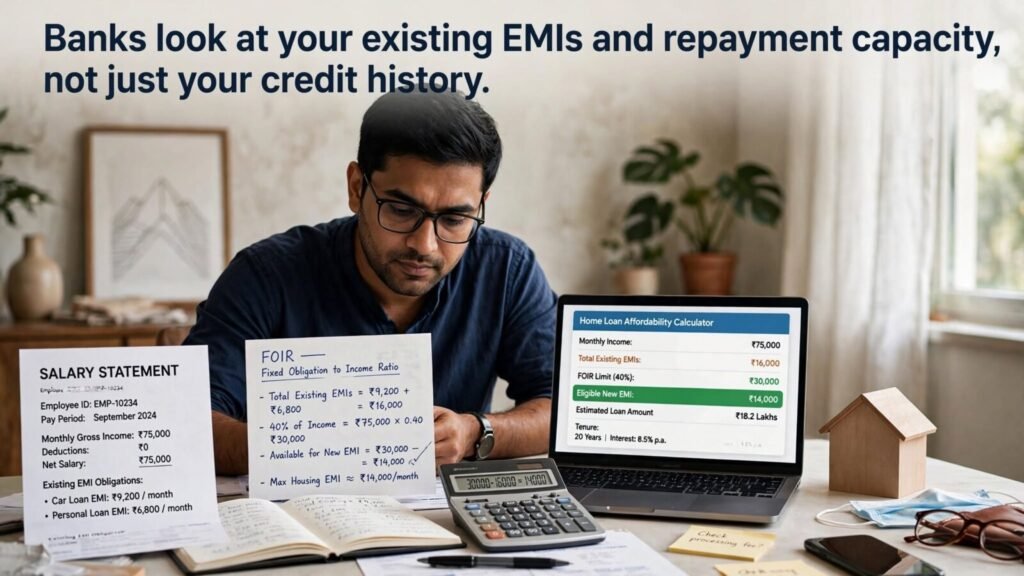
Having no CIBIL score does not mean that you automatically qualify for a large home loan.
The lender will still examine your existing financial commitments.
For example, suppose your monthly income is:
₹75,000
And you already pay:
- Car EMI: ₹15,000
- Personal loan EMI: ₹10,000
Your existing EMI obligation is already:
₹25,000 per month.
The lender then needs to determine how much additional home loan EMI you can reasonably handle.
What Is FOIR?
FOIR stands for Fixed Obligation to Income Ratio.
It is a commonly used underwriting measure that helps lenders understand how much of your monthly income is committed toward fixed financial obligations.
In practice, many lenders may consider an overall FOIR in a broad range of around 40%–50%, although the actual threshold varies depending on the lender, borrower profile, income level and other factors.
This is not a universal RBI-mandated FOIR limit.
For example, if your monthly income is ₹75,000 and a lender considers a 50% FOIR, total fixed obligations could be around:
₹75,000 × 50% = ₹37,500
If you already have ₹25,000 in existing EMIs, only part of that obligation capacity remains for the proposed home loan EMI.
This is why I always tell first-time buyers:
Don’t calculate your home loan eligibility from salary alone. Calculate it after considering your existing obligations.
You can use the PennyPowerPlay Home Loan Planner to estimate your EMI, affordability and potential loan amount before approaching a lender.
3. Your Banking Behaviour
This becomes particularly important when you don’t have an established credit history.
Your bank statement can tell a lender quite a lot about your financial behaviour.
Positive indicators can include:
- Regular salary credits
- Stable monthly balance
- Regular savings
- Existing obligations being paid on time
- No frequent cheque returns
- No unexplained large transactions
Possible warning signs can include:
- Frequent overdrafts
- Repeated cheque or ECS returns
- Very low balances
- Large unexplained cash transactions
- Heavy short-term borrowing
- Financial transactions that raise questions during underwriting
You may not have a CIBIL history, but your bank statement still tells a financial story.
Make sure that story is consistent with the income you have declared.
4. Your Age and Loan Tenure
Age is another important part of home loan underwriting.
Suppose you are:
28 years old.
You may potentially have a long working period ahead of you.
But if you are:
55 years old, the lender may have to structure the loan around your remaining working years or retirement income.
This can affect:
- Maximum tenure
- Eligible loan amount
- EMI
- Co-applicant requirement
The exact age and tenure criteria vary between lenders.
The important point is that no CIBIL score does not exist in isolation.
The lender looks at your complete profile.
5. Down Payment and LTV
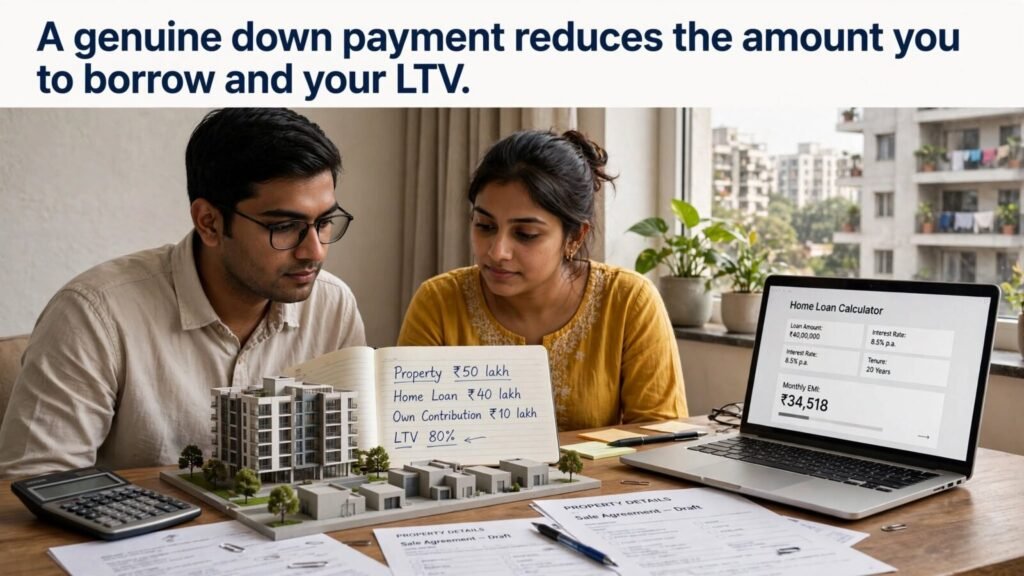
Your down payment is another important part of your application.
Suppose the property costs:
₹60 lakh
and you have:
₹20 lakh of your own documented savings.
You need to borrow:
₹40 lakh.
The lender is financing a smaller portion of the property value compared with a borrower who is seeking the maximum possible loan.
What Is LTV?
LTV stands for Loan-to-Value Ratio.
It represents the percentage of the property’s value being financed through the home loan.
For example:
Property value = ₹50 lakh
Home loan = ₹40 lakh
LTV = 80%
RBI’s housing finance framework specifies maximum LTV limits based on the applicable loan amount/category. However, a lender can choose to finance a lower percentage depending on its own credit policy and assessment of the borrower and property.
This is why your down payment matters.
A higher genuine down payment can:
- Reduce your loan amount
- Reduce your EMI
- Reduce total interest
- Reduce your LTV
- Potentially strengthen the overall application
But remember:
Don’t borrow your down payment through an expensive personal loan just to show a higher contribution.
That can increase your monthly obligations and weaken your repayment capacity.
6. Property Quality and Documentation
A home loan is a secured loan.
The property itself becomes security for the lender.
Therefore, even if your income is strong, a problematic property can create serious difficulties.
The lender may examine:
- Property title
- Sale agreement
- Approved plans
- Construction status
- Property valuation
- Location
- Builder/project profile
- Existing encumbrances
- Legal documentation
- Registration-related documents
This is why I always tell first-time home buyers:
Don’t choose a property only because you like the flat. Make sure the property is legally and technically financeable.
You can also use my Home Loan Documents Checklist before submitting your application.
7. Your Co-Applicant Profile
A co-applicant can sometimes strengthen the overall application.
For example, suppose you are a first-time borrower with no established credit history.
Your spouse has:
- Stable income
- Good repayment history
- Strong employment
- Healthy credit profile
Depending on the lender’s policy, adding your spouse as a co-applicant may improve the overall assessment.
But don’t add a co-applicant simply because you want a bigger loan.
A co-applicant also becomes part of the loan obligation.
New to Credit Home Loan Approval: What Are Your Chances?
There is no single percentage that can tell you your chances of approval.
Why?
Because home loan underwriting is not based on CIBIL alone.
Consider these two borrowers.
Borrower 1
- Salary: ₹90,000
- Age: 29
- Employment: Stable
- Existing EMI: ₹5,000
- Savings: ₹15 lakh
- Credit history: None
- Property: Legally clear
Borrower 2
- Salary: ₹90,000
- Age: 29
- Employment: Unstable
- Existing EMI: ₹35,000
- Savings: ₹2 lakh
- Credit history: None
- Property: Documentation issues
Both borrowers have:
No CIBIL history.
But their overall applications are completely different.
This is the key lesson: Your lack of credit history is only one part of the home loan assessment.
Example: ₹75,000 Salary and No CIBIL Score
Let’s take a practical example.
Suppose Rahul is:
- Age: 28
- Monthly salary: ₹75,000
- Existing EMI: ₹5,000
- Employment experience: 4 years
- Current employer: 2 years
- CIBIL history: None
- Savings: ₹12 lakh
- Property price: ₹50 lakh
Rahul is worried because his credit report does not show a conventional CIBIL score.
Should he assume that the bank will reject him?
No.
The lender can still assess:
- Income
- Employment stability
- Bank statements
- Existing EMI
- Savings
- Down payment
- Property
- Age
- Proposed tenure
- Overall repayment capacity
If these factors satisfy the lender’s credit policy, his application can still be considered.
But remember:
No CIBIL score is not a guarantee of approval either.
The lender still needs sufficient information to assess repayment capacity and overall risk.
Should You Take a Credit Card Before Applying for a Home Loan?
This is one of the most common questions I receive.
My answer is:
Don’t take a credit card or personal loan purely to manufacture a CIBIL score immediately before applying for a home loan.
Why?
Because opening a new credit account does not instantly create a strong repayment history.
And if you start applying for multiple credit cards or loans, you may generate multiple credit enquiries.
Instead, if you genuinely need a credit card, use it responsibly:
- Spend only what you can repay
- Pay the bill on time
- Avoid unnecessary balances
- Keep utilization under control
- Don’t apply for several cards at once
But don’t believe the myth: “Take a personal loan for six months and your home loan will definitely get approved.”
There is no such guarantee.
Your home loan lender will still evaluate your complete financial profile.
How to Improve Your Home Loan Approval Chances Without a CIBIL Score
If you are planning to buy your first home and have no established credit history, focus on these 8 things.
1. Keep your employment stable
Avoid unnecessary job changes immediately before applying for a home loan.
2. Maintain clean bank statements
Your salary and regular income should be clearly visible.
3. Build your down payment from documented sources
Maintain a clear savings trail.
4. Reduce unnecessary EMIs
Lower existing obligations can improve your repayment capacity.
5. Avoid multiple loan applications
Don’t apply to 8–10 lenders simultaneously.
6. Check your credit report
Even if you believe you have no credit history, check the report for unexpected accounts or enquiries.
7. Keep property documents ready
Don’t wait until sanction or disbursement to discover a documentation issue.
8. Choose the right lender
Different lenders can have different credit policies.
A rejection from one lender does not automatically mean every lender will reject you.
7 Mistakes New-to-Credit Home Buyers Should Avoid
Mistake 1: Thinking No CIBIL Means Bad CIBIL
It doesn’t.
You may simply have no borrowing history.
Mistake 2: Taking a Personal Loan Just to Create a Score
Don’t create unnecessary debt because someone tells you that you need a credit history.
Mistake 3: Applying to Every Bank
Don’t submit applications everywhere without understanding the lender’s eligibility and credit policy.
Mistake 4: Hiding Existing Obligations
Never hide:
- Personal loans
- Car loans
- Credit cards
- Other financial commitments
The lender’s verification process can identify financial obligations.
Mistake 5: Using Borrowed Money as Your Down Payment
Your down payment should ideally come from your own documented funds.
Mistake 6: Ignoring Your Bank Statement
Don’t assume the lender only looks at your salary slip.
Your banking behaviour can also matter.
Mistake 7: Borrowing the Maximum Amount Possible
This is one of the biggest mistakes first-time home buyers make.
Just because a lender says you may be eligible for ₹50 lakh does not mean you should borrow ₹50 lakh.
Your home loan should fit your long-term financial life, not just the maximum amount the lender is willing to sanction.
Documents You Should Keep Ready
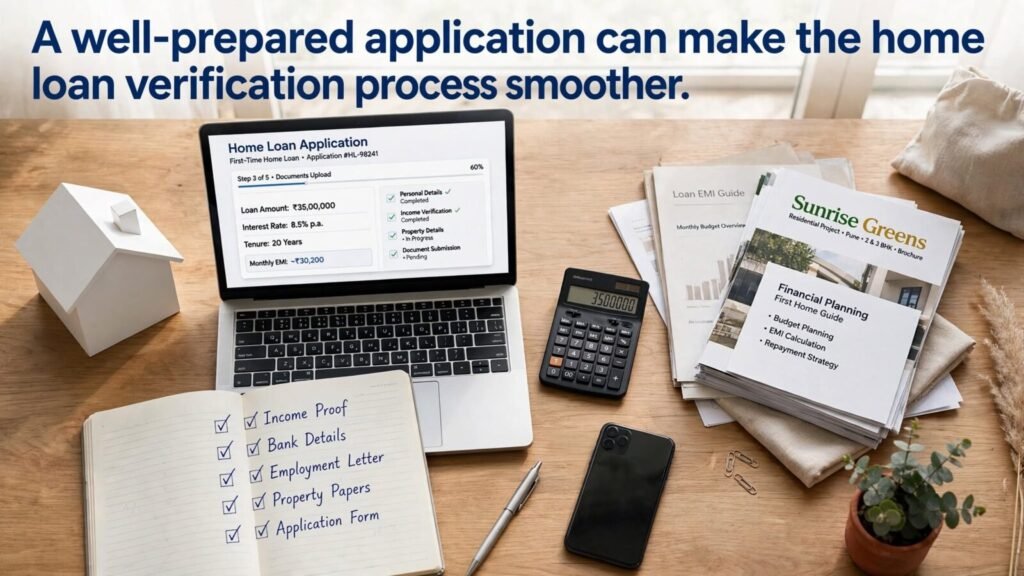
If you are new to credit, make the documentation side of your application as clean as possible.
For a salaried applicant, lenders may ask for documents such as:
Personal Documents
- PAN
- Aadhaar or other accepted KYC documents
- Address proof
- Photographs
Income and Employment Documents
- Latest salary slips
- Salary certificate, where required
- Form 16
- Bank statements showing salary credits
- Employment-related documents, depending on the lender
Property Documents
Depending on the transaction:
- Agreement for sale
- Sale deed
- Title documents
- Approved building plan
- Property tax documents
- Builder/project documents
- Other legal and technical documents
The exact document list varies depending on the lender, borrower and property.
Before applying, use my Home Loan Documents Checklist so you can prepare everything in advance.
New to Credit Home Loan Approval: Step-by-Step Process
New to credit home loan approval depends on much more than whether your credit report shows a conventional score.
Here is how I would approach the process if I were applying for my first home loan with no established credit history.
Step 1: Check Your Credit Report
Don’t assume you have no credit history.
Check your report first.
You may discover:
- An old credit card
- A forgotten consumer loan
- An account incorrectly reported
- A credit enquiry you don’t recognize
Step 2: Calculate Your Real Affordability
Don’t start with:
“How much will the bank give me?”
Start with:
“How much EMI can I comfortably afford every month?”
Then work backwards to the loan amount.
Use the PennyPowerPlay Home Loan Planner to estimate your EMI and affordability.
Step 3: Check Your FOIR and Existing Obligations
List every existing EMI and fixed financial obligation.
Then estimate how much room you have for a home loan EMI.
Remember that FOIR thresholds vary by lender.
Step 4: Plan Your Down Payment
Calculate how much money you genuinely have available from your own documented savings.
Don’t exhaust every rupee you have.
A home purchase also involves expenses such as:
- Stamp duty
- Registration
- Processing charges
- Legal expenses
- Moving costs
- Interiors
- Emergency reserves
Step 5: Prepare Your Documents
Keep your income, employment, banking and property documents ready.
A clean application makes the verification process easier.
Step 6: Choose the Right Lender
Don’t simply choose a bank because your salary account is there.
Compare:
- Interest rate
- Processing fee
- Eligibility
- Loan tenure
- Reset terms
- Credit policy
- Service quality
- Total borrowing cost
Step 7: Submit a Well-Prepared Application
Make sure the information you provide is accurate and consistent.
Your: Application → Salary slips → Bank statements → Form 16/ITR → KYC → Property documents
should tell the same financial story.
Step 8: Read the Sanction Letter Carefully
Before accepting the loan, check:
- Sanctioned amount
- Interest rate
- Benchmark
- Spread
- Reset frequency
- Tenure
- EMI
- Processing fee
- Other charges
- Conditions before disbursement
Never treat the sanction letter as a document you can read later.
It is one of the most important documents in your home loan journey.
Check Your Home Loan Readiness Before Applying
Before approaching a lender, I recommend checking these three things.
1. Check Your Estimated Loan Eligibility
Use the PennyPowerPlay Home Loan Planner to estimate:
- EMI
- Affordability
- Potential loan amount
- Existing obligations
- Prepayment scenarios
2. Check Your Credit Profile
Don’t assume that you have no credit history.
Check your credit report and understand whether it shows:
- A conventional score
- NA/NH
- No Hit
- Another no-history indicator
If you see -1, read the explanation provided with your particular report before assuming that it represents a poor credit score.
3. Check Your Documents
Before submitting the application, review your income, KYC and property documents.
Use my Home Loan Documents Checklist to identify anything that may be missing.
The better prepared you are before applying, the easier it becomes for the lender to understand your financial profile.
New to Credit Home Loan Approval: Frequently Asked Questions
Q1: Can I get a home loan if I have no CIBIL score?
Yes, it is possible.
RBI has advised lenders that first-time borrowers should not be rejected solely because they have no credit history.
However, the lender will still assess your income, repayment capacity, employment, property and other factors.
Q2: Is no CIBIL score the same as a zero CIBIL score?
Not necessarily.
Terms such as NA, NH or No Hit can indicate insufficient credit information to generate a conventional score.
Check your actual credit report rather than assuming what the result means.
Q3: Does RBI prescribe a minimum CIBIL score for home loans?
No.
RBI has not prescribed a universal minimum credit score for sanctioning loans.
Individual lenders apply their own board-approved credit policies.
Q4: Can a bank reject my home loan because I have no credit history?
A lender should not reject a first-time borrower solely because there is no credit history.
However, the lender can reject an application for other reasons, including insufficient repayment capacity, income concerns, property issues, documentation problems or its internal credit policy.
Q5: What does a CIBIL score of -1 mean?
Depending on the credit-reporting system, -1 or a similar indicator can mean that there is insufficient credit history to generate a conventional score.
It should not automatically be interpreted as a bad credit score.
Always check the explanation shown on your particular credit report.
Q6: Should I take a personal loan to create a CIBIL score before applying for a home loan?
I would not recommend taking unnecessary debt simply to create a credit history.
A personal loan creates an EMI and can reduce your home loan repayment capacity.
Q7: Should I take a credit card before applying for my first home loan?
Not necessarily.
If you genuinely need a credit card, responsible use and timely repayment can help establish credit history over time.
But opening a credit card immediately before applying for a home loan does not guarantee approval.
Q8: Can my spouse be a co-applicant if I have no CIBIL score?
Potentially, yes, subject to the lender’s policy.
A co-applicant with stable income and a healthy credit history may strengthen the overall application.
Q9: Will I automatically get a higher interest rate because I have no CIBIL score?
Not necessarily.
There is no universal rule that every new-to-credit borrower must pay a higher home loan interest rate.
Pricing depends on the lender, product, borrower profile, risk assessment and prevailing pricing.
Q10: What is more important if I have no credit history?
Focus on the factors you can control:
Stable income + manageable obligations + clean banking + adequate down payment + suitable property + proper documentation.
These can make your overall home loan application stronger.
Final Thoughts
If you are buying your first home and have never borrowed money before, don’t panic when you see “No CIBIL Score.”
It does not mean:
“You are a bad borrower.”
It means:
“There isn’t enough credit history to evaluate you through a conventional credit score.”
That is an important difference.
RBI has recognized this issue and advised credit institutions that first-time borrowers should not be rejected merely because they have no credit history.
But remember that this does not create an automatic right to loan approval.
The lender will still evaluate your complete financial profile.
After years of working around housing finance and seeing different types of home loan applications, my advice to a new-to-credit borrower is simple:
Don’t manufacture a credit history just because you are afraid of having none.
Instead:
- Keep your income stable
- Maintain clean bank statements
- Save your down payment
- Reduce unnecessary EMIs
- Check your credit report
- Avoid multiple loan enquiries
- Keep property documents ready
- Understand your FOIR
- Understand your LTV
- Choose the right lender
- Borrow an amount you can comfortably repay
Your first home loan is not just about getting a sanction.
It is about getting a loan that you can comfortably live with for the next 15, 20 or 25 years.
And remember: “No CIBIL history doesn’t mean no home loan. It simply means the bank needs to understand your financial story in other ways.”
If you are a first-time home buyer, don’t focus only on:
“Will the bank approve me?”
Ask the more important question:
“Am I financially ready to take this home loan?”
That is the question that can save you from a very expensive mistake.
Official References
- Reserve Bank of India — Guidance relating to access to credit for individuals with no credit history.
- Government of India / Parliament — Information regarding credit history and lender assessment.
- TransUnion CIBIL — Information regarding credit reports, home loans and NA/NH credit history.
- Reserve Bank of India — Housing finance and LTV-related regulatory framework.
Related Posts
- Home Loan Eligibility for Salaried Person in India
- CIBIL Score for Home Loan: What Score Do You Need?
- Home Loan Documents Checklist for Indian Buyers
- Home Loan Guide for India
- Home Loan Eligibility for Self-Employed
- Home Loan Fees and Charges in India
About the Author
Ashok K. Satpute is the founder of PennyPowerPlay.com and a Home Loan Specialist with over 8 years of experience in India’s banking and housing finance industry.
During his career, he has worked with leading financial institutions, including ICICI Bank, HDFC, Axis Bank and PNB Housing Finance, assisting borrowers with home-loan eligibility, loan processing, documentation, CIBIL analysis, balance transfers and other aspects of housing finance.
Through PennyPowerPlay.com, he shares practical, experience-based home-loan guides designed to help Indian home buyers understand the lending process and make better-informed financial decisions.