“Sir, RBI ne toh rate nahi badhaya. Phir mera EMI kyun badh raha hai? Bank wale bol rahe hain spread revise ho gaya. Yeh spread kya hota hai?”
I heard this exact question from a borrower in Pune last week.
And he is not alone.
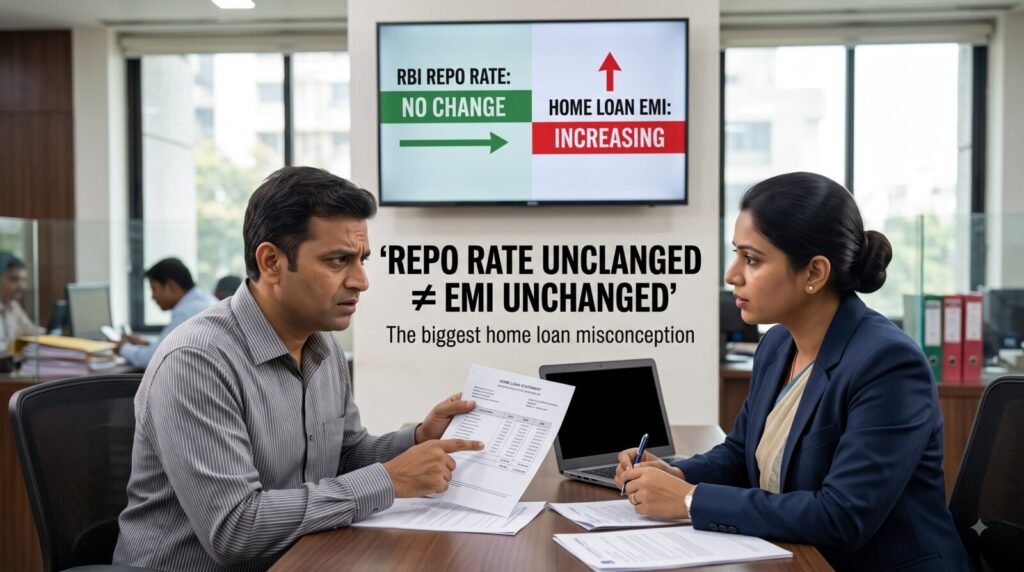
Many floating-rate home loan borrowers assume that if the RBI keeps the repo rate unchanged, their EMI must also remain unchanged.
That’s not always true.
Your home loan EMI can change because of your benchmark, reset cycle, spread and loan agreement, even when the RBI repo rate itself hasn’t moved.
In this guide, I’ll explain the repo rate impact on home loan EMI, how MCLR and EBLR work, why your EMI can increase without a repo rate hike, and what you can do if your lender revises your rate.
Repo Rate Impact on Home Loan EMI: The Biggest Misconception
Not the property price.
Not the CIBIL score.
The misunderstanding about how interest rate transmission works.
Because while news channels announce “RBI keeps repo rate unchanged at 5.25%,” the reality inside your loan account can be very different. By the time your bank’s benchmark moves, your reset date arrives, or a contractual credit-risk adjustment applies, your effective interest rate can move even though the RBI has left the repo rate unchanged.
In this guide, I will show you exactly how the repo rate, the bank’s benchmark system (MCLR or EBLR), the reset cycle, and your loan agreement interact to determine your actual EMI and why a stable repo rate does not automatically mean a stable EMI.
This post explains the real mechanics of home loan interest rate changes in India, based on practical lending experience and RBI’s regulatory framework rather than simplified news headlines.
Rate Alert: RBI Repo Rate Unchanged at 5.25%
The RBI Monetary Policy Committee (MPC) kept the policy repo rate unchanged at 5.25% on August 5, 2026, while maintaining a neutral policy stance
For home loan borrowers, this means the central bank’s policy rate has not moved. But here is what most people miss:
A stable repo rate does not lock your home loan interest rate.
Your actual rate depends on:
- Whether your loan is linked to MCLR or EBLR (External Benchmark Lending Rate)
- Your reset cycle (at least once every three months for most bank EBLR retail loans)
- Your loan agreement terms and the lender’s internal credit policy
- Whether your credit risk premium is reassessed under the terms of your contract
For borrowers trying to understand the repo rate impact on home loan EMI, the first thing to know is that the repo rate is only one piece of the puzzle.
Before we look at what you should do, here is what actually happens at the credit desk versus what borrowers assume.
What Most People Think vs. What Actually Happens
Before we look at what you should do, here is what actually happens at the credit desk versus what borrowers assume about the repo rate impact on home loan EMI.
| Factor | What Most People Think | What Actually Happens at the Credit Desk |
|---|---|---|
| Repo rate unchanged = EMI unchanged | “RBI ne rate nahi badhaya, toh mera EMI same rahega.” | For EBLR loans, the benchmark may not move, but your reset cycle, credit risk premium (if reassessed), or MCLR revision can still change your rate. |
| All floating rates move with RBI | “Floating rate means RBI jitna karega, bank utna karega.” | MCLR-linked loans do not move automatically with the repo rate. EBLR-linked loans move with the external benchmark, but only on your reset date. |
| Rate cuts benefit everyone equally | “RBI ne rate kata, sabka EMI ghatna chahiye.” | Transmission is partial and delayed under MCLR. RBI data shows lending rates do not always move one-for-one with repo-rate changes. |
| Switching to EBLR is always better | “EBLR best hai, MCLR purana hai.” | EBLR is more transparent but can be volatile. Whether it is better depends on your loan terms, remaining tenure, and the rate environment. |
| I can switch benchmarks anytime | “Mujhe MCLR se EBLR mein switch kar do.” | Switching depends on your lender’s applicable process, loan agreement, and charges. It is not an automatic or unlimited right. |
Critical Rule
Your loan agreement defines whether your interest rate is linked to MCLR, EBLR, or another benchmark. The lender’s right to revise components of your rate is governed by your contract and RBI’s regulatory framework.
Always read your sanction letter and loan agreement to understand your benchmark, spread, reset frequency, and the conditions under which any component of your rate can change.
What Is the Repo Rate and Why Does It Matter for Home Loans?

The repo rate is the rate at which the Reserve Bank of India lends money to commercial banks.
When the RBI wants to make borrowing cheaper, it cuts the repo rate.
When it wants to control inflation, it raises the repo rate.
But here is the important distinction:
The repo rate is a policy signal. It is not your home loan interest rate.
Your home loan interest rate is calculated as: Home Loan Interest Rate = Benchmark Rate + Applicable Spread Components
The benchmark can be:
- MCLR (Marginal Cost of Funds Based Lending Rate) the bank’s internal benchmark
- EBLR (External Benchmark Lending Rate) linked to the RBI repo rate, T-bill rates, or other approved external benchmarks
- Base Rate or BPLR (older loans, mostly pre-2016)
The spread includes components such as the bank’s operating costs and, where applicable, a credit risk premium based on the borrower’s profile.
Why this matters:
Under RBI’s external benchmark framework, the credit risk premium component of the spread can generally be revised only when the borrower’s credit assessment undergoes a substantial change, as agreed in the loan contract. However, the benchmark itself (MCLR or external benchmark) can move independently, and your rate will change on the reset date.

Why Your EMI Can Change Even When the Repo Rate Does Not
There are four reasons your EMI can increase even when the RBI keeps the repo rate at 5.25%:
1. MCLR Revision (MCLR Loans)
MCLR-linked loans are tied to the bank’s internal cost of funds, not directly to the repo rate.
“MCLR incorporates factors such as the bank’s marginal cost of funds, negative carry on CRR, operating costs and tenor premium.”
Even if the repo rate is unchanged, if a bank’s cost of funds rises for example, because deposit rates have gone up the MCLR can increase.
And your EMI will increase at the next reset.
2. Reset Cycle Timing (EBLR Loans)

Even if you are on EBLR (repo-linked or T-bill-linked), your interest rate does not change the day the RBI announces a policy.
It changes on your reset date.
For banks’ retail and MSME floating-rate loans linked to external benchmarks, RBI requires the reset periodicity to be at least once in three months. Your exact reset date depends on your loan agreement.
So if the repo rate changed in June but your reset is in August, you will see the change in August. If the repo rate was unchanged in August, but your reset falls in that month, any previous benchmark change will be applied then.
3. Change in Credit Risk Premium (Where Contractually Permitted)
Under RBI’s external benchmark framework, banks can choose the spread over the external benchmark. However, the credit risk premium component can generally be changed only when the borrower’s credit assessment undergoes a substantial change, as agreed in the loan contract.
This is not an arbitrary decision by the bank. It is governed by:
- Your loan agreement
- RBI’s external benchmark guidelines (DBR.No.Dir.BC.12/13.03.00/2019-20, September 4, 2019)
- A documented change in your credit profile
If your credit profile has deteriorated significantly for example, a major drop in CIBIL score, new defaults, or a substantial increase in leverage the bank may reassess your credit risk premium at the next reset, subject to the contractual terms.
4. Change from Fixed to Floating (or Vice Versa)
Some home-loan products have an initial fixed-rate period, after which the loan converts to a floating rate according to the loan agreement.
If your fixed-rate period ended in mid-2026 and the bank’s current floating rate is higher than your fixed rate, your EMI will jump regardless of what the RBI did in August.
MCLR vs EBLR: The Two Systems That Decide Your Interest Rate
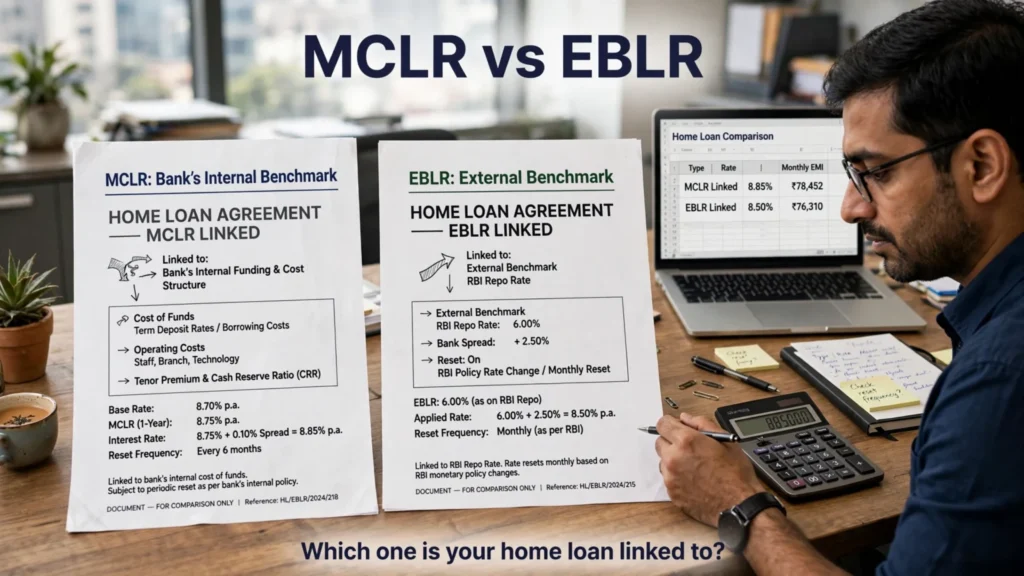
This is the most important section of this guide.
If you do not know which benchmark your loan is on, you cannot predict your EMI.
What Is MCLR?
MCLR stands for Marginal Cost of Funds Based Lending Rate.
Introduced in April 2016, it is the bank’s internal benchmark based on:
- Cost of deposits
- Borrowings from RBI and markets
- Operating costs
- Tenor premium
Key characteristics:
- Reviewed monthly by the bank
- Different MCLR for different tenors (overnight, 1-month, 3-month, 6-month, 1-year)
- Your loan is linked to a specific tenor (usually 1-year MCLR)
- Transmission is slow and incomplete compared to repo rate movements
What Is EBLR?
EBLR stands for External Benchmark Lending Rate.
Introduced in October 2019, it links your home loan directly to an external benchmark:
- RBI repo rate (most common)
- 3-month or 6-month Treasury Bill rates
- CD rates or FBIL rates
Key characteristics:
- Changes when the external benchmark changes
- More transparent than MCLR
- Reset frequency is at least once every three months for retail and MSME loans
- Transmission is faster but not instant
MCLR vs EBLR: Side-by-Side Comparison
| Feature | MCLR | EBLR (Repo-Linked or T-Bill-Linked) |
|---|---|---|
| Benchmark | Bank’s internal cost of funds | RBI repo rate, T-bill, or other approved external benchmark |
| Who controls it? | The bank | RBI (for repo rate) or market (for T-bill) |
| Transmission speed | Slow, with a lag | Faster, more direct |
| Reset frequency | Usually annual (or as per contract) | At least once every three months for retail/MSME loans |
| Spread transparency | Less transparent | More transparent |
| Best for | Borrowers who want rate stability | Borrowers who want to benefit quickly from rate cuts |
| Risk | Bank may not pass full rate cuts | Rate hikes are transmitted quickly too |
Which One Do You Have?
Check your loan sanction letter or latest account statement.
If it says:
- “Linked to 1-Year MCLR” → You are on MCLR
- “Linked to Repo Rate” or “RLLR” or “EBLR” → You are on EBLR
If you took a floating-rate retail or home loan from a bank on or after October 1, 2019, it will generally be linked to an external benchmark under RBI’s framework. Check your sanction letter to confirm.
How Spreads Work Under RBI’s External Benchmark Framework
This is where borrowers feel confused.
“RBI ne rate nahi badhaya, phir bank ne mera EMI kyun badhaya?”
The answer is usually in one of three places:
1. The Benchmark Moved (MCLR)
For MCLR loans, the bank’s internal benchmark may have increased independently of the repo rate. RBI’s MCLR framework requires banks to publish different tenor MCLRs monthly, and the reset period is one year or lower.
2. The Reset Date Arrived (EBLR)
For EBLR loans, a previous external benchmark change is being applied on your reset date. The August MPC decision may be unchanged, but your rate could still be adjusting from a previous change.
3. Credit Risk Premium Reassessment (Where Contractually Permitted)
While banks currently have latitude on benchmark transitions and spread resets, the central bank’s proposed RBI home loan rules 2026 mandate explicit borrower consent before any benchmark change and place a 3-year freeze on non-credit spread increases.
Under RBI’s framework, the credit risk premium component of the spread can generally be revised only when the borrower’s credit assessment undergoes a substantial change, as agreed in the loan contract.
This is not an arbitrary increase. It is governed by:
- Your loan agreement
- RBI’s external benchmark guidelines
- A documented change in your credit profile
In cases where a credit risk premium is revised, the lender should be able to point to the applicable contractual terms and the relevant change in the borrower’s credit assessment.
Pro Tip from My Credit Desk
I have seen borrowers receive a letter saying “Due to revision in risk premium, your spread has been increased by 20 basis points effective next reset date.”
The lesson? The credit risk premium is not fixed forever, but it is not arbitrary either. Read your sanction letter carefully and maintain a clean credit profile.
Historical Transmission: What RBI Data Actually Shows
This is where we need to be careful with numbers.
The 2019–2020 Easing Cycle
Between February and October 2019, the RBI reduced the repo rate by 135 basis points (from 6.50% to 5.15%).
RBI’s own data shows that transmission was slower under the MCLR regime. The one-year median MCLR declined by approximately 90 bps by May 2020, a significant lag compared to the repo rate reduction.
The key point is not a precise percentage of “transmission to existing borrowers.” It is this: Transmission was slower under the MCLR regime. RBI data shows that lending rates did not always move one-for-one with repo-rate changes, partly because banks’ funding costs and reset mechanisms adjusted with a lag.
The 2022–2024 Tightening Cycle
Between May 2022 and October 2024, the RBI raised the repo rate by 250 basis points (from 4.00% to 6.50%).
According to RBI’s published data:
- Repo rate: +250 bps
- 1-year median MCLR: +170 bps
- EBLR: +250 bps
- WALR on fresh rupee loans: +186 bps
- WALR on outstanding rupee loans: +118 bps
RBI data shows that transmission was generally stronger through external benchmarks and that lending rates did not always move one-for-one with repo-rate changes, particularly under the MCLR regime.
This is not a conspiracy. It is how banking economics works. Banks raise lending rates quickly to protect margins, but lower them slowly because their deposit costs (especially fixed deposits) do not fall immediately.
Real Math: How a Small Rate Change Hits Your EMI
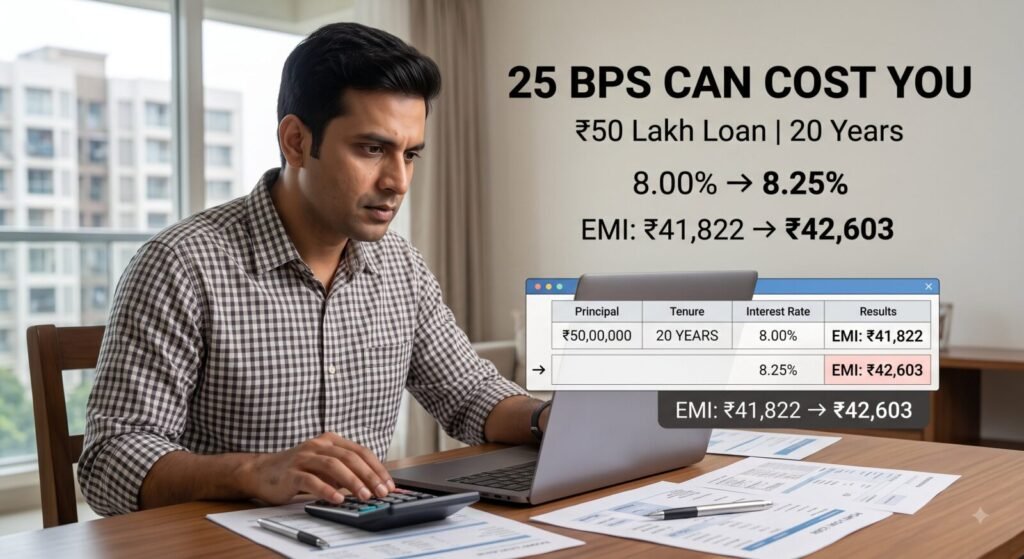
Let me show you the actual numbers.
Assume a ₹50 lakh home loan at 8.00% for 20 years.
| Scenario | Interest Rate | EMI | Total Interest Over 20 Years |
|---|---|---|---|
| Current Rate | 8.00% | ₹41,822 | ₹50,37,280 |
| Rate +10 bps | 8.10% | ₹42,134 | ₹51,12,160 |
| Rate +25 bps | 8.25% | ₹42,603 | ₹52,24,720 |
| Rate +50 bps | 8.50% | ₹43,391 | ₹54,13,840 |
A 25 basis point increase adds ₹781 per month.
Over 20 years, that is ₹1,87,440 in additional interest.
Now let us look at different loan amounts:
| Loan Amount | Rate Increase | EMI Increase (Monthly) | Extra Interest Over 20 Years |
|---|---|---|---|
| ₹30 lakh | +25 bps | ~₹469 | ₹1,12,560 |
| ₹50 lakh | +25 bps | ~₹781 | ₹1,87,440 |
| ₹75 lakh | +25 bps | ~₹1,172 | ₹2,81,280 |
| ₹1 crore | +25 bps | ~₹1,563 | ₹3,75,120 |
Important: These are illustrative calculations. Actual EMIs depend on your exact loan terms, remaining tenure, reset frequency, and whether the bank changes the EMI amount or extends the tenure.
Under RBI’s 2023 framework for applicable EMI-based floating-rate personal loans, regulated entities are required to communicate the impact of interest-rate resets and provide options around EMI or tenure changes. However, the exact implementation can vary by lender and product structure. Check your loan agreement for specifics.
Depending on the lender’s process and the applicable loan terms, a rate increase can result in a higher EMI, a longer tenure, or a combination of both.
What Should You Do Right Now? 5 Practical Steps
If you have a floating-rate home loan, here are five things you should do this week:
Step 1: Check Your Benchmark and Spread
Log into your loan account or check your latest statement.
Find:
- Are you on MCLR or EBLR?
- What is your current interest rate?
- What is the benchmark rate and the spread components?
- When is your next reset date?
If you cannot find this, call your lender’s customer care and ask specifically: “What is my current benchmark, spread, and reset date?”
Step 2: Compare Your Rate With Current Market Rates
Check the current home loan interest rates offered by:
- SBI
- HDFC
- ICICI Bank
- Axis Bank
- Bank of Baroda
- LIC HFL
If your rate is significantly higher than what new borrowers are getting, you may have a case for negotiation or balance transfer.
Step 3: Negotiate With Your Existing Lender
Before you think about switching banks, try this:
Call your existing lender and say: “I see that new borrowers are being offered lower rates. I have a clean repayment track record and a strong credit profile. Can you review my rate?”
Some lenders may offer existing borrowers a rate reduction when the borrower has a strong repayment record and the loan is at risk of being transferred.
What improves your negotiation power:
- Clean repayment track record (no bounces)
- Strong CIBIL score and clean repayment history
- Stable employment or business income
- Low FOIR (Fixed Obligation to Income Ratio)
Step 4: Consider a Balance Transfer If the Gap Is Wide
If your lender refuses to reduce the rate, and the rate difference is significant, a balance transfer may save money.
| Factor | What to Check |
|---|---|
| Outstanding loan | Higher outstanding = more savings from rate reduction |
| Remaining tenure | More years left = more interest savings |
| Rate difference | Depends on your specific numbers and transfer costs |
| Transfer costs | Processing fee, legal/valuation charges, MODT where applicable |
| New lender’s terms | Is the rate promotional? Will the spread increase later? |
Illustrative Example:
You have a ₹50 lakh loan at 8.25% with 15 years remaining.
A new lender offers 7.75%.
| Current Loan | After Balance Transfer | |
|---|---|---|
| Interest Rate | 8.25% | 7.75% |
| EMI | ₹48,507 | ₹47,064 |
| Monthly Saving | — | ₹1,443 |
| Annual Saving | — | ₹17,316 |
| 15-Year Saving (before costs) | — | ₹2,59,740 |
Less applicable processing, legal, valuation, documentation and other transfer costs.
Your actual net saving depends on the charges quoted by the new lender and any applicable costs with your existing lender.
Whether a balance transfer makes sense depends on your outstanding principal, remaining tenure, rate difference, and all associated costs. For a large outstanding loan with many years remaining, even a modest rate difference can matter. For a small balance with only a few years left, the costs may not justify the switch.
Important: The new lender’s benchmark and applicable spread will be governed by the loan agreement and RBI’s applicable framework. Don’t assume today’s rate will remain unchanged for the entire tenure.
Step 5: Build an EMI Buffer
Whether rates rise or not, every borrower should have an emergency fund.
Aim to maintain an emergency fund covering 3–6 months of essential expenses and debt obligations. Your exact target depends on:
- Income stability
- Monthly EMI amount
- Household expenses
- Other financial commitments
- Number of earning members in the family
This protects you against:
- Rate increases
- Job or income disruptions
- Emergency expenses
Pro Tip from My Credit Desk
The borrowers who handle rate shocks best are not the ones with the highest salaries.
They are the ones who:
- Know their loan terms inside out
- Keep an emergency fund
- Review their rate every reset cycle
- Are willing to negotiate or switch when the gap becomes wide
Frequently Asked Questions
FAQ 1: If the RBI repo rate is unchanged at 5.25%, can my EMI still increase?
Yes. The repo rate impact on home loan EMI extends beyond the MPC announcement. If your loan is on MCLR, the bank’s internal benchmark may have increased independently of the repo rate.
FAQ 2: What is the difference between MCLR and EBLR?
MCLR is the bank’s internal benchmark based on its cost of funds. EBLR is linked to an external benchmark, usually the RBI repo rate or T-bill rates. EBLR offers more transparent and faster transmission of RBI rate changes. MCLR offers more stability but slower transmission.
FAQ 3: How often does my home loan interest rate change?
For EBLR-linked bank loans to retail borrowers, RBI requires the reset periodicity to be at least once in three months. For MCLR loans, the reset is typically annual (or as specified in your contract). Your rate changes only on the reset date, not immediately when the RBI announces a policy.
FAQ 4: Can my bank increase my spread without telling me?
The lender should communicate applicable changes to the borrower’s interest rate in accordance with RBI requirements and the loan agreement. Under RBI’s external benchmark framework, the credit risk premium component can generally be revised only when the borrower’s credit assessment undergoes a substantial change, as agreed in the loan contract. Always read your sanction letter and terms carefully.
FAQ 5: Is it better to switch from MCLR to EBLR?
It depends. EBLR is more transparent and transmits RBI rate changes faster. However, in a rising rate environment, MCLR may sometimes lag behind repo rate hikes. Switching depends on your lender’s applicable process, loan agreement, and any conversion charges. Consult your lender and evaluate the costs before switching.
FAQ 6: What is a “reset date”?
The reset date is the specific date on which your interest rate is recalculated based on the current benchmark and applicable spread. For EBLR retail loans, this must happen at least once every three months. For MCLR loans, it is typically annual. Your EMI will change on the reset date, not the day the RBI announces a policy.
FAQ 7: Should I opt for a fixed-rate home loan to avoid this uncertainty?
Fixed-rate loans offer certainty but can carry a higher interest rate than comparable floating-rate loans, depending on the lender and product. They may be suitable if you expect rates to rise sharply, but they limit your ability to benefit from future cuts. Evaluate your risk appetite and financial situation before deciding.
FAQ 8: How do I check if my rate has changed?
Review your latest loan account statement or interest certificate. Compare your current rate with your original sanction letter. If the benchmark has not changed but your rate has, check whether a credit risk premium reassessment or other contractual adjustment has been applied. Contact your lender for clarification.
FAQ 9: Can I negotiate my rate with the bank?
Yes. Existing borrowers with a good repayment history and strong credit profile can ask their lender to review their interest rate, particularly if competing lenders are offering materially lower rates. The lender may or may not agree, depending on its pricing policy and your loan terms.
FAQ 10: What documents do I need for a balance transfer?
Typically:
- Loan statement from current lender
- Property documents
- Income proof
- Bank statements
- KYC documents
- NOC or foreclosure letter from current lender
Specific requirements vary by lender.
Final Thoughts
A stable RBI repo rate at 5.25% is good news for the economy.
Understanding the true repo rate impact on home loan EMI requires looking beyond the headlines and into your loan agreement.
But it is not a guarantee that your home loan EMI will remain unchanged.
“RBI rate stable hai, iska matlab yeh nahi ki aapka EMI bhi automatically stable rahega. Aapka benchmark, aapka reset cycle, aur aapka loan agreement teeno matter karte hain.”
The repo rate is just one piece of the puzzle.
Your benchmark (MCLR or EBLR), your reset cycle, and your loan agreement terms are equally important.
Before your next EMI hits your account:
- Check your current benchmark, spread, and reset date
- Compare your rate with current market offerings
- Negotiate with your existing lender if there is a wide gap
- Consider a balance transfer if negotiation fails and the math justifies the cost
- Build an emergency fund for future rate shocks
My advice from the credit desk:
The borrowers who save the most money over a 20-year loan are not the ones who got the lowest rate on day one.
They are the ones who monitored their rate, understood their loan terms, and acted when the math made sense.
“EMI samajhna aasaan hai, lekin uske peeche ka math samajhna zaroori hai.”
Understanding the math behind your EMI is just as important as paying it.
Official References
This article is based on official regulatory information and the author’s practical experience in India’s banking and housing finance industry.
- Reserve Bank of India — Monetary Policy Statement, August 5, 2026: MPC unanimously voted to keep the policy repo rate unchanged at 5.25% with a neutral stance
- Reserve Bank of India — External Benchmark-Based Lending: Circular DBR.No.Dir.BC.12/13.03.00/2019-20 dated September 4, 2019. Banks must extend floating-rate loans to retail and MSME borrowers using external benchmarks, with interest reset at least once every three months.
- Reserve Bank of India — MCLR Framework: Circular DBR.No.Dir.BC.85/13.03.00/2015-16 dated December 17, 2015. Banks publish different tenor MCLRs monthly; reset period is one year or lower.
- Reserve Bank of India — Interest Rate Transmission Data: Published in RBI Monetary Policy Reports and Annual Reports. For the May 2022–October 2024 tightening cycle: repo rate +250 bps, 1-year median MCLR +170 bps, EBLR +250 bps, WALR on fresh loans +186 bps, WALR on outstanding loans +118 bps.
- Reserve Bank of India — EMI/Tenure Reset Framework: Circular dated August 18, 2023. Regulated entities must communicate the impact of interest-rate resets and provide options to borrowers for applicable EMI-based floating-rate personal loans.
For current official information, readers should verify applicable rates and terms directly with their lender or the RBI before making financial decisions.
About the Author
Ashok K. Satpute is the founder of PennyPowerPlay.com and a Home Loan Specialist with over 8 years of experience in India’s banking and housing finance industry.
During his career, he has worked with leading financial institutions, including ICICI Bank, HDFC, Axis Bank and PNB Housing Finance, assisting borrowers with home-loan eligibility, loan processing, documentation, CIBIL analysis, balance transfers and other aspects of housing finance.
Through PennyPowerPlay.com, he shares practical, experience-based home-loan guides designed to help Indian home buyers understand the lending process and make better-informed financial decisions.
Related Posts
- Home Loan Down Payment India (2026): Avoid Costly Mistakes
- Fixed vs Floating Home Loan Interest Rates: Which Option Is Better for Home Buyers?
- Home Loan Balance Transfer: Does It Really Save Money?
- CIBIL Score for Home Loan: What Score Do You Need in India?
- How Much Home Loan EMI Can You Really Afford? A Practical Guide for Home Buyers
- Home Loan Prepayment & Foreclosure Guide (2026): Should You Repay Early?
Educational Disclaimer: This article is for educational and informational purposes only. It does not constitute financial, legal or tax advice. RBI regulations, lender policies, and interest rate structures are subject to change and can vary by lender, loan type, and borrower profile. Verify current terms directly with your lender before making any financial decisions. All calculations and figures in this article are illustrative unless specifically stated otherwise. Please consult a qualified financial advisor before making major financial decisions.