“Sir, bank ne mera loan MCLR se EBLR mein shift kar diya bina bataye. Ab mera EMI ₹800 zyada aa raha hai. Kya yeh legal hai?”
A borrower from Hyderabad called me with this exact question last month.
And the honest answer, until now, has been complicated.
But that may change soon.
On August 12, 2026, the Reserve Bank of India released draft RBI home loan rules 2026 — a proposal that could significantly change how banks treat existing borrowers when it comes to changing benchmarks, spreads, and reset terms.
If finalized, this framework will give Indian home loan borrowers something they have never had before: the requirement that banks obtain your consent before changing your loan benchmark.
In this guide, I will explain exactly what the RBI has proposed, what it means for your existing home loan, and what you should do to protect yourself.
If you want to understand how your EMI can change even when the RBI keeps the repo rate unchanged, read my detailed guide on repo rate impact on home loan EMI.
Key Takeaways (RBI Draft Guidelines 2026)
- Mandatory Consent: Banks cannot unilaterally shift existing borrowers to a new benchmark without prior explicit consent.
- Zero Cost Migration: No conversion, processing, or administrative fees can be charged for framework transitions.
- Rate Cap Protection: Your revised interest rate post-migration cannot exceed your existing effective interest rate.
- Spread Freeze: Non-credit spread components (operating costs and business margin) are locked against increases for 3 years.
- Implementation Roadmap: Public consultation closed on September 11, 2026; the proposed framework takes effect on April 1, 2027, with complete loan migrations targeted by April 1, 2029.
What RBI Home Loan Rules 2026 Propose: The Big Picture
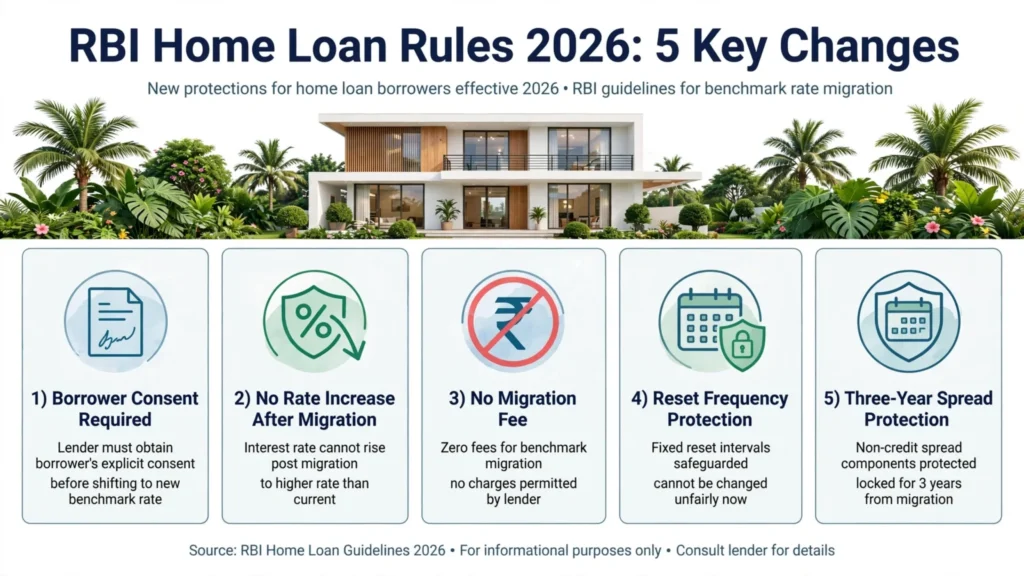
Home Loan Rules and Regulations in India: Core RBI Framework
Under Reserve Bank of India (RBI) guidelines and the 2026 unified interest rate framework, all floating-rate retail loans are governed by strict lending caps, mandatory benchmark linkage, and fee restrictions:
| Regulation Area | RBI Mandate / Benchmark Rule | Borrower Protection |
|---|---|---|
| Benchmark Transition | Mandatory borrower consent required | Lenders cannot auto-migrate loans or increase your effective interest rate upon migration. |
| Loan-to-Value (LTV) Ratio | • Up to ₹30 Lakhs: Max 90% LTV • ₹30 Lakhs to ₹75 Lakhs: Max 80% LTV • Above ₹75 Lakhs: Max 75% LTV | Ensures minimum borrower equity (down payment) of 10% to 25%. |
| Prepayment Penalty | 0% (Nil) for individual floating-rate borrowers | Banks/HFCs cannot charge penalty or foreclosure fees on early prepayments. |
| Spread Component Freeze | Non-credit spread components locked for 3 years | Prevents arbitrary spread creep on operating costs and business strategy margins. |
| Reset Frequency | Capped at a maximum interval of 3 months | Lenders must reset floating rates at least quarterly to pass on rate adjustments promptly. |
The RBI has proposed a common framework for how all banks and regulated entities determine loan interest rates, benchmarks, and spreads.
1. Banks Must Take Your Consent Before Changing the Benchmark
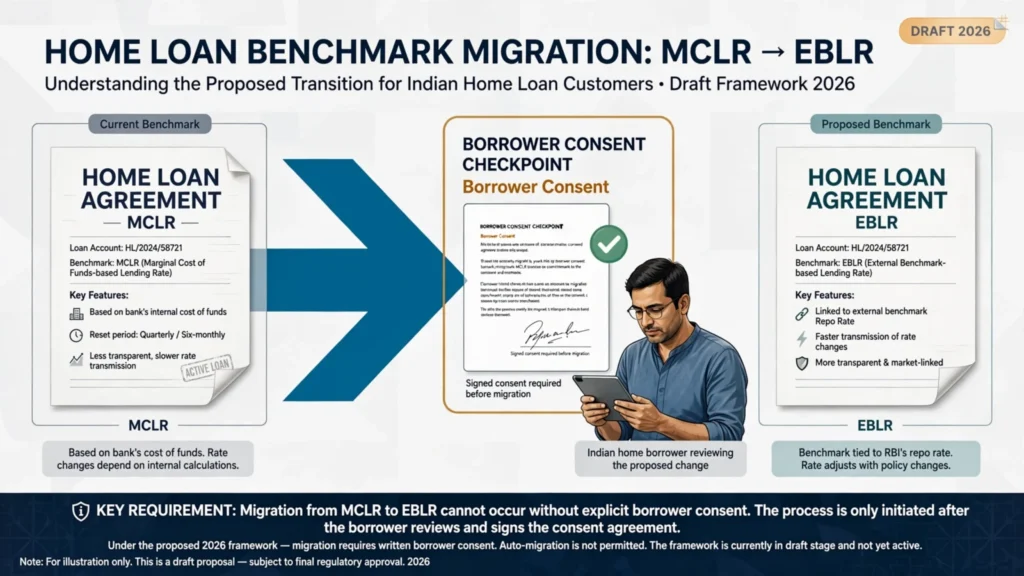
This is the headline change.
Under the proposed framework, if a lender wants to migrate your existing loan from one benchmark to another for example, from MCLR to EBLR, or from one external benchmark to another they must obtain the borrower’s consent first.
They cannot do it unilaterally. They cannot bury it in fine print. They cannot auto-switch you and send a letter two weeks later.
Your consent is mandatory.
2. Your Interest Rate Cannot Increase After Migration
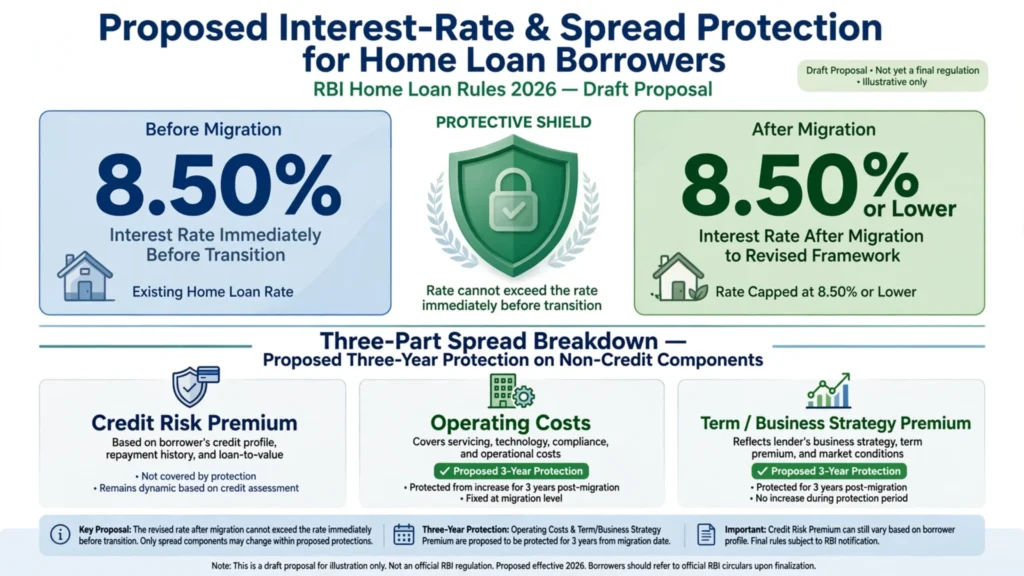
Even if you consent to the benchmark change, the RBI has proposed a critical protection:
The revised interest rate cannot exceed the rate applicable immediately before the transition.
In simple words: if your home loan is running at 8.50% today, and the bank wants to move you to a new benchmark, your new rate cannot be 8.60% or 8.75%. It must be 8.50% or lower.
3. No Migration Fee Can Be Charged
The bank cannot charge you a processing fee, conversion fee, or any other charge for migrating your loan to the new framework.
This is significant because some banks currently charge ₹5,000–₹15,000 for benchmark switches.
4. Reset Frequency Cannot Be Changed Arbitrarily
Under the proposed framework, once your reset frequency is set in the loan agreement, it generally cannot be changed during the loan tenure.
For most floating-rate loans, the benchmark reset frequency cannot exceed three months. Once the reset frequency is chosen, it generally cannot be changed during the loan tenure, subject to specified exemptions.
This prevents banks from suddenly switching you from a quarterly reset to an annual reset (which delays the benefit of rate cuts) or vice versa.
Important Note on Resets: While a 3-month cap ensures policy rate cuts reach your loan much faster than an annual reset, it cuts both ways—benchmark rate hikes will also be passed on to your EMI without long delays.
5. Most Non-Credit Spread Components Are Protected for 3 Years
This is where the draft gets really interesting for borrowers.
The proposed framework puts restrictions on how lenders can alter the spread over the benchmark:
- Credit risk premium: Can only be revised when your credit profile changes substantially and after a comprehensive review
- Operating costs, term premium, business strategy premium: Generally cannot be revised before 3 years for a floating-rate loan
Banks can reduce these components earlier for customer retention, but they cannot increase them arbitrarily.
Why RBI Home Loan Rules 2026 Matter for Borrowers
Let me tell you what I have seen at the credit desk.
Problem 1: Silent Benchmark Migration
Some banks have quietly moved borrowers from older benchmarks (like Base Rate or BPLR) to MCLR or EBLR over the years. Borrowers often received a letter saying “Your loan has been migrated to the new benchmark effective [date].” No discussion. No consent. Just a notification.
If finalized as proposed, that practice would end.
Problem 2: Spread Creep
I have seen cases where a borrower’s spread was increased by 15–25 basis points at reset, with the explanation that “risk parameters have changed.” When the borrower asked for specifics, the response was vague.
The proposed 3-year restriction on non-credit spread components addresses this directly.
Problem 3: Benchmark Discontinuation
What happens if RBI discontinues the repo rate as a benchmark and introduces something new? Or if your bank decides the T-bill rate is no longer suitable?
The draft addresses this: if a benchmark is discontinued, the lender must replace it while ensuring the borrower is not placed at a disadvantage. The loan agreement may also specify a fallback benchmark.
Timeline: When Will These Rules Apply?
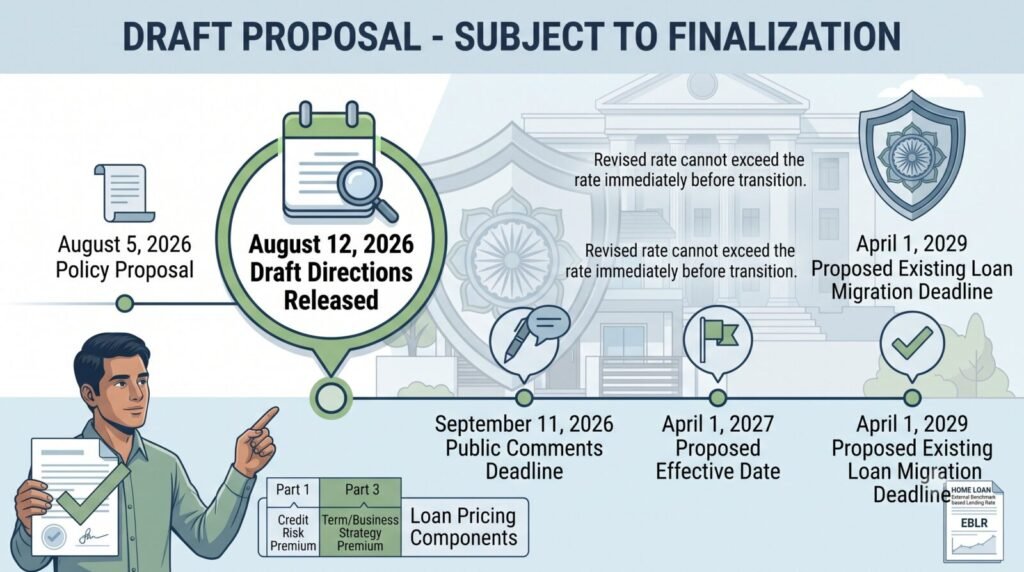
“Here is the timeline for when RBI home loan rules 2026 may take effect:”
| Milestone | Date |
|---|---|
| RBI announces the policy proposal | August 5, 2026 |
| Draft Directions released for public consultation | August 12, 2026 |
| Public comment deadline | September 11, 2026 |
| Proposed effective date for new framework | April 1, 2027 |
| Deadline to migrate existing loans | April 1, 2029 |
| Current status | Draft only not yet finalized |
Status Update: The public consultation window closed on September 11, 2026. Lenders and borrowers are now awaiting the release of the final notification from the RBI ahead of the planned April 1, 2027 implementation date.
RBI Home Loan Rules 2026: What Happens to Your Existing Loan?
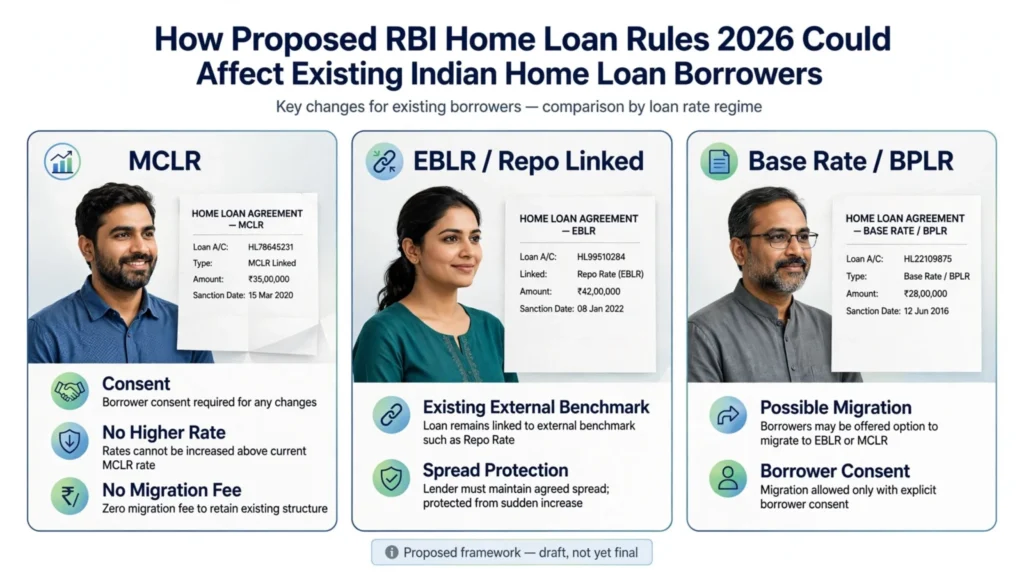
If you already have a home loan, here is what the proposed framework means for you:
If You Are on MCLR
Your bank may want to migrate you to the new unified framework by April 1, 2029. Under the draft:
- They must ask for your consent
- Your new rate cannot be higher than your current rate
- They cannot charge a fee
- The migration would require your consent, although the draft does not yet specify what happens if a borrower does not consent
Should you consent? It depends. The new framework offers more transparency and spread protection. But if your current MCLR loan has favorable terms (low spread, good reset cycle), you may want to stay where you are.
Not sure whether a fixed or floating rate suits your risk profile better? Read my detailed comparison of fixed vs floating home loan interest rates.
If You Are on EBLR (Repo-Linked)
You are already on an external benchmark, which is closer to what the new framework wants. Your migration may be simpler, but the bank still needs your consent if any benchmark change is involved.
The biggest benefit of RBI home loan rules 2026 for you is the 3-year spread protection and stricter rules on credit risk premium changes.
If your current lender refuses to pass on rate cuts or offers unfavorable terms, switching through a home loan balance transfer could save you lakhs over the remaining tenure.
If You Are on Base Rate or BPLR (Pre-2016 Loans)
These older benchmarks are not aligned with the new framework. Your bank will almost certainly want to migrate you. Under the draft, you have full protection: consent required, no rate increase, no fees.
RBI Home Loan Rules 2026: What Changes for New Borrowers?
If you are taking a fresh home loan after the framework is implemented:
- All floating-rate personal loans and MSME loans from commercial banks must be linked to an external benchmark (repo rate, T-bill, or other approved benchmark)
- NBFCs, regional rural banks, and cooperative banks have discretion on whether to offer external benchmark-linked loans
- Your loan agreement must clearly specify the benchmark, reset frequency, and reset date
- Spread components are transparent and protected for 3 years
How Much Home Loan Do I Qualify For? (The Bank’s Calculation)
Before sanctioning an amount, bank credit underwriters evaluate your Fixed Obligation to Income Ratio (FOIR):
$$\text{FOIR (\%)} = \left( \frac{\text{Total Existing EMIs} + \text{Proposed Home Loan EMI}}{\text{Net Monthly Income}} \right) \times 100$$
- Permissible FOIR Limit: Most Indian lenders cap FOIR between 40% and 50% of net monthly take-home salary.
- Example: If your net monthly salary is ₹80,000, your total monthly debt obligations (including the new home loan EMI) cannot exceed ₹40,000 (50% FOIR).
- For a detailed salary-tier breakdown, credit thresholds, and multiplier benchmarks, review my detailed salaried home loan eligibility breakdown.
“If you are a first-time buyer, start with my complete home loan guide for India to understand the full process.”
RBI Home Loan Rules 2026: 4 Practical Steps to Protect Yourself
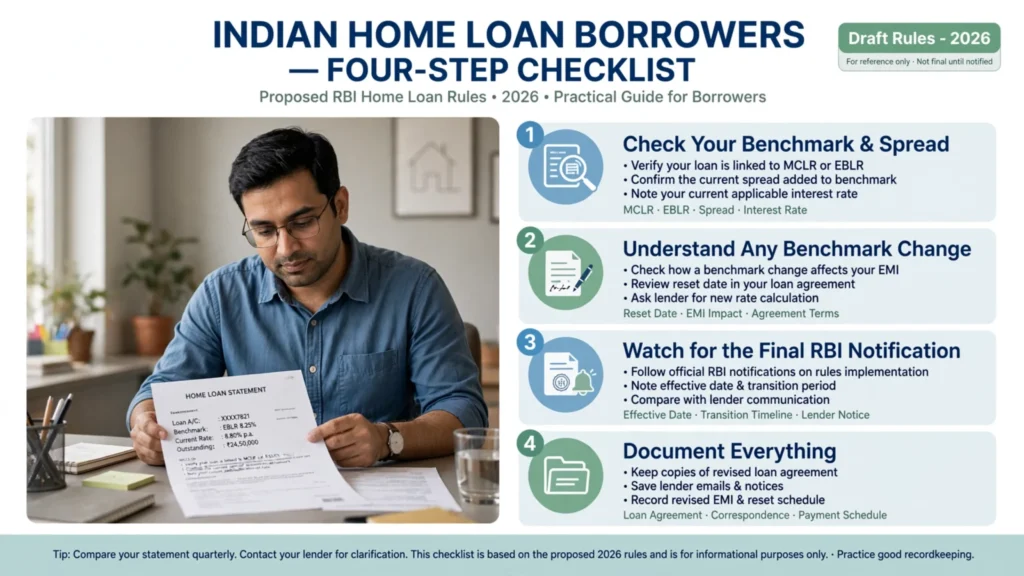
Even though RBI home loan rules 2026 are still a draft, here is what I recommend:
Step 1: Check Your Current Benchmark and Spread
Log into your loan account and find:
- Which benchmark are you on? (MCLR / EBLR / Base Rate / BPLR)
- What is your current interest rate?
- What is your spread breakdown?
- When is your next reset date?
If you do not have this information, email your lender and ask for a detailed interest rate breakdown.
“Before you apply, check your CIBIL score it directly affects your credit risk premium under these rules.”
Step 2: Do Not Agree to Any Benchmark Change Until You Understand It
If your bank sends you a letter saying “We are migrating your loan to a new benchmark,” do not sign anything until you:
- Understand what the new benchmark is
- Confirm your new rate will not be higher
- Ask if any fees are involved
- Compare the new terms with your current terms
Step 3: Watch for the Final RBI Notification
Public consultation closed on September 11, 2026. Regulated entities and borrowers are now awaiting the final official notification, slated to take effect from April 1, 2027.
Step 4: Document Everything
If your bank has already changed your benchmark without proper notice, document:
- The original loan agreement
- Any letters or emails from the bank
- Your sanction letter showing the original benchmark and spread
- Your current statement showing the changed terms
This documentation will be useful if the final rules provide retrospective protection or if you need to escalate to the RBI Ombudsman.
Insider Credit Note: Legal vs. Technical Verification
Technical Valuation: An approved civil engineer/evaluator inspects the physical site, verifies construction quality, assesses fair market value (FMV), and confirms compliance with sanctioned building plans.
Legal Scrutiny: An empanelled bank advocate examines 30-year chain title deeds, the non-encumbrance certificate (Form 15/16), local body NOCs, and property tax receipts to confirm a clean, marketable title.
If your current interest rate is still significantly higher than market rates even after these protections, read my home loan prepayment and foreclosure guide to see if closing your loan early makes financial sense.
RBI Home Loan Rules 2026: Frequently Asked Questions
Q1: Is this rule already active? “No. It is a draft direction released on August 12, 2026. Public consultation closed on September 11, 2026, and the framework is slated to take effect from April 1, 2027.
Q2: Can my bank change my benchmark today without asking me? Currently, banks have varying practices. Some notify borrowers; others include migration clauses in loan agreements. The proposed framework would make consent mandatory for all regulated entities.
Q3: What if I refuse to migrate to the new benchmark? The draft requires borrower consent for the migration, but it does not yet specify what happens if a borrower does not consent. The RBI may provide clarity on this in the final directions.
Q4: Will my EMI definitely go down if I consent to migration? Not necessarily. The rule says your rate cannot increase — it does not guarantee a decrease. Your new rate will be the same or lower than your current rate.
Q5: Does this apply to NBFCs/HFCs like Bajaj Housing Finance and LIC Housing Finance? Yes, the proposed framework applies to all regulated entities, including banks and NBFCs/HFCs. However, NBFCs have discretion on whether to offer external benchmark-linked floating-rate loans for new lending.
Q6: What is a “fallback benchmark”? If your original benchmark is discontinued during your loan tenure, the fallback benchmark is the alternative rate specified in your loan agreement. The draft requires that this fallback does not disadvantage the borrower.
Q7: Can the bank increase my spread after 3 years? After 3 years, the operating cost and term premium components can be revised, but credit risk premium can only change if your credit profile changes substantially. The bank must justify any increase.
Final Thoughts
For years, Indian home loan borrowers have been at the mercy of their lenders when it comes to benchmark changes, spread revisions, and reset terms.
The RBI’s August 2026 draft is a significant step toward borrower empowerment.
If finalized, RBI home loan rules 2026 would mean:
- No more silent benchmark migrations without consent
- No more arbitrary spread increases on non-credit components
- No more fee-based conversion traps
- Clear, transparent loan agreements
But remember: this is still a draft. Do not make loan decisions based on it yet. Use this time to understand your current loan terms, document everything, and be ready to exercise your rights when the final rules come into force.
“Aapka loan aapka haq hai. Bank ko aapki marzi ke bina kuch nahi badalna chahiye.”
Your loan is your right. The bank should not change anything without your consent.
Official References
- Reserve Bank of India — Draft Directions, August 12, 2026: Reserve Bank of India (Interest Rates on Loans and Advances) Directions, 2026. Proposed effective date: April 1, 2027. Migration deadline for existing loans: April 1, 2029. Public consultation closed on September 11, 2026.
- LiveMint — RBI Loan Rules 2026: “Banks may need borrower consent to change loan benchmark” (August 17, 2026).
- Business Today — RBI Draft Rules: “Can banks change your loan benchmark? RBI draft says borrower consent will be needed” (August 17, 2026).
Related Posts
- Repo Rate Impact on Home Loan EMI: Why Your EMI Can Still Change
- Fixed vs Floating Home Loan Interest Rates: Which Is Better?
- Home Loan Balance Transfer: Does It Really Save Money?
- Home Loan Prepayment & Foreclosure Guide
About the Author
Ashok K. Satpute is an independent personal finance analyst and former Home Loan Officer with background verification experience across retail banking and credit underwriting in India. He writes practical, regulatory-backed guides to help Indian borrowers navigate lending contracts and interest benchmarks. Connect with him on LinkedIn.