Last updated: September 17, 2026

Taking a joint home loan can help a family increase home-loan eligibility.
But there is another reason many couples consider a joint home loan:
Tax benefits.
If a husband and wife are genuine co-owners and co-borrowers, each may be able to claim eligible home-loan deductions separately, subject to the applicable conditions.
But there is one important misconception to clear up immediately:
Two names on a home loan do not automatically mean double tax benefits.
Your actual tax position can depend on:
- Who owns the property
- Who is a borrower
- Who actually contributes towards repayment
- The ownership share
- Whether the property is self-occupied or let out
- How much eligible interest was paid
- How much eligible principal was repaid
- Which tax regime each taxpayer uses
- Whether the relevant conditions are satisfied
- Whether the claim can be supported with proper documents
If you are researching joint home loan tax benefits for husband and wife, these are the details you need to understand before assuming that both spouses can simply claim the same amount.
And FY 2026-27 is particularly important because the Income-tax Act, 2025 now applies to tax years beginning on or after April 1, 2026. The Income Tax Department has also confirmed that the new tax regime continues under the new Act and remains the default regime.
In this guide, I will explain joint home loan tax benefits in India, how co-owners and co-borrowers are treated, how interest and principal deductions work, what changes under the new regime, what happens if one spouse pays most of the EMI, and how to keep your documentation clean.

Quick Answer: How Do You Maximize Tax Benefits on a Joint Home Loan?
For a typical joint home loan, the basic framework is:
Co-owner + Co-borrower + genuine repayment contribution + qualifying property + correct tax treatment + proper documentation
For a qualifying self-occupied property under the optional old-regime framework, the familiar home-loan interest deduction is subject to a ₹2 lakh limit per eligible taxpayer, where the applicable conditions are met. The Income Tax Department continues to publish this ₹2 lakh self-occupied limit in its guidance for taxpayers using the old regime.
Eligible home-loan principal repayment can fall within the overall ₹1.5 lakh deduction limit for qualifying savings and payments under the old-law Section 80C framework. For Tax Year 2026-27, the corresponding deduction under the new Act is structured differently but retains the ₹1.5 lakh aggregate limit for specified qualifying payments. It is not available under the new concessional regime.
So two eligible spouses may potentially use their own eligible limits.
But do not make this calculation:
Joint loan = automatic double deduction.
That is too simplistic.
The ownership, repayment and tax position of each borrower matter.
FY 2026-27: What Has Changed?
Before looking at home-loan deductions, it is important to understand the tax-law transition.
From April 1, 2026, the Income-tax Act, 2025 replaces the Income-tax Act, 1961 for new tax years.
The new law uses Tax Year terminology for periods beginning on or after April 1, 2026.
Therefore:
Tax Year 2026-27 = April 1, 2026 to March 31, 2027.
The Income Tax Department has confirmed that the 1961 Act continues to govern tax years beginning before April 1, 2026, while the 2025 Act applies to the new tax years. The new tax regime continues under the 2025 Act and remains the default regime.
This means home-loan articles written years ago can contain terminology or section references that need to be read carefully when applying them to Tax Year 2026-27.
For example, many borrowers still search for:
- Section 24(b) home-loan interest
- Section 80C home-loan principal
- Section 80EE
- Section 80EEA
Those are familiar terms from the earlier tax framework.
For FY 2026-27, however, taxpayers should check the corresponding provisions under the Income-tax Act, 2025 and the current Income Tax Department guidance.
Joint Home Loan Tax Benefit Under Old Tax Regime
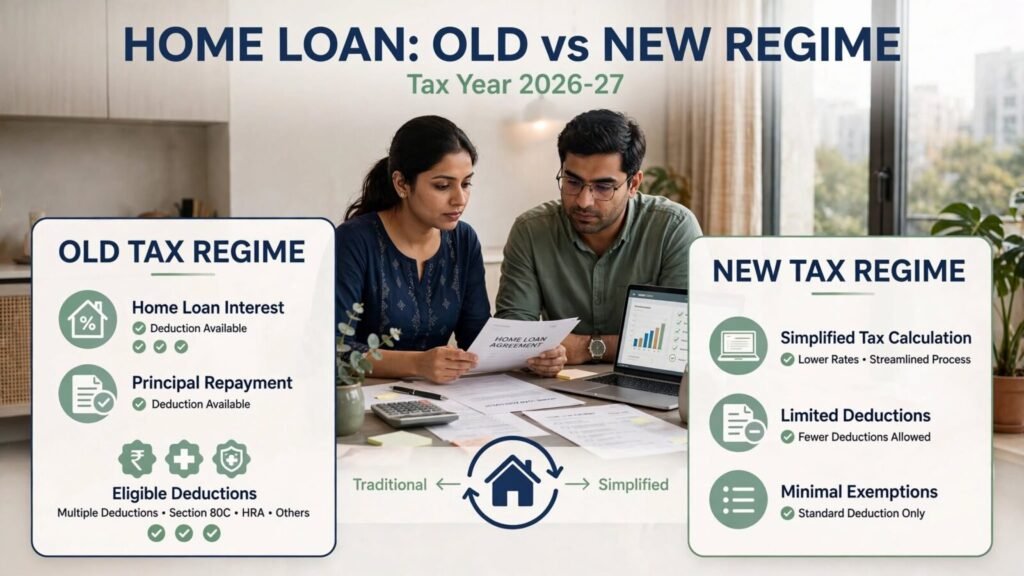
The old-regime framework remains important because it provides deductions that are generally not available under the default new regime.
For a qualifying self-occupied property, the familiar interest deduction can be up to:
₹2 lakh per eligible taxpayer
subject to the applicable conditions.
The Income Tax Department’s current guidance states that for a self-occupied property, the upper limit for interest on qualifying housing borrowing is ₹2 lakh under the old regime.
Eligible principal repayment can also qualify under the old Section 80C framework, subject to the overall limit.
That means a couple may potentially have two separate taxpayer-level limits if both spouses independently satisfy the conditions.
But the word “potentially” is important.
A joint loan does not itself create an automatic deduction.
Joint Home Loan Tax Benefit Under New Tax Regime
The new tax regime is the default regime for Tax Year 2026-27.
This is one of the most important points for anyone taking a new home loan.
For a self-occupied property, the traditional home-loan interest deduction available under the old regime is not available in the same way under the new concessional regime.
Likewise, the traditional Section 80C deduction framework is not available under the new regime.
The Income Tax Department confirms that the corresponding ₹1.5 lakh specified-investment deduction is not allowed under the new concessional regime.
However, there is an important distinction for a let-out property.
Under the new regime, actual eligible interest on borrowed capital for a let-out property can be considered without the ₹2 lakh ceiling while computing house-property income. But if this results in a house-property loss, the new-regime rules restrict its set-off against other heads and its carry-forward.
So the question is not simply: “I have a home loan. Should I choose the old regime?”
Instead, calculate the tax position under both regimes for each taxpayer.
FY 2026-27 New Tax Regime Slabs
For individuals below 60 years of age, the published new-regime slabs for the relevant framework are:
| Taxable income | Tax rate |
|---|---|
| Up to ₹4 lakh | Nil |
| ₹4 lakh to ₹8 lakh | 5% |
| ₹8 lakh to ₹12 lakh | 10% |
| ₹12 lakh to ₹16 lakh | 15% |
| ₹16 lakh to ₹20 lakh | 20% |
| ₹20 lakh to ₹24 lakh | 25% |
| Above ₹24 lakh | 30% |
The Income Tax Department’s published guidance also states that the Section 87A rebate under the new regime is increased to ₹60,000 for eligible taxpayers with total income up to ₹12 lakh from AY 2026-27 onward.
For a married couple, remember one important point:
Husband and wife are separate taxpayers.
You should therefore calculate the tax position separately for each spouse.
The Income Tax Department’s tax calculator can compare tax under the old and new regimes and now supports calculations under both the Income-tax Act, 2025 and the earlier Act where applicable.
First Understand Co-Owner vs Co-Borrower

This is where many home buyers make a mistake.
A co-borrower is a person who is jointly responsible for the loan.
A co-owner is a person who has legal ownership in the property.
These are two different concepts.
They can be the same person, but they do not have to be.
Example
Suppose a husband buys a flat.
His wife is added to the home loan as a co-borrower because her income helps the lender calculate eligibility.
But the property is registered only in the husband’s name.
The wife should not automatically assume that simply being a co-borrower gives her the same property-related tax benefits as an owner.
Now consider another arrangement:
- Husband owns 50%
- Wife owns 50%
- Husband is a co-borrower
- Wife is a co-borrower
- Both contribute towards repayment
This is a much clearer structure when considering separate home-loan tax claims.
Joint Home Loan Tax Benefit for Co-Owners
When discussing a joint home loan tax benefit for co-owners, look at the complete arrangement rather than just the loan application.
You should consider:
- Legal ownership
- Ownership percentage
- Loan responsibility
- Actual repayment
- Property usage
- Tax regime
- Supporting documents
A person should not be added to property ownership merely because someone believes it will automatically create another tax deduction.
Property ownership can affect future matters such as:
- Sale of the property
- Capital gains
- Rental income
- Stamp duty
- Succession
- Financing
- Legal rights
The ownership structure should therefore make legal and financial sense, not just tax sense.
The Most Important Rule: Don’t Automatically Split Everything 50:50

This is one of the most important points in this entire article.
Suppose:
- Property ownership = 50:50
- Loan = joint
- Husband pays 80% of the EMI
- Wife pays 20%
Do not automatically assume that every tax claim should simply be divided 50:50.
The actual facts and contribution should be considered, and the claim should be supported by appropriate records.
Example
Suppose the annual eligible interest is:
₹4 lakh
Assume the repayment arrangement supports:
- Husband: 80%
- Wife: 20%
The corresponding interest amounts would be:
Husband: ₹3.2 lakh
Wife: ₹80,000
For a qualifying self-occupied property under the old-regime framework, the husband’s claim would remain subject to the applicable ₹2 lakh ceiling.
The wife’s eligible amount would be based on her attributable share and the applicable conditions.
This is very different from saying:
₹4 lakh ÷ 2 = ₹2 lakh each.
The tax claim should be consistent with the actual arrangement.
Joint Home Loan Section 24(b) Benefit
Many borrowers still use the search phrase “joint home loan Section 24(b) benefit” because Section 24(b) is the familiar provision under the Income-tax Act, 1961 for interest on borrowed capital used for qualifying house-property purposes.
For the old-regime framework, the Income Tax Department currently states that the self-occupied interest deduction can be up to ₹2 lakh, subject to the applicable conditions.
For Tax Year 2026-27, taxpayers should use the corresponding provisions of the Income-tax Act, 2025 rather than blindly copying old section numbers from older articles.
The important practical concept remains:
Eligible interest on qualifying housing borrowing can provide a house-property deduction, but the amount and treatment depend on the property, tax regime and statutory conditions.
Example: Husband and Wife Claiming Interest
Suppose:
- Property value: ₹1 crore
- Home loan: ₹70 lakh
- Husband’s ownership: 50%
- Wife’s ownership: 50%
- Both are co-borrowers
- Property is self-occupied
- Total eligible interest: ₹4 lakh
- Both genuinely contribute equally
If the interest is appropriately attributable 50:50:
Husband: ₹2 lakh
Wife: ₹2 lakh
Under the applicable old-regime rules, each may potentially use up to the ₹2 lakh self-occupied limit, assuming all other conditions are satisfied.
Combined eligible interest deduction:
₹4 lakh
But notice what created the potential benefit.
It was not simply:
Two names on the loan.
It was:
Two taxpayers + ownership + borrowing + supported repayment + qualifying property + applicable tax regime.
Joint Home Loan Section 80C Benefit
The other major search term is “joint home loan Section 80C benefit.”
Under the earlier Income-tax Act framework, eligible home-loan principal repayment could qualify under Section 80C.
The overall Section 80C limit was:
₹1.5 lakh per taxpayer
But Section 80C was never a home-loan-only deduction.
It was a combined limit covering several qualifying payments and investments.
The Income Tax Department continues the ₹1.5 lakh aggregate structure under the Income-tax Act, 2025 for specified qualifying savings and payments, although the deduction is not available under the new concessional regime.
Therefore, you should not tell a borrower: “You get ₹1.5 lakh tax benefit on home-loan principal.”
A more accurate statement is: Eligible home-loan principal repayment can use part or all of the applicable ₹1.5 lakh overall deduction limit, subject to the relevant conditions and tax regime.
Example: Why the ₹1.5 Lakh Limit Matters
Suppose Rahul has:
- EPF: ₹90,000
- Home-loan principal: ₹1,00,000
- Life insurance: ₹30,000
Total qualifying payments:
₹2.20 lakh
But the applicable overall limit is:
₹1.50 lakh
Rahul cannot claim ₹2.20 lakh merely because he paid that amount.
His eligible deduction remains subject to the applicable overall limit.
His wife, as a separate taxpayer, may have her own limit if she independently qualifies.
This is one reason joint ownership and genuine repayment by both spouses can matter when both have taxable income.
Can Both Husband and Wife Claim ₹1.5 Lakh?
Potentially, yes.
Each taxpayer has a separate taxpayer-level limit.
But the actual amount each person can claim depends on their eligible payments and the applicable tax regime.
For example:
- Husband’s eligible principal repayment: ₹90,000
- Wife’s eligible principal repayment: ₹90,000
If both satisfy the relevant conditions and have sufficient unused deduction capacity, each may potentially claim ₹90,000.
The important point is that the couple does not simply receive one family-wide ₹1.5 lakh limit.
The taxpayers are assessed individually.
What If One Spouse Pays 100% of the EMI?
This situation needs special attention.
Suppose:
- Husband owns 50%
- Wife owns 50%
- Both are co-borrowers
- Husband pays the entire EMI
Do not automatically create a 50:50 tax claim merely because the property is jointly owned.
Keep evidence of who actually paid and understand how the relevant deduction should be attributed under the applicable law.
My Practical Tip
If both spouses are genuinely contributing towards the home loan, make the contribution traceable.
For example:
- Husband transfers his agreed contribution.
- Wife transfers her agreed contribution.
- The EMI is paid through the agreed account.
- Bank statements show the transactions.
- Annual loan certificates are retained.
- The ownership and loan documents are kept together.
A clean paper trail makes tax reporting much easier.
Does 50:50 Ownership Always Make Sense?
Not necessarily.
A couple might own a property 50:50.
But their financial contribution might be:
- Husband: 70%
- Wife: 30%
Another family might have:
- Husband: 50%
- Wife: 50%
- Equal EMI contributions
There is no universal rule that every couple should own a property 50:50.
The ownership structure should consider:
- Down payment
- EMI contribution
- Loan contribution
- Legal ownership
- Stamp duty
- Future sale
- Capital gains
- Succession
- Family arrangements
- Tax consequences
Do not create an artificial ownership structure only to chase a tax deduction.
The legal documents and actual financial arrangement should make sense together.
What About a Parent and Child Joint Home Loan?
Parents and adult children sometimes take joint home loans.
A joint application may help with loan eligibility depending on the lender’s policies.
But tax benefits require separate analysis.
Suppose a son buys a property and adds his father as a co-borrower.
The father should not assume that being a co-borrower automatically gives him the same property-related tax deductions.
Ownership and actual financial contribution matter.
Now suppose both father and son are genuine co-owners, co-borrowers and contributors.
The tax position may be different, subject to the applicable rules and documentation.
Important point
Do not add someone’s name to a property simply to manufacture a tax deduction.
Property ownership can affect:
- Future sale
- Capital gains
- Succession
- Rental income
- Stamp duty
- Legal rights
For substantial family transactions, obtain specific advice from a qualified tax professional before signing the property documents.
What If the Property Is Rented Out?
The tax treatment can be different when a property is let out.
Under the new regime, the Income Tax Department states that actual eligible interest on borrowed capital for a let-out property can be deducted without an upper limit while computing income from house property. However, any resulting house-property loss cannot be set off against other heads or carried forward under the new-regime treatment stated by the Department.
This means you should not automatically apply the self-occupied ₹2 lakh interest ceiling to a genuinely let-out property.
Example
Suppose:
- Rental income: ₹4 lakh
- Eligible home-loan interest: ₹5 lakh
The eligible interest can be considered while computing income from the let-out property, subject to the applicable rules.
But the next question is:
What happens if the property calculation produces a loss?
The answer depends on the tax regime.
Under the new regime, the Department specifically restricts the set-off and carry-forward of such house-property losses.
So landlords should compare the tax treatment carefully rather than looking only at the interest deduction.
Pre-Construction Interest: Don’t Forget This
Under the familiar home-loan tax framework, eligible interest relating to the period before acquisition or completion of construction is generally allowed through five equal annual instalments beginning from the year in which the property is acquired or constructed, subject to the applicable conditions.
For example:
Eligible pre-construction interest:
₹5 lakh
Potential annual instalment:
₹1 lakh for five years
However, the FY 2026-27 rules contain an important change concerning the treatment of prior-period interest within the applicable self-occupied interest ceiling. The Finance Bill materials for the new Act state that the ₹2 lakh aggregate ceiling for self-occupied property is to include prior-period interest from April 1, 2026.
Therefore, buyers with significant pre-construction interest should not rely on older articles without checking the current-year rules.
Keep all lender interest certificates from the beginning.
What About Section 80EE?
You may still find old articles saying: “First-time home buyers can get an additional ₹50,000 deduction.”
Be careful.
Section 80EE was a legacy provision linked to loans sanctioned during a specified historical period.
It is not a general new benefit available simply because you are buying your first home in 2026.
Therefore, do not include Section 80EE in your Tax Year 2026-27 planning unless your specific loan falls within the historical eligibility conditions.
What About Section 80EEA?
The same warning applies to Section 80EEA.
Section 80EEA provided an additional interest deduction of up to ₹1.5 lakh for qualifying loans sanctioned during the specified historical window, subject to conditions.
The relevant loan-sanction window was:
April 1, 2019 to March 31, 2022
Therefore:
New home loan sanctioned in 2026?
You generally cannot claim Section 80EEA merely because you are a first-time buyer.
The historical sanction-date condition is critical.
This is one reason buyers should be careful with old home-loan tax articles published before the current tax year.
What About Stamp Duty and Registration?
Eligible stamp duty and registration expenses can fall within the qualifying deduction framework for specified payments, subject to the applicable conditions.
But remember:
They do not automatically create an additional unlimited deduction.
Under the old Section 80C framework, eligible stamp duty and registration expenses shared the overall ₹1.5 lakh limit with other qualifying payments.
For example:
- Home-loan principal: ₹1 lakh
- Eligible stamp duty and registration: ₹80,000
Total qualifying amount:
₹1.8 lakh
That does not automatically mean a ₹1.8 lakh deduction.
The applicable overall limit must still be considered.
How Much Tax Benefit on Joint Home Loan Can You Claim?
This is one of the most common questions borrowers ask.
Let’s take a realistic example.
Property
Property value:
₹1 crore
Ownership:
- Husband: 50%
- Wife: 50%
Loan
Joint home loan:
₹70 lakh
Both are:
- Co-borrowers
- Co-owners
Property:
Self-occupied
Annual loan figures
Total eligible interest:
₹4.8 lakh
Total eligible principal repaid:
₹1.8 lakh
Assume both genuinely contribute equally.
Husband
Interest attributable:
₹2.4 lakh
Applicable self-occupied interest deduction:
Up to ₹2 lakh, subject to the applicable regime and conditions.
Principal attributable:
₹90,000
Potential eligible principal deduction:
₹90,000, assuming sufficient unused deduction capacity and eligibility.
Wife
Interest attributable:
₹2.4 lakh
Applicable self-occupied interest deduction:
Up to ₹2 lakh
Principal attributable:
₹90,000
Potential eligible principal deduction:
₹90,000, subject to the same considerations.
Combined potential deductions
Interest:
₹4 lakh
Principal:
₹1.8 lakh
Potential combined deductions:
₹5.8 lakh
But this is extremely important:
₹5.8 lakh of deductions does not mean ₹5.8 lakh of tax savings.
A deduction reduces taxable income.
The actual tax saving depends on:
- Each person’s taxable income
- Applicable tax regime
- Tax slab
- Rebate
- Other deductions
- Other income
- Applicable surcharge and cess
- Individual eligibility
So never advertise a home loan as giving a fixed rupee amount of tax savings without calculating the taxpayer’s actual situation.
Another Example: Unequal EMI Contribution
Now change one thing.
Suppose the same couple owns the property 50:50, but:
- Husband contributes 80%
- Wife contributes 20%
Total eligible interest:
₹4 lakh
If the documented arrangement supports the same proportion:
Husband
80% of ₹4 lakh:
₹3.2 lakh
Subject to the applicable self-occupied ceiling and other conditions.
Wife
20% of ₹4 lakh:
₹80,000
The wife should not simply claim ₹2 lakh because the property ownership is 50:50.
This is why repayment documentation matters.
How to Choose the Right Tax Regime for a Joint Home Loan
Do not ask: “Which tax regime is best for a joint home loan?”
Instead, calculate separately.
For spouse 1
What is my tax liability under the old regime?
What is my tax liability under the new regime?
For spouse 2
What is my tax liability under the old regime?
What is my tax liability under the new regime?
Then compare.
The Income Tax Department’s calculator provides a comparison between old and new regimes and can be used to estimate the tax outcome based on income and eligible deductions.
This is particularly important because spouses may have different:
- Salaries
- EPF contributions
- Insurance payments
- Investments
- Home-loan interest
- Principal repayments
- Other deductions
- Rental income
- Business income
There is no reason to assume that the tax result will be identical for both spouses.
A Simple Tax-Planning Strategy for Couples
Before signing the property documents, work through these five questions.
1. Who should own the property?
Decide the ownership structure first.
2. Who should borrow?
Consider income, eligibility and lender requirements.
3. Who will actually repay?
Make the repayment arrangement realistic.
4. Which tax regime works for each person?
Calculate separately.
5. Can you document everything?
If the answer is yes, your tax records will be much cleaner.
This approach is more useful than simply asking: “How much tax can we save?”
How to Claim Tax Benefit on Joint Home Loan
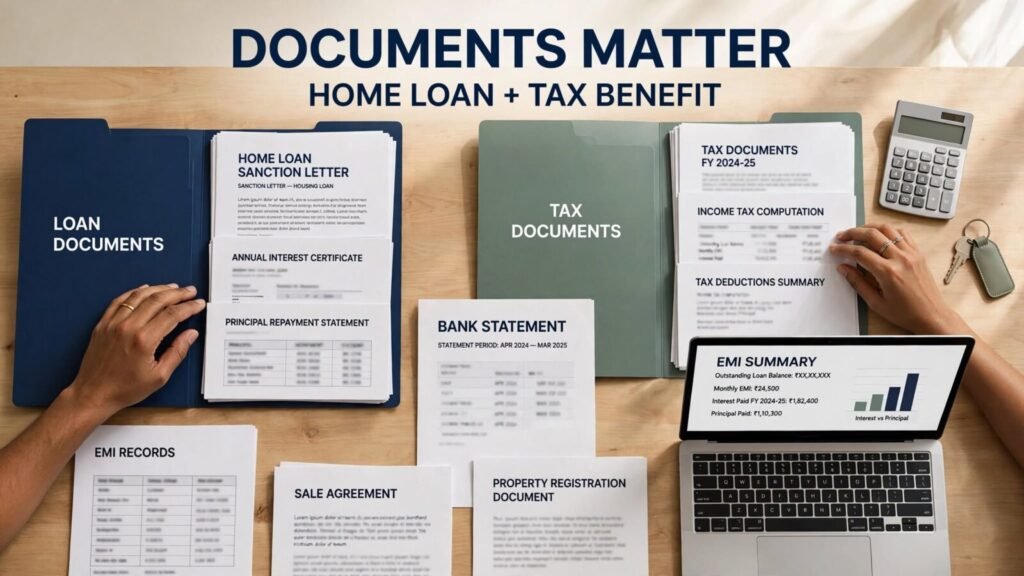
If you want to understand how to claim tax benefit on joint home loan, start with documentation rather than the ITR form.
Before filing your return, verify:
Property ownership
- Sale agreement
- Sale deed
- Registration documents
- Ownership percentage
- Property address
Loan
- Sanction letter
- Loan agreement
- Loan account details
- Annual interest certificate
- Principal repayment statement
- Outstanding loan statement
Repayment
- Bank statements
- EMI records
- Transfers between spouses
- Down-payment records
- Evidence of each person’s contribution
Tax records
- Form 16
- Previous ITR
- EPF records
- Insurance records
- Other qualifying investment documents
The Income Tax Department’s current ITR guidance also requires taxpayers to provide specific housing-loan information when claiming the relevant interest deduction, including lender details, loan account number and sanction information.
Documents You Should Keep
Don’t wait until ITR filing season.
Create a simple digital folder containing:
Property documents
- Agreement for sale
- Sale deed
- Registration documents
- Ownership/share details
- Stamp-duty records
Loan documents
- Sanction letter
- Loan agreement
- Loan account number
- Annual interest certificate
- Principal repayment certificate
- Outstanding loan statement
Payment records
- Bank statements
- EMI records
- Transfers between co-borrowers
- Down-payment records
Tax records
- Form 16
- Previous ITR
- EPF statement
- Insurance records
- Other eligible deduction documents
A clean paper trail can make tax filing much easier.
12 Common Mistakes to Avoid
1. Thinking two names mean two deductions
They don’t.
2. Making someone a co-borrower without checking ownership
Co-borrower and co-owner are different concepts.
3. Automatically splitting the interest 50:50
Check the actual arrangement and supporting records.
4. Ignoring the tax regime
The new regime is the default for Tax Year 2026-27.
5. Assuming ₹1.5 lakh is only for home-loan principal
It is an overall limit for qualifying payments under the applicable framework.
6. Claiming ₹2 lakh each without checking the eligible interest attributable to each taxpayer
The individual claim must be supported.
7. Paying everything from one person’s account but claiming equal deductions
Make the actual contribution structure clear and documented.
8. Using old Section 80EEA information for a new 2026 loan
The historical loan-sanction window has already closed.
9. Forgetting pre-construction interest
Check the current rules and retain all lender records.
10. Applying the self-occupied ₹2 lakh ceiling automatically to a let-out property
The treatment of let-out property is different, including under the new regime.
11. Confusing a deduction with tax saving
A ₹2 lakh deduction does not mean ₹2 lakh comes back into your bank account.
12. Taking a bigger loan just to save tax
A tax deduction should never be the reason you borrow more than you can comfortably repay.
My Practical Tip From 8+ Years in Banking and Housing Finance
During my experience across ICICI Bank, HDFC Home Loans, Axis Bank and housing finance, I saw many borrowers focus almost entirely on one question:
“How much home loan can I get?”
But there is another question that deserves equal attention:
“How will this loan affect my finances after disbursement?”
A home loan can continue for 15, 20 or even 30 years.
During that period:
- Your salary may increase
- Your spouse may change jobs
- Your family may grow
- Interest rates may change
- You may prepay
- You may transfer the loan
- You may rent out the property
- Your income may change
- Your tax position may change
So don’t build your entire home-loan decision around today’s tax deduction.
Use tax benefits as one part of your financial plan, not as the reason to borrow more than you can comfortably repay.
How to Maximize Your Joint Home Loan Tax Benefit: Final Checklist

Before claiming your deduction, check every box.
Property
☐ Both owners are correctly shown in the legal documents
☐ Ownership shares are clear
☐ Property status is correctly identified
☐ Self-occupied or let-out status has been considered correctly
Loan
☐ Eligible borrowers are correctly shown
☐ Loan is used for the qualifying property
☐ Loan documents are available
Repayment
☐ EMI contribution is documented
☐ Bank statements are available
☐ Contributions between co-borrowers can be demonstrated
Interest
☐ Annual interest certificate is available
☐ Each person’s eligible share has been calculated
☐ Applicable self-occupied limit has been considered
☐ Pre-construction interest has been checked
Principal
☐ Principal repayment has been checked
☐ Existing qualifying investments have been calculated
☐ Applicable overall deduction limit has been considered
Tax regime
☐ Old-regime tax calculated
☐ New-regime tax calculated
☐ Each spouse has been assessed separately
Additional items
☐ Section 80EE eligibility checked only if the historical conditions apply
☐ Section 80EEA eligibility checked only if the historical conditions apply
☐ Stamp duty and registration eligibility checked
☐ All supporting documents saved
Frequently Asked Questions
Can both husband and wife claim joint home loan tax benefits?
Yes, potentially.
If both are eligible co-owners and co-borrowers and the relevant ownership, borrowing and repayment conditions are satisfied, each may have a separate eligible claim.
But joint home loan tax benefits for husband and wife are not automatic simply because both names appear on the loan.
Does a joint home loan automatically double the tax benefit?
No.
This is the most important point.
Two borrowers do not automatically mean two full deductions.
Ownership, actual contribution, property status and tax regime matter.
Can a co-borrower get home loan tax benefit without being a co-owner?
Do not assume so.
Being a co-borrower and being a co-owner are different legal positions.
The property ownership and actual contribution should be examined before claiming a property-related deduction.
Can both spouses claim ₹2 lakh interest?
Potentially, for a qualifying self-occupied property under the applicable old-regime framework, if each person’s eligible interest and the other conditions support the claim.
It is not automatic.
Can both spouses claim ₹1.5 lakh under Section 80C?
Each eligible taxpayer can have their own applicable limit under the old framework.
However, home-loan principal is only one of several qualifying payments that can use that limit.
The traditional deduction is not available under the new concessional regime.
What if the husband pays 80% of the EMI and the wife pays 20%?
The tax position should be consistent with the actual supported arrangement.
Do not blindly divide the deduction 50:50 simply because the property is jointly owned.
Keep bank records and other evidence showing the contributions.
Is home-loan interest available under the new regime?
For a self-occupied property, the traditional interest deduction is not available in the same way as under the old regime.
For a let-out property, actual eligible interest can be considered while computing house-property income, but the new regime restricts the treatment of resulting house-property losses.
Can I claim the traditional Section 80C deduction under the new regime?
No.
The corresponding specified-investment deduction under the new Act is not available under the new concessional regime.
Can a new home buyer in 2026 claim Section 80EEA?
Generally no.
Section 80EEA was linked to a historical loan-sanction window ending March 31, 2022, along with other conditions.
A new 2026 loan does not become eligible simply because the buyer is purchasing their first home.
Can I claim pre-construction interest?
Potentially, subject to the applicable conditions.
Historically, eligible pre-construction interest has been spread over five annual instalments beginning from the year in which the property is acquired or constructed.
For Tax Year 2026-27, check the current rules carefully because the treatment of prior-period interest within the self-occupied interest ceiling has been addressed under the new framework.
Is the ₹2 lakh interest limit applicable to a rented property?
Not in the same way.
For a let-out property, actual eligible interest can be considered without the self-occupied ₹2 lakh ceiling while computing house-property income.
However, separate rules apply to the treatment of house-property losses, especially under the new regime.
Should I choose the old tax regime because I have a home loan?
Not automatically.
Calculate your tax under both regimes.
A home loan may make the old regime more valuable for some taxpayers, but the answer depends on the person’s complete financial situation.
The Income Tax Department provides an online calculator that can compare the old and new regimes.
Final Takeaway
The easiest way to misunderstand joint home-loan tax benefits is to think:
“Two borrowers = double tax benefit.”
That is not the right way to look at it.
Instead, think about:
Ownership + Borrowing + Actual Repayment + Property Usage + Tax Regime + Documentation
These factors together determine the practical tax position.
For a qualifying self-occupied property under the applicable old-regime framework, an eligible taxpayer can potentially claim up to ₹2 lakh of home-loan interest deduction, subject to the relevant conditions.
Eligible principal repayment can also fall within the applicable overall deduction limit.
With two genuine co-owners and co-borrowers, a family may potentially use each taxpayer’s separate eligible limits.
But each claim needs to be supported.
And Tax Year 2026-27 makes the regime decision particularly important because the Income-tax Act, 2025 applies to the new tax year and the new tax regime remains the default.
So before signing your home-loan documents, don’t ask only:
“How much loan can I get?”
Also ask:
“Who should own the property?”
“Who should borrow?”
“Who will actually repay the EMI?”
“How should the repayment be documented?”
“Which tax regime works for each borrower?”
And most importantly:
“Am I taking this loan because I can comfortably afford the home, or only because I was told I will get a tax benefit?”
A tax deduction should reduce the cost of a sensible home loan.
It should never be the reason you take a loan that you cannot comfortably repay.
Related PennyPowerPlay Guides
If you are planning a home loan, these guides can help you with the next steps:
- Home Loan Guide India
- Home Loan Eligibility for Salaried Employees
- Home Loan Eligibility for Self-Employed
- Home Loan Application Checklist
- CIBIL Score for Home Loan
- Home Loan Without ITR
- Home Loan Planner
You can also use the official Income Tax Department’s tax calculator to compare your estimated tax under the applicable regimes.
Important Disclaimer
This article is intended for general educational purposes and reflects the income-tax rules and official guidance available for Tax Year 2026-27 at the time of publication.
Tax treatment can vary depending on property ownership, loan structure, actual repayment, property usage, income, tax regime and other individual circumstances.
The Income-tax Act, 2025 applies to tax years beginning on or after April 1, 2026, while transitional provisions preserve the treatment of earlier tax years under the earlier law.
Before making a property-ownership decision or filing a tax return based on a specific joint-home-loan arrangement, verify your individual position with a qualified Chartered Accountant or tax professional.
About the Author
Ashok K. Satpute is the founder of PennyPowerPlay.com, a home-loan education platform helping Indian home buyers understand home loans, eligibility, documentation, EMIs, interest costs and tax-related considerations.
With 8+ years of experience in banking and housing finance, Ashok has worked with ICICI Bank, HDFC Home Loans, Axis Bank and PNB Housing/DHFL, gaining practical experience in the home-loan process and common challenges faced by borrowers.
At PennyPowerPlay, he simplifies complex home-loan topics into practical, easy-to-understand guidance so buyers can make better-informed financial decisions before applying for a home loan.
Note: Tax rules can change. Readers should verify their individual tax position with a qualified tax professional before making tax-related decisions.