Last reviewed: September 14, 2026
If you earn ₹60,000 per month, you may be wondering:
“Can I get a ₹40 lakh home loan?”
The answer is possibly, but it is not guaranteed. A ₹40 lakh home loan may be possible for some borrowers earning ₹60,000 per month, but your actual eligibility depends on factors such as existing EMIs, CIBIL score, age, income profile, loan tenure, property value and the lender’s internal credit policy.
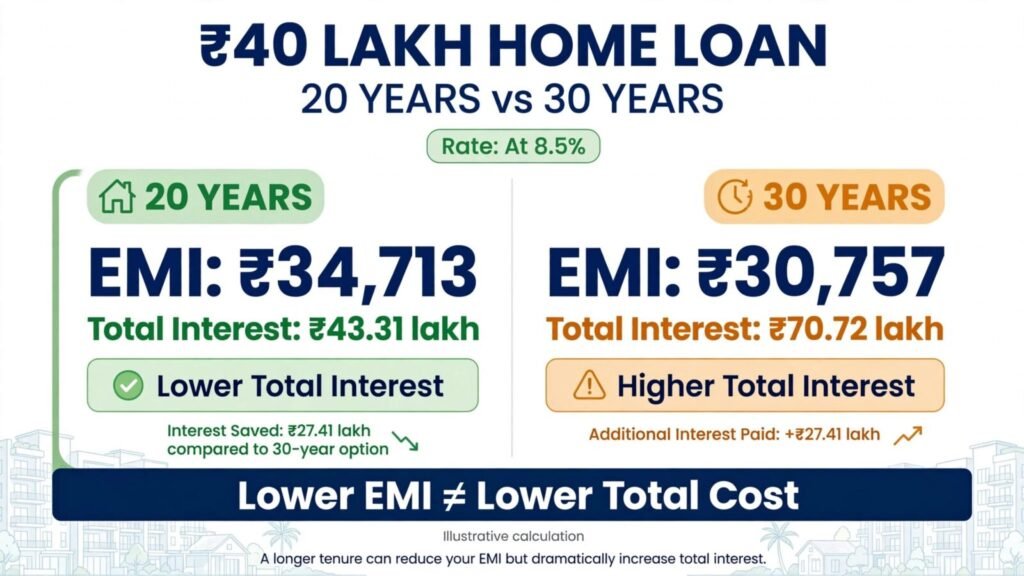
At an illustrative interest rate of 8.5%, a ₹40 lakh home loan would have an EMI of approximately ₹34,713 for 20 years or ₹30,757 for 30 years. That means the loan may be technically possible for some borrowers, but the more important question is whether the EMI is comfortable and sustainable for your household budget.
This guide explains how lenders may assess a ₹60,000 monthly salary, what a ₹40 lakh loan could actually cost, how your existing debt and CIBIL score can affect eligibility, how property value and LTV come into the picture, and what you should check before applying.
More importantly, we will look beyond the simple question of “How much home loan can I get?” and help you understand “How much home loan can I realistically afford?”

Quick Answer: Can ₹60,000 Salary Get a ₹40 Lakh Home Loan?
It may be possible, but you should not assume that you will qualify.
For example, a ₹40 lakh loan at 8.5% for 20 years has an EMI of approximately ₹34,713.
That EMI is about 58% of a ₹60,000 monthly income.
If you extend the tenure to 30 years, the EMI falls to approximately ₹30,757, or about 51% of ₹60,000.
That can improve eligibility under some lender assessment methods, but it does not mean every lender will approve ₹40 lakh.
Your existing EMIs, credit profile, age, income type and property can change the result significantly.
So the better question is not simply: “Can I get ₹40 lakh?”
It is: “Can I qualify for ₹40 lakh and still afford the EMI comfortably?”
What Does a ₹40 Lakh Home Loan Cost in 2026?
Interest rates vary between lenders and according to borrower profile.
As of September 2026, the RBI’s policy repo rate is 5.25%.
Current lender pages show that home-loan pricing can vary considerably.
For example:
- SBI currently displays home-loan rates starting from 7.25% p.a. from April 1, 2026.
- Bank of Maharashtra shows a starting rate of 7.10% for its Maha Super Housing Loan, with the actual rate varying according to CIBIL score and borrower category. Its published table shows 7.10% for salaried borrowers with CIBIL 800+ and 7.20% for non-salaried borrowers with CIBIL 800+.
- Canara Bank currently displays home-loan interest of 7.15% on its website.
- HDFC Bank’s home-loan page currently shows rates starting from 7.75% p.a.
- ICICI Bank’s published September 2026 information shows a special home-loan rate of 7.55% p.a. valid until September 30, 2026, while its rate structure also varies according to credit score, customer segment and profile.
- Bajaj Housing Finance currently advertises home loans starting at 7.25% p.a., while its affordable-home-loan products and other products have different terms.
These figures show why there is no single “2026 home-loan interest rate.”
“The rates below are examples of advertised rates available when this article was reviewed. They can change without notice, and the rate offered to you may be different.”
Your final rate can depend on your credit score, income, employment profile, loan amount, property and lender-specific pricing.
₹40 Lakh Home Loan EMI at Different Interest Rates
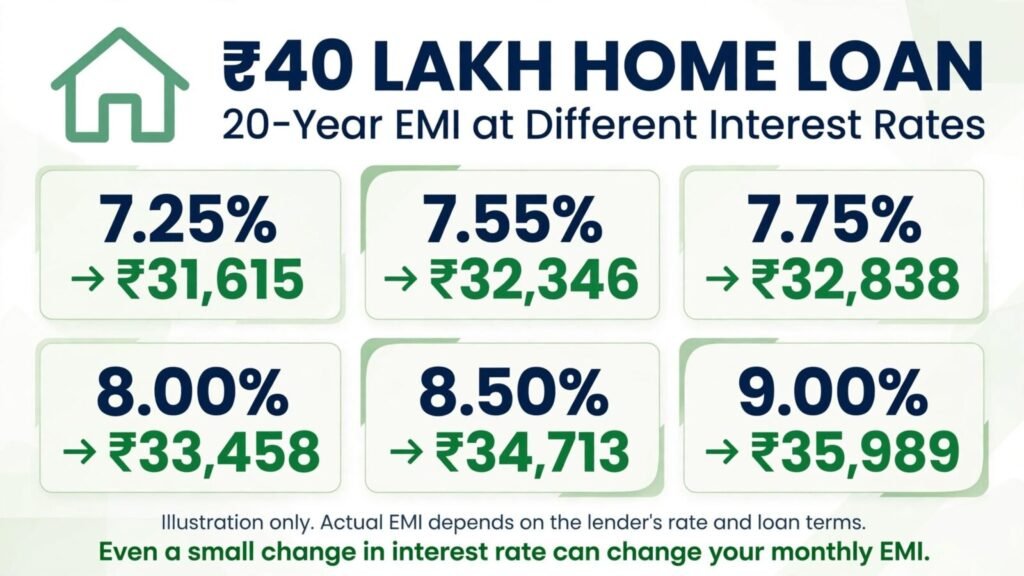
Above is an illustration for a ₹40 lakh loan over 20 years:
These are mathematical illustrations using the standard reducing-balance EMI formula.
Your actual EMI may differ if your lender offers a different interest rate or changes a floating rate later.
For comparison, ICICI Bank’s own calculator explains that EMI depends on the loan amount, interest rate and tenure.
How Much EMI Would You Pay on ₹40 Lakh?
The tenure makes a major difference.
Using an illustrative interest rate of 8.50%, the approximate EMI and total interest look like this:
| Tenure | Approx. EMI | EMI as % of ₹60,000 income | Approx. Total Interest |
|---|---|---|---|
| 10 years | ₹49,547 | 82.6% | ₹19.46 lakh |
| 15 years | ₹39,390 | 65.7% | ₹30.90 lakh |
| 20 years | ₹34,713 | 57.9% | ₹43.31 lakh |
| 25 years | ₹32,209 | 53.7% | ₹56.63 lakh |
| 30 years | ₹30,757 | 51.3% | ₹70.72 lakh |
For someone earning ₹60,000 per month, even the 30-year EMI would be around 51% of monthly income at this illustrative interest rate.
A longer tenure reduces the monthly EMI, but it can substantially increase the total interest paid over the life of the loan.
For example, at 8.5%, a ₹40 lakh loan for 20 years would cost approximately ₹43.31 lakh in interest, while a 30-year loan would cost approximately ₹70.72 lakh in interest.
This is why you should not look at the EMI alone.
A lower EMI can make a loan easier to manage each month, but a longer tenure can make the loan much more expensive overall.
Important: The percentages above are mathematical illustrations based on a monthly income of ₹60,000. They are not a lender’s eligibility or affordability rule. Your actual home-loan eligibility depends on your income, existing EMIs, credit profile, age, tenure, property and the lender’s assessment.
What Salary Is Needed for a ₹40 Lakh Home Loan?
There is no single salary figure that applies to every bank or NBFC.
Some lenders assess repayment capacity using their own internal income and obligation norms.
For illustration, suppose a lender considers an EMI equivalent to 50% of eligible monthly income.
At 8.50%:
20-year loan
₹40 lakh EMI = approximately ₹34,713
Illustrative income requirement:
₹34,713 ÷ 50% = approximately ₹69,426 per month
30-Year Loan
₹40 lakh loan EMI at 8.5% = approximately ₹30,757
If we use a 50% EMI-to-income ratio purely as an illustration:
₹30,757 ÷ 50% = approximately ₹61,514 monthly income
This demonstrates why loan tenure matters. Extending the tenure from 20 years to 30 years reduces the EMI and therefore lowers the illustrative income needed under the same 50% assumption.
However, 50% is only an illustration, not a universal home-loan eligibility rule. Lenders may use FOIR, permissible deduction norms, income-based calculations and their own internal underwriting policies when assessing repayment capacity. There is no single RBI rule saying that exactly 50% of a borrower’s salary can be used for a home-loan EMI.
Different lenders can therefore arrive at different eligible loan amounts for borrowers with similar salaries.
For example, Bank of Maharashtra states that the maximum eligible loan amount is determined by taking the lowest of the amount assessed under permissible deduction norms, the maximum permissible LTV ratio and the loan amount requested.
This is why a salary-based calculation should be treated as an estimate, not a loan sanction or guarantee of eligibility.
Why Two People Earning ₹60,000 Can Get Different Loan Amounts
Imagine two borrowers.
Borrower A
- Monthly income: ₹60,000
- No existing EMI
- Strong credit history
- Stable employment
- Good repayment history
- Suitable property
- Adequate down payment
Borrower B
- Monthly income: ₹60,000
- Existing EMI: ₹15,000
- Lower credit score
- Recent credit applications
- Less stable income
- Limited down payment
Both earn exactly ₹60,000.
But their home-loan eligibility can be very different.
This is why you should never calculate home-loan eligibility from salary alone.
Existing EMIs Can Reduce Your Home Loan Eligibility
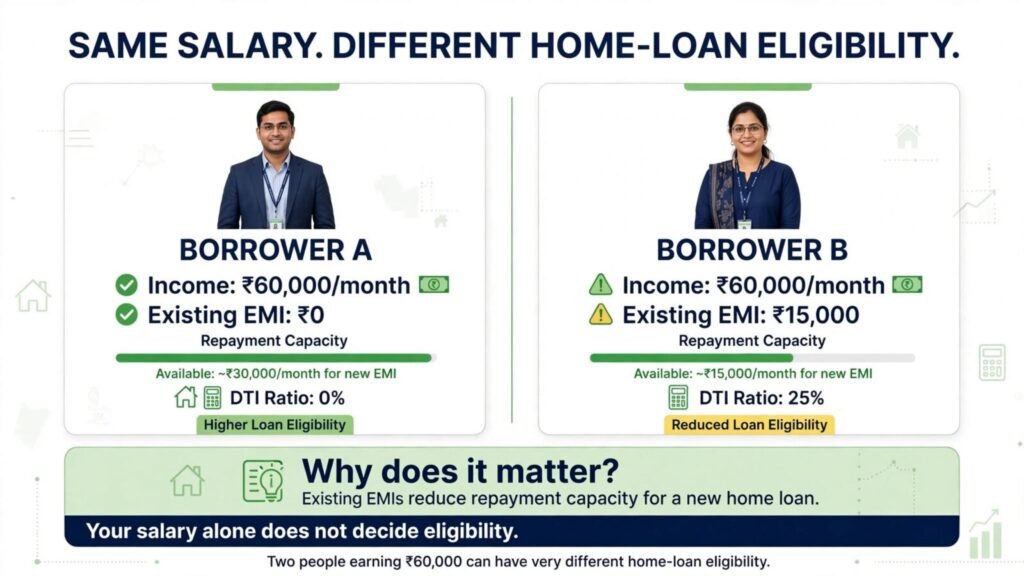
Suppose you earn ₹60,000 and already pay:
₹15,000 per month in existing EMIs.
Your lender may not treat the full ₹60,000 as freely available for the new home-loan EMI.
The existing debt obligation affects your repayment capacity.
This can make a significant difference to the maximum home loan you qualify for.
Current lender calculators also ask borrowers to consider existing financial obligations.
For example, lender eligibility tools commonly consider income, existing EMIs, interest rate and tenure when assessing loan eligibility.
Practical tip: If you have an existing personal loan, car loan or other substantial EMI, check your eligibility before finalising the property budget.
Your CIBIL Score Can Affect the Rate You Receive
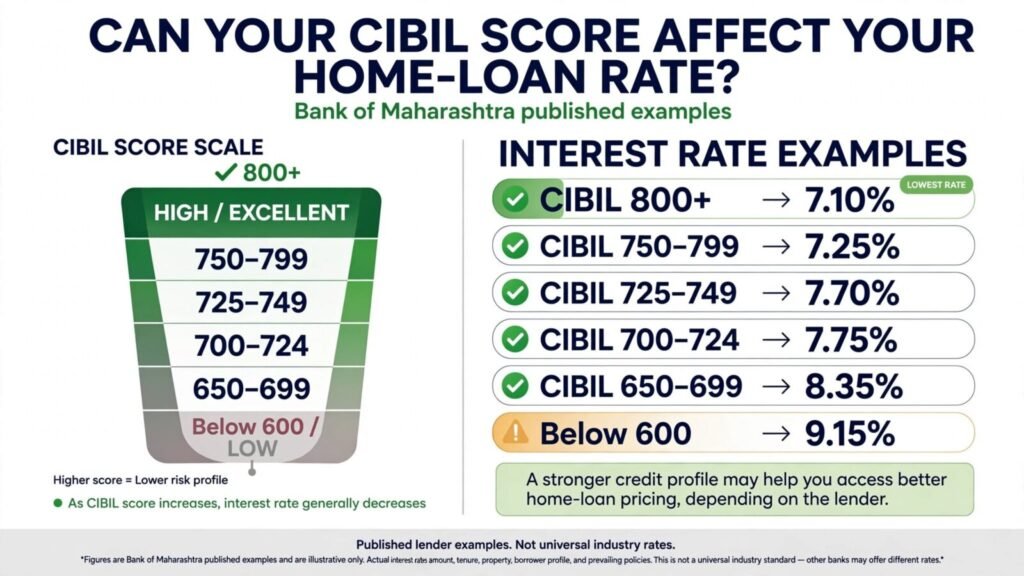
A higher credit score can strengthen your application and may help you access better pricing.
Bank of Maharashtra’s current published housing-loan rate table is a useful example of risk-based pricing.
For salaried borrowers under its Maha Super Housing Loan:
- CIBIL 800+: 7.10%
- CIBIL 750–799: 7.25%
- CIBIL 725–749: 7.70%
- CIBIL 700–724: 7.75%
- CIBIL 650–699: 8.35%
- CIBIL 600–649: 8.75%
- Below 600: 9.15%
These are Bank of Maharashtra’s published rates, not universal industry rates.
This illustrates an important point:
Your CIBIL score can affect not only whether you qualify, but also the price of the loan.
Before applying, you can also check how your CIBIL score affects home-loan eligibility and interest rates.
A small difference in interest rate can become significant over a 20- or 30-year repayment period.
What Does RBI Say About the Loan-to-Value Ratio?
This is where the earlier version of this article needed an important correction.
We should not tell readers that RBI currently imposes a universal 75% LTV ceiling on a ₹40 lakh individual home loan.
Under the applicable RBI prudential framework, individual housing loans above ₹20 lakh and up to ₹75 lakh are subject to an 80% LTV ceiling for banks.
That means:
₹40 lakh loan on ₹50 lakh property
₹40 lakh ÷ ₹50 lakh × 100
= 80% LTV
So an ₹80% LTV example should not automatically be described as prohibited by RBI.
However, there is another important point:
80% LTV does not mean every lender must give you 80% of the property’s value.
The lender can have its own underwriting rules, valuation methodology, property restrictions and margin requirements.
Your loan amount may also be limited by your income and repayment capacity even if the property value supports a higher amount.
What If the Property Costs ₹50 Lakh?
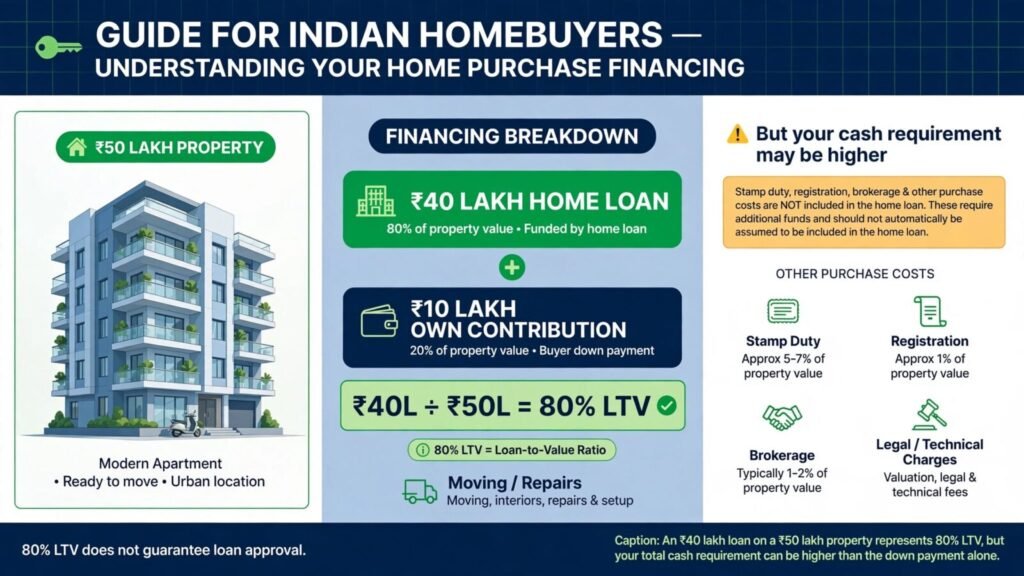
Suppose you find a flat priced at:
₹50 lakh
and you want:
₹40 lakh home loan
That means you would need:
₹10 lakh from your own funds
before considering other purchase costs.
But you should not assume that ₹10 lakh is your complete cash requirement.
You may also need money for:
- Stamp duty
- Registration
- Brokerage, if applicable
- Legal or technical charges
- Processing fees
- Documentation expenses
- Moving and furnishing
- Repairs or renovation
- Emergency savings
Some costs may not be financed as part of the home loan.
Also, the lender’s property valuation can matter. The lender may assess the property independently rather than simply accepting the buyer-seller agreement value.
Never finalise a property assuming the bank will automatically fund the exact amount you need.
Is ₹40 Lakh Home Loan on ₹60,000 Salary Comfortable?
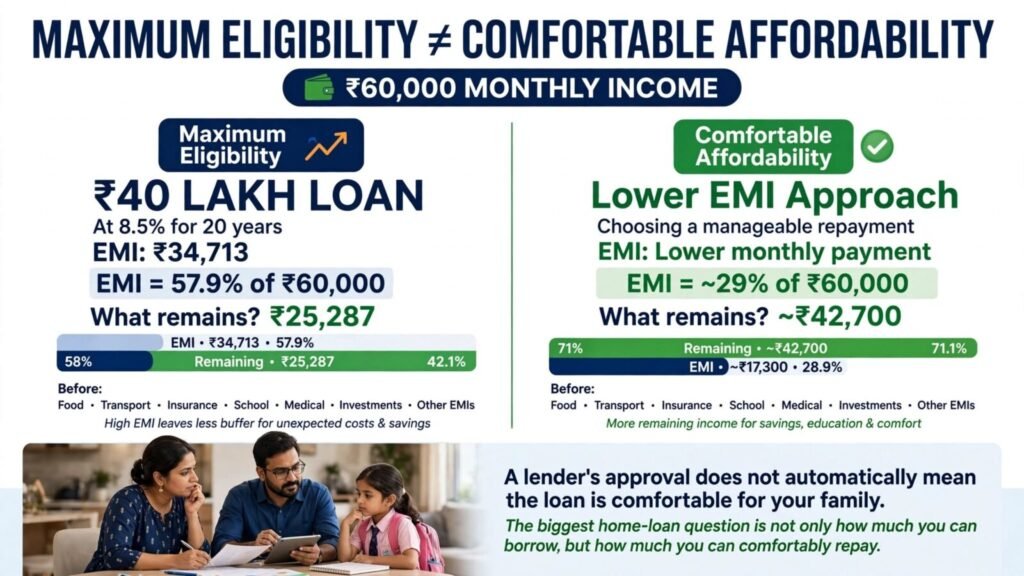
This is the question I would encourage borrowers to focus on.
At 8.5%:
20-year EMI: approximately ₹34,713
That leaves:
₹60,000 – ₹34,713
= approximately ₹25,287
before considering:
- Food
- Electricity
- Transport
- Insurance
- School fees
- Medical expenses
- Existing obligations
- Investments
- Family expenses
- Property maintenance
- Unexpected expenses
So although a lender may potentially consider a ₹40 lakh loan, that does not automatically mean ₹40 lakh is the right amount for you.
Maximum eligibility is not the same as comfortable affordability.
This is one of the most important lessons for first-time home buyers.
What Happens If Home-Loan Interest Rates Rise?
Many Indian home loans are floating-rate loans.
That means your interest rate can change according to the applicable benchmark and lender spread.
For applicable floating-rate EMI-based loans, RBI rules require lenders to communicate the impact of interest-rate resets and provide specified options relating to EMI, tenure and prepayment. The exact applicability depends on the loan and lender.
For housing loans, RBI’s housing-finance instructions also require banks to consider repayment capacity and provide appropriate treatment for floating-rate EMI-based housing loans.
So when you calculate eligibility, do not ask only:
“Can I pay today’s EMI?”
Also ask:
“Could I handle the loan if the interest rate rises?”
An Important 2026 Borrower Protection: Prepayment Charges
There is a major RBI development that home-loan borrowers should know about.
The RBI (Pre-payment Charges on Loans) Directions, 2025 apply to loans sanctioned or renewed from January 1, 2026.
For floating-rate loans granted for purposes other than business to individual borrowers, regulated entities are not permitted to levy prepayment charges under the applicable directions. The framework applies across commercial banks, co-operative banks, NBFCs and All India Financial Institutions.
This is particularly relevant for home-loan borrowers because it can make future part-prepayments or full repayment more flexible, subject to the exact loan structure and applicability of the RBI directions.
Always check your sanction letter and Key Facts Statement rather than relying on a general statement.
Ask for the Key Facts Statement Before Signing
Another important borrower-protection measure is the Key Facts Statement, or KFS.
RBI’s KFS framework applies to retail term loans and requires lenders covered by the framework, including commercial banks and NBFCs/HFCs, to provide important loan information in a standardised format.
The KFS is designed to help borrowers understand the cost of the loan, including the Annual Percentage Rate and applicable charges.
Before accepting a home loan, check:
- Interest rate
- Benchmark
- Spread
- Annual Percentage Rate where applicable
- Processing fee
- Other charges
- Prepayment conditions
- Penal charges
- EMI
- Tenure
- Repayment schedule
Do not compare home loans only by looking at the advertised interest rate.
Banks vs NBFCs/HFCs in 2026
A borrower earning ₹60,000 should not automatically assume that only a large private bank is suitable.
You can compare:
Public Sector Banks
Examples include:
- SBI
- Bank of Maharashtra
- Bank of Baroda
- Canara Bank
- Punjab National Bank
- Union Bank of India
Public sector banks can be particularly attractive for borrowers with strong documentation and stable income.
For example, SBI currently advertises home loans from 7.25%, Bank of Maharashtra publishes rates from 7.10% for eligible profiles, and Canara Bank currently displays a 7.15% home-loan rate.
Private Banks
Examples include:
- HDFC Bank
- ICICI Bank
- Axis Bank
Private banks can offer competitive rates and digital application processes, but pricing and eligibility depend heavily on borrower profile.
HDFC currently displays home-loan rates starting at 7.75%, while ICICI’s published September 2026 offer includes a 7.55% special rate valid through September 30, 2026.
HFCs and NBFCs
Housing finance companies and NBFCs can sometimes have different underwriting approaches.
Bajaj Housing Finance currently advertises home loans starting at 7.25%, while also offering specialised affordable-housing products.
The important lesson is:
Do not choose a lender only because its advertised rate is the lowest.
Compare the complete loan offer.
What If You Are Self-Employed?
A ₹60,000 monthly income does not necessarily mean the same thing for a salaried employee and a self-employed applicant.
For self-employed borrowers, lenders may look more closely at:
- ITRs
- Business income
- Bank statements
- GST records, where applicable
- Profit and loss statements
- Balance sheets
- Business continuity
- Existing obligations
- Credit history
- Property documents
Some HFCs/NBFCs may cater to borrowers with less conventional income profiles, but that does not mean documentation requirements disappear.
If your income is self-employed, you should calculate eligibility using the income that the lender is actually prepared to recognise.
Can You Get a ₹40 Lakh Home Loan Without ITR?
For some borrowers, particularly salaried applicants, ITR may not be the primary income document in the same way it can be for self-employed applicants.
But “no ITR” does not mean “no income verification.”
A lender can still assess:
- Salary slips
- Bank statements
- Form 16
- Employment history
- Credit report
- Existing EMIs
- Employer profile
- Other income evidence
Self-employed applicants should be especially careful because income assessment can be more documentation-intensive.
How to Improve Your Chances of Getting ₹40 Lakh
If your target is a ₹40 lakh home loan, work on these areas before applying.
1. Reduce existing EMIs
Paying down expensive existing debt can improve your repayment capacity.
2. Maintain a strong credit profile
Pay EMIs and credit-card bills on time.
Avoid making multiple loan applications unnecessarily.
3. Build a stronger down payment
A higher contribution can reduce the loan requirement and EMI.
But do not use all your savings just to increase the down payment.
4. Choose the property carefully
Property title, valuation, approvals, location and documentation can affect financing.
5. Compare lenders
Do not apply blindly to one lender.
Compare:
- Interest rate
- EMI
- Processing fee
- Other charges
- Prepayment rules
- Benchmark and spread
- Loan tenure
- Service quality
- Property acceptance
6. Consider a suitable co-applicant
A spouse or other eligible co-applicant with recognised income may strengthen the application where the lender permits it.
7. Consider tenure carefully
A longer tenure may improve monthly affordability, but it can substantially increase total interest.
₹40 Lakh Home Loan: Maximum Eligibility vs Comfortable Loan
Consider this example.
Scenario A: Maximum possible loan
Income:
₹60,000
Possible home-loan EMI:
₹30,000–₹35,000
You may potentially qualify depending on the lender’s assessment.
But your household budget could become tight.
Scenario B: More comfortable loan
Suppose you decide your preferred EMI is around:
₹25,000
At 8.5% for 20 years, a ₹25,000 EMI corresponds to a loan of approximately ₹28.8 lakh, considerably lower than ₹40 lakh.
That lower loan may require:
- A larger down payment
- A lower property budget
- A co-applicant
- More savings
- A different property
But it may also leave you with greater monthly financial flexibility.
Getting approved is not the same as making a good financial decision.
What Should You Check Before Applying for ₹40 Lakh?
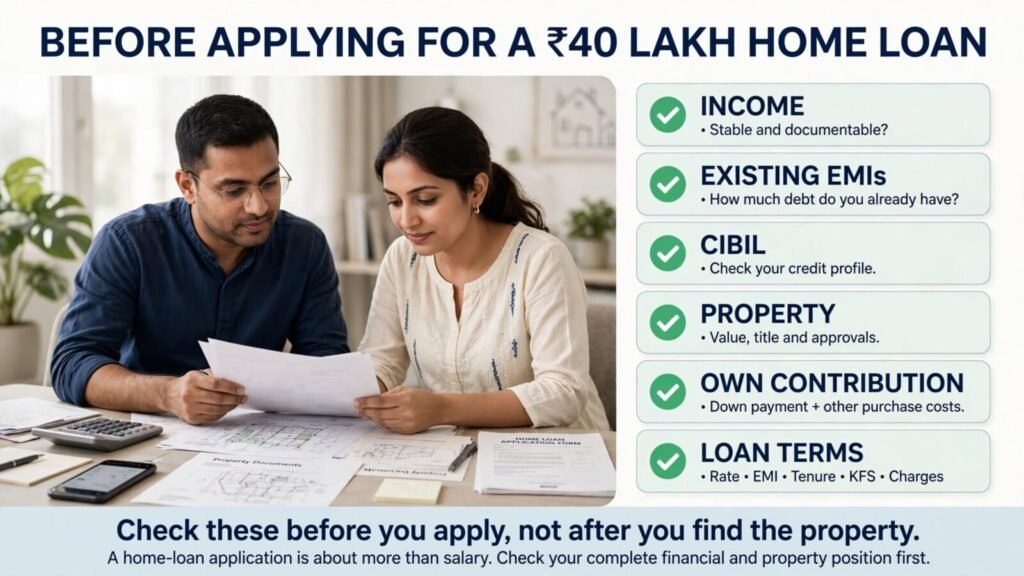
Use this checklist:
Income
- Is ₹60,000 your gross or net monthly income?
- Is your income stable?
- Do you receive regular salary credits?
Existing debt
- Do you have personal-loan EMIs?
- Car loan?
- Credit-card balances?
- Other financial obligations?
Credit
- What is your current CIBIL score?
- Have you missed any recent payments?
- Have you made several recent credit applications?
Property
- What is the agreed property value?
- What value will the lender accept?
- Are the title and approvals clear?
- Is the property eligible for financing?
Own contribution
- How much down payment can you make?
- Have you separately budgeted stamp duty and registration?
- Will you still have an emergency fund after buying?
Loan
- What is the interest rate?
- Is it floating or fixed?
- What is the benchmark?
- What is the spread?
- What is the tenure?
- What is the EMI?
- What is the total interest?
- What does the KFS say?
Use a Home Loan Calculator Before Applying
Before approaching a lender, calculate your:
- Maximum possible EMI
- Comfortable EMI
- Loan amount
- Interest cost
- Down payment
- Tenure
- Prepayment scenarios
You can use the free PennyPowerPlay Home Loan Planner to compare different loan scenarios before applying.
It can help you look beyond the simple question of “How much loan can I get?” and understand what the repayment could look like.
Final Answer: Can You Get ₹40 Lakh on a ₹60,000 Salary?
Possibly, yes. But you should not treat ₹40 lakh as guaranteed eligibility.
A ₹40 lakh loan at 8.5% would have an approximate EMI of:
- ₹34,713 for 20 years
- ₹30,757 for 30 years
Your actual eligibility could be higher or lower depending on your:
- Income
- Existing EMIs
- CIBIL score
- Age
- Employment or business profile
- Income documents
- Loan tenure
- Interest rate
- Property value
- Property documents
- Down payment
- Lender’s internal credit policy
Current September 2026 lender pricing also shows why borrowers should compare offers rather than assume that one advertised rate applies to everyone. SBI, Bank of Maharashtra, Canara Bank, HDFC Bank, ICICI Bank and housing-finance companies currently publish different starting rates and borrower conditions.
The biggest lesson is simple:
Don’t ask only, “How much home loan can I get?”
Ask:
“How much home loan can I repay comfortably without putting my family’s finances under pressure?”
That is the difference between loan eligibility and smart home-buying.
Frequently Asked Questions
1. Can I get a ₹40 lakh home loan on a ₹60,000 salary?
A ₹40 lakh home loan may be possible for some borrowers earning ₹60,000 per month, but approval depends on income, existing EMIs, credit profile, age, tenure, property and lender policy.
2. What is the EMI for a ₹40 lakh home loan?
At 8.5% interest, the approximate EMI is ₹34,713 for 20 years and ₹30,757 for 30 years.
3. What salary is required for a ₹40 lakh home loan?
There is no universal salary requirement. The lender assesses repayment capacity using its own eligibility rules. A 50% EMI-to-income calculation can be used as an illustration, but it is not a universal RBI rule.
4. Can I get ₹40 lakh if I already have another EMI?
Possibly, but your existing EMI can reduce your home-loan eligibility because the lender has to assess your overall repayment obligations.
5. Can I get a ₹40 lakh loan for a ₹50 lakh property?
An ₹40 lakh loan against a ₹50 lakh property represents 80% LTV. That does not automatically mean the loan will be approved. The lender’s applicable LTV framework, property valuation, internal policy and your repayment capacity must all be considered.
6. Is a 30-year tenure better for a ₹40 lakh loan?
A 30-year tenure can reduce the monthly EMI, but it can substantially increase the total interest paid. Choose the tenure based on both monthly affordability and long-term cost.
7. Does CIBIL score affect home-loan interest rates?
Yes. Lenders can use credit history and credit score as part of their risk assessment and pricing. Bank of Maharashtra’s current published rates, for example, vary by CIBIL score.
8. Can I prepay my floating-rate home loan without charges?
For loans covered by the RBI’s Pre-payment Charges on Loans Directions, 2025, floating-rate loans for non-business purposes to individual borrowers sanctioned or renewed from January 1, 2026 are generally not subject to prepayment charges. Always verify the applicability to your specific loan and read your KFS and loan agreement.
9. Should I compare banks and NBFCs?
Yes. Compare the complete offer rather than only the headline interest rate. Look at the rate, benchmark, spread, fees, eligibility, property acceptance, service and repayment conditions.
10. What should I do before applying?
Calculate your comfortable EMI, check your credit profile, reduce unnecessary debt, arrange your own contribution, verify the property documents and compare multiple lenders before accepting an offer.
Related Posts
Home Loan Eligibility for Salaried Employees
How Much Home Loan EMI Can You Really Afford?
Home Loan Eligibility on ₹30K, ₹50K, ₹75K & ₹1 Lakh Salary
Home Loan Down Payment in India
Home Loan Application Checklist
Disclaimer: Interest rates, eligibility criteria, fees and lender policies can change. The EMI calculations in this article are illustrations and should not be treated as a loan sanction or guarantee of eligibility. Always confirm the current rate, charges, LTV treatment and loan terms directly with the lender before making a financial commitment.
Sources checked: Reserve Bank of India, SBI, Bank of Maharashtra, Canara Bank, HDFC Bank, ICICI Bank and Bajaj Housing Finance. Interest rates and lender policies were reviewed in September 2026 and may change.
About the Author
Ashok Satpute is the founder of PennyPowerPlay.com, a home-loan education platform helping Indian homebuyers understand home loans, eligibility, EMI affordability, documentation, property costs and borrowing decisions.
He has 8+ years of experience in banking and housing finance, with experience across ICICI Bank, HDFC Home Loans, Axis Bank, DHFL/Piramal Housing and PNB Housing.
His goal is simple:
Help Indian families make better home-loan decisions before they commit to decades of repayment.